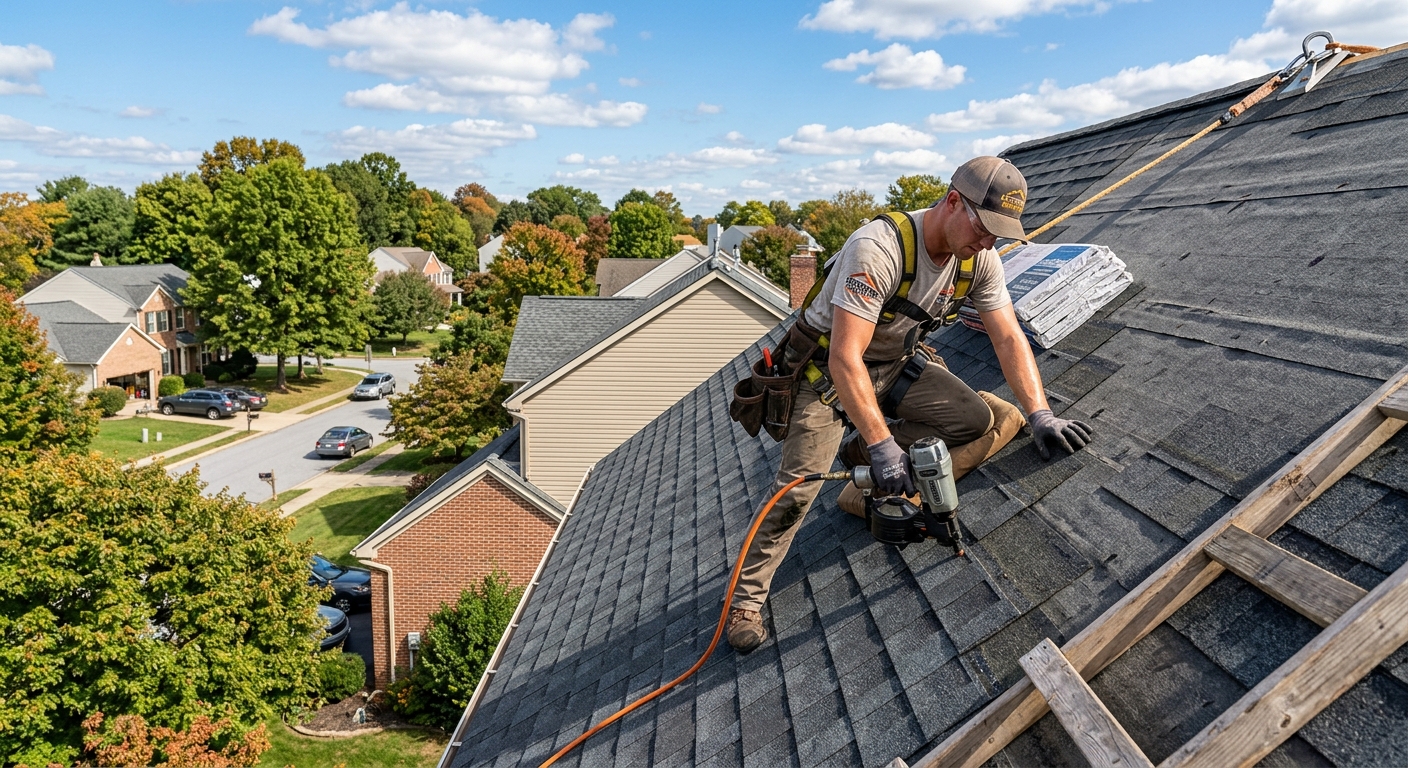
What roof replacement costs in Abington in 2026
In Abington, where over three-quarters of households own their homes and nearly 70% are single-family structures (U.S. Census Bureau, ACS 2024), roof replacement is a recurring reality. Most homes here date before 1980, so demand is driven by age-related wear and the distinct construction methods used during the region’s post‑World War II suburban expansion. These tract-built homes tend toward moderately pitched roofs and, often, a single layer of original shingles, though some carry two layers from earlier replacements.
This construction era means Abington roofs are often due not just for fresh shingles, but for full tear-offs, updated underlayment, and sometimes code upgrades if the decking falls short of today’s standards. Common replacement jobs focus on architectural asphalt shingles—chosen for durability, HOA acceptance, and cost effectiveness. Flat roofs, while less common, are seen on some ranches and additions, demanding a different skill set and material balance.
Prices for a typical roof replacement in Abington are shaped by this older housing stock, storm exposure along the Schuylkill valley, and regional labor rates. Here’s what you can expect in 2026:
| Material / Scope |
Lifespan |
Best for |
Price range (installed) |
| Asphalt shingles — architectural (30-yr) |
25–30 yrs |
Most Abington homes |
$10,500–$21,500 |
| Asphalt shingles — impact-resistant (Class 4) |
30+ yrs |
Branches, impact risk |
$17,000–$21,500 |
| Metal standing seam |
40–70 yrs |
Low-slope ranches, upgrades |
$25,000–$44,500 |
| Flat roof — TPO or EPDM |
15–25 yrs |
Porches, additions, low-slope |
$13,000–$26,000 |
| Roof repair — leak or isolated section |
n/a |
Spot repair, storm patch |
$550–$2,100 |
Prices are estimates for a typical Abington home and vary with roof size, pitch, decking condition and material selection.
Roof age and construction era in Abington
Nearly 90% of Abington homes were built before 1980 (U.S. Census Bureau, ACS 2024), a direct result of the post‑World War II construction boom that shaped much of Montgomery County. Rooflines in these older tract houses tend to have moderate pitches, providing enough slope for asphalt shingles to perform well, but not so steep that repairs become unreasonably complex or hazardous. Most houses from this era use solid wood plank or—on some later homes—early plywood decking, which was common until the widespread adoption of OSB in newer construction. It’s not unusual to find some rot along the overhangs or at any valleys, especially if the roof is well past its prime.
Ice barrier underlayment at the eaves was not required by code when these houses went up, so unless a previous reroof included it, many older homes are still unprotected against ice damming. Multiple layers of shingles also crop up: on Abington roofs that haven’t been redone since the 1980s or ‘90s, you may find two layers, as earlier building departments—especially before code uniformity—allowed re-roofing over the old. This can influence your project budget, since a full tear-off costs more than just installing atop old shingles, and the code now demands a single-layer system for new roofing work.
For homeowners tackling their first replacement in these aged neighborhoods, expect uncovering deck repairs and underlayment upgrades as part of the real cost picture. Upfront assessment helps avoid surprises before the crew strips any shingles.
Permits and code requirements in Abington
Abington roofing work falls under the Pennsylvania Uniform Construction Code (UCC), which is based on the International Residential Code. Code enforcement in Montgomery County is handled by each municipality, so Abington Township operates its own permitting and inspection office. In general, replacing more than 25% of a roof’s surface in jurisdictions like Norristown (the county seat) triggers a building permit requirement—and Abington typically follows similar thresholds for substantial repairs or replacement. Minor shingle repairs covering less than one roofing square may not require a permit, but always check directly with the Abington Township code office before scheduling work.
Pennsylvania does not require a trade-specific roofing license, but contractors must maintain Home Improvement Contractor (HIC) registration from the Pennsylvania Office of Attorney General for any contract over $500. You can verify registration at hic.attorneygeneral.gov. Proof of workers’ compensation coverage is mandatory if your contractor employs a crew, and you should check active status via the state’s WCAIS database (wcais.pa.gov) before signing anything.
All projects over $500 must use a written contract under the Home Improvement Consumer Protection Act, and you have a three business day right of cancellation. If your home was built prior to 1978 and any scraping, painting, or disturbance of painted surfaces is involved, the federal EPA Lead RRP Rule applies. You can confirm whether a contractor is lead-certified at certifiedrenovatorsearch.epa.gov.
The cost drivers behind a Abington roof replacement
No two Abington roof quotes are built alike, even for neighbors with the same 1950s ranch design. Several cost drivers matter here because of the unique housing stock and the region’s climate requirements. The age and style of local homes—the majority dating from before 1980—mean you may need to budget for tearing off one or even two layers of old shingles, with disposal costs stacking up fast. Labor can climb if the decking turns out to be plank (typical for original construction), which requires more fasteners, adds time, and may call for partial replacement if rot is exposed.
The 30 psf ground snow load for Montgomery County makes proper roof structure and underlayment—such as ice-and-water shield at the eaves—a must, especially on lower-pitched or north-facing sections prone to ice damming. If this barrier wasn’t installed previously, it adds not just a materials charge—typically $300–$800—but possible carpentry to prep the area. When storms move through the county, particularly along the Schuylkill River valley, impact-resistant shingles are sometimes recommended. Upgrading to these adds cost, with full roof installation usually in the $17,000–$21,500 range for a typical Abington home.
Below are the main cost drivers and their effect on your roof project:
| Factor |
Why it matters here |
Cost impact |
| Roof size in squares |
Each square is 100 sq ft of roof surface |
Primary multiplier |
| Pitch and access |
Steep pitches need harnesses and slow the crew |
+20–30% labor |
| Existing layers to tear off |
Two or more layers means full tear-off and disposal |
$500–$1,500 per layer |
| Decking condition |
Rot is found during tear-off, not before |
$75–$150 per sheet |
| Ice barrier at eaves |
Required where ice damming has a history |
$300–$800 |
| Material grade |
3-tab vs architectural vs Class 4 impact-resistant |
$500–$2,500 |
Storm damage and insurance claims in Abington
Storms funneling through the Schuylkill River valley can drive wind and water damage on Abington roofs, especially in neighborhoods without mature tree cover. If a storm hits and you suspect damage, your first step is to document everything before any cleanup: photograph shingles, gutters, skylights, and interior water stains. Insurers want evidence that the damage is storm-related, and missed photos can drag out or reduce your payout.
When filing a claim, your insurer will usually send an adjuster to inspect and write a scope of loss. Understand up front whether your policy pays replacement cost or actual cash value—the former covers a full new roof, the latter subtracts a heavy chunk for depreciation, often leaving you to bridge the gap. When you get roofing estimates, insist on a detailed written scope and match it to what the insurer will pay. Don’t sign incomplete or vague proposals—they’re hard to enforce if issues crop up later.
Under the Pennsylvania Home Improvement Consumer Protection Act, the contract must be in writing if the job is over $500, and you have three business days to cancel. You cannot legally waive your insurance deductible—if a contractor offers to “cover” it, that’s a red flag. This is strictly prohibited in Pennsylvania, and such offers could jeopardize your claim as well as run you afoul of the terms of your insurance. Always check contractor HIC registration and workers’ comp before allowing anyone on your property; reputable companies expect this scrutiny and will provide the paperwork without hesitation.
Reading the warranty on a Abington roof
Abington homeowners often think their “50-year” roof is covered for everything, but there are actually two warranties at play. The manufacturer warranty covers material defects—blisters, granule loss, cracking—not labor or mistakes. These are nearly always prorated: the longer you own your roof, the less you get back, and the payout rarely includes full tear-off or reinstallation after the first decade. You must register this warranty, sometimes within 60–90 days, or you risk losing coverage when you need it most.
The second warranty—workmanship—comes from your installer. This promises to fix leaks caused by installation errors. It only holds value if the company stands the test of time. In Abington, with roofers constantly coming and going, a “25-year” guarantee from a two-year-old firm is less meaningful than a 10-year promise from a crew with a reputation and real address in Montgomery County. When selling your home, check whether these warranties transfer—many do for the first resale, but only if you notify the manufacturer or contractor within a set window.
What can void your warranty? Layering new shingles over old ones (now prohibited), poor attic ventilation, unauthorized repairs, and skipping annual maintenance all risk your roof’s coverage. Read the fine print before you sign—the only surprise you want is how well that roof holds up after a storm.
What Abington's climate does to a roof
Abington’s proximity to the Schuylkill River valley exposes homes to severe thunderstorms and the associated wind-driven rain, which is a different hazard mix than you’ll find just a township or two away. These wind events frequently lift shingles at corners and eaves, and in some cases, create small tears in flat roof membranes—damage that often requires focused repair in the $550–$2,100 range. Architectural shingles were chosen for most homes here after post-war development for their better wind resistance compared to old three-tabs, but spring storms still challenge their integrity.
The 30 psf ground snow load means every Abington roof is built with sufficient rafter sizing, but that doesn’t stop ice dams after a deep freeze or thaw cycle. When snow sits on the roof above a poorly insulated attic, escaped heat melts the underside, sending water pooling behind the first shingle course at the eaves. Without ice and water barrier—often absent in original 1950s–1970s builds—this water wicks under shingles and into the decking. If repairs are needed, localized wood replacement averages $75–$150 per sheet on top of shingle work.
Occasional hail does hit here, but it’s rarely the kind that leaves visible holes. Instead, hail compresses shingle granules, undermining their UV protection and aging them prematurely. These bruises can go unnoticed until leaks show up a season or two later, which is why insurance adjusters look for such damage after summer storms. Ignoring these clues can mean a more expensive full replacement—architectural shingles run $10,500–$21,500—rather than a minor patch had you caught it early.
Frequently asked questions — roofing in Abington
What happens if rotted decking is found after tear-off?
If your Abington roofer opens up your old shingles and finds areas of rotted or softened decking, they’re required under modern code to replace any affected sheets before installing new underlayment or shingles. Most Abington homes built before 1980 have plank or early plywood decks, so it’s not uncommon for some rot to show up around the eaves or valleys. Typically, your written contract will note a per-sheet rate—expect $75–$150 for each 4’x8’ sheet of plywood or OSB replaced. This cost covers materials, disposal of the old wood, and labor for installing and renailing. Repairs to the deck are best done at tear-off since covering over rot is both a code violation and a disaster waiting to happen, leading to premature leaks. Good contractors will photo-document these finds for your records.
Are storm-chasing roofers a problem in Abington?
Yes, Abington can attract storm-chasing roofers after severe weather, especially because thunderstorms along the Schuylkill River valley periodically damage roofs here. These crews often go door-to-door right after a storm, offering quick repairs or “free roofs.” Some have legitimate credentials, many do not, and few stay around to honor warranties. To protect your investment, always verify Home Improvement Contractor registration at hic.attorneygeneral.gov. Legitimate roofers carry required insurance—check it via WCAIS—and never offer to "waive your deductible," which is not allowed under Pennsylvania law. If a deal sounds too good or a crew's truck has out-of-state plates, walk away. A reputable fix or full replacement in Abington should align with local market rates, like $10,500–$21,500 for architectural shingles.
How much snow load can a Abington roof handle?
Abington roofs are engineered for a ground snow load of 30 pounds per square foot, as required by regional building codes. This standard ensures that almost all single-family homes here can safely support typical southeastern Pennsylvania snowfalls, but it doesn’t mean every roof is immune to ice damming or improper snow removal practices. Even if your roof can handle the snow, persistent build-up at eaves and valleys can push water under shingles—especially if your original roof lacked a modern ice barrier. If ice dam leaks develop, repairs often cost $550–$2,100 depending on the extent of damage. Always be wary of anyone recommending expensive “structural upgrades” unless they can demonstrate that your home was built below code.
How do I file a storm damage roof claim in Pennsylvania?
Start by documenting all visible damage before cleanup—take wide and close-up photos of missing shingles, dented accessories, and interior leaks. Call your insurer to open a claim and request an adjuster visit. In Abington, paperwork must include a clear written scope and cost estimate that matches what your adjuster describes. Your contract needs to be in writing if work totals more than $500, and by state law you have a three-day right of cancellation. Never let a roofer start repairs or bill your insurance directly before you see the adjuster’s scope of loss. Insist on licensed, insured contractors and avoid anyone suggesting they will "cover your deductible"—that offer is illegal in Pennsylvania and could get your claim denied.
How much does it cost to repair a roof leak in Abington?
A typical roof leak repair in Abington costs between $550–$2,100, with most jobs landing around $1,300. This covers locating the source—whether it’s a missing shingle, flashing fault, or nail pop—and making good the affected area. Because many Abington homes were built before modern underlayment standards, even a small leak can spread water quickly between decking planks and insulation. Don’t delay repairs: what starts as a minor drip can turn into interior ceiling or wall damage, adding thousands more to your eventual bill. If your repair quote looks much higher, ask for photographic proof of the problem and clarification whether the scope includes hidden damage or only a basic patch.
Is metal roofing noisy in rain?
Abington homeowners sometimes worry that a metal roof will amplify rain noise, but this is rarely true on modern installations. Metal standing seam roofs are typically installed over solid wood decking and underlayment, which absorbs much of the sound. In most single-family Abington homes, the ambient rain noise is barely different from a shingle roof, especially if you have insulated attic space. If your installer is simply screwing metal directly to battens or open framing—more typical of agricultural buildings—then you might hear extra noise. A full metal roof on a standard Abington house will run between $25,000–$44,500, and includes all the layers needed to reduce sound as well as boost durability.
Are there historic district rules affecting roofing in Abington?
Abington doesn’t have the strict historic district regulations you’ll find in Norristown or Lower Merion, but some pockets or HOAs within the township may have appearance codes or restrictions. This mostly influences color and shingle profile rather than limiting modern materials. If your house is in a notable historic area or on a township list, always call the local permit or code office before ordering materials. Typically, roof replacements still favor architectural asphalt shingles for their ability to blend with the look of mid-century and older homes. Expect a standard architectural shingle replacement to cost $10,500–$21,500. Before you commit, double-check for any neighborhood-specific requirements.
Is a sagging roof line an emergency?
In Abington, a sagging roof line almost always needs immediate investigation, but it’s not always a life-and-death emergency. If you spot a curve or dip in your ridge, it could be the result of long-term moisture damage, decking rot, undersized rafters, or, in rare cases, heavy snow combined with original code shortfalls. Because so many Abington homes predate 1980, older framing and plank decks can become compromised after decades of small leaks. Even if the structure is holding for now, the underlying cause can rapidly develop into failure during a storm or heavy snow. It’s wise to contact a contractor for a proper inspection and budget at least $550–$2,100—sometimes more if structural carpentry is required.
Why is my Abington roofing quote higher than the online average?
Online roofing cost calculators rarely reflect what it takes to reroof a mid-century Abington home. Local costs are shaped by old decking material, ice barrier needs, multiple shingle layers, and the requirement for tear-off and disposal. Additional code upgrades and the need for a written contract under Pennsylvania’s Home Improvement Consumer Protection Act all add to the bottom line. A roof that might be quoted at $9,000 online will usually total $10,500–$21,500 here once accurate square counts, labor, permits, and local material specs are factored in. Make sure your quote is apples-to-apples—local scope and compliance add cost but protect your investment for decades.