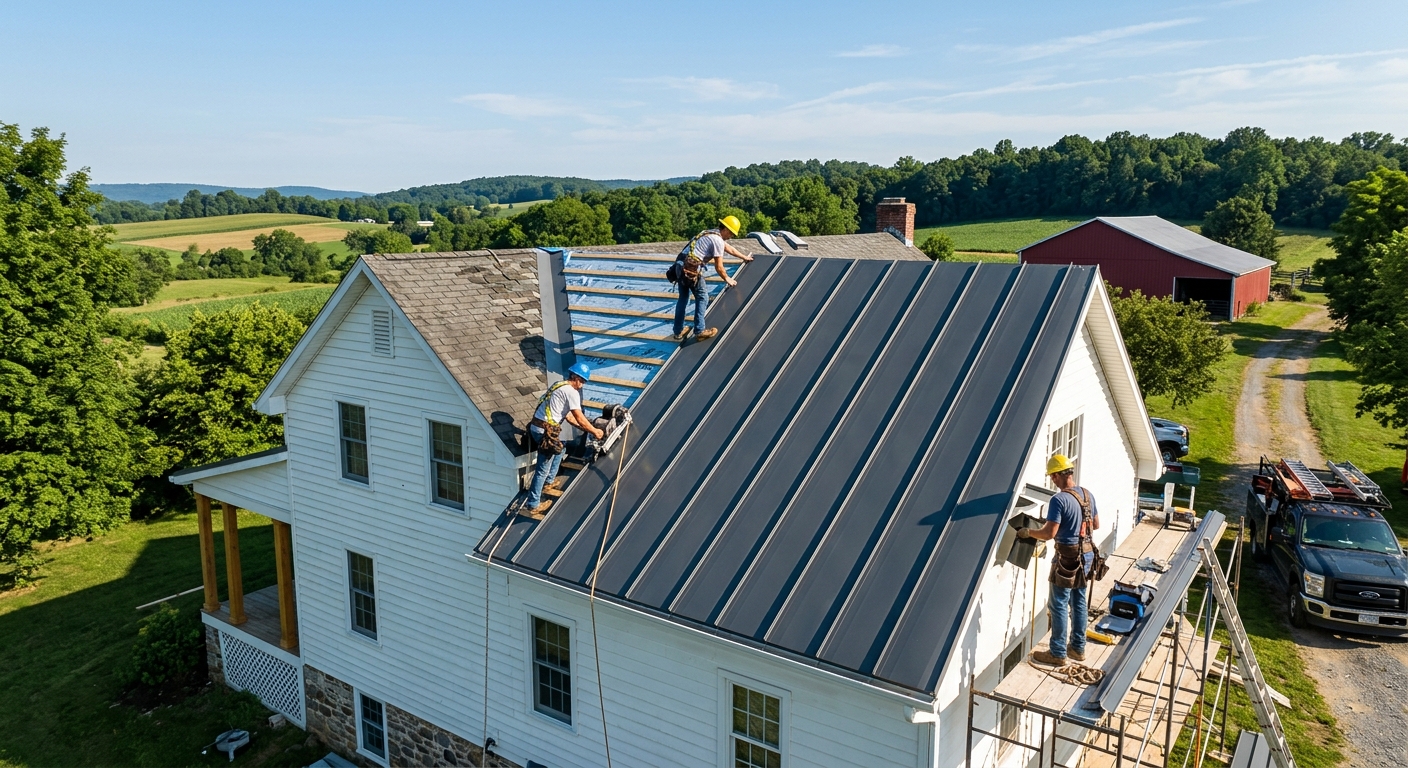
What roof replacement costs in Antrim in 2026
In Antrim, roof replacement costs reflect the local makeup of owner-occupied, single-family homes and the practical realities of Franklin County’s housing stock. With 87.6% of households owning their homes and 85.6% living in detached houses (U.S. Census Bureau, ACS 2024), most roofing work here is full replacement of original architectural shingles rather than patch jobs on rentals or multi-family complexes. Because over half of Antrim’s homes were built before 1980, and since a large share of Franklin County housing was built 1950–1980, many area roofs are now hitting a synchronized end-of-life curve—a direct result of postwar building booms and subsequent waves of single-layer architectural shingle installations. For many Antrim homes, your shingle tear-off is not unique: it is part of a county-wide cycle, which keeps contractors busy but gives homeowners price benchmarks based on their neighbors’ recent jobs. The rural nature of Antrim and its location at the fringe of the Harrisburg–Carlisle market means travel costs can run higher south of Chambersburg, and you won’t see the deep volume discounts that appear in larger metros. Below is a summary of what you can expect to pay for typical roof work in Antrim in 2026.
| Material / Scope |
Lifespan |
Best for |
Price range (installed) |
| Asphalt shingles — architectural (30-yr) |
25–30 yrs |
Most single-family homes in Antrim |
$9,600–$20,500 |
| Asphalt shingles — impact-resistant (Class 4) |
30+ yrs |
Areas exposed to ridge-line winds |
$15,500–$20,500 |
| Metal standing seam |
40–70 yrs |
Agricultural, rural, or high-value homes |
$23,500–$41,500 |
| Flat roof — TPO or EPDM |
15–25 yrs |
Porch, addition, or commercial-style homes |
$12,000–$24,500 |
| Roof repair — leak or isolated section |
n/a |
Patching storm or occasional damage |
$500–$1,950 |
Prices are estimates for a typical Antrim home and vary with roof size, pitch, decking condition and material selection.
Roof age and construction era in Antrim
Antrim’s housing landscape is defined by its mid-20th-century roots. More than half—52.1%—of homes were built before 1980, which directly shapes the kind of roofing issues that surface here (U.S. Census Bureau, ACS 2024). If your roof was originally installed on a 1950–1980 home, expect to find common traits of that era: medium to steeper pitches, 1/2" plywood or sometimes diagonal plank deck, and very often only a single layer of architectural shingles. Local subdivisions platted during the postwar building boom standardized on asphalt shingle roofs, with minimal attic ventilation and no ice barrier since it was not code at the time.
Few pre-1980 homes in Antrim have ever had full-deck synthetic underlayments or peel-and-stick ice barrier—these only became requirements in new construction much later with updates to the Pennsylvania Uniform Construction Code. If your house saw a re-roof in the late ‘90s or early 2000s, you’re likely right at the “first replacement after new build” mark—making decking and attic ventilation key concerns after decades of freeze-thaw cycling. Since almost all these homes were built with shingle-specified stick framing, there’s typically enough roof ventilation possible and roofers don’t encounter double shingle layers as often as in older cities. In most Antrim homes, the original deck is serviceable unless water intrusion has occurred from flashing or valley leaks, but your roofer should always include a sheet-replacement price just in case they uncover rot or fungus after tear-off.
Roofing warranties in Antrim: what's actually covered
In Antrim, most homeowners see two types of roofing warranties—manufacturer and workmanship—and it’s important to know exactly what each covers. Manufacturer warranties typically protect against defects in the shingles or metal itself. These guarantees are usually prorated over time, with most requiring registration within 30–60 days of installation and proof that you’ve used all recommended components and installed only a single layer (no “roof-overs”). Manufacturer coverage can be voided if your attic isn’t properly ventilated or if the new roof is installed over existing shingles, both of which are common issues for homes in Franklin County’s aging stock.
Workmanship warranties, on the other hand, come directly from the roofing company. These cover errors in installation, but the protection is only as strong as the longevity and reputation of whoever did the work. A 25-year labor warranty sounds generous, but if the business is just two years old or has a history of rebranding, your practical coverage is minimal. Most reliable local companies offer 5–10 years of workmanship coverage, and reputable ones are clear about what’s included and how claims are handled. If you sell your Antrim home, some manufacturer warranties transfer, but usually only once and with a strict timeline. Read the fine print to make sure you’re not left exposed by missed deadlines or hidden exclusions.
Checking out a roofer in Antrim: what to verify
Before you hire a roofer in Antrim, take these practical steps to avoid common problems. Pennsylvania requires Home Improvement Contractor (HIC) registration for roofing contracts over $500—always confirm your roofer’s status through the Pennsylvania Office of Attorney General registry at hic.attorneygeneral.gov. Get written evidence of workers’ compensation insurance for all crew members (required by state law) and verify through the WCAIS online system (wcais.pa.gov). If your home was built before 1978, check for EPA Lead RRP certification through certifiedrenovatorsearch.epa.gov in case any paint is disrupted during the project. Insist on a detailed contract as required by the Home Improvement Consumer Protection Act and be wary of anyone who offers to “waive your deductible”—that’s not legal in Pennsylvania.
- Check HIC registration at hic.attorneygeneral.gov
- Verify business name, address, and phone are local and consistent
- View workers’ compensation insurance certificate and confirm via WCAIS
- Request a copy of EPA Lead RRP certification for pre-1978 homes
- Demand a written contract for all jobs over $500
- Review warranty documentation—both manufacturer and workmanship
- Ensure detailed scope of work and material specifications are listed
- Request an itemized estimate and clear payment schedule
- Check at least three local references, not just online reviews
- Get clarification on project start/finish dates and insurance claims handling
- Avoid anyone who pressures for a large cash deposit or full payment up front
Red flags in Antrim and rural Franklin County: out-of-state or “traveling” crews without a local address; estimates that only list a lump sum; failure to provide insurance confirmation; lack of a written contract; or pressure to start immediately because they’re “working in the area.” In a thinner rural market like ours, transient crews and inconsistent local addresses are warning signs you’re dealing with someone unlikely to stand behind their work.
Roofing season and lead times in Franklin County
Franklin County, including Antrim, sees a classic South-Central Pennsylvania roofing calendar. Shingle work ramps up as soon as daytime highs stay above 45°F—typically late March or April—when new installations can properly seal. The peak busy season is late spring through the end of October, with September seeing a surge as homeowners aim to finish jobs before colder weather returns. Once November arrives, many local crews slow down or close out their schedule, since adhesives and sealants don’t work reliably with winter’s pronounced freeze-thaw cycling and average temps dipping near the local winter design low of 12°F.
If you have a true emergency—like storm damage or a major leak requiring tarping—in February, you’ll pay a premium for short-notice work and cold-weather hazards. Plan for longer wait times if you call in the high season or after a big storm event, as Franklin County’s rural market has fewer crews nearby compared to denser metro areas. It’s common for homeowners south of Chambersburg to see travel surcharges or to be told “three to six weeks” lead time during the spring rush. For the best pricing and scheduling flexibility, book your roof in the quieter windows—early spring or late fall, when demand is lower and experienced crews have more time to work with your schedule.
How to compare roofing quotes in Antrim
A detailed roofing estimate is your best protection against surprise costs or sloppy work—especially in Antrim, where most homes are of similar vintage and straightforward scope. Start by confirming that the roof area is spelled out in “squares” (100 sq ft sections), and that the pitch is explicitly stated. Estimates should break out each main piece: tear-off and disposal (with the number of layers counted), product and type of underlayment, ice and water shield (measured in feet up from the eaves), per-sheet pricing for any new plywood decking, and line-item costs for flashing and vent boots. Don’t let a contractor fold these items into one vague lump sum; a single number means you have no way to compare apples to apples.
Warranties must be separated—manufacturer material defects vs. the roofer’s workmanship—and payment should never mean handing over a large cash deposit. If your quote doesn’t clearly state what happens with damaged decking or how many sheets of replacement are included, ask for contingency pricing. Vague estimates often hide corners cut on materials, or leave you exposed to unexpected add-ons once the old roof is stripped off.
| Line item |
What to look for |
Red flag if… |
| Roof area |
stated in squares, with pitch |
no measurement given |
| Tear-off and disposal |
number of layers, dumpster included |
bundled into one figure |
| Underlayment |
product type and coverage |
listed only as 'felt' |
| Ice and water shield |
coverage height at eaves |
omitted entirely |
| Decking |
per-sheet contingency price |
no allowance at all |
| Warranty |
workmanship years stated separately |
only the shingle warranty |
| Payment |
deposit under 15%, balance on completion |
large upfront cash |
Roofing permits in Antrim: what you need before work starts
Roofing permits in Antrim and Franklin County depend on the type and scope of work and exactly where your house is located. Pennsylvania’s Uniform Construction Code (UCC) is the applicable residential code, with municipal enforcement unless your area has opted out—in which case the state Department of Labor & Industry steps in as the authority. In the Borough of Chambersburg, you must get a building permit for any roof replacement that involves deck, sheathing, or framing changes. For direct “tear-off and replace” of asphalt shingles without repairing or replacing the decking, most unincorporated Franklin County townships don’t require a building permit at all.
No Pennsylvania trade license is granted for roofers, but any roofer working on a job over $500 must show valid Home Improvement Contractor (HIC) registration, which you can verify directly at hic.attorneygeneral.gov. Written contracts are mandatory for jobs over $500 by state law. Confirm active workers’ compensation insurance through the WCAIS portal (wcais.pa.gov) before the first shingles come off. Franklin County home inspectors or code authorities will rarely be involved in a simple shingle swap, but you should never skip these checks for contractor registration and insurance. If your home was built before 1978, check the federal registry for EPA Lead RRP certification.
Frequently asked questions — roofing in Antrim
How much deposit should I pay a roofer upfront?
Pennsylvania law for home improvement contracts limits what a contractor can ask for upfront, and in Antrim you should never pay more than 15% as a deposit—or $1,000, whichever is less—before work actually begins. This protects you if the roofer disappears or shuffles you to the back of their schedule after cashing your check. Any demand for a much larger deposit (or full payment ahead of time) is a red flag, especially in the rural Franklin County market where some crews travel in and might not be around if problems arise later. For example, on a typical architectural shingle replacement that costs $15,500, your deposit shouldn’t exceed about $1,000–$2,000. Pay by check or credit card, never cash, and make sure it’s spelled out in your contract.
How do I know if my Antrim roof needs replacing?
Many Antrim homes still have their first roof from the post-1970s building wave, and with over half the area homes built before 1980, symptoms of worn-out roofs show up together in neighborhoods. Warning signs include curling or missing shingles after ridge-line windstorms, granular loss filling your gutters, water stains on ceilings, and especially any roof over 25 years old—common for homes roofed with architectural shingles (with a price today of $9,600–$20,500). You’re also more likely to see exposed or soft decking if there’s been any leak history in valleys or around flashing. If you see these signs, or if neighbors have begun replacing roofs en masse, it’s time for a professional inspection.
How much snow load can an Antrim roof handle?
South-central Pennsylvania, including Antrim, is designed for a ground snow load of 30 pounds per square foot under the building code. For typical single-family homes built 1950–1980, this is sufficient for all but the very worst winter storms we see locally. Most stick-framed roofs here won’t have structural trouble unless snow piles up due to blocked valleys or repeated freeze-thaw cycles causing ice dams. However, if you have added weight with multiple layers of roofing, that can reduce safety margins, so be sure your roofer removes all old material (not just adding over the top). A replacement shingle roof ($9,600–$20,500) installed to code will be designed to handle the standard load for our climate.
What happens if rotted decking is found after tear-off?
It’s fairly common for Antrim roofs—especially those from the 1970s and earlier—to have some areas of rotted plywood or plank decking after tear-off, usually where water has leaked at chimneys, valleys, or eaves. Your original contract should spell out a per-sheet price for unforeseen decking replacement (typically included as a line item on bids between $9,600–$20,500 for shingle jobs). Good roofers will show you the damaged area, mark the number of sheets, and provide before/after photos. Replacing all rot is critical for roof longevity, but you should never pay for more than what’s truly needed. If the quote doesn’t mention decking at all, ask for it to avoid costly surprises.
Can I install new shingles over old ones in Pennsylvania?
Pennsylvania’s code allows up to two layers of asphalt shingles, but it is rarely a good idea—especially for Antrim homes that see pronounced freeze-thaw cycling and ridge-line wind. Overlays hide deck problems and void many manufacturer warranties, since most require a single layer, proper venting, and full underlayment for their coverage to stay valid. Roofers should always price a full tear-off (typically $9,600–$20,500 for architectural shingles) to avoid future headaches. In the long run, you’ll save money on repairs and insurance claims because leaks caught early won’t be hidden under a second layer.
What if my insurer denies my roof claim?
Homeowners in Antrim sometimes find insurance claims denied, especially if the roof is at or past its expected life or if the insurer suspects pre-existing wear. If your claim is turned down, don’t panic. First, have a reputable local roofer document all storm or wind damage with photos and repair estimates (an emergency temporary repair may cost $500–$1,950). Many insurance adjusters will revisit a claim if shown new evidence or contractor opinions. Avoid any roofer who says they can “work the claim” to get your deductible waived—it’s illegal in Pennsylvania. If your insurer still refuses, you may need to proceed out of pocket, so choose repairs that address the immediate leak first while saving for full replacement later.
How much does a new roof cost in Antrim?
For most Antrim single-family homes, a complete tear-off and replacement with architectural asphalt shingles falls between $9,600–$20,500 in 2026, with the majority of homes landing near $15,500. Upgrading to impact-resistant shingles pushes you toward the upper end, while metal standing seam runs higher at $23,500–$41,500. Your price is shaped by roof size, pitch, and material choice. Because many area homes were built 1950–1980 with simple roof lines and one shingle layer, costs are stable and directly tied to the standard specs of this era.
What is the best roofing material for Antrim's climate?
In Antrim, most homes are best served by architectural asphalt shingles. These are specified for our region’s stick-framed housing stock and hold up well to freeze-thaw cycles and ridge-line winds common in Franklin County. If you want extra durability against high wind gusts and hail, impact-resistant (Class 4) shingles cost more ($15,500–$20,500) but can offer peace of mind. Metal standing seam is also an option for rural or high-value homes, with the advantage of a 40–70 year lifespan. Flat roofs (on additions or porches) are best done with TPO or EPDM ($12,000–$24,500), as they handle our snow load and ponding water.
How much does a flat roof replacement cost in Antrim?
Flat roofs—found mainly on porches, smaller additions, and some older commercial-style homes in Antrim—typically run from $12,000–$24,500 for a full membrane replacement in 2026. The actual price depends on whether your substrate is wood or concrete, how many penetrations there are, and if repairs are needed to correct drainage or rotted decking. These costs include TPO or EPDM membrane, insulation as needed, and edge metal. Because of Franklin County’s freeze-thaw cycles and snow load, skimping on membrane thickness or insulation is false economy; it just means more leaks and repairs sooner than necessary.