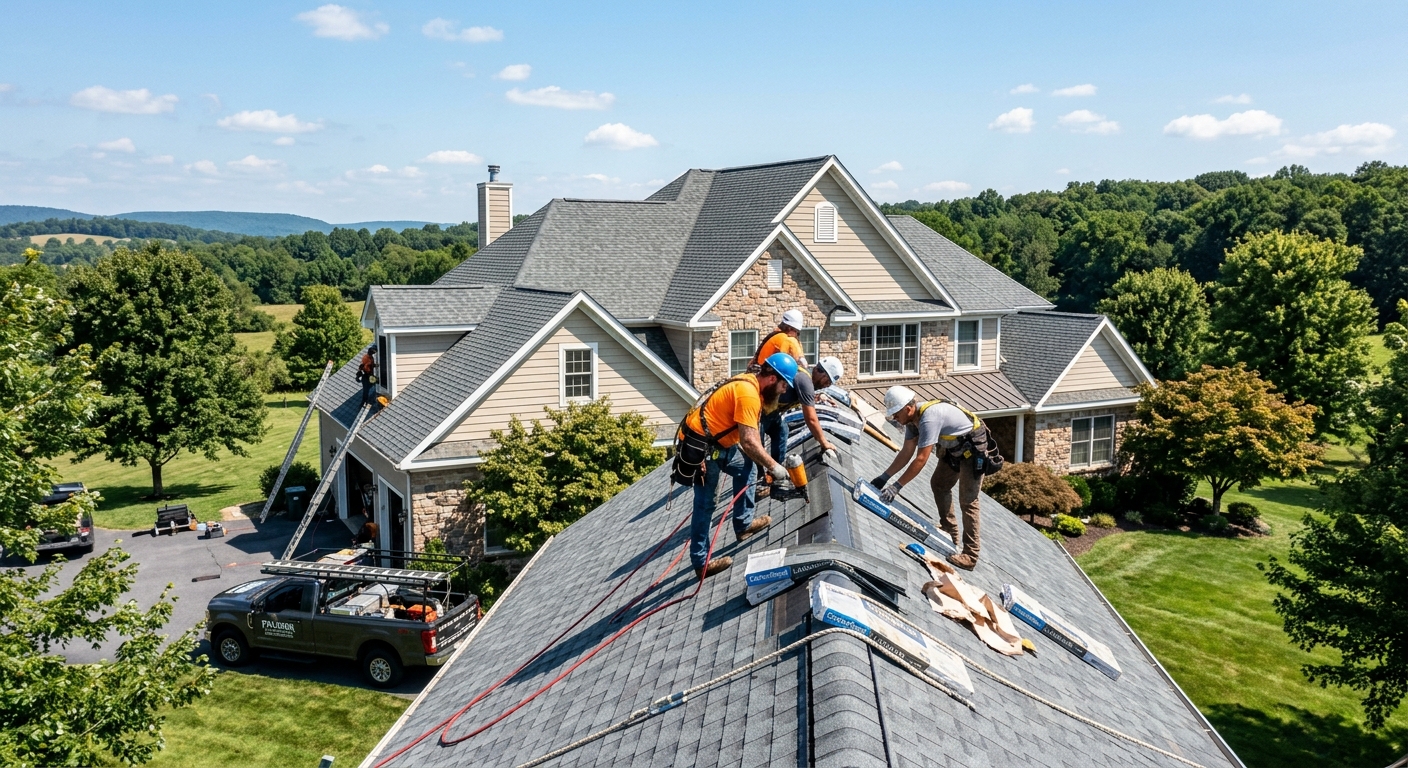
What roof replacement costs in Catasauqua in 2026
Catasauqua’s roofing costs in 2026 reflect both its older housing stock and its position in the densely competitive Lehigh Valley market. With 88.9% of local homes built before 1980 and a homeownership rate of 70.3% (U.S. Census Bureau, ACS 2024), most roofs here will be at or past their original service life, pushing replacements rather than repairs. Neighborhoods in South Whitehall and Upper Macungie—post‑WWII suburban tracts—shape the size and roof style you’ll commonly see in Catasauqua: moderately pitched, gable roofs that lend themselves to asphalt shingle replacement. That built-in uniformity means local roofers are proficient at “standard” tear-offs and installations, which helps keep labor efficient for similar houses in Catasauqua, especially when compared to more custom work found in older boroughs. But the same market factors driving competitive bids can also create a squeeze on quality if you aren’t careful who you hire.
Below are realistic installed price ranges you can expect in Catasauqua for roof replacement or repair:
| Material / Scope |
Lifespan |
Best for |
Price range (installed) |
| Asphalt shingles — architectural (30-yr) |
25–30 yrs |
Most Catasauqua homes built after 1940 |
$9,400–$20,000 |
| Asphalt shingles — impact-resistant (Class 4) |
30+ yrs |
Homes exposed to tree debris or hail |
$15,500–$20,000 |
| Metal standing seam |
40–70 yrs |
Owners wanting longevity and snow performance |
$22,500–$40,500 |
| Flat roof — TPO or EPDM |
15–25 yrs |
Rowhomes, low-slope additions |
$12,000–$23,500 |
| Roof repair — leak or isolated section |
n/a |
Small leaks, limited damage |
$500–$1,900 |
Prices are estimates for a typical Catasauqua home and vary with roof size, pitch, decking condition and material selection.
Material comparison for Catasauqua homeowners
Material choice matters in Catasauqua’s climate, where roofs are routinely tested by 40 pounds-per-square-foot snow loads and 4°F winter design temperatures. Architectural asphalt shingles dominate the Lehigh Valley’s housing stock because their upfront cost is significantly lower, and local roofers have decades of experience installing them efficiently. They shed enough snow for most moderate pitches, and their 25–30 year lifespan suits the replacement cycles needed for homes prone to seasonal ice dams.
Metal standing seam roofs are superior in cold-climate performance—they excel at shedding heavy snow and resisting ice damming. However, metal’s high cost—up to $40,500 installed—often outweighs its long-term value, unless you plan to stay in the home for decades or want the look. TPO and EPDM membranes are usually reserved for flat or low-slope roofs, common on older rowhomes and rear additions, and require attentive installation to handle ponding water under snow cover.
Asphalt’s predominance is simple math: with tract housing patterns and efficient installation, material and labor savings pile up in Catasauqua. Paying a premium for a metal roof is rarely worth it unless heavy snow-shedding or architectural style are primary concerns. For most owners here, Class 4 impact shingles are only necessary if overhanging trees or hard hail are season-long threats.
| Material |
Installed cost |
Lifespan |
Cold-climate performance |
Maintenance |
| Asphalt architectural |
$9,400–$20,000 |
25–30 yrs |
Handles snow, may ice-dam if attic is poorly ventilated |
Simple: seasonal check and gutter cleaning |
| Asphalt Class 4 impact-resistant |
$15,500–$20,000 |
30+ yrs |
Better against hail and large tree debris |
Same as standard architectural |
| Metal standing seam |
$22,500–$40,500 |
40–70 yrs |
Excellent snow shed, least risk of ice dams |
Minimal: check fasteners, clear valleys |
| TPO / EPDM membrane |
$12,000–$23,500 |
15–25 yrs |
Only for flat roofs; handles ponding but can be punctured by ice |
Annual check for seams and drains |
What moves the price of a roof in Catasauqua
Several factors explain why roofing quotes around Catasauqua differ for the same job, and most boil down to details revealed at the house itself. Roof size is the biggest driver—tract housing and single-family footprints here mean most jobs fall within 18 to 30 squares (each square is 100 square feet of roof). For a medium Catasauqua home, the difference between a 20 and 28 square roof can mean a swing from $12,000 up to $20,000 for architectural shingles.
Pitch and access also matter more than you’d think: many borough homes built pre-1980 have walk-up attics and moderate slopes, which are efficient for roofers. Where there’s a steep pitch, labor slows by as much as 30%, raising your all-in cost. The region’s history of heavy snow and ice damming (with 40 psf snow load design) frequently necessitates upgraded ice-and-water barrier at all eaves, a step that can add $300–$800 to even a plain re-roof.
Layer count, decking repairs, and upgraded materials also move the needle. Code here typically doesn’t require a permit for shingle patches, but full replacements almost always call for a tear-off, especially if more than a single layer is present. With older homes, rot discovered at tear-off is common, with each sheet of replacement decking running $75–$150.
| Factor |
Why it matters here |
Cost impact |
| Roof size in squares |
Each square is 100 sq ft of roof surface |
Primary multiplier |
| Pitch and access |
Steep pitches need harnesses and slow the crew |
+20–30% labor |
| Existing layers to tear off |
Two or more layers means full tear-off and disposal |
$500–$1,500 per layer |
| Decking condition |
Rot is found during tear-off, not before |
$75–$150 per sheet |
| Ice barrier at eaves |
Required where ice damming has a history |
$300–$800 |
| Material grade |
3-tab vs architectural vs Class 4 impact-resistant |
$500–$2,500 |
What gets discovered after tear-off in Catasauqua
It’s what’s under your old shingles that can surprise you most. In Catasauqua—where almost nine in ten homes predate 1980—rot in the roof decking turns up at tear-off in about one out of three jobs I see. Each sheet of plywood costs $75–$150 (installed) depending on thickness. Attic ventilation shortfalls also pop up. In our cold climate, poor ventilation can trigger ice damming, which doesn’t just create leaks—it actually avalanches water under shingles, rotting out framing and eaves and voiding manufacturer warranties. Upgrading vents or cutting in a ridge vent often runs $400–$950 on a standard house here.
Flashing around chimneys and wall junctions is another common “hidden” cost; if your previous roofers used roof cement or didn’t step-flash correctly, a thorough re-flash can add $250–$850 depending how many transitions your roof has. Plumbers’ boots, pipe jack flashings, and worn drip edge also get discovered and replaced in most full re-roofs, generally adding another $150–$400 to the invoice. These corrections aren’t upsells—they’re what keep your new shingles from failing five years early.
How to vet a Catasauqua roofing contractor
Hiring a roofer in Catasauqua requires more than seeing a truck sign. Always verify that your contractor holds a Pennsylvania Home Improvement Contractor (HIC) registration using the state tool at hic.attorneygeneral.gov—registration is mandatory for any job over $500. Ask to see proof of active workers’ compensation insurance, which is required for all employers, and confirm it directly using the WCAIS portal (wcais.pa.gov). If your house was built before 1978, request the contractor’s EPA Lead RRP certification from the federal lookup; these legal details protect you and your home from both shoddy work and legal risk.
- Verify HIC registration at hic.attorneygeneral.gov
- Review written contract terms; never accept verbal-only agreements
- Request insurance certificate and check workers’ compensation via WCAIS
- Ask about local project references (especially in Lehigh County towns)
- See samples or manufacturers’ data sheets for all shingle and underlayment options
- Insist on a clear written scope—no “allowances” for decking without a price range
- Check that permits will be pulled if the job triggers a requirement in Allentown or locality
- For pre-1978 homes, confirm EPA Lead RRP certification for all tear-off work
- Obtain a warranty in writing (material and labor, not just “lifetime” claims)
- Request daily cleanup commitments if you have children, pets, or open yards
- Confirm how the roofer handles punch-list or last-payment disputes
- Demand the final invoice itemizes any added scope, not a single lump sum
Red flags in our tight Lehigh Valley market: out-of-area phone numbers, pushy door-knockers after storms, “we’ll cover your deductible” offers (illegal in PA), contractors unwilling to provide HIC or insurance proof, and anyone promising a price far below other local bids for the same asphalt or metal system.
Storm damage and insurance claims in Catasauqua
If your Catasauqua home suffers storm damage, document everything before you clean up. Take photos showing shingle loss, debris patterns, and any water marks inside. Contact your insurance carrier right away and request a written scope of loss from their adjuster—you’ll need this for any qualified Lehigh County roofer to bid the fix correctly. Insurers will typically handle roof claims on either actual cash value (ACV) or replacement cost; most policies default to ACV unless you’ve specifically upgraded.
Don’t sign any roofing contract until you’ve reviewed the full scope with both your adjuster and the roofer. In Pennsylvania, the Home Improvement Consumer Protection Act means any job over $500 requires a written contract and gives you three business days to cancel. Be wary of any contractor who offers to “waive” or “cover” your deductible. Waiving a homeowner’s deductible is prohibited under state law; if someone offers this, walk away—they’re risking your policy and their own legitimacy.
Expect the insurer to send an adjuster to verify damage on site, especially if widespread wind or hail events swept through western Lehigh County’s ridge lines. Never let a roofer pressure you for an up-front deposit before claim approval. The right local roofer will help you communicate with your insurer but should never steer the claim or take over negotiations.
Permits and code requirements in Catasauqua
Roofing work in Catasauqua falls under the Pennsylvania Uniform Construction Code (UCC), which is based on the IRC. In the Allentown area, the Bureau of Building Standards & Safety is your code authority for building permits. For all other townships in Lehigh County, check with the specific municipality’s code office, as each runs its own enforcement. In practice, structural roof replacement or installing a new roof over existing shingles in Allentown requires a building permit. However, if you’re just repairing a small roof leak—such as replacing a few shingles—a permit is often not needed in Allentown or the surrounding towns.
Before hiring anyone, verify their Home Improvement Contractor registration at hic.attorneygeneral.gov (required for contracts over $500 statewide). Proof of workers’ compensation is required for all employers in Pennsylvania; use the WCAIS system at wcais.pa.gov to confirm your roofer’s coverage. Never take a printed insurance certificate as final—online confirmation is the only safe bet, especially in storm seasons when unregistered contractors swarm dense metro markets like Lehigh Valley. If your home predates 1978, check for the contractor’s Lead RRP certification at the EPA lookup.
Frequently asked questions — roofing in Catasauqua
Can I install new shingles over old ones in Pennsylvania?
In Pennsylvania, the Uniform Construction Code is based on the IRC, which allows shingle overlays (a second layer) if the existing roof deck is sound and there’s only one layer present. However, in Catasauqua—where homes are mostly pre-1980 and older layers are likely—this isn’t usually a good idea. Overlaying saves on tear-off costs (about $1,200–$2,000 on a standard roof), but it shortens shingle lifespan, increases weight load, and can void manufacturer warranties. Also, deck rot, flashing issues, or poor attic ventilation will go undiscovered and uncorrected. If you want the job done for longevity, a full tear-off with modern ventilation is simply the safer bet for most Catasauqua homes.
What warranty should a Catasauqua roofer offer?
You should expect any reputable Catasauqua roofer to provide a written warranty covering both material (from the shingle manufacturer) and labor/workmanship (from the contractor). Most architectural shingles installed here come with a manufacturer’s limited “lifetime” warranty—prorated after 10–15 years—and contractors typically supply 5–10 years of labor coverage. For a roof costing $15,500, insist that the specifics are in writing: not just a generic “lifetime” claim. Also, verify that improper attic ventilation or unaddressed rot won’t void the warranty. If your house is pre-1980, also ask if the warranty is transferable should you sell; resale can be affected if paperwork is missing.
Will filing a roof claim raise my premium?
Filing a roof claim in Pennsylvania, including in Catasauqua, may increase your homeowner’s insurance premium, especially if the insurer determines that claims are frequent in your area. However, a single event—like wind or hail causing a $1,900 repair—typically results in a renewal review rather than a drastic immediate increase. Insurers often look at both individual and local claim histories (the Lehigh Valley’s regular wind damage is factored in). If you’ve never had a claim and your roof is old, a legitimate storm event claim shouldn’t penalize you long-term, but multiple claims can trigger non-renewal. Always document the loss, keep paperwork, and don’t claim minor wear—that’s routine maintenance, not a covered peril.
What are the signs of hail damage on a roof?
On an asphalt shingle roof in Catasauqua, hail damage will show as pock marks or bruises—spots where the granules are missing, exposing the black asphalt underlayment. These are usually most obvious on roof slopes facing northwest, matching the typical path of storms funneled by South Mountain. Impact-resistant shingles (Class 4) are better at resisting these marks. Hail damage often voids manufacturer warranties, so if you spot such marks after a storm, get a professional assessment before repairs. If replacement is needed, you’re looking at $15,500–$20,000 for architectural shingles, but targeted repair can sometimes be done for $500–$1,900.
What's the cheapest way to replace a roof in Catasauqua?
The least expensive legitimate roof replacement for a typical Catasauqua home is a simple tear-off and installation of architectural asphalt shingles—at the low end, about $9,400 for a minimal scope. Saving further by overlaying new shingles atop old, or hiring an unregistered out-of-town crew, will usually shortchange you on both warranty and problem-prevention. Opt for basic architectural shingles, skip unnecessary upgrades (like high-end ventilation if yours functions well), and avoid changes to roof shape or extra cut-ins. Ensure your roofer is HIC-registered with the state and don’t be tempted by “cash price” pitches—they often void warranties and can risk your insurability.
How long do architectural shingles last compared to 3-tab?
In Catasauqua, architectural (laminated) shingles reliably last 25–30 years, while the older 3-tab style averages just 15–20—sometimes less when exposed to local wind or heavy snow. Modern homes in the Lehigh Valley almost always get architectural shingles, even when pricing is close ($9,400–$20,000 for architectural vs. minimal savings for 3-tab). The added thickness and contour of architectural shingles handle both wind and snow-melt cycles better. With heavy winter design loads (40 psf snow), architectural shingles simply outperform 3-tabs in both appearance and durability, making them the default in local replacements today.
What causes ice dams on Catasauqua roofs?
Ice dams in Catasauqua come from warm attic air melting snow on the upper roof, which then refreezes at cold, uninsulated eaves. This is a particular problem in our climate, with winter design temps down to 4°F and significant snow loads. Poor attic ventilation, inadequate insulation, or blocked soffit vents make it worse—common in local homes built before 1980. Water backs up under shingles and leaks into the house, sometimes causing a need for repairs between $500–$1,900 if caught early, or full replacements if ignored. Solving ice dams takes proper eave ventilation, attic air sealing, and, on new roofs, a rolled ice-and-water barrier under the shingles at all overhangs.
Is a metal roof worth the extra cost in Catasauqua?
A metal standing seam roof, despite costing $22,500–$40,500, isn’t a default upgrade for most Catasauqua homeowners. The material’s snow-shedding is unbeatable—reducing ice dam risk—so it pays off only if you’re planning to stay in your home long-term or have trouble with persistent ice dams or snow drift damage. For most Lehigh County homes, especially those in tract housing built post-WWII, the typical architectural asphalt roof at $15,500 is more cost-effective and meets all local snow and wind code demands. Metal makes sense for owners with steep roofs, long eaves, or design-driven needs, but expect a long payback period and limited ROI on sale.
Will the crew damage my landscaping or driveway?
Every Catasauqua roof replacement poses some minor risk to landscaping and driveways, especially during the tear-off process when debris and nails can come loose. Reliable Lehigh County contractors—especially those used to dense neighborhoods—should use tarps to protect beds, roll magnets across lawns and concrete, and stage materials only on agreed spots. Even so, large dumpsters may scuff asphalt driveways. Discuss protection steps in writing before work begins, and avoid crews who refuse cleanup commitments (especially in the busy Lehigh Valley season). If you’re paying $12,000–$20,000 for a new roof, demand clean-up and daily checks—detailing this in your contract is your best insurance.