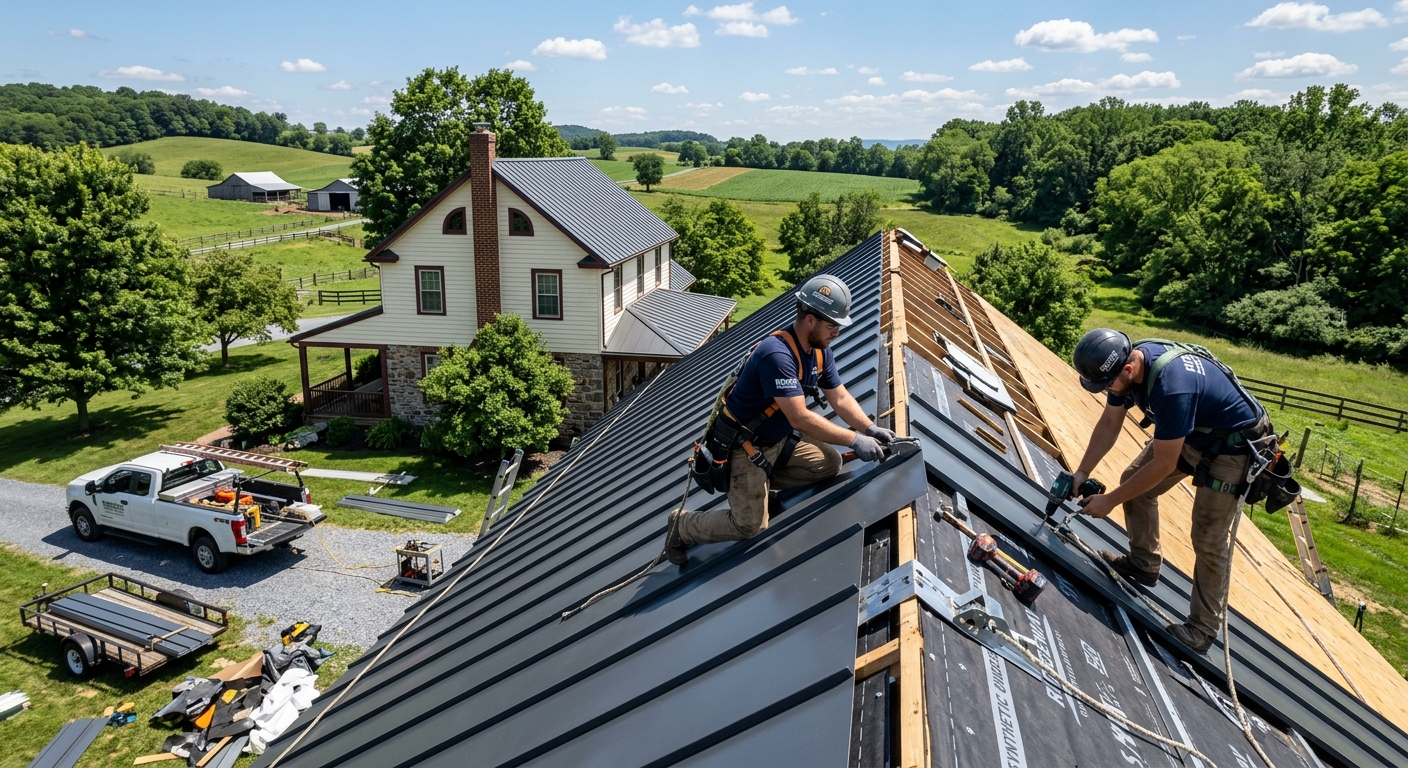
What roof replacement costs in Cumberland in 2026
Residents of Cumberland Township are looking at real 2026 dollars when it comes to roofing work, but a couple of local factors shape what you’ll pay. First, with over four out of five homes owner-occupied (U.S. Census Bureau, ACS 2024), the market for replacement is steady — owners aren’t patching to sell, they need a reliable fix. Second, nearly half of all houses here were built before 1980, and most came from a big wave of construction between 1940 and 1970. That means you’re rarely dealing with your first roof since new; in fact, plenty of replacement jobs here uncover old plank decking or degraded plywood that’s already been through cycles of patching and shingle layovers.
Large shares of Gettysburg and Cumberland Township housing date from 1940–1970 infill, driving frequent tear-off and deck repair needs. What this means for scope: Many jobs here require not just new shingles but also pulling up multiple layers to the deck, replacing rotted boards, and upgrading venting. It’s rare to find a single-layer roof, and common to spot spongy sheathing in the attic. So, expect both the material and labor in Cumberland to reflect the realities of older homes and a certain amount of necessary deck work most contractors will have to bill for.
| Material / Scope |
Lifespan |
Best for |
Price range (installed) |
| Asphalt shingles — architectural (30-yr) |
25–30 yrs |
Standard replacement on most single-family homes; code-compliant for Gettysburg historic areas |
$10,000–$21,000 |
| Asphalt shingles — impact-resistant (Class 4) |
30+ yrs |
South-facing ridge lines near South Mountain or areas with repeat wind uplift damage |
$16,500–$21,000 |
| Metal standing seam |
40–70 yrs |
Non-historic homes with open roof lines; long lifespan for rural properties |
$24,500–$43,500 |
| Flat roof — TPO or EPDM |
15–25 yrs |
Porches, additions, low-slope roofs on mid-century infill homes |
$12,500–$25,500 |
| Roof repair — leak or isolated section |
n/a |
Spot leaks at vent pipes, flashing, or around chimneys on older roofs |
$550–$2,000 |
Prices are estimates for a typical Cumberland home and vary with roof size, pitch, decking condition and material selection.
How to vet a Cumberland roofing contractor
Before hiring anyone to work on your roof in Cumberland, make sure you’re dealing with a legitimate contractor. For any contract over $500, Pennsylvania requires Home Improvement Contractor (HIC) registration. You can check this at hic.attorneygeneral.gov — don’t just take their word for it, look them up. Every employer must carry workers’ compensation insurance; you can confirm this status quickly through the WCAIS system at wcais.pa.gov. Any roofing project on a home built before 1978 must have a contractor certified under the federal EPA Lead RRP Rule. Steer clear of anyone who doesn’t provide a written contract — Pennsylvania’s Home Improvement Consumer Protection Act (HICPA) requires it.
- Verify HIC registration at hic.attorneygeneral.gov
- Ask for proof of workers’ compensation; check via wcais.pa.gov
- Get a written contract for any job over $500
- Ensure Lead RRP certification for pre-1978 homes (certifiedrenovatorsearch.epa.gov)
- Confirm a local, physical address (not just a PO box or out-of-state number)
- Request recent customer references in Cumberland or Adams County
- Ask about their crew — company employees or subcontracted labor
- Understand who pulls the permit if required
- Check what type of warranty is offered and ask for it in writing
- Receive a detailed estimate showing line items for materials and labor
- Do not pay cash up front or the full amount before work starts
- Insist the contract states your 3 business-day right of cancellation
Red flags for Cumberland: Crews coming from the York–Hanover or Chambersburg–Carlisle corridors charging heavy travel surcharges; no local address or established track record in Adams County; only a cell phone, no landline; will not provide proof of workers’ comp or registration; wants all payment up front before a nail is driven.
Roofing season and lead times in Adams County
Adams County’s shingle season typically opens in late March and runs through early November, but the best months for shingle sealing in Cumberland are May through September when daytime highs and overnight lows allow the asphalt to bond properly. Local crews try not to install architectural shingles in deep winter, since anything below 40 °F can prevent proper adhesive activation until spring sun comes. If you line up a replacement during October’s shoulder, you can get quality work but jobs stack up fast — the queue starts growing after Labor Day as folks rush to beat the cold.
In the thin rural market around Cumberland Township, don’t assume you can get next-day service. Crews commonly cover a two-county radius, so a routine roof replacement may book two to six weeks out in summer. Emergency leak or tarp calls in February, especially after a freeze-thaw stretch, get hit with travel charges and overtime rates. September is often the sweet spot — last-year’s storms are settled by then, shingle adhesion is reliable, and the waitlist is at its shortest. For porch or flat roof work, aim for the dry side of spring or late summer to avoid the extended dew and morning slicks.
Decking, ventilation and flashing — the hidden roof costs
Most quotes in Cumberland don’t capture the full bill until the shingles come off. Unexpected rot in decking is common here, with 1940–1970s houses often showing soft spots below the valleys and eaves. If more than two or three sheets of plywood or plank need replacing, that’s another $700–$2,500 on the invoice. Attic ventilation is a must in this freeze-thaw climate; older ridge lines with blocked soffit or no ridge vent risk heavy ice damming. Rebuilding venting — new ridge vent, baffles, and extra roof cuts — generally adds $900–$1,800 depending on roof size and access.
Chimney, wall, and valley flashings — especially on roofs originally installed before 1990 — may show rust or were never stepped right to begin with. Replacing or reworking flashings costs $400–$1,100 per penetration. Don’t overlook vent boots and drip edge: aged rubber collars split and let water track right into the attic, and lack of metal drip edge leaves eaves rotting out from the bottom. These “small” accessories often add another $250–$600. None of these contingencies are padding; in Cumberland, skipping them usually invites callbacks, leaks, or warranty headaches.
Snow load, ice dams and wind in Cumberland
South-facing ridge lines near South Mountain in western Adams County have a local problem: repeat wind uplift events hit older architectural shingles hard, often on second or third layer installs. Even a fresh roof can lose tabs when gusts exploit nails set shallow or poorly sealed self-adhesive strips, leading to repairs in the $550–$2,000 range. Adams County sits in a moderate snow belt with a ground snow load of 30 psf. Snow buildup isn’t catastrophic for most Cumberland Township roofs, but prolonged cycles of thaw and freeze mean ice dams form readily at eaves, especially when attic ventilation is weak and heat loss lets meltwater pool above the fascia.
These ice dams back water under shingles and over the old deck seams, leading to interior leaks and pervasive rot. When melting backs up into old plank sheathing, you often jump from what seemed like a basic overlay to a full tear-off and deck patch job — an upgrade of $10,000–$21,000 if a new architectural system goes down. Local hail storms do occur but typically bruise shingles without punching holes. The bruising knocks granules loose, kills shingle life early, and can be hard to spot without up-close inspection. In Cumberland, roofs without the right ice barrier and underlayment at the eave fail prematurely, driving costs that could have been avoided with an extra $700–$1,200 in underlayment during the last install.
Roof age and construction era in Cumberland
Cumberland Township’s housing stock is shaped by the 1940–1970 infill era, with 47.7% of homes predating 1980 (U.S. Census Bureau, ACS 2024). Roofs on these homes typically feature steeper pitches than newer suburban builds, and deck materials often shift from thick plank in the oldest houses to early plywood or OSB in postwar stock. Few roofs that age are still on their first layer. Most have at least one tear-off in their history, but you’ll still find houses with two or even three layers of shingle stacked up — a “cheap fix” that today’s code will force you to remove.
Ice barrier underlayment was not a code requirement during the mid-century wave, so unless your last roof was recent and code-compliant, there’s a good chance only bare felt or even nothing covers the eaves. Tear-offs in Cumberland frequently reveal long-nailed overlays through soft underdecking, wavy ridges, and plenty of granule build-up in the gutters. If your home is up for its second or third roof — as is the norm here — you’re likely inheriting all the quirks of midcentury Pennsylvania construction. Budget for some deck repair and modern venting as standard, not as a surprise.
Roofing permits in Cumberland: what you need before work starts
Roof permits in Cumberland depend exactly where you live. In Gettysburg Borough, replacing more than 25% of your existing roof area typically requires a building permit. Any job under that limit — like small repairs or patching — usually proceeds without formal review, but check with your local municipal office, especially if you’re in a township outside Gettysburg. In rural Reading Township, minor shingle patching under a roofing square often skips permits entirely.
All residential roof work falls under the Pennsylvania Uniform Construction Code (UCC), based on the IRC, with enforcement by the municipality or by the PA Department of Labor & Industry (L&I) if your area hasn’t opted in to local enforcement. Before work begins, verify your roofer’s Home Improvement Contractor (HIC) registration for jobs over $500 at hic.attorneygeneral.gov, and confirm they carry current workers’ compensation insurance through the WCAIS system (wcais.pa.gov). For homes built before 1978, ensure the contractor is Lead RRP certified by checking the EPA registry. Only a written contract is legal above $500, and you should never be asked to waive your homeowner’s insurance deductible — Pennsylvania law prohibits it.
Frequently asked questions — roofing in Cumberland
How long do architectural shingles last compared to 3-tab?
Architectural shingles, which dominate the Adams County market due to historic district restrictions in places like Gettysburg, offer a substantial upgrade over old-style 3-tabs. In Cumberland, a properly installed 30-year architectural shingle is likely to last 25–30 years, especially if attic ventilation is squared away. In contrast, 3-tab shingles from earlier eras rarely made it past 18–20 years here given our freeze-thaw cycling and moderate snow load. Architectural shingles also perform better in our county’s common wind uplift areas, resisting blow-offs and curling. This longer service means while the up-front replacement cost is higher — $10,000–$21,000 for architectural versus what 3-tabs cost a generation ago — you typically get a third more life, fewer repairs, and a better shot at avoiding critical deck rot found in many tear-offs.
Is ice barrier underlayment required in Cumberland?
For most roofing projects in Cumberland, ice barrier underlayment is not optional. The Pennsylvania Uniform Construction Code (UCC), enforced locally or via PA Department of Labor & Industry, adopts IRC standards which require ice barrier along the eaves for homes in snow load zones like Adams County. Most of our township’s housing wave (1940–1970) was re-roofed before this became standard, so if your roof predates recent work it may lack proper ice protection. Retrofitting with a modern ice and water shield — typically at least two feet up from the eave — is included in any reputable bid and can prevent the kind of water intrusion that drives full deck and drywall repair (typically $10,000–$21,000 for a new shingle job). Ask your contractor specifically about this.
How much does it cost to repair a roof leak in Cumberland?
Roof leak repairs in Cumberland generally run $550–$2,000 when caught early — most jobs land around $1,250 for a single flashing, vent boot, or small field shingle patch. Expect the lower end for a one-square fix without rot and the upper for anything with plywood replacement or extensive rotten wood. Because nearly half our area’s roofs are on their second or third layer, leaks may travel before showing inside, sometimes taking longer to trace and resolve. Hiring a credible local contractor helps avoid repeated callbacks since out-of-county outfits may not know to spot our common attic vent or deck issues that allow leaks to reappear.
What causes ice dams on Cumberland roofs?
Ice dams here form when snow melts on a warmer roof — often due to insufficient attic insulation or poor ventilation — only to refreeze at the colder eaves. Frozen runoff builds a dam at the edge, forcing meltwater back under the shingles and onto decking or into wall cavities. This is made worse in older Cumberland homes (especially pre-1980) where ventilation was not code and eaves are narrower. Two freeze-thaw cycles in one storm aren’t rare, especially with our 30 in frost depth and 12 °F winter design temp. Fixing damage afterward can mean a new shingle section or even a full replacement at $10,000–$21,000. Preventive upgrades like added ventilation or proper ice barrier are a must for Cumberland roofs.
How can I tell if my roof decking is rotted?
In Cumberland homes, especially those with 1940–1970 decks, you can often spot rotted sheathing if you observe wavy shingle lines, spongy areas when walking the roof, or attic evidence of previous leaks (dark patches, water stains, or wood that flakes at touch). Tap test from inside the attic or look for daylight where there shouldn't be any. During most professional tear-offs, discovering soft or punky wood is common, with per-sheet replacement adding $700–$2,500 depending on how extensive the damage is. If your roof is on its third layer or more, odds are good that sooner or later you’ll need some section of deck rebuilt — better to plan for it in your budget than be surprised mid-job.
Is a metal roof worth the extra cost in Cumberland?
Standing seam metal roofs have a much longer lifespan — typically 40–70 years — compared to architectural shingle roofs. While the up-front installation is higher, at $24,500–$43,500 compared to shingles, you’ll see fewer repairs and less worry about big wind events, especially in open rural areas near South Mountain. Just note that in Gettysburg historic districts, metal roofing is often restricted, so check first. In non-historic Cumberland homes, a metal roof can be a solid long-term bet, especially for those planning to stay put. You avoid most issues of layering and ventilation that plague shingle jobs on older decks, and resell value for rural properties can be stronger with a well-done metal system.
Do I need my own inspection before the adjuster visits?
In Cumberland, if you’re dealing with an insurance claim, having a local roofer inspect the damage before your adjuster visit is generally smart. Many Adams County roofs have multiple shingle layers, hidden flashing issues, or undetected deck problems dating from the midcentury era. Roofers familiar with our local stock can flag missed items and help document damage with photos or measurements, making the case to your adjuster for a full-scope repair or replacement. A pro inspection might reveal hidden costs that an adjuster overlooks, which could mean the difference between a $550–$2,000 repair and a properly scoped replacement settlement. There’s no requirement to use their preferred vendor, so protect your own interest upfront.
How long does a roof replacement take in Cumberland?
Typical residential shingle replacements in Cumberland finish in two to three days, weather permitting, with one day for tear-off, one for install, and half a day for cleanup and detail work. If your home has multiple shingle layers, hidden deck rot, or surprise vent issues — as many pre-1980 houses here do — finishing time can stretch by a day or two. Metal installs may need three to five days, particularly if historic district details or complex flashing are involved. In peak season, some wait time is to be expected, but once your job starts, a solid crew won’t leave you open to the weather overnight unless forced by an emergency. For a typical Cumberland asphalt job, expect the cost to run $10,000–$21,000 and plan for the possibility of an extra day if deck repairs crop up when the old roof comes off.
How much deposit should I pay a roofer upfront?
Under Pennsylvania’s Home Improvement Consumer Protection Act (HICPA), your roofer can’t ask for more than one-third of the contract price as a deposit, plus the cost of special-ordered materials. In practice, for a Cumberland job, this means you’d often put down about $3,500–$7,000 for a typical architectural shingle replacement — no more. Always get a detailed, signed contract before handing over money, and never pay the full balance before the job is finished to your satisfaction. If a contractor pushes for full payment before starting or won’t document the terms, that’s a strong sign to look elsewhere in Adams County’s tight market.