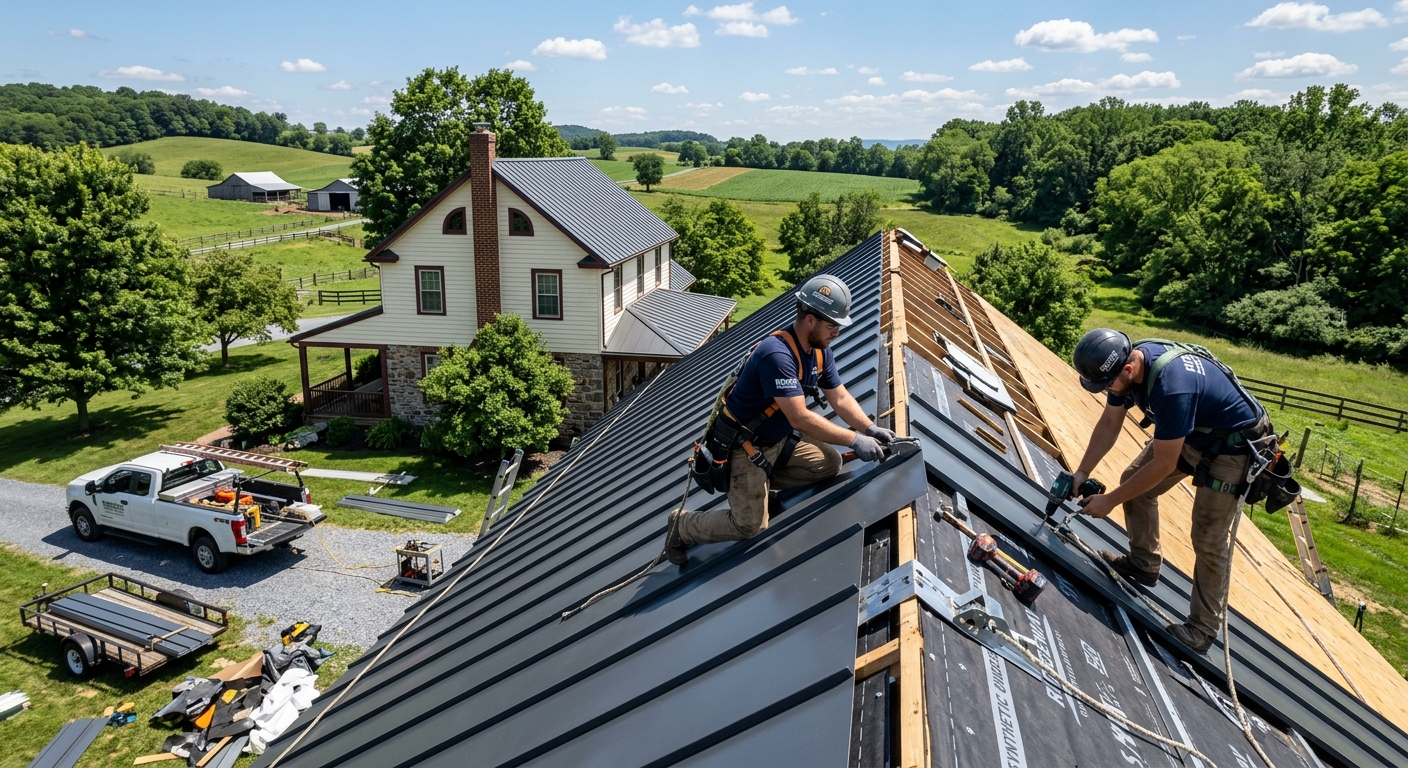
Roofing Replacement & Repair costs in Cumberland — 2026
Cumberland homeowners face roofing realities shaped by the area’s coal-country history and rural market. With a population of just 6,365 and a homeownership rate above 80% (U.S. Census Bureau, ACS 2024), nearly everyone here is caring for a roof on a single-family home. Labor surcharges are common because Cumberland sits at the rural edge of Greene County, where finding a contractor means dealing not just with the work, but with the travel time it takes to get crews out from the Pittsburgh metro.
Most of Cumberland’s roofs sit atop homes built between 1900 and 1940, remnants of the coal era that dominate the local landscape. These older structures often come with hidden costs and surprises—irregular framing, plank decking, and multiple shingle layers from a century’s worth of patches and retrofits. When you replace a roof in Cumberland, it’s rarely a simple tear-off. You’re likely dealing with structural repairs as well, especially where rafter spacing and decking don’t match modern code or have weakened over time.
Below are cost bands you can expect in 2026 for primary residential roofing and repair jobs in Cumberland. These include not only material and installation, but also the complexity that’s common in the local housing stock.
| Material / Scope |
Lifespan |
Best for |
Price range (installed) |
| Asphalt shingles — architectural (30-yr) |
25–30 yrs |
Most single-family homes; affordable, good snow shedding |
$8,900–$18,500 |
| Asphalt shingles — impact-resistant (Class 4) |
30+ yrs |
Homes exposed to microbursts and ridge-line wind |
$14,500–$18,500 |
| Metal standing seam |
40–70 yrs |
Long-term owners, challenging snow loads, minimal maintenance |
$21,500–$38,500 |
| Flat roof — TPO or EPDM |
15–25 yrs |
Additions, low-slope porches, some farmhouses |
$11,000–$22,500 |
| Roof repair — leak or isolated section |
n/a |
Smaller areas, urgent repairs |
$475–$1,750 |
Prices are estimates for a typical Cumberland home and vary with roof size, pitch, decking condition and material selection.
What Cumberland's climate does to a roof
Roofs in Cumberland take a beating from Ohio Valley ridge-line winds and the occasional Appalachian thunderstorm microburst—conditions that aren't as fierce a county or two east, but mean real trouble here. These microbursts can uplift shingles suddenly, especially on older homes with loose decks or thin layers, a primary reason local architectural shingle roofs run toward the upper end of the $8,900–$18,500 band.
The area’s 30 psf ground snow load and winter design temperature of 8°F aren’t just statistics; they dictate how ice dams form at the eaves. When attic insulation is thin (not uncommon for early 1900s homes), warm air melts snow, which refreezes at the gutters. This backs up under shingles and can soak the original plank decking, leading to leaks or rot before the snow even clear. That's why modern re-roofing here nearly always introduces a self-adhered ice barrier at least three feet up the eave, adding $300–$800 to your bill—but saving much more long-term.
Hail isn’t a daily threat, but when it swings through Cumberland, it's rarely “quarter-sized” and instead produces bruising—compressing individual shingle mats without obvious holes. Those bruises may turn into leaks over the next couple freeze-thaw cycles, creating “out of nowhere” problems. It’s why some homeowners consider upgrading to impact-resistant Class 4 shingles, even at the higher upfront cost of $14,500–$18,500.
In sum: Cumberland’s roofs aren’t just exposed—they’re challenged in ways your neighbors in flatter, less wind-prone counties don’t have to consider.
Why two Cumberland roofing quotes can differ by 40%
In Cumberland, it’s common to see two bids for the same roof diverge by thousands of dollars. Why? First: the labor market is tight, and if you live outside the Waynesburg hub, there are travel surcharges—no contractor wants to send a crew up a hilly, clay-soil lane without making it worth their while. This alone can nudge a straightforward architectural shingle job from $8,900 into the high teens per roof.
The coal-era housing stock brings unpredictability. Roofs that look simple on paper may hide two or even three layers of brittle, patchwork shingles, with plank decking underneath. Each extra layer to tear off and dispose of runs about $500–$1,500, and rotted or gapped decking will mean new sheets at $75–$150 apiece—rarely quoted in the upfront price, but very real once the old roof is off. If you hear one contractor mention deck replacement and another assures you “all’s well,” be skeptical: older Cumberland homes often surprise even experienced crews.
Snow load—30 psf—and wind mean a steeper pitch or reinforced deck might be factored in. Local microbursts mean an ice/water barrier is no luxury—so expect to see a line for $300–$800 at the eaves (if not all valleys and rakes). Material grade is another gap: some quotes are for the bare-minimum 3-tab, others for architectural or impact-resistant. The bid that looks lowest might be for a product you’d need to replace ten years sooner, costing you more in the long run.
| Factor |
Why it matters here |
Cost impact |
| Roof size in squares |
Each square is 100 sq ft of roof surface |
primary multiplier |
| Pitch and access |
Steep pitches need harnesses and slow the crew |
+20–30% labour |
| Existing layers to tear off |
Two or more layers means full tear-off and disposal |
$500–$1,500 per layer |
| Decking condition |
Rot is found during tear-off, not before |
$75–$150 per sheet |
| Ice barrier at eaves |
Required where ice damming has a history |
$300–$800 |
| Material grade |
3-tab vs architectural vs Class 4 impact-resistant |
$500–$2,500 |
Permits and code requirements in Cumberland
In Cumberland Township, roof replacement work must follow the Pennsylvania Uniform Construction Code (UCC), which is based on the International Residential Code (IRC). If you’re replacing an entire roof, altering roof framing, or adding structural elements, a permit from your local municipal code office is required. Repairs that do not disturb the structure, such as shingle replacement over an existing single layer, may not always need a permit, but it is safest to check with your township’s code office.
Code enforcement is the responsibility of each municipality in Greene County, so if you’re in or around Cumberland you’ll need to contact your township’s code office directly—Waynesburg Borough has its own enforcement, while townships manage their own permitting separately.
Pennsylvania requires all contractors doing roofing work over $500 to have a Home Improvement Contractor (HIC) registration from the Office of Attorney General. You can (and should) confirm a roofer’s HIC registration at hic.attorneygeneral.gov before you sign a contract. For worker safety, workers’ compensation insurance is mandatory for all employers—this you can verify through the WCAIS database (wcais.pa.gov). Any roofing work in pre-1978 homes must comply with federal lead-safe laws; verify lead-safe credentials at certifiedrenovatorsearch.epa.gov. Make sure you get a written contract for any work over $500, as required by state law, and remember that a roofer promising to “waive your deductible” is breaking Pennsylvania rules.
Roof age and construction era in Cumberland
Cumberland’s roofs tell the story of Greene County’s coal-town boom. Nearly three-quarters of local homes were built before 1980 (U.S. Census Bureau, ACS 2024), and many rooftops go back to the 1900–1940 era. This vintage housing stock means you’ll likely find steep pitches designed to throw off snow, decked with true 1x plank boards (not modern plywood or OSB), and layers of older asphalt or even long-dead slate beneath the surface.
Early 20th-century construction in Cumberland typically did not include a modern ice barrier underlayment at the eaves or valleys. Builders trusted gravity and steep slopes rather than membrane products, so water intrusion from backup is a frequent discovery during replacement work. Multiple shingle layers—legal for most of the county’s building history—are common, with patchwork from decades of repairs. You’re unlikely to find a “first overlay”; more often it’s a full tear-off down to deck, correcting a mix of past materials and flashing mistakes.
Homes built later, up through 1980, may have plywood or (rarely) early OSB, but those often have aged out of their original roofs by now, especially with freeze-thaw cycles and wind-driven rain. No matter the precise street in Cumberland, be prepared for the possibility of hidden decking repairs, correcting old venting, and fully updating ice and water protection to current standards.
Patching vs full replacement in Cumberland
If your Cumberland home’s roof is under 15 years old with only one isolated leak—say, a missing shingle after a strong wind—paying $475–$1,750 for a proper repair makes sense. But in this township, most roofs are riding past their 20th or even 25th year, and repeated patches quickly add up. If you’ve had two repairs in the last five years, you’re likely already into the realm of “money not well spent.” For example, three rounds of repair (totalling $1,300–$3,900) comes awfully close to a down payment on replacement, especially in Cumberland homes where coal-era construction means surprises for every future contractor.
For houses between 15–25 years old with several leak points—think valley rust, blistered shingles, or soft spots at the eaves—it’s time to get serious about replacement, as repair costs in Cumberland’s market rarely solve underlying decking or layer problems. Once the roof is past 25 years or actively leaking from multiple locations, money spent patching goes straight down the drain, particularly with winter storms and thaw—the replacement range of $8,900–$18,500 is simply the best investment at that point.
| Situation |
Recommendation |
Typical cost |
Reasoning |
| Under 15 years, one isolated leak |
Repair |
$475–$1,750 |
Roof likely still under warranty; isolated issue; fast and cost-effective |
| 15–25 years, several leak points |
Replace |
$8,900–$18,500 |
Patches rarely last; decking and multiple layers usually need full replacement |
| 25+ years, any active leak |
Replace now |
$8,900–$18,500 |
Roof is past service life; further repair is not cost-effective |
| Storm damage, wind or hail |
Document, claim, replace |
$8,900–$18,500 |
Insurance will expect full replacement after significant storm loss |
| Flat roof ponding or blistering |
Replace membrane |
$11,000–$22,500 |
Ponding and blistering signal system failure; repair isn’t likely to last |
| Active leak entering winter |
Emergency repair, schedule replacement |
$475–$1,750 |
Urgent to keep water out until full tear-off can be done in stable weather |
Material comparison for Cumberland homeowners
Here in Cumberland, your material options aren’t just about personal taste—they’re about how the roof copes with 30 psf snow loads, the long winter, and the ridge-line wind. Asphalt architectural shingles are the local staple for a reason: they balance cost, work well on steep coal-era pitches, and are easy to repair on old plank decks. That’s why nearly every home here is capped with them—they’re straightforward for crews, shed snow well, and don’t punish you on price; installed, they run $8,900–$18,500 depending on roof size and tear-off complexity.
Metal standing seam roofing is the best at sliding off snow and stopping ice dams. It’s pricey up front—$21,500–$38,500—but can last two or even three times as long as asphalt, especially if you plan to live in the house for decades. The downside for Cumberland is that installing metal on old, uneven rafters and planked decks often means more deck prep—a cost sometimes missed in the first quote.
TPO and EPDM membranes get used for flat porches, additions, and certain rural farmhouses where nothing else will work at low pitch. They’ll handle our winter temperature swings, but require disciplined installation to prevent seams from splitting after years of freeze-thaw. Impact-resistant shingles make sense only for homes directly exposed to the worst of ridge wind or where insurance offers a break.
| Material |
Installed cost |
Lifespan |
Cold-climate performance |
Maintenance |
| Asphalt architectural |
$8,900–$18,500 |
25–30 yrs |
Sheds snow, resists ridge wind, moderate ice-dam risk |
Inspect after storms, replace sections as needed |
| Asphalt Class 4 impact-resistant |
$14,500–$18,500 |
30+ yrs |
Good for wind/hail; same snow-shedding as regular architectural |
Minimal if installed correctly |
| Metal standing seam |
$21,500–$38,500 |
40–70 yrs |
Best for snow slides, ice dam elimination, and wind resistance |
Periodic fastener check; rare section repair |
| TPO / EPDM membrane |
$11,000–$22,500 |
15–25 yrs |
Performs if well-installed; seams can fail with freeze-thaw |
Annual seam/surface inspection, patch as required |
Frequently asked questions — roofing in Cumberland
Does roof pitch affect the price in Cumberland?
Absolutely. In Cumberland, steeper, coal-era roof pitches are the rule, not the exception. High-pitch means crews must work slower, wearing safety harnesses and staging more material with each lift—adding direct labor hours to even a “simple” roof. On a 30- or 40-degree roof, the labor cost can be about 20–30% higher than for a shallow suburban roof. So, while an asphalt shingle replacement might start at $8,900, you could be looking at costs toward $14,500–$18,500 for a steep or hard-to-access roof. Always make sure your quote specifies how the contractor handles pitch and safety, so there aren’t price surprises after work begins.
Will the crew damage my landscaping or driveway?
In Cumberland, much of the housing sits on clay and shale soil, with narrow drives and yards that see plenty of snow runoff. Most local roofers use plywood sheets or roll-out protection to keep dumpsters from gouging your driveway. Still, the weight of a loaded shingle dumpster can leave shallow ruts or compress soft ground, especially after rain. Professional crews will protect flower beds and yards, but older asphalt driveways common here can scuff or crack under truck tires. If your driveway is newly paved, warn your roofer ahead of time. While the extra labor for setup is built into the replacement cost (usually $8,900–$18,500 for architectural), it’s worth asking for specifics on their protection plan when you sign the contract.
How long should a roof last in Cumberland?
For homes in Cumberland, properly installed architectural shingles typically last 25–30 years, assuming regular storm inspection and clear gutters to prevent ice dams. Impact-resistant Class 4 products might stretch that to 35 years if you’re lucky with wind and hail, but older framing and plank decks from the coal era can sometimes mean a shorter real-world lifespan. Metal standing seam roofs, though much pricier at $21,500–$38,500, have been known to hold up 50 years or more even in our freeze-thaw climate. Keep in mind that severe weather, multiple layers, or neglected repair will always cut years off the lifecycle—so inspection after storms and ice events pays off long-term.
Do I need a permit to replace a roof in Cumberland?
Yes, for full roof replacement or anything that alters the structural framing, a permit is required in Cumberland Township—not just in town but across Greene County’s small municipalities. Roofing is governed by the Pennsylvania Uniform Construction Code (UCC), enforced locally. Simple repairs—like replacing a patch of shingles without touching the deck—may not need a permit if no structure or framing is involved, but always confirm with your township’s office before work begins. Permitting fees are generally built into the job price, around $8,900–$18,500 for most architectural jobs. Never trust a contractor who says you can skip permits or offers to “handle it under the table” here; local inspectors do drive-bys, and unpermitted work can slow or void insurance claims.
Should I use a local roofer or a national company?
In Cumberland, you’re better off with a roofer who knows the quirks of Greene County’s coal-era homes—plank decking, steep slopes, and all the region’s little headaches. National firms may subcontract travel crews with little accountability or charge higher travel rates for sending workers out from Pittsburgh, impacting your bottom line. Local roofers are more familiar with township permitting and quickly handle emergency work—especially after a thunderstorm microburst. Most local firms also work for the long-term, knowing they’ll see you at the grocery store or gas station. For a typical repair or replacement, you’ll find competitive pricing—$475–$18,500—with a level of neighborly accountability rarely matched by rotating big-brand crews.
How much does a flat roof replacement cost in Cumberland?
Replacing a flat roof—either TPO or EPDM membrane—on a Cumberland home typically runs between $11,000–$22,500 as of 2026. This wide range reflects the size of the area, the number of seams, and whether you need insulation upgraded at the same time. Because Cumberland’s cold winters (design temp: 8°F) and mild summers put stress on membrane seams and adhesives, it pays to invest in top-shelf installation here. You’ll usually see longer service from TPO or EPDM than a patchwork repair, which often fails as freeze-thaw cycles open up seams and let water in. Most homes in this area use these materials only for porches, additions, or the rare bungalow, but for those spaces, full replacement is simply more cost-effective and reliable than piecemeal work.
Do I need my own inspection before the adjuster visits?
If you’ve had storm damage—wind or hail—from the ridge-line events common in Cumberland, it’s smart to have a local roofer do a quick inspection before the insurance adjuster arrives. This doesn’t need to be a formal report (which can cost extra), but an experienced roofer will mark up damaged areas, note old patchwork, and spot the kinds of issues that adjusters sometimes miss. Often this means the difference between a repair settlement ($475–$1,750) and a full replacement claim ($8,900–$18,500 for shingles). Local pros know what adjusters look for in Greene County and can be on hand during the visit—helping you get a fair adjustment without missing local code upgrades required by the UCC.
How long do architectural shingles last compared to 3-tab?
In Cumberland, the difference is significant. Architectural shingles last 25–30 years if well vented and maintained, while the older 3-tab shingles often punched out at 15–20 years—speeded along by wind-driven rain and repeated freeze-thaw cycles. Most homes here already switched to architectural during the last replacement, but if you’re still running a 3-tab roof (very possible on “last replaced in the 1990s” homes), you’re on borrowed time. Replacing with architectural shingles—$8,900–$18,500—gets you nearly double the future roof life and lower odds of storm damage. In the long run, you’ll spend less per year than repeatedly patching or overlaying 3-tabs.
Does Cumberland get enough hail to justify Class 4 shingles?
Cumberland sits on the edge of the Ohio Valley storm track, where microbursts are more of a concern than frequent hailstorms. That said, when hail does hit, it can bruise standard shingles badly enough to cause hidden leaks (not always visible right after the storm). Class 4 impact-resistant shingles cost more—$14,500–$18,500 for a typical roof—but may not be worth it unless you’re on an exposed ridge, have suffered repeated hail claims, or your insurer gives a real premium break for Class 4. Most homeowners in Cumberland find architectural shingles adequate; only a few need the extra protection and expense of highest-grade options.