Roofing Replacement & Repair costs in Dormont — 2026
When considering a new roof or major repair in Dormont, it pays to understand how the local housing mix and homeownership landscape shape roofing needs here. Many homes are older, with 95% built before 1980 (U.S. Census Bureau, ACS 2024), which means issues like hidden rot or worn decking are more common than in newer neighborhoods. With a homeownership rate just under 58%, the market for replacement and repair tends to focus on upgrades that protect property value—especially for residents planning to stay put for years.
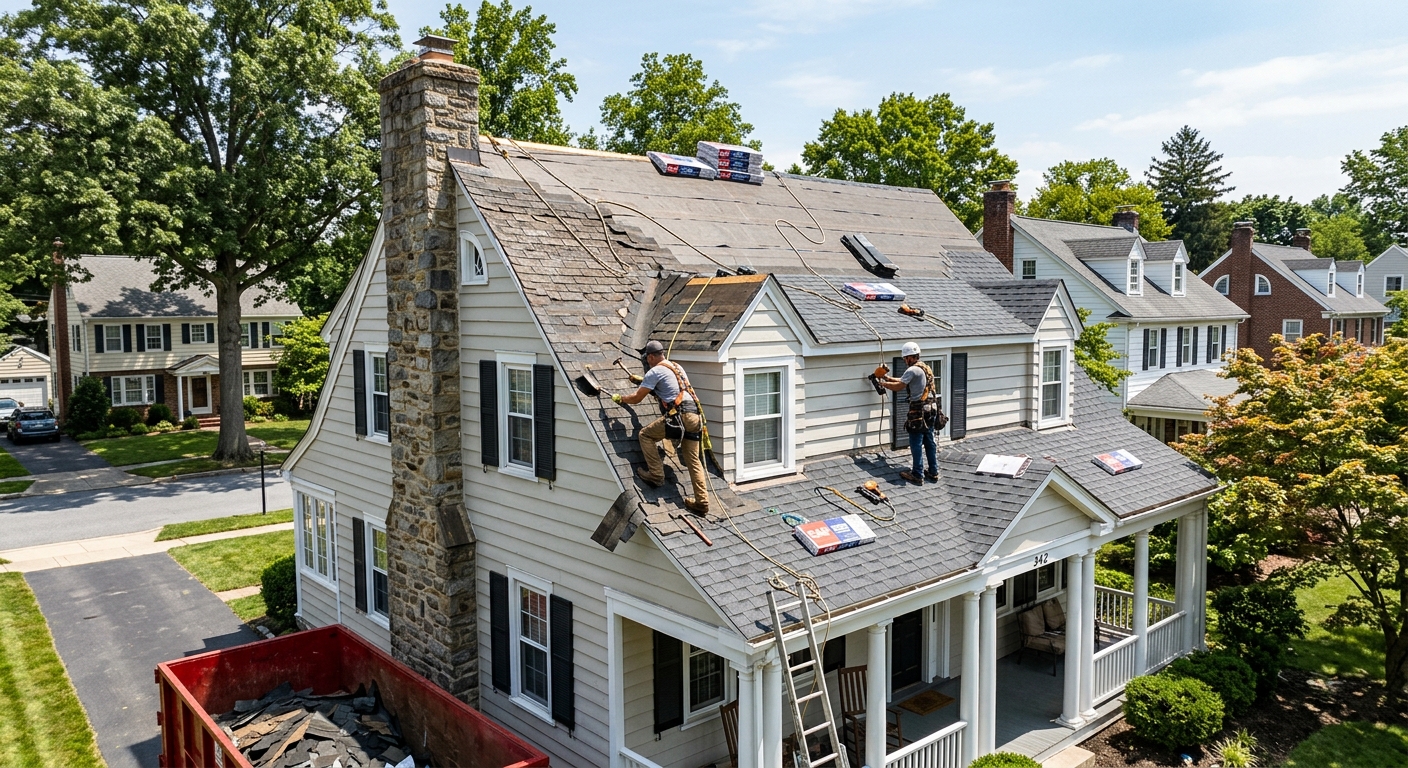
This era of homes—dating predominantly from 1900 to 1950—means full “tear-off” jobs are a regular reality in Dormont, not the exception. Layers of old shingles usually need to be removed; far more often, you'll find deteriorated wood beneath than you would in a brand new suburb. Decking repairs become necessary once the old roof is off, affecting both your timeline and cost. That's why many initial quotes here assume some wood replacement will be needed.
Below is a Dormont-specific overview of typical roof replacement and repair costs using materials that genuinely stand up to local climate and building code expectations.
| Material / Scope |
Lifespan |
Best for |
Price range (installed) |
| Asphalt shingles — architectural (30-yr) |
25–30 yrs |
Most Dormont homes—solid value and weather performance |
$9,300–$19,500 |
| Asphalt shingles — impact-resistant (Class 4) |
30+ yrs |
Storm-prone spots, tree/shade areas |
$15,000–$19,500 |
| Metal standing seam |
40–70 yrs |
Owner-occupied, long-term, low-maintenance roofs |
$22,500–$40,000 |
| Flat roof — TPO or EPDM |
15–25 yrs |
Row homes, additions, low-slope dormers |
$11,500–$23,500 |
| Roof repair — leak or isolated section |
n/a |
Small, well-defined leaks or wind damage |
$500–$1,850 |
Prices are estimates for a typical Dormont home and vary with roof size, pitch, decking condition and material selection.
The scope items Dormont homeowners don't budget for
When a Dormont homeowner is comparing roofing quotes, most don’t realize how common it is to discover unforeseen repairs once the old roof is peeled away. With most homes here built before 1980, rotted roof decking comes up frequently—a hidden cost that can add $450–$1,200 to your project if several sheets need replacing. You rarely know the full extent until shingles are stripped, especially with homes constructed 1900–1950.
Poor attic ventilation is another culprit. In Dormont’s freeze-thaw climate, insufficient roof vents not only trap heat and moisture but directly cause ice damming. This isn’t just about heating bills. Ice dams force water backward under your shingles, leading to leaks and shortened roof life. If your ventilation is under code, expect to pay $750–$2,200 for upgraded ridge vents, soffit vents, or attic fans—an expense well worth it for snow-heavy winters.
Flashing around chimneys and where roofs meet walls is often corroded or missing outright, especially in houses from Dormont’s big building wave. New step or counterflashing runs $300–$850 per feature, depending on complexity and size. Don’t overlook smaller upgrades like rubber vent boots ($90–$200 each) and new drip edge along the roof eaves and rakes ($400–$900 total). Last, if a ridge vent wasn’t “standard” when your house was built, adding one is crucial for warranty and ice protection, and runs alongside the ventilation upgrade costs above.
Workmanship vs manufacturer warranty
Dormont homeowners should know there are always two separate warranties with any roof job—a distinction that gets muddled all the time. The manufacturer warranty covers only material defects, meaning shingle failure due to a factory issue. This is typically prorated and requires registration soon after installation. If the installer does not follow the manufacturer's requirements—like proper attic ventilation or using an ice barrier where needed—that warranty can be voided before the shingles ever fail. Installing over an old roof also cancels coverage on almost every modern warranty.
The workmanship warranty is issued by the contractor and only covers installation errors—improper shingle nailing, skipped flashing, or anything that leads to leaks or performance problems due to their labor. This is not insurance, and its strength depends entirely on whether the company is still local and solvent years from now. Transferability matters for resale: most manufacturers allow warranty transfer within 30 or 60 days of selling your house, but coverage is often reduced. Workmanship guarantees are rarely transferable unless written specifically into your contract.
If you see a 25-year workmanship warranty from a company that opened shop last year, take it with a grain of salt. In Dormont, I tell homeowners that a solid 10-year written labor warranty from a company with a longstanding, visible service history is more meaningful than a long promise from a newcomer.
The cost drivers behind a Dormont roof replacement
In Dormont, no two roof quotes are the same, even on similar-looking houses. Part of this is the varied roof shapes and sizes you get in neighborhoods developed between 1900 and 1950—steep-pitched Cape Cods, multi-gable foursquares, and narrow row homes each have unique tear-off and install requirements. Pitch and access challenges can easily add 20–30% to labor costs, especially in hillside sections where ladders and harnesses slow every move.
Homes of this era often have two or more roof layers. Local practice was to “shingle over” until the last roof failed, which is why a true tear-off—removing everything down to wood deck—is now so common. Each extra layer costs between $500–$1,500 for labor and landfill fees. Often, the hidden expense appears in the wood decking. If that’s gone soft after decades of leaks or attic condensation, every 4x8 sheet replaced runs another $75–$150.
This part of Allegheny County is subject to a 30 psf ground snow load and regular freeze-thaw conditions, so ice barrier and better underlayment at the eaves are not optional. Skipping them just leads to callbacks for leaks and warranty headaches. Materials selections also drive cost: upgrading from basic architectural to Class 4 shingles (to handle Ohio Valley hailstorms) ups your price by $500–$2,500, but can make sense for wind- and hail-exposed sections of Dormont.
| Factor |
Why it matters here |
Cost impact |
| Roof size in squares |
Each square is 100 sq ft of roof surface |
primary multiplier |
| Pitch and access |
Steep pitches need harnesses and slow the crew |
+20–30% labour |
| Existing layers to tear off |
Two or more layers means full tear-off and disposal |
$500–$1,500 per layer |
| Decking condition |
Rot is found during tear-off, not before |
$75–$150 per sheet |
| Ice barrier at eaves |
Required where ice damming has a history |
$300–$800 |
| Material grade |
3-tab vs architectural vs Class 4 impact-resistant |
$500–$2,500 |
Roofing permits in Dormont: what you need before work starts
In Dormont, roofing work falls under the Pennsylvania Uniform Construction Code (UCC), which is based on the IRC and overseen in this area by the Department of Permits, Licenses, and Inspections in Pittsburgh. If your roofing project involves replacing more than 50% of your home’s roof area, a building permit is typically required. Smaller like-for-like shingle repairs under a small area threshold generally proceed without permits. Always check specifics before work starts, as enforcement can shift between local municipalities and the county seat (Pittsburgh) depending on opt-in status.
Pennsylvania requires contractors performing home improvement projects over $500 to hold a Home Improvement Contractor (HIC) registration, which any homeowner can verify on hic.attorneygeneral.gov. For worker safety, all employers must provide workers’ compensation insurance, which you should check at WCAIS (wcais.pa.gov) before signing a contract. Written contracts are required by the Home Improvement Consumer Protection Act for jobs over $500, and you have a three business-day cancellation right.
No trade-specific roofer’s license exists in Pennsylvania beyond the required HIC registration. Avoid any contractor dodging these basics, or offering to “waive your deductible”—that’s prohibited. For homes in Dormont built before 1978, lead-safe work rules also apply; check the EPA certified firm list if renovations disturb paint.
How southwestern Pennsylvania's weather shapes roofing here
Dormont’s place within Allegheny County and the Ohio Valley storm track means your roof faces unique stress compared to other parts of Pennsylvania. A ground snow load rating of 30 psf is not academic—heavy, wet snow events common to this region put constant strain on older rafters and slippery slopes. Roof designs here need underlayment strategies that anticipate long freeze-thaw cycles, where melting snow refreezes at the cold gutter line, pushing ice up under shingles and creating what’s known as ice dams. This is why ice barrier underlayment at the eaves isn’t optional, and why repairs for leaks at the eave almost always point to missing or failed ice barrier. Skipping this detail leads to water intrusion right behind the fascia, with repair costs running from $500–$1,850.
The Ohio Valley storm track is notorious for spring and summer storms packing straight-line winds and hail. In Dormont, this means architectural shingles need to carry a higher wind rating, and it’s no surprise that Class 4 impact-resistant shingles see demand after every hail event—while they cost more ($15,000–$19,500 for a replacement), they often save that price in avoided repairs. Even small hail can bruise asphalt shingles below the surface, reducing lifespan with no apparent damage for years if you’re not up close during inspection.
All of this is why insurance adjusters and local roofers scrutinize decks, flashing, and shingle condition more in Dormont than in many nearby towns—weather simply reveals hidden weaknesses faster here.
What Dormont's housing stock means for your roof
The overwhelming majority of Dormont homes—about 95%—were built before 1980 (U.S. Census Bureau, ACS 2024), and Allegheny County’s big construction wave was between 1900 and 1950. This age profile defines nearly every roofing challenge you’ll face here. Most roofs have steeper pitches than post-1980 builds, and many still use original plank decking rather than modern plywood or OSB. This older wood, especially on homes that have seen previous leaks, is much more likely to be rotted or uneven—a common discovery once old shingles are removed.
Back when these homes were built, ice barrier underlayment was not required by code in Dormont. As a result, modern replacements must include this layer along all eaves, valleys, and around any penetrations to ensure compliance and durability. You should also be prepared for the likelihood of multiple layers of shingles. Many local homeowners or handymen opted to install new shingles directly over the old instead of full tear-off, so roofers here expect to remove two or even three layers before reaching the deck. This adds labor and disposal cost, and often reveals hidden rot or improper repairs done decades prior.
Architectural shingles continue to be the norm for full replacements, because they strike the balance between budget and performance for Dormont’s mix of older, owner-occupied homes. If your house hasn’t had a roof replacement since the late 1990s or early 2000s, expect a full tear-off and deck assessment to be necessary—not just an overlay of new shingles.
Frequently asked questions — roofing in Dormont
What happens if rotted decking is found after tear-off?
When re-roofing in Dormont, it’s common on pre-1980 homes to uncover rotted or soft roof decking once the old layers are removed. Contractors will pause, photograph the damage, and show you the affected areas. Typical fix is replacing each bad 4x8-foot sheet (often tongue-and-groove if your house is older), at an extra cost of $75–$150 per sheet. The crew won’t shingle over soft decking; it risks warranty and future leaks. You should require that this step be documented in writing, and get a detailed change order before work proceeds. It’s a hidden cost, but it ensures the new roof has a solid, warrantiable base. In Dormont’s older homes, budgeting for at least a few sheets is the norm, not an exception.
How much does a new roof cost in Dormont?
For a full roof replacement on a typical Dormont single-family home, expect installed costs for architectural asphalt shingles to range from $9,300–$19,500. The median price lands near $15,000 for a middle-sized, manageable roof without unusual pitch or detail work. Dormont roofs are rarely “easy” due to the age and complexity of local housing—think multiple dormers, valleys, and the possibility of tearing off several old layers. These local realities are why Dormont averages a bit higher than newly built suburbs. Always get a contract that spells out what’s included and what counts as an upcharge, especially with hidden repairs possible.
Does roof pitch affect the price in Dormont?
Yes, and sometimes more so in Dormont than in newer housing markets. Many local homes have steep and complex rooflines, which slow down labor significantly. OSHA fall protection is always required, but setups for 1930s two-story homes can be trickier, adding about 20–30% more to labor compared to a low-pitch ranch-style house. This means a project estimate that might begin at $9,300 for a straightforward roof can end at $19,500 or above if pitch and access are complicated. If your home is on a hillside or has limited exterior space, expect additional setup and clean-up costs.
Does homeowner's insurance cover roof replacement in Dormont?
Homeowner’s insurance in Dormont generally covers roof replacement only if it’s due to a covered peril like storm damage (hail or wind), and not ordinary aging or wear. If a recent Ohio Valley storm tears off shingles or drops a limb, your carrier may pay for repairs up to a full replacement—minus your deductible. But even then, insurance companies scrutinize maintenance history and number of existing shingle layers. Keep photos and prompt documentation if damage occurs. Typical out-of-pocket repair costs for uncovered leaks land between $500–$1,850; full replacements for wear and tear are the homeowner’s responsibility. Watch out for contractors offering to waive your deductible—that’s prohibited in Pennsylvania.
How do I find a reputable roofer in Dormont?
Always verify two things: current Home Improvement Contractor (HIC) registration, and up-to-date workers' compensation coverage. For Dormont, check HIC credentials at hic.attorneygeneral.gov and workers’ comp status via WCAIS (wcais.pa.gov). Written contracts are mandatory for projects over $500. Look for local, stable companies with a written ten-year workmanship warranty. Ask specifically how they handle rot and ventilation, since Dormont’s housing stock makes “hidden” extra costs more likely. Avoid anyone pressuring you for large upfront payments or offering to "waive your deductible." A legitimate roofer knows Dormont’s quirks and has local references.
How much snow load can a Dormont roof handle?
The local code in Dormont (Allegheny County) sets design ground snow load at 30 pounds per square foot (psf). Most original framing on pre-1980 homes is sized accordingly, but heavy, wet snow can push limits—especially after decades of settling or prior roof overs. If your home seems to sag under winter snow or if you have concerns about attic upgrades, ask your roofer to evaluate rafter size and spacing during deck inspection. If repairs are needed due to snow-related leaks, common fixes can cost between $500–$1,850. Upgrades, reinforcement, or ice barrier installation are wise investments where repeated snow buildup is a concern.
How do I confirm a roofer carries workers' compensation?
For Dormont homeowners, confirming workers’ comp is as easy as using the state’s WCAIS (wcais.pa.gov) database. Enter the contractor’s legal name or HIC number and check active policy status. Every employer is required to participate; if your roofer is using day labor or “helpers” without coverage, you could be liable for injuries occurring on your property. No registered roofer will hesitate to provide up-to-date insurance certificates—never accept verbal assurances. Remember, jobs over $500 in Pennsylvania also require a written contract reflecting the business details and legal compliance.
What does it mean if my shingles are curling or losing granules?
In Dormont, curling shingles or significant granule loss usually points to either material end-of-life (often 18–28 years for older architectural shingles) or problems with attic ventilation and ice damming. The local climate’s freeze-thaw cycle, plus summer sun, accelerates these wear patterns on older roofs. Once granules are mostly gone, the roof loses UV resistance and water can quickly break down the asphalt. Don’t ignore these symptoms: isolated repairs for affected sections typically run $500–$1,850. But if the curling is widespread, a full roof replacement may be necessary—especially if underlying decking shows signs of soft spots. Always have a professional assess attic venting as well, since many Dormont homes were built without enough airflow.
How long do architectural shingles last compared to 3-tab?
On Dormont homes, modern architectural shingles reliably last 25–30 years, sometimes longer with good attic ventilation and proper installation. By contrast, the flat-profile 3-tab shingles found on many pre-1990s roofs often topped out at 15–20 years in this climate, especially after repeated freeze-thaw and heavy snow loading. The thicker construction of architectural styles offers better resistance to wind and hail (which is crucial on the Ohio Valley storm track). For a full replacement, architectural shingle installs currently run $9,300–$19,500 here. Investing in this upgrade gives you more peace of mind than patching worn 3-tab, especially with Dormont’s age and roof complexity.