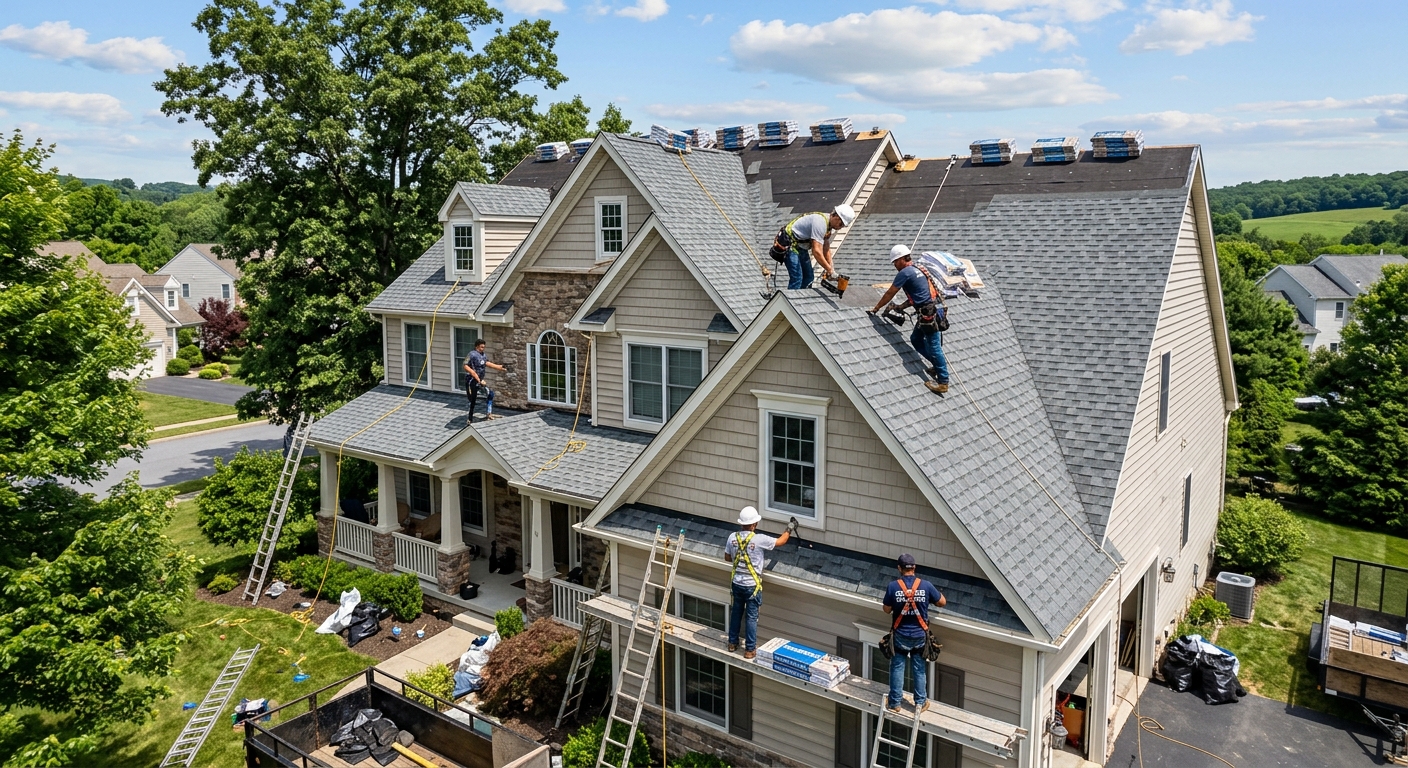
Ephrata roofing prices by material and scope — 2026
In Ephrata, roof replacement estimates reflect the town’s older housing stock and high rate of single-family homes. With 64.6% of houses built before 1980 and over 39% being single-family, many Ephrata roofs have complex needs compared to newer developments. Particularly, steep-pitch roofs with layers of old shingles—common across Lancaster County—require extra labor for tear-off and follow-up repairs, pushing prices above what homeowners might expect in areas with newer homes or simpler rooflines. These older, multi-layered roofs can hide surprises like rotted decking, which must be corrected for the new roof system to last.
Most Ephrata houses still use asphalt shingles due to their affordability and availability, especially with long-standing Amish and Mennonite crews specializing in this material. Metal roofing is less frequent but gaining interest for those planning to stay decades; it carries a higher upfront cost but yields much longer lifespan. Flat roof membranes are needed where a porch, low-slope addition, or old rowhouse section is present. Minor repairs—more common than total replacement, thanks to roofers patching sections—are often sufficient if flashing or a few shingles are the problem. Below, you’ll find local pricing based on 2026 projections for installed systems:
| Material / Scope |
Lifespan |
Best for |
Price range (installed) |
| Asphalt shingles — architectural (30-yr) |
25–30 yrs |
Most Ephrata homes |
$9,100–$19,000 |
| Asphalt shingles — impact-resistant (Class 4) |
30+ yrs |
Storm-prone locations |
$15,000–$19,000 |
| Metal standing seam |
40–70 yrs |
Long-term ownership or historic homes |
$22,000–$39,500 |
| Flat roof — TPO or EPDM |
15–25 yrs |
Low-slope porches, additions |
$11,500–$23,000 |
| Roof repair — leak or isolated section |
n/a |
Targeted shingle or flashing issues |
$475–$1,850 |
Prices are estimates for a typical Ephrata home and vary with roof size, pitch, decking condition and material selection.
Permits and code requirements in Ephrata
For roofing in Ephrata, the Pennsylvania Uniform Construction Code (UCC), based on the International Residential Code (IRC), governs what needs a permit. If your roof replacement involves installing new sheathing or any structural work, you’ll need a building permit—this is enforced by the municipality or, in places that have opted out, by the PA Department of Labor & Industry. Simple repairs, like replacing a few damaged shingles to stop a leak, usually don’t require a permit in Lancaster County townships, including Ephrata, as long as there is no structural work or full-layer removal.
Pennsylvania does not have a trade-specific roofing license, but contractors performing jobs over $500 must have Home Improvement Contractor (HIC) registration through the Pennsylvania Office of Attorney General. You can look this up by contractor name at hic.attorneygeneral.gov. For insurance, employers are required to carry workers’ compensation, which you should verify through the state’s WCAIS system at wcais.pa.gov before any work begins.
Every contract over $500 must be in writing, per the Home Improvement Consumer Protection Act, and you’re entitled to a three business-day right of cancellation. Make sure your contractor respects these requirements—if they push you to sign anything less, that’s a red flag.
Low-slope and flat roofs in Ephrata
Many Ephrata homes have a section of flat or low-slope roof—think rear porch enclosures, kitchen additions, or parts of a rowhouse. These roofs need more than just shingles. On any pitch below about 3/12, shingles can’t shed water quickly enough. Water will linger, seep beneath the tabs, and eventually rot out the decking. In this region, freeze-thaw cycles make ponding even worse by pushing moisture below the surface with every cold snap.
Proper flat roofs here rely on TPO or EPDM membrane systems, which are seamless and tolerate standing water without leaks. Membranes last 15–25 years if installed well, which does mean they usually don’t match the lifespan of a pitched roof. If a roofer suggests standard shingles for a 2/12 pitch—common on back additions—they’re telling you not to trust their standards or experience. Expect to spend from $11,500–$23,000 for a full membrane replacement in Ephrata depending on details like size and the number of penetrations. It’s not money wasted—the alternative is ongoing leaks and damage inside your home.
Decking, ventilation and flashing — the hidden roof costs
A roof quote in Ephrata might look tidy, but it rarely ends up that simple—especially with so many pre-1950 houses. Once the old shingles are stripped, roofers often find rotted or soft decking (the boards under your shingles) where moisture has seeped in from past leaks or poor ventilation. Replacing bad decking can add anywhere from $600–$2,000 to the job, depending on how many boards or sheets need swapping. If your last roofer simply added another shingle layer instead of a full tear-off, lingering rot or mildew is common.
In our south-central Pennsylvania climate, attic ventilation is not optional. Without proper airflow, warm household air meets cold roof sheathing and causes condensation—which, in winter, drives ice damming at the eaves and destroys the lower courses of shingles and decking. Upgrading attic vents or adding a ridge vent typically runs $400–$1,200, but not doing it voids nearly every manufacturer warranty and shortens roof life.
Chimney and wall flashing are also wildcards—new step and counterflashing can add $400–$1,000 per section. Expect to pay a bit more for new vent boots, drip edge, or ridge cap, all of which are vital to prevent moisture entry. If a roofer’s price seems low and these “hidden” items aren’t listed, budget extra or be ready for a surprise invoice. In Ephrata’s older homes, they’re nearly always needed.
What Ephrata's climate does to a roof
Ephrata sits in a stretch of Lancaster County where storm damage patterns differ from neighboring areas. Here, the roofs are more likely to face high winds from Susquehanna River valley thunderstorm bursts than the heavy lake-effect snow that hits areas further north. While our ground snow load (30 psf) is nothing to ignore and the winter design temperature can dip to 12 °F, extended snowpack isn’t the top concern; it’s the sequence of melt, refreeze, and rain that creates trouble.
Along the eaves, poor attic or soffit ventilation lets warm interior air melt the underside of a snow layer while the edge of your roof stays cold. That sends meltwater behind the gutter, then down into the wall, forming an ice dam. Ripples of water damage follow and can leave you with the need for a targeted repair around $475–$1,850, or much more if left unchecked. In true snowbelt counties, builders are more aggressive with ice-and-water underlayment, sometimes running it several feet up the slope; in Ephrata, many older homes have only basic or minimal eave protection due to slightly milder winters and older building practices. If hail hits in a summer storm, it rarely punches through the shingle but commonly creates bruising that knocks granules loose and cuts the roof’s life short—visible only on close inspection. That can hasten a full shingle replacement ($9,100–$19,000) sooner than you’d planned.
The bottom line: Ephrata roofs need tailored protection against repeated wind and water stress, not just snowfall. Expect recurring small repairs unless your underlayment and ventilation are built for our very specific climate pattern.
What insurance covers on a Ephrata roof
If your Ephrata roof suffers storm damage, the first step is documentation—take photos of every area before cleanup or stabilization. Your insurer will want a “scope of loss” describing exactly what’s damaged, ideally written by someone who knows how to match insurance jargon to the reality on your house. In most policies, you’ll be paid on either an actual cash value (ACV) basis, factoring in depreciation for your roof’s age, or full replacement cost if your policy pays out for repairs using new materials. The adjuster’s visit usually sets the payout limit, so have any written contractor quotes or inspection notes ready for review.
Your policy’s deductible will apply, and under Pennsylvania law, it is illegal for a roofer to offer to “waive” or “cover” your deductible as part of their price or as a sales incentive. If someone offers this, walk away; it means breaking both the insurer’s rules and the Home Improvement Consumer Protection Act. Such gimmicks put your claim (and possibly coverage) at risk.
Your contract for repairs must always be in writing for any job over $500, and you get a three-business-day right to cancel, giving you time to read both your insurer’s scope and your roofer’s estimate. If you face a dispute over the insurer’s offer or scope, a second inspection and professional documentation from a reputable Ephrata contractor can help, but don’t pay out of pocket until you have written agreement. Insurance covers leaks or replacement only when linked to a covered “event”—regular wear, or a replacement for age alone, is yours to fund.
Reading the warranty on a Ephrata roof
When a new roof goes up in Ephrata, you actually receive two separate warranties—though most homeowners only hear about one. The manufacturer’s warranty covers defects in the roofing material itself, not how it was installed. Most shingle warranties run prorated: the longer you own the roof, the less compensation you’ll get if something fails, and many require registration within a certain deadline after install. Ventilation problems or layering new shingles over old—both common in Ephrata’s older housing—will void this warranty on the spot.
The workmanship warranty, meanwhile, comes from the contractor. It’s only as good as the company’s stability; a 25-year promise from a two-year-old outfit means nothing if they’re out of business after five. Some work warranties are transferable at resale, but always get the terms in writing. Look closely at what’s excluded (flashing, storm damage, ventilation). If anything is left vague, be cautious—especially in a competitive market like Lancaster County. Solid companies, with years serving Ephrata, usually offer a real 5–10 year guarantee in writing, which matters far more than an empty “lifetime” pitch. When in doubt, ask who pays for re-doing the work if they’re gone.
Frequently asked questions — roofing in Ephrata
Does roof pitch affect the price in Ephrata?
Roof pitch absolutely affects price here, mainly due to the high number of steep-pitch roofs in Ephrata’s older homes. Lancaster County houses often have 9/12 or even steeper slopes, especially those built before 1950 with multiple shingle layers. Higher pitch means added safety requirements (scaffolding, harnessing), extra labor to tear off material and reinstall, and sometimes more waste due to awkward shingle cuts. For a typical architectural shingle replacement, expect a steep, multi-layer roof to land at the upper end of the local price range: about $19,000 for a complex tear-off, compared to $9,100 for a basic single-layer roof. If your roof is walkable and simple, you’ll save substantially; if it’s steep and historic, budget extra. Local Ephrata contractors will often mention pitch and access first in explaining their estimates.
What causes ice dams on Ephrata roofs?
Ice dams in Ephrata are caused by our freeze-thaw winter climate. When attic ventilation is lacking, warm air in your home rises and melts snow on the upper part of your roof while the eaves remain cold. This meltwater backs up and refreezes at the colder edge, forming a dam that prevents drainage. Water pools behind the dam and can seep under shingles, eventually rotting out your decking and attic insulation. With so many older homes and insulation gaps common in Ephrata, this is a persistent problem. Preventing ice dams usually involves upgrading attic vents and, when replacing your roof, adding ice-and-water shield underlayment for several feet above the eaves, which is a small bump in cost compared to the price of a leak repair ($475–$1,850) or full replacement. Local contractors should address these specifics, not just offer “standard” protection.
How do I confirm a roofer carries workers' compensation?
In Pennsylvania, including Ephrata, all roofing contractors with employees are required to have workers’ compensation insurance. You can verify this for any company by checking the state-run Workers’ Compensation Automation and Integration System (WCAIS) at wcais.pa.gov. Don’t just rely on a printed certificate—those can be outdated or changed. Verifying through WCAIS ensures that the coverage is current and legally compliant. If a contractor only has HIC registration but not active coverage, you’ll be responsible for any injuries that occur on your property. This is especially important on larger replacement projects ($9,100–$19,000) where crews may be present several days working at height. Don’t be shy about asking for proof— reputable Ephrata contractors expect the question.
How much does it cost to repair a roof leak in Ephrata?
Roof leak repairs in Ephrata usually cost between $475–$1,850, depending on the nature of the issue. Most leaks here are due to flashing around chimneys, valleys, or old vent boots—especially on older steep roofs typical in Ephrata. Simple shingle replacements on a small area are at the lower end, but large or complex leaks, such as those involving rotten decking or decades-old flashing, can push the price higher. Always ask for photos of the problem before work starts; it’s not unusual for underlying rot or hidden issues to appear only once shingles or flashing are removed. In Ephrata’s older homes, those hidden surprises are more the rule than the exception, so build in some contingency when budgeting repairs.
What underlayment should be used on a Ephrata roof?
For Ephrata roofs, especially those with a history of ice damming or wind-driven rain, underlayment is more than just felt paper. Most reputable contractors will use a synthetic underlayment across the field for durability and better moisture resistance, paired with an ice-and-water shield membrane for the first few feet directly above all eaves and valleys. This guards against water that backs up from ice dams—a frequent winter hazard given our climate’s freeze-thaw cycles. Some older homes in Ephrata, especially those with no or poor eave protection, are prone to leaks if this layer is skimped on. While it’s a small cost compared to the full replacement ($9,100–$19,000), skimping here guarantees trouble. Always confirm underlayment details in your written proposal and ensure the installer follows what’s specified.
What if my insurer denies my roof claim?
If your insurer denies your roof claim in Ephrata, first review their written explanation—often, a denial comes down to a “maintenance” issue rather than sudden damage, or there’s a dispute over the documented cause. Gather all your written estimates, before-and-after photos, and any communications documenting the roof’s pre-event condition. If you still disagree, request a second inspection. A reputable Ephrata roofing contractor can sometimes provide additional documentation or a written opinion clarifying the cause of damage. Remember, Pennsylvania's Home Improvement Consumer Protection Act requires your repair contract to be in writing, and you have a three-day right to cancel. If you have to pay out-of-pocket, know that targeted repairs usually run $475–$1,850 locally. Only escalate to formal appeals or legal action for major losses—minor fixes aren't worth the stress and time.
How can I tell if my roof decking is rotted?
Detecting rotted decking in Ephrata is tough until your roofer removes the shingles. Signs from the attic can include visible staining, sagging boards, or areas where you can push a screwdriver through easily. From the outside, soft roof spots that feel spongy underfoot—or shingles that look wavy and buckled—are red flags. Because most Ephrata houses were built before 1980 and have seen multiple roof layers, they’re more likely to have hidden rot, especially near eaves, valleys, and chimneys. When a roofer quotes your replacement price ($9,100–$19,000), ask how they handle decking surprises. Most contractors explain the per-sheet charge for replacing actual bad wood, but make sure you see the damage (photos or a quick attic look) before agreeing to any “overage” line items.
How do I find a reputable roofer in Ephrata?
Start by checking that any Ephrata roofer you’re considering has a valid Home Improvement Contractor (HIC) registration. Search directly at hic.attorneygeneral.gov—this screens out outright scammers. Ask for references from recent jobs in Ephrata or Lancaster County. Speak with those homeowners, especially if their homes are older and similar to yours. Next, verify workers’ compensation coverage through WCAIS at wcais.pa.gov. Be wary of contractors willing to work without a written contract or who offer to “waive” your insurance deductible (illegal in Pennsylvania). Reputable roofers don’t just bid low—they thoroughly explain products, warranties, and specify what’s covered. For a full replacement ($9,100–$19,000), one or two hours of homework can make the difference between a good experience and a costly lesson.
What is the best time of year to replace a roof in Ephrata?
In Ephrata, the optimal time for roof replacement is typically late spring through early fall, when temperatures are mild and weather is predictable. This timing lets materials like asphalt shingles and membrane adhesives seal properly, reducing risk of installation issues. Summer’s longer daylight gives contractors more working hours per day, shortening the job. Winter installs are sometimes necessary, but colder temperatures and freeze-thaw cycles can make shingle sealing unreliable—localized snow melt and rapid temperature swings are common risks. That said, emergencies happen: if you need urgent storm damage repair ($475–$1,850 for a leak), don't wait. For planned replacements, booking earlier in the season also means better scheduling and, often, attention from the most established crews—not those scrambling to fill winter gaps.