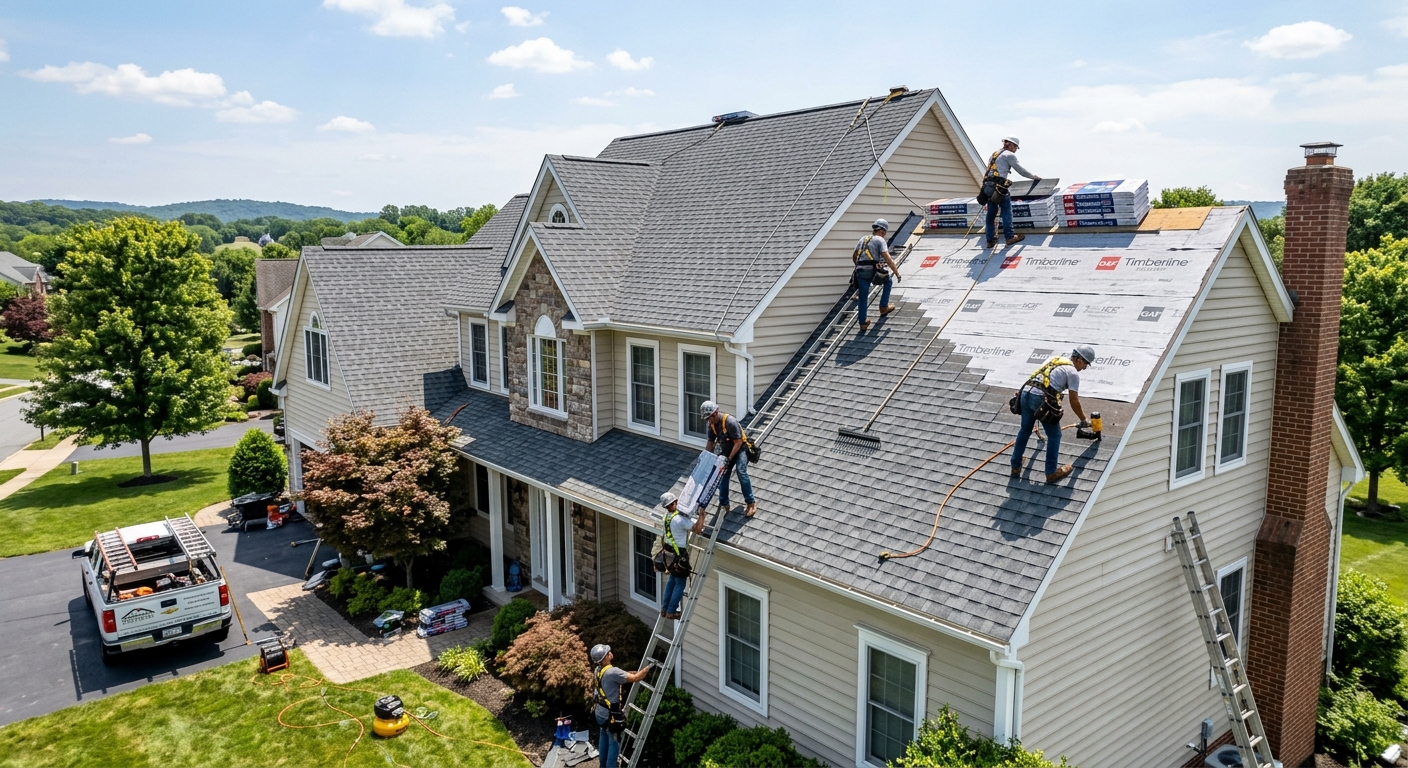
Bethel roofing prices by material and scope — 2026
In Bethel, home roofing projects follow patterns shaped by the local market and neighborhood housing. With an owner occupancy rate of 82.6% and over half of local homes built before 1980 (U.S. Census Bureau, ACS 2024), there’s a strong demand for both re-roofing and modern upgrades. Many Bethel residents are in single-family homes with asphalt shingle roofs—usually not their first, given how Lebanon’s housing stock surged between 1945–1975. That wave of building means homeowners now contend with roofs at or past their second lifecycle, and many still lack modern attic ventilation, making proper upgrades crucial when reroofing.
In Bethel, architectural asphalt shingle roofs are the standard when replacing aging systems, offering 25–30 years of protection if properly installed. Some opt for Class 4 impact-resistant shingles for added storm protection, but most replacements are architectural. Metal standing seam roofs, while more expensive, are gaining traction with those planning to stay put for decades. Flat roofs—rare on homes, more common on additions or porches—are usually TPO or EPDM and have their own pricing tier.
Below is a summary of installed price ranges and lifespans for the typical Bethel roofing job:
| Material / Scope |
Lifespan |
Best for |
Price range (installed) |
| Asphalt shingles — architectural (30-yr) |
25–30 yrs |
Suburban homes, moderate budgets, typical re-roof |
$9,800–$20,500 |
| Asphalt shingles — impact-resistant (Class 4) |
30+ yrs |
Upland exposures, storm-prone locations |
$16,000–$20,500 |
| Metal standing seam |
40–70 yrs |
Owners wanting longest life, minimal maintenance |
$23,500–$42,000 |
| Flat roof — TPO or EPDM |
15–25 yrs |
Low-slope porches, additions, garages |
$12,500–$24,500 |
| Roof repair — leak or isolated section |
n/a |
Small leaks, flashing fixes, single-plane damage |
$500–$1,950 |
Prices are estimates for a typical Bethel home and vary with roof size, pitch, decking condition and material selection.
What a proper Bethel roofing quote contains
When you get a roofing estimate in Bethel, pay close attention to the details. A legitimate quote will state the total roof area measured in “squares” (100 sq ft units) and list the pitch; these details prevent guesswork and make it possible to compare bids. Every quote should itemize the tear-off and disposal of each layer—most Bethel roofs have at least two layers from decades of overlays—so you know if you’re paying for a full removal. Underlayment and ice barrier should name the actual product and coverage area, not just “felt.”
A trustworthy roofer will include an explicit per-sheet contingency price for decking replacement. With Lebanon County’s 1945–1975 housing wave, rotten or thin decking is common and a smart estimate anticipates those possible costs. Flashing at chimneys and vent boots should be called out, not assumed. Warranties should clearly separate the manufacturer’s shingle term from the contractor’s workmanship coverage, so there’s no confusion about who to call if there’s a problem. Lastly, expect a payment schedule with a deposit under 15% and balance on completion; big upfront demands are a red flag.
A quote that just lists a single lump sum, or claims “materials and labor” with no breakdown, isn’t comparable or safe. If you don’t see clear measurement and materials disclosure, you aren’t being told what you’re paying for.
| Line item |
What to look for |
Red flag if… |
| Roof area |
stated in squares, with pitch |
no measurement given |
| Tear-off and disposal |
number of layers, dumpster included |
bundled into one figure |
| Underlayment |
product type and coverage |
listed only as 'felt' |
| Ice and water shield |
coverage height at eaves |
omitted entirely |
| Decking |
per-sheet contingency price |
no allowance at all |
| Warranty |
workmanship years stated separately |
only the shingle warranty |
| Payment |
deposit under 15%, balance on completion |
large upfront cash |
Bethel homes and their roof lines
Most Bethel homes reflect the big housing boom in Lebanon County between 1945 and 1975—a period that produced the majority of the region’s single-family housing stock. Over half the homes here were built before 1980 (U.S. Census Bureau, ACS 2024), so their roof structures are classic: moderate to steep pitch, often with traditional plank or early plywood decking. Many of these homes got their original “tab” shingles swapped for thicker architectural shingles decades ago, with overlays sometimes added rather than full replacements. The odds are good your current roof is at least the second layer—sometimes even the third—on old sheathing from the postwar era.
Ice barrier underlayment was not in code during that original build-out, so roofs from this era can be prone to leaks or ice dam damage near the eaves. Modern replacement jobs nearly always call for at least one sheet of rotted decking replaced and the addition of an ice and water shield, especially along the Bethel ridge lines where winter wind and snow are routine. Flat roofs—found mostly on porches and low-slope additions—tend to have rubber membrane or rolled roofing and are rarely original.
If your home was built after 1980, you’re likely coming up on your first full roof replacement rather than dealing with multiple layers. For these, the structural deck is often OSB or plywood, and underlying water shield is more consistent, but venting and flashing still always deserve a fresh set of eyes.
Why gutters get replaced with the roof
In Bethel, gutters and downspouts work alongside your roof as a single water system. The drip edge at the eaves, gutters, downspout positioning, and ground grading all play a role in moving water well away from your home’s foundation. Skipping gutter replacement when re-roofing means trying to reuse old, dented systems that can leak at seams or pull away from new fascia—jeopardizing both your new shingles and your basement.
With many Bethel homes on full basements or crawlspaces, downspout discharge too close to the house leads directly to foundation seepage and even wet basements. Some roofing manufacturer warranties require proof of proper drainage so the shingle system isn’t blamed for water that actually made its way inside through a bad downspout discharge.
For most asphalt shingle replacement projects in Bethel, expect new seamless aluminum gutters and downspouts (with screens, if you wish) to add $1,950–$3,500 to the job—well worth it to address the whole drainage system while the roofers have scaffolding and ladders up.
Choosing a roofer in Lebanon County
Selecting a roofer in Bethel means more than comparing bottom lines. Start by confirming the contractor’s Home Improvement Contractor (HIC) registration through the Pennsylvania Office of Attorney General (verify at hic.attorneygeneral.gov). For work over $500, a written contract is legally required. Workers’ compensation is also mandatory for any employer and can be checked through the WCAIS system (wcais.pa.gov). Insurance details—including liability and workers’ comp—should be shown before you sign anything.
- Check HIC registration at hic.attorneygeneral.gov
- Verify workers’ compensation insurance at wcais.pa.gov
- Get proof of general liability insurance
- Insist on a written contract outlining all work
- Review the payment schedule—never big cash up front
- Ask about permit responsibility—who files, who pays
- Demand detailed itemization: underlayment, flashings, vent boots
- Get both manufacturer and workmanship warranties in writing
- Request recent local references (in Lebanon County)
- Visit a current site if possible
- Don’t be rushed by “today-only” discounts
- Confirm physical business address within reasonable distance
Red flags in the Bethel market: storm-chasing companies with no local address, very low bids from out-of-area crews, pushy salespeople after wind events, high cash deposits, or refusal to show HIC registration and workers’ comp. These are often seen where the market is only moderately saturated and storm exposure draws crews in from outside the county.
Permits and code requirements in Bethel
In Bethel, roofing work falls under the Pennsylvania Uniform Construction Code (UCC), which is based on the International Residential Code. The Pennsylvania Department of Labor & Industry sets the code, but most Lebanon County municipalities—including those near Bethel—enforce it through their own offices. In the City of Lebanon, you need a building permit if your roof replacement includes new structural decking or any truss work. In the surrounding townships common to the Bethel area, like North Lebanon, small shingle repairs covering less than one square usually do not require a permit.
Pennsylvania requires every contractor taking on work over $500 to hold a Home Improvement Contractor (HIC) registration, which homeowners should verify before signing. Always check a contractor’s registration status using the state’s portal at hic.attorneygeneral.gov. Do not sign a contract or pay a deposit until you review active workers’ compensation coverage, which is mandatory for employers and publicly accessible at wcais.pa.gov.
Consumer protection regulations—Home Improvement Consumer Protection Act—guarantee you a three-day cancellation right on roofing contracts over $500 and prohibit any contractor from waiving your insurance deductible. If your house was built before 1978, federal lead paint regulations apply and certification can be checked at certifiedrenovatorsearch.epa.gov.
What gets discovered after tear-off in Bethel
Once old shingles are stripped off a Bethel roof, it’s common to find issues hidden underneath, especially in homes built during the 1945–1975 boom. First, expect to encounter sections of rotted decking. These can’t be predicted exactly from below; each 4x8 sheet that must be replaced typically adds $150–$350 per sheet to the final bill. If the original roof lacked an ice barrier (as it often did), expect to see water stains at eaves or above porch valleys—these are clear signs an upgrade is due now.
Attic ventilation is a recurring issue. In local winters, poor ventilation lets moisture collect and then freeze, sometimes causing attic frost or ice damming. This can void shingle warranties—and worsen roof lifespan. Adding a continuous ridge vent during replacement usually costs $800–$1,500 but is almost always money well spent if your current system is lacking. Chimney and wall flashings may also reveal prior shortcuts; replacing these correctly can cost $250–$700 per location, but leaving bad flashing is an invitation to leaks. Vent boots—those rubber seals around pipes—often crack after 10–15 years and should cost $90–$225 each replaced.
Always review contingencies in your contract for deck replacement and ventilation. Surprises do cost, but covering them up isn’t a solution—especially in a climate where freeze-thaw cycles and moderate snowfall put Bethel roofs to the test every winter.
Frequently asked questions — roofing in Bethel
How much does a flat roof replacement cost in Bethel?
Flat roof replacements in Bethel—most often for porches, small additions, or low-slope garages—typically use TPO or EPDM rubber membrane. The 2026 price range here is $12,500–$24,500, with most projects for residences coming in closer to $17,500. That price includes a full tear-off, new material, flashing, and proper attachment. Local flat roofs endure harsher freeze-thaw and ponding than in warmer climates, so proper drainage and insulation are worth every penny. Very small or simple porch roofs might be less, while anything with complex edges, skylights, or tied-in walls comes in at the higher end of the range. Always request exact membrane type and warranty details on your quote for a flat roof replacement in Bethel.
What does roof replacement cost per square in Bethel?
The per-square cost in Bethel for a typical asphalt shingle replacement falls between $490–$815 per roofing square (100 sq ft), depending on complexity, tear-off requirements, and number of stories. These prices are drawn directly from the overall job ranges of $9,800–$20,500 for a 20–25-square home. Prices go higher for steep pitches, additional layers needing removal, extra ventilation, or extensive decking replacement. Every quote should list the square footage being priced—if it doesn’t, insist on a measurement before you sign. Per-square pricing on flat or metal jobs is less relevant, as bigger material and flashing costs dominate.
Are storm-chasing roofers a problem in Bethel?
Bethel and greater Lebanon County do experience visiting crews—particularly after wind events that run along the South Mountain or Cornwall upland—who knock doors offering quick roof replacements. While not as crowded a market as Harrisburg, it’s common for storm-focused companies to show up after major storms, offering deals or insurance-related work. Always verify any roofer’s Home Improvement Contractor (HIC) registration at hic.attorneygeneral.gov and insist on a detailed, written contract as required by Pennsylvania law. If a company refuses to supply references or wants a large cash deposit, be wary. Legitimate local companies will clearly spell out warranty coverage, supply insurance, and accept payment after work is done. Rushed quotes with untraceable addresses are a common sign of storm-chasers. Lastly, reputable local roofers rarely have time to knock on doors—they’re busy meeting the steady demand for replacements in a community where most homes have roofs aging past 25–30 years, with a typical replacement cost of $16,000.
How long should a roof last in Bethel?
In Bethel, architectural asphalt shingle roofs—by far the most common choice—are built to last 25–30 years if installed properly and with the right attic ventilation. The local climate puts roofs through repeated freeze-thaw and moderate annual snowfall, so homes lacking enough ventilation or with persistent ice damming might see shortened shingle life. Metal standing seam options will last much longer, often 40–70 years, though at a higher up-front cost of $23,500–$42,000. Always replace failing vent boots, manage attic insulation, and insist on full ice barrier installation when reroofing. Proper care makes it possible to reach or even exceed the rated lifespan for Bethel roofs.
How do I confirm a roofer carries workers' compensation?
Pennsylvania requires every roofing employer to hold active workers’ compensation insurance. You can confirm current coverage for a Bethel roofer by searching the employer name at wcais.pa.gov (the Workers’ Compensation Automation and Integration System). Ask your contractor for their legal business name and enter it to check that status is listed as “active.” Don’t accept a printed certificate alone, as those can be out of date or even forged. Homeowners are exposed to liability if an uninsured worker is injured on their property, so always verify before signing any contract or paying a deposit. If you’re hiring for a job over $500, you’re entitled by the Home Improvement Consumer Protection Act to see all proof of insurance before work begins.
How much snow load can a Bethel roof handle?
Homes in Bethel are built for south-central Pennsylvania’s snow loads, with the local building code requiring roofs to support a ground snow load of 30 pounds per square foot (psf). For homes constructed between 1945 and 1975, that loading standard typically means solid framing and safe support for most winter conditions here. This snow load—in line with Lebanon County’s moderate snowfall—means you generally do not need to worry about routine storms overloading a code-compliant roof. If your roof is showing signs of sag, chronic leaks, or you know decking has repeatedly been patched, it may be time to replace it, in which case an architectural shingle replacement will average $9,800–$20,500. Regular gutter and roof maintenance are the best ways to keep that load from creating issues.
Can a contractor cover my insurance deductible in Pennsylvania?
No—under Pennsylvania law, it is prohibited for a contractor to waive or “cover” your homeowners insurance deductible for a roof claim. The Home Improvement Consumer Protection Act (HICPA) makes it clear that you as the policyholder must pay your deductible out-of-pocket. If a roofer offers to “eat your deductible,” it’s a sure sign they’re not following legal requirements and likely cutting other corners as well. This applies in Bethel just as anywhere else in the state. If you get a quote for roof repair or replacement—anywhere from $500 for a small patch up to $20,500 for full replacement—the amount your insurance covers comes directly off your claim, but your deductible portion is your own responsibility.
What happens if rotted decking is found after tear-off?
In Bethel, discovering rotted roof decking after tear-off is common, especially in homes built before 1980 where the original plank or thin plywood may have seen decades of leaks or condensation. If it happens, your contractor should pause and show you the affected areas. A good contract will spell out a per-sheet charge—usually $150–$350—for any new plywood needed. Don’t be alarmed: local roofers are used to these contingencies and keep extra sheets on hand. If too much is discovered, the scope may need to be updated and, if your home is in the City of Lebanon, a revised permit might be needed if structural trusses are involved. Always make sure your proposal itemizes this per-sheet price, so there are no big surprises on the final bill.
Do metal roofs shed snow better in Bethel?
Yes, metal standing seam roofs are well suited to Bethel’s moderate snowfall and regular freeze-thaw cycles. Their smooth, slick surface helps snow slide off faster and resists ice damming much more effectively than older asphalt shingle roofs. Homeowners along the South Mountain ridge especially benefit from the quick snow-shedding—reducing weight on the structure and lowering the risk of leaks from melting and refreezing. Metal roofs are a bigger up-front investment ($23,500–$42,000), but provide outstanding weather protection and longevity. If ice buildup or snow loading has been a constant worry, especially on north-facing slopes or low-pitch sections, considering a metal upgrade is a smart long-term decision in Bethel.