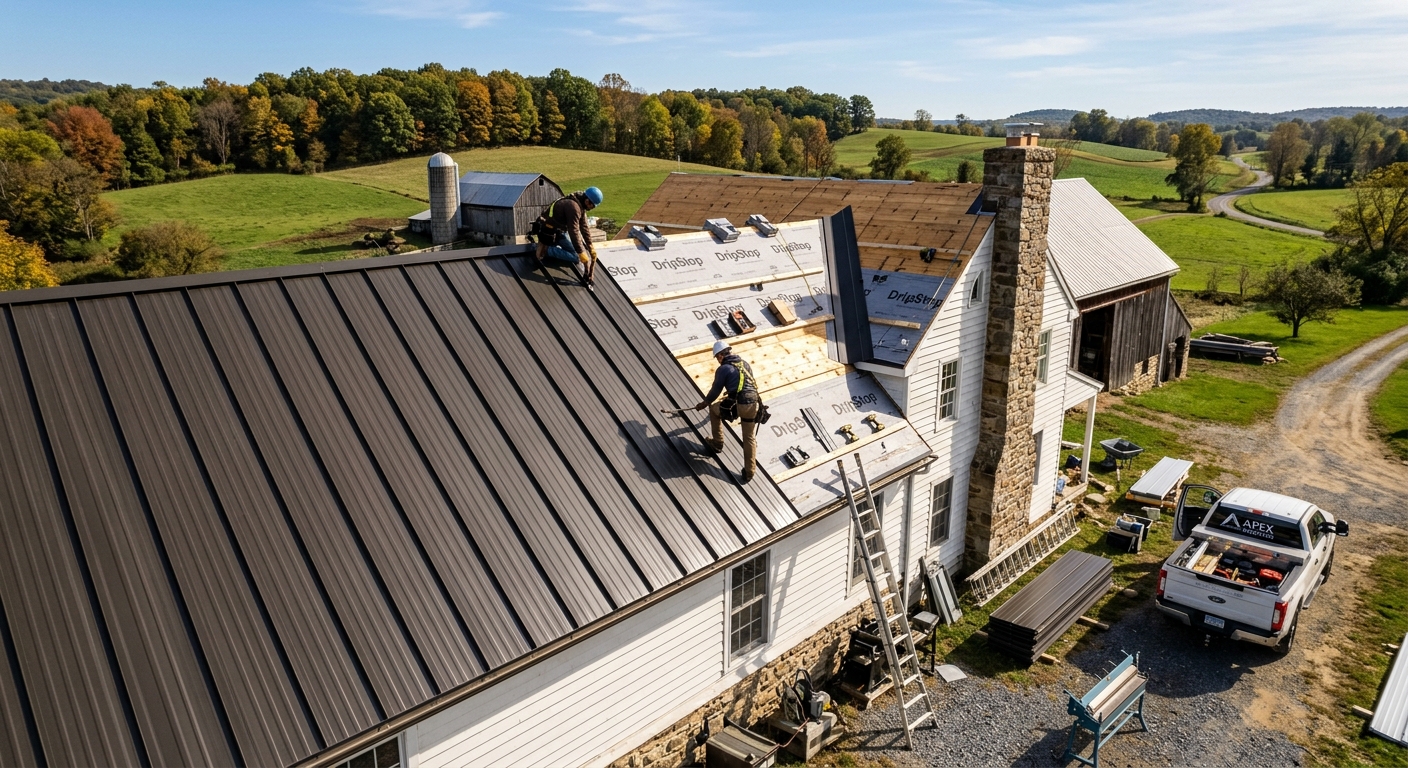
Roofing Replacement & Repair costs in Monroe — 2026
Monroe homeowners face a roofing market shaped by local conditions, from the layout of our neighborhoods to the makeup of our homes. With an 86.0% homeownership rate and the majority of houses being single-family—facts you won’t find everywhere else—there’s a strong demand for reliable roofing services tailored to well-kept, owner-occupied properties. Many Monroe roofs were built before 1980 (U.S. Census Bureau, ACS 2024), which means roofs here are at or past their original life expectancy and are often on their second or even third replacement cycle.
Post‑1950 suburban tracts, especially near Hampden and Silver Spring Townships, have led to a repetitive cycle of asphalt shingle replacements every two to three decades. This cycle hits Monroe directly, because subdivisions from that era dominate our local housing—expect to see a rush of replacement jobs as those 1990s and early 2000s roofs age out.
Here’s what Monroe homeowners can expect for 2026 roofing replacement and repair costs:
| Material / Scope |
Lifespan |
Best for |
Price range (installed) |
| Asphalt shingles — architectural (30-yr) |
25–30 yrs |
Most Monroe subdivisions |
$10,000–$21,500 |
| Asphalt shingles — impact-resistant (Class 4) |
30+ yrs |
Ridge-line homes exposed to wind/hail |
$16,500–$21,500 |
| Metal standing seam |
40–70 yrs |
Farmhouses, long-term investment |
$24,500–$44,000 |
| Flat roof — TPO or EPDM |
15–25 yrs |
Low-slope ranches, porches, additions |
$13,000–$25,500 |
| Roof repair — leak or isolated section |
n/a |
Small leaks or single patch |
$550–$2,000 |
Prices are estimates for a typical Monroe home and vary with roof size, pitch, decking condition and material selection.
Patching vs full replacement in Monroe
In Monroe, deciding between roof repair and full replacement is not about playing it safe—it’s about age, leak history, and getting out ahead of compounding costs. Many houses here have roofs approaching or passing that 20–25 year mark, especially in older tracts. If your asphalt shingles are under 15 years old and you find one isolated leak, a repair is a sound investment. But if your roof is 20 or 25 years old and new leaks are popping up every few years, nickel-and-dime repairs quickly add up. Three repairs at $1,300 each total $3,900, closing in on the cost of a new roof—without solving the underlying wear.
Post‑1950 tracts mean cyclical replacement. If your house is on its second roof, don’t throw good money after bad if you’re near the expected lifespan. On exposed ridges, especially with repeated storm history, replacement can mean the difference between a dry living room and thousands in water damage. Here’s what makes sense for Monroe:
| Situation |
Recommendation |
Typical cost |
Reasoning |
| Under 15 years, one isolated leak |
Repair |
$550–$2,000 |
Early failure unlikely, patch extends life |
| 15–25 years, several leak points |
Replace |
$10,000–$21,500 |
Old roof, system past prime, repeated repairs wasteful |
| 25+ years, any active leak |
Replace now |
$10,000–$21,500 |
Entire roof system is spent—no repair will last |
| Storm damage, wind or hail |
Document, claim, replace |
$10,000–$21,500 |
Insurance will not pay for patches if damage is widespread |
| Flat roof ponding or blistering |
Replace membrane |
$13,000–$25,500 |
Underlying issues signal system failure |
| Active leak entering winter |
Emergency repair, schedule replacement |
$550–$2,000 |
Stabilize now, plan replacement before spring thaw |
What Monroe's climate does to a roof
Roofs in Monroe take a beating you don’t see everywhere in south-central PA. Our ridge-line winds in the Cumberland Valley funneled straight across farmsteads and exposed subdivisions regularly lift or bend shingles—especially on the north and west slopes. That’s a recipe for missing tabs and wind-driven leaks that a sheltered lot down the valley simply wouldn’t encounter.
Our ground snow load is 30 psf, meaning eaves see both the weight and the melting cycle that leads to ice dams. Freeze-thaw cycling is pronounced: as warm air in the attic melts the underside of the roof snow, that water runs to the colder eave where it refreezes. Repeated cycles cause water to back up under shingles, exposing decking and causing rot—that’s where a leaky spot can require a full new roof, running $10,000–$21,500 instead of a $1,300 repair.
Moderate snowfall doesn’t mean low impact in Monroe. Ice and water shield is nonnegotiable up to at least 24 inches above the outside wall line, or you’re gambling with every January thaw. Hail doesn’t often puncture our shingles outright, but even moderate storms will bruise the shingle mat, weakening the integrity. Damage can be almost invisible, but two years later, granular loss shows up as leaks. Spotting and documenting these after a storm can mean the difference between a covered claim and footing the full bill.
How to compare roofing quotes in Monroe
The right estimate lets you compare apples to apples—and prevents nasty surprises halfway through your Monroe reroof. Every proposal should spell out total roof area in “squares” (100 sq ft units), including the pitch, as steeper roofs require more material and labor. Tear-off and disposal of old shingles—especially if you have two or more layers—should be detailed by layer, with a dumpster specifically included. Underlayment and ice barrier must be named by product and coverage; “30-lb felt” tells you nothing about ice or water protection.
Decking replacement, especially common in Monroe’s older housing stock with possible plank decks or delaminated plywood, needs a per-sheet price—otherwise you’re on the hook for open-ended “extras.” Roof vent boots and flashing (at chimneys and walls) should be named outright. Review the warranty for years of workmanship versus manufacturer guarantee—and insist the payment schedule keeps your deposit under control. If you get a lump sum with no measurements, it’s not a quote, it’s a guess.
| Line item |
What to look for |
Red flag if… |
| Roof area |
stated in squares, with pitch |
no measurement given |
| Tear-off and disposal |
number of layers, dumpster included |
bundled into one figure |
| Underlayment |
product type and coverage |
listed only as 'felt' |
| Ice and water shield |
coverage height at eaves |
omitted entirely |
| Decking |
per-sheet contingency price |
no allowance at all |
| Warranty |
workmanship years stated separately |
only the shingle warranty |
| Payment |
deposit under 15%, balance on completion |
large upfront cash |
Monroe homes and their roof lines
Monroe roofs reflect the township’s growth: subdivisions built after 1950 dominate, with the census showing 56.8% of homes built before 1980. Roof pitches are typically moderate, running from 5/12 to 8/12, since most are ranches or two-story colonials from the suburban boom. Most roofs have plywood or early OSB decking, not older spaced planks, but it’s not rare to find plank decks on properties at the edge of the township or converted farmhouses.
Ice barrier (ice and water shield) wasn’t mandatory in code until the 1990s, so houses from the 1970s and 1980s may have paper or minimal eave protection—these are the lawns with icicles and the attics with suspect mold patches. Multiple shingle layers are less common here, as standard practice in Cumberland County was to tear off, but it’s wise to verify during quoting. For most Monroe homeowners, you’re either at your first main replacement (if the house was built in the late 90s or early 2000s), or facing the second cycle if your place is older. That means a different calculus than a city rowhome: you’re fighting sun, wind, and material age, not century-old rot.
Water management on a Monroe roof
A roof in Monroe works as a system—ignore gutters and drainage at your wallet’s peril. When you replace your roof but skip the aged or undersized gutters, you’re setting yourself up to revisit water issues at the foundation or in the basement. Proper downspout discharge is critical. If water dumps within a foot or two of your foundation, Monroe’s clay soils make for soggy basements and wrecked landscaping. That’s why roofing warranties here may require demonstration of adequate guttering and positive grading away from the house, especially for warranty coverage on leak claims.
Replacing standard aluminum gutters alongside a new roof adds $2,200–$4,400 for most Monroe homes, including downspouts and leaders sized for our roof areas. Gutter guards, while optional, cut out the need for risky ladder work, especially as mature trees are common in older subdivisions. Don’t let a “roof only” bid fool you—water management costs a bit extra up front, but pays off in a dry basement and a roof system that actually lasts.
Permits and code requirements in Monroe
Roofing in Monroe must follow the Pennsylvania Uniform Construction Code (UCC), which is based on the International Residential Code and enforced locally by the municipality or, if the township opted out, by the PA Department of Labor & Industry. In practical terms, a full roof replacement generally requires a building permit, while minor repairs like a few shingle swaps do not—but always confirm with your township.
Any roofing contract over $500 must be with a contractor registered as a Home Improvement Contractor (HIC) through the Pennsylvania Office of Attorney General. You can verify registration using the HIC registry at hic.attorneygeneral.gov. Workers’ compensation coverage is mandatory for all employers, and you should check a contractor’s current status yourself at WCAIS (wcais.pa.gov) before signing. The Home Improvement Consumer Protection Act mandates a written contract and gives you a three business-day right to cancel. If your home was built before 1978, the federal EPA Lead RRP Rule applies—verify your contractor at certifiedrenovatorsearch.epa.gov.
There’s no roofing trade license in Pennsylvania beyond the HIC registration, and no countywide board. If someone tries to sell you on a “special” state roofing license, they’re stretching the truth.
Frequently asked questions — roofing in Monroe
How much deposit should I pay a roofer upfront?
In Monroe and the rest of Pennsylvania, the rule under the Home Improvement Consumer Protection Act is straightforward: for jobs over $500, your deposit should never exceed one-third of the contract price or the value of materials needed to start—whichever is less. On a typical architectural shingle replacement of $16,500, you should not pay more than about $5,500 upfront, but best practice is to keep your deposit under 15% if the contractor agrees. Most reputable local firms only require enough to secure materials, not a massive prepayment. Balance is due when the job's complete and you've had a chance to inspect. If someone demands half or all up front, that's a red flag—especially with so many contractors operating in our saturated Harrisburg–Carlisle market.
How much snow load can a Monroe roof handle?
For Monroe, building codes require roofs to support a ground snow load of 30 pounds per square foot (psf). Most homes built after 1950 in our township—especially with well-built truss systems—are designed for this, but older, pre-1980 homes may only meet former standards. This snow load supports typical local storms, but ice dams and drifting can put extra weight on eaves and valleys. If you have concerns about how your roof was framed, modern replacements with architectural shingles (in the $10,000–$21,500 range) can be an opportunity to check and reinforce load-bearing details. Don’t ignore significant new sags or creaks—those are cues to have a pro look before disaster.
Can I install new shingles over old ones in Pennsylvania?
Pennsylvania code allows a single layer of new asphalt shingles over an existing one, but not if the roof already has two or more layers. In Monroe, most homes from the last seventy years are torn-off and reroofed, mainly because this township’s older decks may not support the weight or show hidden rot. Laying over old shingles can save $1,500–$2,200 in tear-off and disposal, but you lose the chance to address damaged decking, needed ice barrier, and improve ventilation. Any respectable local contractor should explain these trade-offs and confirm your roof’s eligibility before quoting a price. Townships here still require you to meet current code, including ventilation and underlayment—we’re not the wild west.
What's the cheapest way to replace a roof in Monroe?
The lowest total outlay for a full roof replacement in Monroe is to use architectural asphalt shingles, single-layer, during the offseason (late fall), with minimal deck repairs. This approach means your job could land close to $10,000 if your roof is straightforward and decking is solid. You can further trim cost by selecting standard (non-impact resistant) shingles and handling site cleanup yourself. But shortcuts—like skipping ice barrier or skimping on flashing—will only cost more in repairs later. Ask for clear measurements and product types in writing; ambiguous quotes are common when chasing the rock-bottom bid. Remember, the cheapest job often isn’t the best value if you’re still in for another $1,300 repair two years later.
What if my insurer denies my roof claim?
If your Monroe roof suffers from storm or wind damage and your insurer denies the claim, start by requesting a written explanation for the denial and reviewing your policy’s exclusions. Many denials stem from “wear and tear” exclusions or ambiguous photo documentation. If you believe the damage should be covered—for example, if recent storms align with missing shingles documented by a contractor—consider hiring a public adjuster for guidance or ask your local contractor for additional documentation and photos. While some homeowners try patching for $550–$2,000, extensive damage almost always means replacement is a better investment. In the saturated Carlisle market, re-quoting and pressing your claim with the right paperwork can sometimes result in reversal. Don’t let rejection force an unsafe rooftop band-aid.
How long does a roof replacement take in Monroe?
For the majority of Monroe’s single-family homes, a complete architectural shingle replacement takes two to three days of active work, assuming weather cooperates and no major decking surprises. Add a day if your structure is especially steep, complex, or if heavy rot is found that requires replacement sheets (at a contingency rate typically included in your quote). Metal standing seam jobs may stretch to a week due to custom fabrication and longer setup. Plan for possible delays around spring rains or if your township inspector is swamped—Monroe and other Cumberland County towns still require compliance checks. Fast-track jobs, often promised with lowest bids, can shortchange underlayment or flashing. To avoid callbacks or leaks, don’t push for rushed work on a $16,500 job.
What are the signs of hail damage on a roof?
Hail is sneaky in Monroe because most local storms throw mid-sized hail that bruises but rarely punctures. Signs of hail damage include pitted or soft spots on shingles, random granule loss (not just at the eaves or valleys), and faint, dark marks where the mat’s exposed. After a wind-driven storm across the Cumberland Valley ridges, check for new spots that look bare or “battered,” as well as dented gutters and downspouts. Even if your shingles don’t show holes, bruised mat weakens fast—what looks cosmetic in April can translate to full leaks by the next spring with costs up to $2,000 for necessary spot repairs, or effectively require a total reroof to restore coverage. Always document with photos and ask your contractor to inspect thoroughly following hail.
What is the difference between TPO and EPDM?
TPO and EPDM are both membrane materials used for Monroe's flat or low-slope roofs—like additions, porches, and some ranches. TPO (thermoplastic polyolefin) is white, reflecting heat and improving energy performance, popular on newer builds. EPDM (ethylene propylene diene monomer) is black, rubbery, tried-and-true, and often used on older homes or when price is the main factor. TPO seams are heat-welded for a watertight bond; EPDM seams use adhesives or tape. In Monroe, both perform well for 15–25 years, depending on weather and installation, with full membrane replacement costs ranging $13,000–$25,500 for typical residential sizes. Choice comes down to roof design, energy priorities, and sometimes the installer’s experience.
Why is my Monroe roofing quote higher than the online average?
Monroe’s roof replacement prices sometimes seem steep compared to generic internet estimates, but those numbers rarely account for our suburban lot sizes, roof pitches, and the Cumberland Valley’s labor rates. Homes here—especially post‑1950 subdivisions—often have larger, multifaceted roofs than city rowhouses or mobile homes. Material quality and code-required ice and water shield, plus full tear-off (not just overlays), bump up the cost. A typical Monroe replacement lands between $10,000–$21,500 because it includes reliable disposal, attic ventilation, and decking contingency for older plywood or OSB—all less common in national averages. Add township permit fees and the need to work around local wind exposures, and your “real life” price reflects the genuine costs for lasting work in our surroundings.