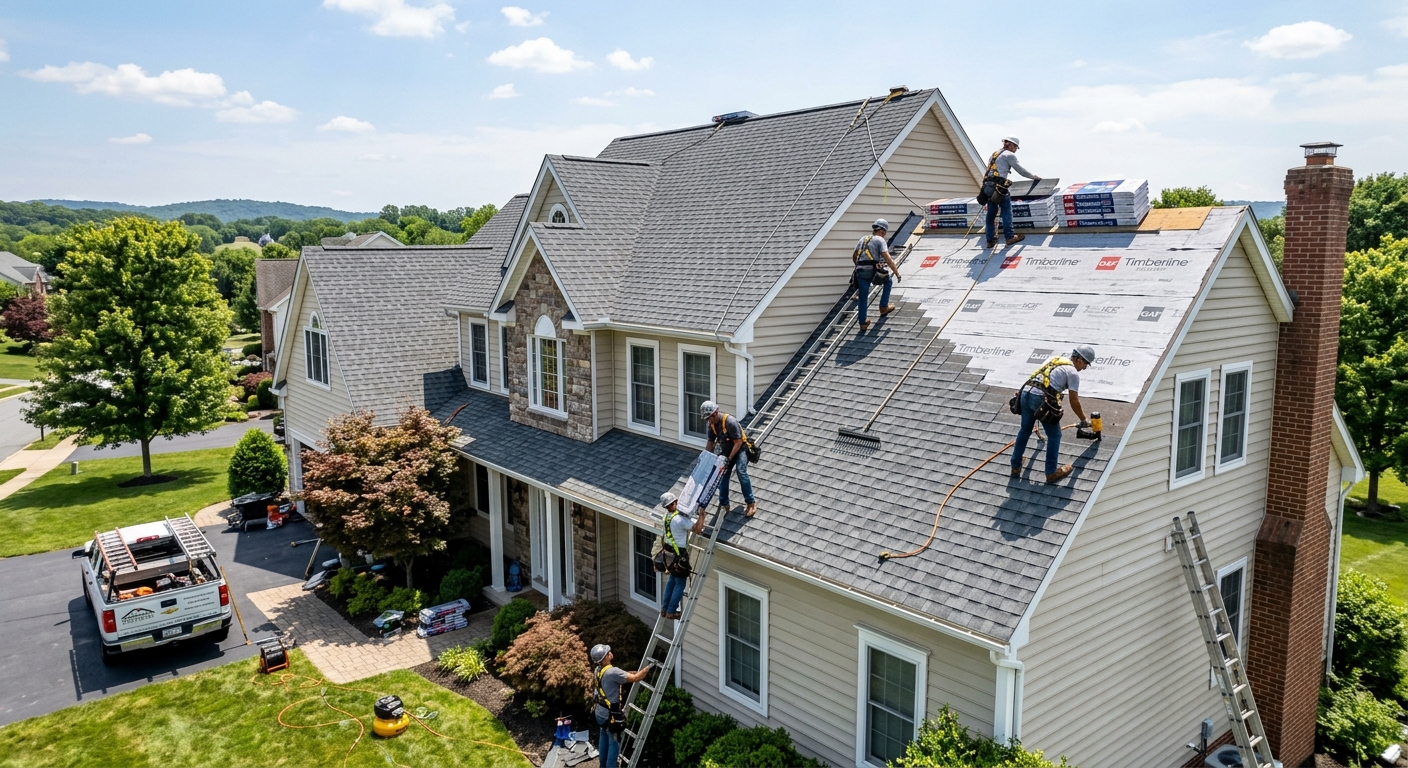
Conshohocken roofing prices by material and scope — 2026
In Conshohocken, homeowners considering a roof replacement or repair are operating in one of southeastern Pennsylvania’s most competitive roofing markets, influenced by proximity to the Philadelphia area and the overall affluence of the region (median household income sits at $114,523, U.S. Census Bureau, ACS 2024). With just 15% of local residences classed as single-family homes, much of the work here involves low- to medium-pitch roofs on homeowner-occupied properties built before 1980. That aging housing stock, plus the mix of post-war neighborhoods in nearby Abington and Cheltenham, means there’s steady need for full asphalt shingle replacements instead of just spot repairs.
Post‑World War II tract developments in surrounding townships have directly shaped the Conshohocken roof market: most roofs are broad, simple gables or hips covered in architectural asphalt shingles. Now, as these original roofs and their first replacements hit the end of their service lives, jobs here tend to involve a full tear-off rather than patching—a direct contrast to center city rowhomes or new subdivisions. That pushes project sizes into the 2,000–2,800 square foot range and ensures most quotes fall into full-system replacement pricing.
| Material / Scope |
Lifespan |
Best for |
Price range (installed) |
| Asphalt shingles — architectural (30-yr) |
25–30 yrs |
Most Conshohocken single-family homes |
$10,500–$22,500 |
| Asphalt shingles — impact-resistant (Class 4) |
30+ yrs |
Areas prone to storm debris or HOA requirements |
$17,500–$22,500 |
| Metal standing seam |
40–70 yrs |
High-value homes & long-term owners |
$25,500–$46,000 |
| Flat roof — TPO or EPDM |
15–25 yrs |
Garage roofs & small multifamily buildings |
$13,500–$27,000 |
| Roof repair — leak or isolated section |
n/a |
Patching or limited replacement |
$550–$2,100 |
Prices are estimates for a typical Conshohocken home and vary with roof size, pitch, decking condition and material selection.
Roofing permits in Conshohocken: what you need before work starts
Roofing work in Conshohocken falls under the Pennsylvania Uniform Construction Code (UCC), based on the International Residential Code. Local municipalities enforce the code, unless they've opted out and delegated to the PA Department of Labor & Industry. In Norristown, replacing more than 25% of a roof usually requires a building permit. For homeowners in the rest of Montgomery County, each township operates its own code enforcement—always confirm with your local office before starting work. Minor shingle repairs under one square (roughly a 10' x 10' area) in Lower Merion Township, for example, may not require a permit.
For any roofing contract over $500, Pennsylvania requires your contractor to have a Home Improvement Contractor (HIC) registration, issued by the Office of Attorney General. You can verify the HIC at hic.attorneygeneral.gov, and do not sign anything until you have checked that number. Every employer must also carry workers’ compensation by law. You can look up workers' comp coverage in the WCAIS system (wcais.pa.gov) using the contractor's business name. Roofing contractors in this state do not hold a specific trade license, but HIC registration and proof of active coverage are non-negotiable. If your contractor can't provide both, find another.
If your home was built before 1978, federal EPA Lead RRP rules may also apply—ask to see your contractor’s EPA lead safe certification if paint will be disturbed.
Roofing warranties in Conshohocken: what's actually covered
Conshohocken homeowners receive two separate warranties during a roof replacement: a manufacturer warranty on the roofing material itself, and a workmanship warranty (or labor warranty) from the contractor who installs it. This distinction matters—many people assume “lifetime warranty" means every future roof problem is covered, but that is almost never the case.
The manufacturer warranty is usually a limited, prorated policy that covers defects in the shingles or panels—not improper installation or normal wear. Some architectural shingles provide up to 30 years of coverage, but poor attic ventilation or installing over old shingles can void these terms. These warranties often require timely registration after installation, and only sometimes transfer once at resale—check the details if you plan to sell. Metal roofing typically offers 30–50 years of limited coverage, also with restrictions.
The contractor’s workmanship warranty covers the installation methods—flashing details, fastener placement, etc. This coverage is only as reliable as the company’s longevity: a 25-year workmanship warranty from a two-year-old business is frankly less valuable than a 10-year warranty from a company with documented history and positive references. Always ask for warranty paperwork and confirm what's covered, for how long, and under what conditions you’ll make a claim.
What gets discovered after tear-off in Conshohocken
Even on a well-inspected Conshohocken home, surprises beneath the shingles can bump your final invoice past the initial quote. With so much of the town’s housing stock built before 1980, it’s common to uncover rotted or delaminated wood sheathing, which must be replaced to meet code and ensure shingle warranties remain valid. Replacing a 4x8 sheet of plywood will run $120–$180 per sheet, and most jobs uncover two to five sheets needing replacement.
Attic ventilation is another silent culprit in this climate. Inadequate venting contributes to winter ice dams and summer heat buildup, risking shingle failure and voided manufacturer coverage. Adding a ridge vent and new soffit vents can add $400–$1,000 depending on roof size. Chimney and wall flashings are typically reused only if pristine; new step and counter flashing costs $450–$1,200 for labor and materials, but is crucial for long-term leak resistance given Montgomery County’s humid summers and freeze-thaw cycles.
Other common add-ons: vent boots (replace at $70–$150 each) and new drip edge along the eaves ($3–$6 per linear foot). Most homeowners should budget at least $700–$1,500 in contingency funds for these possible discoveries. A transparent contractor will list these items in the original quote as "per unit installed" charges, with clear pricing before work starts.
What Conshohocken's climate does to a roof
Conshohocken sits close to the Schuylkill River valley, which means its roofs take more thunderstorm wind than the average Montgomery County town. That added wind exposure pushes flashings and ridge caps harder—one loose fastener can let in water and turn into a leak. Homeowners sometimes see shingle bruising from wind-thrown debris or hail, which doesn't always punch holes but can crush shingle mat and lower its lifespan. This can trigger the need for isolated repairs that average $1,350—not just a cosmetic concern.
The region’s ground snow load of 30 pounds per square foot isn’t punishing, but is enough to cause ice damming at the eaves if your attic isn’t properly insulated and vented. In this moderate freeze-thaw environment, a warm roof edge allows snowmelt to run down and refreeze at the gutter, forming ice dams that push water up under shingles. This isn’t just a theoretical risk: it can force premature replacement (full shingle roof at $10,500–$22,500) or lead to interior damage if left unchecked. Counties further north spec heavier ice and water shield underlayment, but here you’re likely to see a standard 3–6 foot width installed along the eaves as a minimum.
Summers are humid, accelerating algae growth and black streaking on shingles. That’s mainly a cosmetic issue, but over time, high moisture levels in the attic shorten roof life and can void warranties. Montgomery County’s 14°F winter design temperature and 4,800 heating degree days further justify the use of high-quality underlayment and attention to ridge venting, since moisture and freeze-thaw cycles drive most local roof failures.
Conshohocken homes and their roof lines
Conshohocken’s homes reflect Montgomery County’s waves of building: the majority were erected before 1980 (61.1% per U.S. Census Bureau, ACS 2024), with post‑war development in Abington and Cheltenham towns shaping the region’s suburban identity. Roofs here tend to be medium-pitch (4:12 to 7:12), wide, and simple—classic gable or hip structures common to one- and two-story detached homes or semi-attached twins. Decking on pre-1965 homes is usually 1x6 or 1x8 plank, sometimes with old knots or rot; post‑war and 1970s homes often use plywood, which can delaminate but is more uniform for re-roofing work.
Most of these roofs were installed without modern ice barrier, as that wasn’t code-mandated in southeastern Pennsylvania until decades later. Don’t be surprised to find two layers of shingles—many homes were "resurfaced" in the 1990s or early 2000s without full tear-off. Today, local code requires removing old layers down to the decking, so be wary of a quote that suggests layering new over old as a shortcut.
If your house dates from the late 1990s or 2000s, you’re probably facing its first full replacement now, which means decking is more likely to be OSB, and you may have at least some basic ice barrier at the eaves—but careful inspection is still warranted. Each era comes with its own quirks, but most Conshohocken roof replacements are first or second cycle jobs with original roof geometry intact.
What a proper Conshohocken roofing quote contains
Reading a roofing quote in Conshohocken means looking past the bottom line. Reliable estimates always break out the roof area in squares (100 sq. ft. units), state the pitch (steepness) of your roof, and specify the number of shingle layers to be torn off and disposed of. Disposal fees should be itemized (not “included”), since access and haul-away costs can run higher here than elsewhere.
Material line items must include the brand and grade of underlayment, plus the width and length of ice barrier being installed at the eaves—especially important for meeting current building code in Montgomery County. Decking replacement should be quoted per sheet of plywood or OSB, not a guess for “minor repairs.” Flashing at all critical intersections (walls, chimneys) and boot replacements for any roof penetrations must be clear line items, not just “miscellaneous.”
Your quote should state both the manufacturer’s material warranty and the contractor’s workmanship warranty, as separate numbers. Any payment schedule that calls for more than 15% upfront can be a red flag. If you see a one-line lump sum for the whole project, with no size or scope noted, you can’t compare apples to apples—and that’s the point. Insist on a detailed scope.
| Line item |
What to look for |
Red flag if… |
| Roof area |
stated in squares, with pitch |
no measurement given |
| Tear-off and disposal |
number of layers, dumpster included |
bundled into one figure |
| Underlayment |
product type and coverage |
listed only as 'felt' |
| Ice and water shield |
coverage height at eaves |
omitted entirely |
| Decking |
per-sheet contingency price |
no allowance at all |
| Warranty |
workmanship years stated separately |
only the shingle warranty |
| Payment |
deposit under 15%, balance on completion |
large upfront cash |
Frequently asked questions — roofing in Conshohocken
Does attic ventilation matter in Conshohocken's climate?
Attic ventilation is critical for Conshohocken homes, especially with the area’s humid summers and moderate freeze-thaw winters. Without proper intake and exhaust vents, heat and moisture build up in your attic—leading not just to comfort issues, but to actual roof damage. In winter, poor ventilation traps warmth at the eaves, causing snow to melt and re-freeze at the gutters. This drives up the risk of ice dams, which can push water under shingles and lead to leaks costing $550–$2,100 to repair. During the summer, excessive attic heat cooks shingles and shortens their lifespan. When you replace your roof, a good contractor will inspect your vents and recommend upgrades if needed—often adding a continuous ridge vent and soffit vents to bring your attic inline with modern code for Montgomery County. Proper venting can extend your roof’s life and keep your manufacturer warranty valid.
Can I inspect my own roof safely?
While it’s legal for Conshohocken homeowners to check their own roof, be realistic about risk. Many local homes have a moderate pitch that feels safe from the ground but can be hazardous, especially with aging shingles or damp mornings. Instead, use binoculars or a phone camera on a pole to check for missing shingles, granule loss, or rusted flashing around chimneys and vent stacks. If you see signs of trouble, hiring a professional for a leak diagnosis (typically $550–$2,100) is safer and more thorough. A reputable contractor will photograph trouble spots and can explain if it’s a roofing issue or another concern. Never walk on a wet or frozen roof—Conshohocken’s climate means slick spots can appear anytime from October through April.
What happens if rotted decking is found after tear-off?
If your contractor discovers rotted wood sheathing during a roof replacement in Conshohocken, building code requires replacing it before shingles go down. This often happens with pre-1980 homes due to decades of leaks or condensation. The typical cost per sheet of replacement plywood ranges from $120–$180, and an average home uncovers 2–5 bad sheets. Replacing the decking on the spot ensures your new shingles lay flat and remain under warranty. A good estimate will spell this out as a per-sheet “contingency,” so there are no surprises. Insist on before-and-after photos and an updated contract total when wood repairs are needed—this is standard practice under the Home Improvement Consumer Protection Act, and protects you against surprise bills.
What's the cheapest way to replace a roof in Conshohocken?
The lowest legal price for a full shingle replacement in Conshohocken is with 3-tab asphalt—but due to local building standards and HOA requirements, nearly all jobs now use architectural (dimensional) shingles. Expect a range of $10,500–$22,500 for a typical home. Skipping a tear-off to install new shingles over old is generally forbidden by code today, and only saves money upfront at the expense of future resale value and warranty coverage. If your budget is tight, get three detailed quotes and ask about off-season scheduling, which sometimes lowers labor costs. Do not cut corners on underlayment or skip necessary flashing; those short-term "savings" almost always cost more later. In Conshohocken, the cheapest legitimate job will still include code-mandated tear-off, underlayment, and new drip edge at the eaves.
What should a roofing quote include in Conshohocken?
A proper roofing quote in Conshohocken will break down the roof area in squares (10x10-foot increments), specify roof pitch, and list the number of old layers slated for removal. It should detail underlayment and ice barrier types, flashing locations, and include a per-sheet price for unexpected wood decking replacement—often $120–$180 per sheet. Manufacturer and workmanship warranties should be stated separately with exact durations. Always check for a payment schedule that requires no more than 15% upfront, with the balance due only after satisfactory completion. If the estimate provides only a lump-sum total or says “standard materials” without listing brands or thicknesses, that’s a warning sign you might not get what you expect. Montgomery County’s roofing market is competitive, so clear and detailed scopes put you in control.
Can a contractor cover my insurance deductible in Pennsylvania?
No, Pennsylvania law prohibits roofing contractors from waiving, rebating, or “covering” your homeowner’s insurance deductible for storm claims or any other roof work. This is outlined in the Home Improvement Consumer Protection Act, which every local contractor must follow for contracts above $500. If a contractor offers to handle your deductible—often as a sales tactic—know that this is illegal in Conshohocken and can void your insurance policy. At best, you risk cancelled claims; at worst, you’re party to insurance fraud. All proper storm damage repair bills, whether a minor patch ($550–$2,100) or a full roof replacement, will show your deductible as your out-of-pocket responsibility. If someone suggests otherwise, move on.
Do metal roofs shed snow better in Conshohocken?
Standing seam metal roofs do shed snow more efficiently than shingles—an advantage during Conshohocken’s occasional coastal snow events or heavy thunderstorms that dump sleet. The smooth panels and hidden fasteners help prevent snow buildup and ice dams at the eaves, pushing meltwater off before it backs up under the roofing. That said, our area’s 30 psf design snow load isn’t extreme, so metal isn’t required for snow management here, but is popular for long-term value and reduced winter maintenance. The installed cost for a standing seam roof runs from $25,500–$46,000 depending on roof size and details. Metal also handles wind and storm debris well—useful given Conshohocken’s exposure near the Schuylkill River. Snow guards may be recommended over walkways or entries to prevent dangerous slides in winter.
Is ice barrier underlayment required in Conshohocken?
Yes—Conshohocken roof jobs must meet the Pennsylvania Uniform Construction Code, which generally requires an ice barrier (ice and water shield) along eaves and sometimes valleys or sidewalls, especially given the moderate freeze-thaw cycles in Montgomery County. For most homes, this means installing a 3–6 foot strip of self-adhering underlayment from the eaves upward, covering any areas prone to ice damming. Older roofs, particularly those built before 1980, often lack this protection and are upgraded during full tear-offs. Including ice barrier on your project may add several hundred dollars to the cost but protects against leaks that could require repairs of $550–$2,100 down the line. Always look for this item named specifically on your quote to ensure you’re covered.
How much does a new roof cost in Conshohocken?
For a typical single-family home in Conshohocken, a new architectural asphalt shingle roof costs between $10,500 and $22,500, with most jobs falling around $17,500. More complex or steeper roofs, or those requiring significant wood decking replacement, trend toward the higher end of that band. If you choose premium materials like standing seam metal, expect costs from $25,500–$46,000. Flat roof membrane replacements on rowhomes or garages generally run $13,500–$27,000. Always request a detailed estimate that matches your home’s roof type and includes possible contingencies, since the final price will reflect roof size, complexity, and the labor market in Montgomery County.