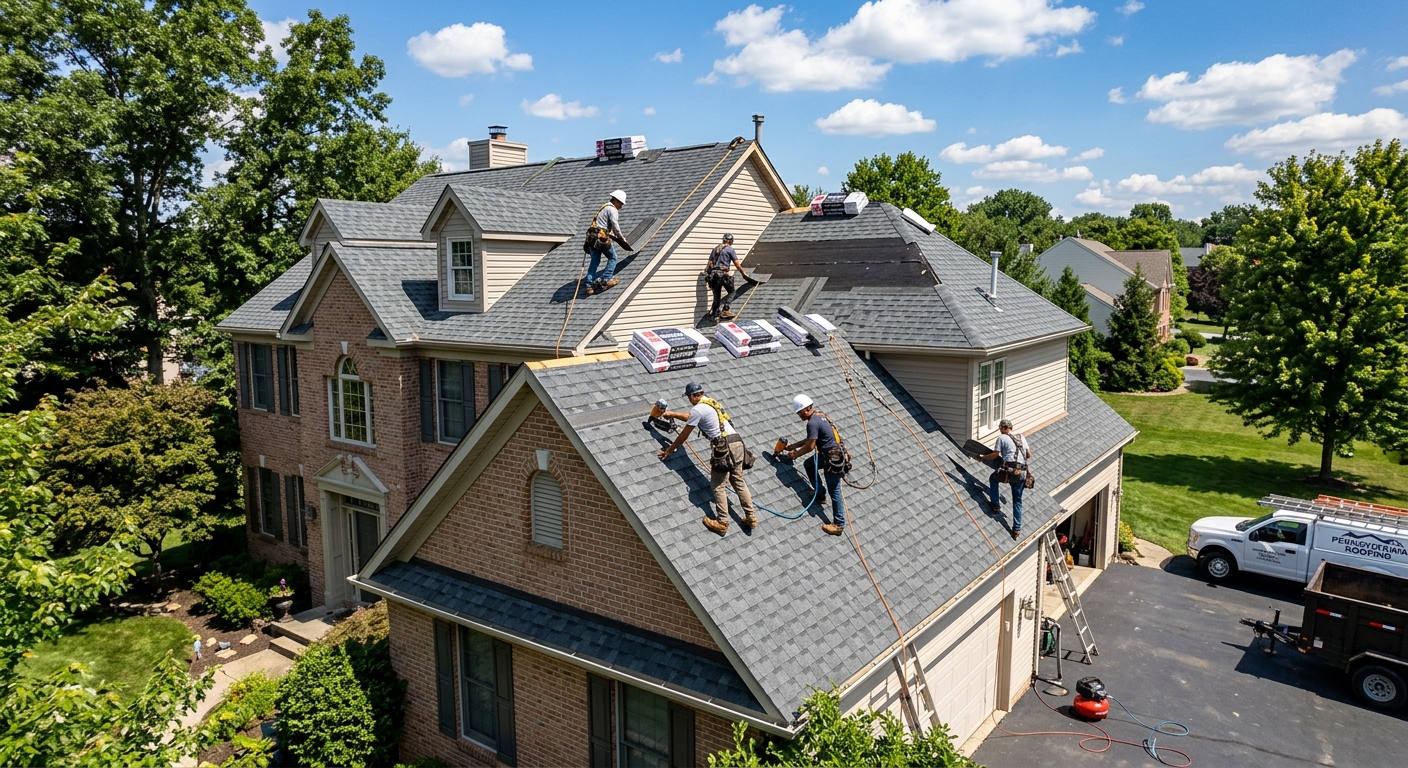
Roofing Replacement & Repair costs in Rostraver — 2026
Rostraver’s roofing market is driven by homes built before 1980 and a homeownership rate above 80% (U.S. Census Bureau, ACS 2024). These older single-family homes, typical here, are reaching the age where roof replacement is unavoidable—especially in neighborhoods built during the big subdivision surge of the 1960s–1980s seen near Hempfield and North Huntingdon. If your house has an aging asphalt roof, you’re not alone; thousands of homeowners around Rostraver are facing the same replacement horizon, so roofers know the local inventory inside and out.
Because most homes here were built in the postwar period, contractors are prepared to address roof decks and insulation styles common to that era. The predominance of asphalt shingles reflects both contractor practices and what’s held up to Westmoreland County’s climate stresses: wind, freeze-thaw, and the occasional hail event rolling off the Ohio Valley. Replacement or repair costs you’ll see in quotes here reflect these very local conditions—and they are nothing like prices you’ll see online for other states or urban cores. Here’s what to expect on typical Rostraver roof work in 2026:
| Material / Scope |
Lifespan |
Best for |
Price range (installed) |
| Asphalt shingles — architectural (30-yr) |
25–30 yrs |
Most Rostraver and Hempfield homes built after 1960 |
$9,300–$19,500 |
| Asphalt shingles — impact-resistant (Class 4) |
30+ yrs |
Ridge-line homes with hail/wind exposure |
$15,000–$19,500 |
| Metal standing seam |
40–70 yrs |
High-value, long-term upgrade for exposed lots |
$22,500–$40,000 |
| Flat roof — TPO or EPDM |
15–25 yrs |
Porches, additions, or low-slope ranches |
$11,500–$23,500 |
| Roof repair — leak or isolated section |
n/a |
Emergency patches, targeted leak fixes |
$500–$1,850 |
Prices are estimates for a typical Rostraver home and vary with roof size, pitch, decking condition and material selection.
Decking, ventilation and flashing — the hidden roof costs
Many Rostraver homes were built when fast suburban construction was the rule, which means some corners were cut on attic ventilation and decking materials. When a roofing crew tears off old shingles, they frequently find rotted plywood—especially above bathrooms or on north-facing slopes. Replacing a single 4x8 sheet of plywood decking typically runs $75–$150 each, and a 20–30 square roof can easily require a handful if past leaks were ignored or original tarpaper did its job poorly.
In southwestern Pennsylvania, proper attic ventilation isn’t just about energy efficiency—it’s the front line against ice damming, which occurs when insufficient airflow lets heat escape unevenly, causing snowmelt and refreezing at the eaves. Adding or upgrading ridge vents, soffit vents, or power fans during replacement might cost an extra $400–$1,200 total, but it prevents $2,000+ winter water damage down the line.
Chimney and wall flashing is a different animal here. Many postwar homes have double brick or fieldstone details; reworking step and counter flashing, especially if it’s original, adds $300–$1,100 per complex roofline due to labor. Don’t overlook rubber vent boots or drip edge either. Boots dry-rot after twenty years for another $90–$160 each, and missing drip edge is a leading cause of hidden rot along eaves for older Rostraver homes.
Reading a roofing estimate line by line
A detailed roofing quote spells out what you’re actually paying for—vague lump sums are meaningless, especially with decades-old Rostraver homes that often need more than just shingles. Start with total roof area in “squares” (one square equals 100 square feet), and check if pitch is given; steep roofs cost more due to safety and labor. Tear-off and disposal should show how many layers come off (many older local roofs are double-layered), and a dumpster should be expressly included. Underlayment and ice/water shield coverage needs to name the brand or type—“15# felt” alone is too vague.
Decking replacement is a contingency, not an afterthought, so there should always be a per-sheet price for plywood replacement. Look for separate line items for chimney flashing and vent boots. Warranty language matters: distinguish between manufacturer coverage (for materials) and workmanship (labor quality)—they are not interchangeable. Any payment schedule should ask for less than 15% upfront, with the remainder at completion; large cash deposits are a red flag.
| Line item |
What to look for |
Red flag if… |
| Roof area |
stated in squares, with pitch |
no measurement given |
| Tear-off and disposal |
number of layers, dumpster included |
bundled into one figure |
| Underlayment |
product type and coverage |
listed only as 'felt' |
| Ice and water shield |
coverage height at eaves |
omitted entirely |
| Decking |
per-sheet contingency price |
no allowance at all |
| Warranty |
workmanship years stated separately |
only the shingle warranty |
| Payment |
deposit under 15%, balance on completion |
large upfront cash |
Pennsylvania code and Westmoreland County permit rules for roofing
Pennsylvania follows the Uniform Construction Code (UCC), based on the International Residential Code (IRC). In Westmoreland County, the UCC is enforced by each municipality’s code office; if your municipality opted out, the state’s Department of Labor & Industry enforces it instead. For roof replacements (not just repairs or overlays under one square), a permit is typically required in Rostraver and surrounding Westmoreland townships, but you should contact your specific municipal code office for exact requirements. No statewide roofing trade license exists; what’s required is a Home Improvement Contractor (HIC) registration, issued by the Pennsylvania Office of Attorney General, which applies to jobs over $500.
Before you sign, verify that your roofer has an active HIC registration at hic.attorneygeneral.gov and confirm current workers’ compensation coverage for every crew member via the WCAIS state database (wcais.pa.gov). Consumer protection comes from the Home Improvement Consumer Protection Act (HICPA): for any roof contract over $500, you must receive a written contract and hold a 3-business-day right of cancellation. If your home was built before 1978, ensure the contractor is EPA Lead RRP certified (certifiedrenovatorsearch.epa.gov).
Workmanship vs manufacturer warranty
Every roof in Westmoreland County comes with two types of warranties—don’t let a contractor blur these lines. Manufacturer warranties cover only defects in the shingles or metal panels themselves; they’re usually prorated and require product registration within a strict period (often 60 days after install). These warranties are sometimes transferable to a new owner at resale, but the clock doesn’t reset; check the fine print. Poor attic ventilation or installing shingles over old roofing can void the warranty completely, so make sure these details are addressed in your contract.
Workmanship warranties, on the other hand, guard against installation errors like nail pops, flashing mistakes, or poorly integrated valleys. Their value depends wholly on the contractor’s local reputation and how long they’ve been in business. Legitimate, established companies in Westmoreland County commonly offer 5–10 years, and some pitch longer—if a roofer founded last year promises 25 years, be skeptical. Always get warranty terms, duration, and claim process in writing, and confirm any manufacturer warranty was submitted on your behalf after install.
Choosing a roofer in Westmoreland County
Verifying your contractor in Westmoreland County is straightforward if you stick to state-backed registries. Confirm the roofer’s active Home Improvement Contractor (HIC) registration at hic.attorneygeneral.gov and check their workers’ compensation insurance using the WCAIS lookup (wcais.pa.gov). For homes built before 1978, ask to see an EPA Lead RRP certificate (certifiedrenovatorsearch.epa.gov). Make sure your written contract complies with the Home Improvement Consumer Protection Act (HICPA): it must be signed, dated, and include your 3-business-day cancellation right. If permits are required, the contractor should pull them with your township code office—not leave you with municipal red tape.
- Check HIC registration at hic.attorneygeneral.gov
- Confirm workers’ compensation insurance at wcais.pa.gov
- Ask for EPA Lead RRP certification for pre-1978 homes
- Review contract details before signing—HICPA applies
- Require written warranty terms, not just verbal promises
- Check references in Westmoreland County, not just Pittsburgh
- See photos of completed local roofs and drive by, if possible
- Ask about contingency pricing for decking or chimney flashing
- Reject pressure to sign before insurance or adjuster inspections
- Never pay more than 15% up front
- Get a copy of the building permit (if required) before work starts
- Beware “No deductible” or waiver offers—they’re illegal
Red flags in this market: crews with no address in Westmoreland County, unmarked trucks, high-pressure sales after hail/wind storms, large cash deposits, or a refusal to show HIC registration. After major storms, expect to see out-of-town crews canvassing—the greater Pittsburgh area draws storm chasers whenever wind or hail events hit exposed ridges. That’s when vetting matters most.
Why two Rostraver roofing quotes can differ by 40%
In Rostraver, large swings between roofing bids are common, and it isn’t just guesswork or price gouging. For homes built in the 1960s–1980s development boom, a contractor’s labor cost can climb sharply depending on roof design: steep pitches with multiple valleys and dormers slow installation and increase safety measures. Add in the common problem of double-layered asphalt shingles—popular in local subdivisions decades ago—and a roof replacement can require full tear-off and disposal, an extra $500–$1,500 for each layer.
Westmoreland County’s climate doesn’t help: snow load requirements (30 psf) mean your new roof must meet stricter fastening and underlayment rules than on the coastal plain. Contractors who cut corners on ventilation or ice barriers expose you to ice damming and future rot. If one quote omits an ice and water shield at the eaves—often $300–$800—it might show as the cheaper bid, but it’s not a fair apples-to-apples comparison for a home here.
The material upgrade path matters too. Architectural shingles are now the local standard, but some contractors push cheap three-tab, while others quote Class 4 impact-resistant shingles to win insurance-conscious business for homes exposed on higher ridge lines, swinging prices from $9,300 to $19,500 for the same footprint. Always get every quoted scope in writing to understand why numbers jump around.
| Factor |
Why it matters here |
Cost impact |
| Roof size in squares |
each square is 100 sq ft of roof surface |
primary multiplier |
| Pitch and access |
steep pitches need harnesses and slow the crew |
+20–30% labour |
| Existing layers to tear off |
two or more layers means full tear-off and disposal |
$500–$1,500 per layer |
| Decking condition |
rot is found during tear-off, not before |
$75–$150 per sheet |
| Ice barrier at eaves |
required where ice damming has a history |
$300–$800 |
| Material grade |
3-tab vs architectural vs Class 4 impact-resistant |
$500–$2,500 |
Frequently asked questions — roofing in Rostraver
Will filing a roof claim raise my premium?
Insurance companies in Pennsylvania, including those covering homes in Rostraver, may raise your premium after a roof claim, especially for hail or wind—which aren’t exactly rare here, given the area’s exposure to Ohio Valley storm tracks. The cost of a typical roof replacement in Rostraver ranges from $9,300–$19,500, making a claim tempting, but multiple claims within a short span or a pattern of storm claims in Westmoreland County can put your policy at risk for non-renewal or an additional surcharge at renewal time. Before you file, call your agent and ask about your loss history. If the repair is on the lower side (say, under $1,850), it may not be worth risking a rate hike; sometimes, paying out of pocket saves more than filing.
Are impact-resistant shingles worth it in Rostraver?
Impact-resistant (Class 4) shingles are often marketed aggressively after hail events in the Rostraver and Hempfield corridor. They do hold up better in wind and hail than standard architectural shingles. For homeowners living on exposed ridges—a common site here due to hilly terrain—the upgrade cost (typically about $15,000–$19,500 installed) can make sense. However, not every insurer provides a discount for Class 4 shingles, and the ROI depends on your home's actual storm risk. If your history shows repeated shingle failures or you’re directly in the storm corridor, it's a practical upgrade. For a sheltered lot, standard architectural shingles are often enough and save several thousand dollars.
Why do roofs fail faster in southwestern Pennsylvania?
Roofs in Rostraver and across southwestern Pennsylvania take more punishment than most realize. The big culprits: frequent freeze-thaw cycles, humid summers, and heavy snow burdens (local code: 30 psf ground snow load). Water gets under poorly installed or aged shingles, freezes, then expands—and that repeated cycle is why a 25-year roof here often ages out by 17–20 years. Even the best asphalt shingle, priced at $9,300–$19,500 for replacement, won’t hit its full rated lifespan without excellent ventilation and ice/water shield. If your roofer doesn’t address these climate realities, you’ll be back at it much sooner.
Why is my Rostraver roofing quote higher than the online average?
Most online roof calculators and national averages are pulled from low-labor or low-snow-load regions with cheaper landfill disposal. Here in Rostraver, both the climate (freeze-thaw, snow, and ridge winds) and the typical home size push costs up. Our average architectural shingle replacement comes to $15,000, but a home with complex pitches, two shingle layers, or rotted decking can quickly climb higher. Local contractors must budget for additional underlayment, ice/water shield, and extra labor—cost drivers not factored into many generic online ballparks. That’s why Pennsylvania quotes, especially in Westmoreland County, land well north of the national norm.
What are the signs of hail damage on a roof?
In Rostraver, after a hailstorm you may see bruised or dented shingles (especially on the ridge or windward slopes), granule loss in patches, or small round divots visible from a ladder. On older asphalt roofs, impact marks can force shingle fractures, even causing minor leaks right away. Metal roofs may show cosmetic dings but are less likely to leak unless seams are compromised. If you notice shingle grit in your gutters following a storm, that’s a clue. Local roof repairs for hail damage typically run $500–$1,850 for targeted work; full replacement may be necessary if large roof sections are compromised. Always have a local, insured roofer assess—storm chasers often exaggerate damage to push for full replacements.
Do I need a permit to replace a roof in Rostraver?
For a full roof replacement in Rostraver Township and much of Westmoreland County, yes, a permit is typically required—since Pennsylvania follows the Uniform Construction Code (UCC), enforced locally by municipalities or the Department of Labor & Industry. Repairs under a certain size (typically under one square) may be exempt, but it varies by township. Always ask your contractor to pull the permit and include that step in their quote. This safeguard protects you from improper work and avoids headaches at resale. Permit costs themselves are minor compared to the full job price (for example, a $9,300–$19,500 re-roof), but skipping one risks failed inspections and insurance headaches.
What's the cheapest way to replace a roof in Rostraver?
The cheapest approach in the Rostraver market is to use basic architectural asphalt shingles and stick to essential tear-off/replace scope—no upgrades, reuse existing ventilation where possible, and patch any sound decking rather than full replacement. This can land your cost near the bottom of the architectural price band, around $9,300 for an average-sized single-family home. Avoid layovers (installing new over old shingles); these are sometimes quoted as a low-cost option but are much more likely to void your manufacturer warranty and trap moisture, leading to costly rot. Hiring a properly registered local contractor, and skipping unnecessary extras, lands the best value.
Do I need to leave my house during a roof replacement?
For the vast majority of roof replacements in Rostraver—whether asphalt, metal, or flat membrane—you do not have to leave your house. There’s no hazardous material involved unless your decking or painted trim predates 1978 (then, lead-safe protocols must be observed). Roofers will make noise and temporarily block access at the driveway, so plan accordingly. Typical asphalt shingle jobs can be completed in 1–2 days (for a roof in the $9,300–$19,500 range). Children and pets should avoid yard areas during tear-off for safety. If major decking or interior ceiling repairs are needed, your contractor will discuss temporary access limits.
Are storm-chasing roofers a problem in Rostraver?
Yes; in Westmoreland County’s suburban market, especially around Rostraver and Hempfield, the post-storm influx is real. Contractors from across the region—and sometimes out-of-state—descend after hail or wind events, canvassing neighborhoods with flyers and aggressive pitches. Many promise fast insurance work for little or “no out-of-pocket cost,” which is illegal in Pennsylvania (your deductible can’t be waived). Be wary of anyone unwilling to show HIC registration or proof of Westmoreland County projects. A legitimate Rostraver roofer will know the specific needs of homes here and have no problem walking you through a contract for anything from a $1,150 repair to a full replacement at local market rates.