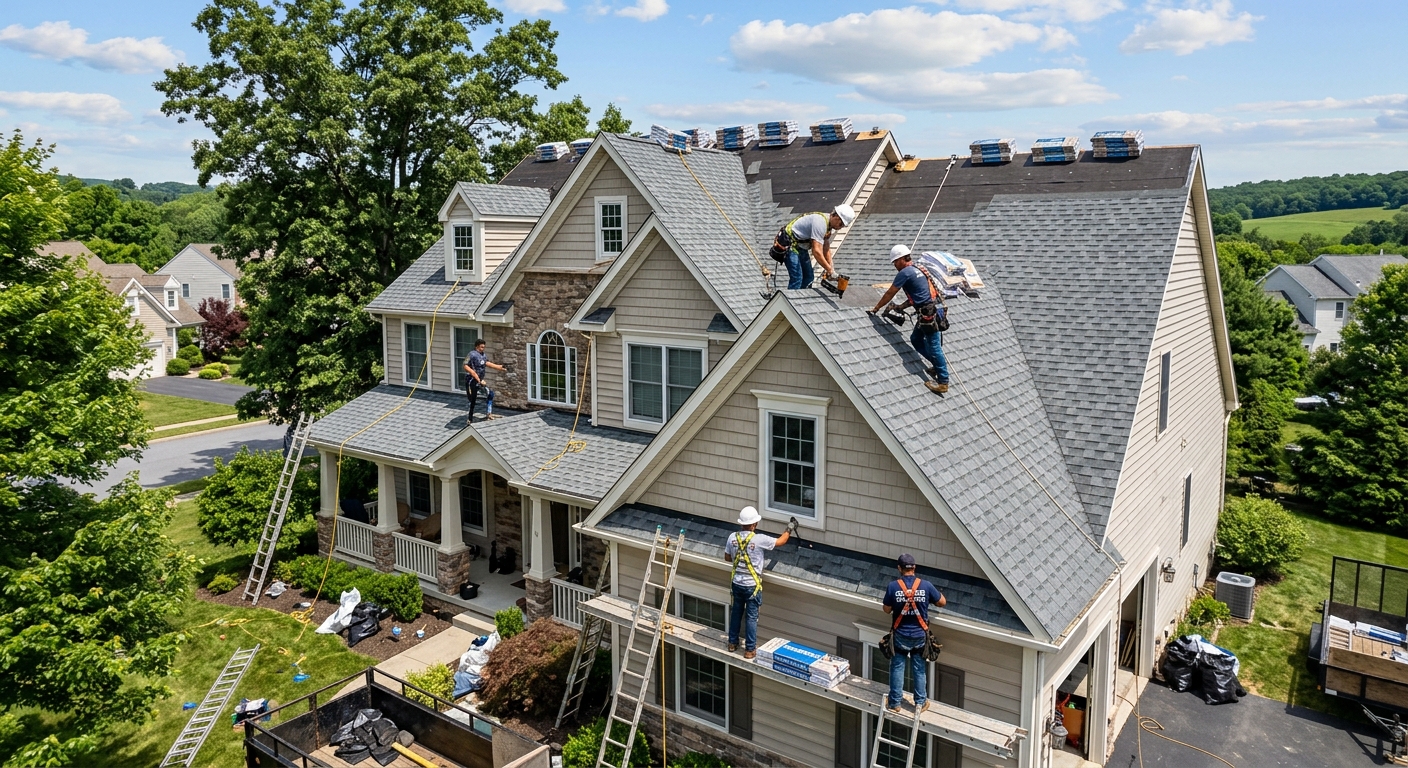
Delaware roofing prices by material and scope — 2026
In Delaware, Pennsylvania, homeownership is high and most properties are single-family homes, reflecting a market where long-term roofing performance matters (U.S. Census Bureau, ACS 2024). As a rural county with large subdivisions built in the 1980s–1990s near Dingman’s Ferry, many asphalt shingle roofs are now hitting the end of their expected lifespan. This concentrated aging in the housing stock means that roofing projects often aren’t scattered but come in waves—entire streets are sometimes due for full replacements within a few seasons of each other. That means contractors here see a lot of full-roof replacements, rather than piecemeal repairs, and bulk jobs can push up demand on materials and labor from nearby Scranton–Wilkes-Barre suppliers.
If you live in Delaware, don’t expect city-level competition or one-day turnarounds: Pike County forms a thin rural contractor market, and crews often travel in. Metal roofing, while durable, is less common due to the higher upfront investment. Flat roof membrane jobs in Delaware are usually smaller residential additions, not large commercial sheets. Repairs—often from wind-driven rain and shingle tab tearing unique to the Delaware River ridge-lines—drive a steady callout business but seldom delay the need for full replacement past the 25-year mark, especially where snow and ice dams have taken a toll.
| Material / Scope |
Lifespan |
Best for |
Price range (installed) |
| Asphalt shingles — architectural (30-yr) |
25–30 yrs |
Most Delaware homes & subdivisions |
$9,400–$19,500 |
| Asphalt shingles — impact-resistant (Class 4) |
30+ yrs |
High-wind/exposed ridge homes |
$15,500–$19,500 |
| Metal standing seam |
40–70 yrs |
Longevity, snow and ice shedding |
$22,500–$40,500 |
| Flat roof — TPO or EPDM |
15–25 yrs |
Sunrooms, additions, porches |
$12,000–$23,500 |
| Roof repair — leak or isolated section |
n/a |
Spot leaks, storm patching |
$500–$1,850 |
Prices are estimates for a typical Delaware home and vary with roof size, pitch, decking condition and material selection.
When a Delaware roof is worth repairing — and when it isn't
If you own a home in Delaware, deciding between repair and full replacement means paying close attention to your home’s age and the shingles’ condition. Those subdivisions built in the 1980s and 1990s are now at the inflection point: a single leak on a 13-year-old roof is a candidate for repair, but multiple leaks after year 18–20 usually signal systemic wear from Pike County’s harsh winters and ridge-line wind. Once an architectural shingle roof approaches 25 years, especially with signs of granule loss or frequent patch repairs, continued fixes become a false economy. Spend $1,200 two or three times patching leaks over a couple of seasons and you’ve soon paid out nearly a third of a full replacement ($9,400–$19,500)—with only a temporary fix to show for it.
Storms in the Delaware Valley can rip up shingles on exposed ridges, and insurance may cover full replacement after documented wind damage. For active leaks headed into winter, a fast repair ($500–$1,850) is prudent, but expect to replace the roof soon after. Flat roofs with evidence of ponding or membrane blisters in our freeze/thaw climate rarely recover; replacement is the only real option.
| Situation |
Recommendation |
Typical cost |
Reasoning |
| Under 15 years, one isolated leak |
Repair |
$500–$1,850 |
Single leaks on younger roofs are often storm- or vent-related, not systemic failure. |
| 15–25 years, several leak points |
Replace |
$9,400–$19,500 |
Multiple leaks signal end-of-life in 1980s–1990s Delaware housing stock. |
| 25+ years, any active leak |
Replace now |
$9,400–$19,500 |
Most shingle roofs here are fully expired by year 25 under Pike County conditions. |
| Storm damage, wind or hail |
Document, claim, replace |
$9,400–$19,500 |
Wind in the valley commonly tears shingles; insurance replacement is typical. |
| Flat roof ponding or blistering |
Replace membrane |
$12,000–$23,500 |
Ponding and blisters progress rapidly in our freeze/thaw cycles. |
| Active leak entering winter |
Emergency repair, schedule replacement |
$500–$1,850 |
Freezing will make the leak far worse and risk interior damage. |
Choosing a roofer in Pike County
Delaware homeowners have to select carefully—Pike County’s thin, rural contractor market draws roofers in from the Scranton–Wilkes-Barre area, so not everyone stamping a yard sign is equipped for the local snow and wind. Always verify Home Improvement Contractor (HIC) registration through the Pennsylvania Office of Attorney General for projects over $500. Confirm active workers’ compensation in the WCAIS system, and ask for written contracts as required under the Home Improvement Consumer Protection Act. For roofs on homes built before 1978, federal EPA Lead RRP certification is legally required. There is no separate roofing trade license in Pennsylvania.
- Confirm HIC registration at hic.attorneygeneral.gov
- Request a certificate of insurance—check both liability and workers’ comp
- Check workers’ comp status in WCAIS (wcais.pa.gov)
- Ask for a written contract (required above $500)
- Insist on a 3-day right to cancel, as protected by law
- Verify Lead Safe Renovator status at certifiedrenovatorsearch.epa.gov if home built before 1978
- Get a local address and phone number—avoid only PO boxes or out-of-state numbers
- Request supplier references for major material purchases
- Require a detailed line-item quote (not just a lump sum)
- Ask for both manufacturer and workmanship warranties in writing
- Avoid all-cash contracts; pay by check or card to document payment
- Never sign a blank or undated contract
Red flags here: no HIC registration or insurance, only a non-local number or no actual office, refusal to show contract paperwork, or pushy sales tactics from crews driving in from outside Pike County. Word-of-mouth and local supplier confirmation matter, since door-knockers aren’t as common as slow-to-return outside crews who vanish mid-job.
The scope items Delaware homeowners don't budget for
Unexpected costs on a Delaware roof job often come from what’s uncovered at tear-off. Rotted roof decking is a particular threat in Pike County, where nearly half the homes were built before 1980 and ventilation shortfalls feed ice dams and hidden leaks. Budget an extra $85–$155 per sheet of plywood discovered soft or rotted. Poor attic ventilation isn’t just about energy bills here—it directly causes winter ice damming, which can void a shingle warranty and leave you footing a multi-thousand dollar repair. If your roof needs upgraded continuous ridge venting or baffles, plan for $400–$1,200 depending on roof size.
Chimney and wall flashing replacements catch people off guard, especially at intersections and valleys that see ice buildup; flashing can run $350–$950 per feature if done right. Rubber vent boots dry-rot and crack in our climate, but swapping them is typically included in the replacement price—standalone, they run $90–$140 each. Drip edge is crucial along eaves and rakes against snow and wind uplift, costing $4–$6 per foot installed.
Don’t skip these: shingle manufacturers and insurers both look for upgrades if your past leak or ice damming was due to inadequate attic airflow. Proper scope and contingency pricing upfront will protect you from “we found a surprise, now it costs thousands more” near the end.
Roofing permits in Delaware: what you need before work starts
Roofing projects in Delaware, Pike County, fall under the Pennsylvania Uniform Construction Code (UCC), as enforced by either your municipal office or, for certain areas, the PA Department of Labor & Industry. Major work like replacing more than 25% of the roof deck (the boards beneath your shingles) in Milford Borough requires a permit through the Milford Borough Code Enforcement Office. In surrounding Delaware Township and similar Pike County townships, like-for-like shingle repairs covering less than one roofing square can often be done without a permit.
Before signing a contract over $500, always verify the roofer’s Home Improvement Contractor (HIC) registration at hic.attorneygeneral.gov. Get a copy and independently confirm their workers’ compensation policy status using the WCAIS state portal (wcais.pa.gov). A written contract is not just good sense but a legal requirement under Pennsylvania’s Home Improvement Consumer Protection Act. There is no specialty roofing license in Pennsylvania, only HIC registration.
If your Pike County home was built before 1978, ensure your contractor is Lead-Safe Certified under the EPA Lead RRP Rule by checking certifiedrenovatorsearch.epa.gov. Always check with your local municipal office or Milford Borough’s permitting office to confirm exactly what permit, if any, is needed for your specific project.
What a proper Delaware roofing quote contains
A trustworthy Delaware roofing quote gives you full visibility on what is being installed, how much, and where costs could change. Every estimate should spell out the roof’s size in “squares” (1 square = 100 sq ft) and clearly document roof pitch—steeper roofs involve more labor per square. Tear-off and disposal must show how many old layers are removed and whether dumpsters are included. Underlayment (felt, synthetic, or ice barrier) should be named by type and coverage. Decking replacement is almost always a contingency; the quote should list a per-panel price in case soft or rotted sections are found under old shingles.
Check that flashing, drip edge, and vent boots are listed, not skipped as “extras.” Warranties from the contractor (workmanship) should be detailed and separated from the shingle manufacturer’s written material warranty. Payment terms should require low deposits—state law sets clear limits. If a quote bundles everything as a lump sum or omits square or pitch details, you’ll never be able to compare apples to apples—nor protect yourself if a dispute comes.
| Line item |
What to look for |
Red flag if… |
| Roof area |
stated in squares, with pitch |
no measurement given |
| Tear-off and disposal |
number of layers, dumpster included |
bundled into one figure |
| Underlayment |
product type and coverage |
listed only as 'felt' |
| Ice and water shield |
coverage height at eaves |
omitted entirely |
| Decking |
per-sheet contingency price |
no allowance at all |
| Warranty |
workmanship years stated separately |
only the shingle warranty |
| Payment |
deposit under 15%, balance on completion |
large upfront cash |
Storm damage and insurance claims in Delaware
Storms along the Delaware River valley near Milford can bring ripped shingles and downed branches, especially with the ridge-line wind this area sees. If your roof suffers visible storm damage, document everything immediately: take clear photos of each affected area before cleanup or any tarping. Notify your insurer and request a formal scope of loss in writing. The process will usually involve an adjuster’s inspection and a payout based either on replacement cost—what it takes to return your roof to pre-storm status—or actual cash value, which subtracts depreciation for age.
In Pike County, contractors should always give you a written contract for any insurance claim over $500, as required by the Home Improvement Consumer Protection Act. The Pennsylvania Uniform Construction Code still applies—if structural decking must be replaced on more than 25% of the roof, a permit from your municipal office or Milford Borough is necessary. If a roofer offers to “cover” your insurance deductible, walk away. Pennsylvania law prohibits waiving homeowners’ insurance deductibles. Any contractor suggesting this is either violating the law or baking the deductible cost into hidden invoice items, potentially endangering your claim with the insurer.
After major weather, do not authorize emergency repairs or cleanup until you’ve thoroughly documented the damage. Contractors must never commence permanent work (beyond emergency tarping) without insurance approval. Get estimates in writing, keep all claim documentation, and never sign checks over until repairs are confirmed finished and permitted.
Frequently asked questions — roofing in Delaware
What warranty should a Delaware roofer offer?
In Delaware, Pennsylvania, a reputable roofer should provide two types of warranty: a manufacturer’s warranty on the shingles and a separate workmanship warranty on labor. For architectural shingles, manufacturers commonly offer a limited lifetime warranty (which often reads as 30–50 years pro-rated for defects), but this only stands up if the shingles were installed to spec with proper ventilation and flashing, per the climate here. Workmanship guarantees should be no fewer than five years—higher with established local contractors. If you get only the shingle paperwork and nothing on craftsmanship, you have little protection; defects from poor installation (common when unqualified crews travel in) won’t be honored by the manufacturer. Full roof replacement in Delaware typically costs $9,400–$19,500 and a warranty is essential security at that spend.
What does roof replacement cost per square in Delaware?
Delaware homeowners generally see installed pricing for architectural shingle replacement in the range of $470–$640 per roofing square (100 sq ft), using 2026 price bands. On a typical 25-square roof, that’s a full project cost of $9,400–$19,500 depending on pitch, decking condition, material upgrade, and tear-off complexity. Expect the higher end where ventilation is lacking, access is tight, or decking needs replacement (especially on pre-1980 homes common to this area). Always insist that quotes state square count and pitch, or you can't properly compare bids or guard against “change order” pricing once work begins.
How do I know if my Delaware roof needs replacing?
Here in Delaware, with many homes built during the 1980s–1990s boom, most architectural shingle roofs start failing between 20 and 28 years due to Pike County’s snowy winters and ridge-line wind. Warning signs include missing or curled shingles, granules filling your gutters, soft spots when walked, interior leaks after storms, and ice dam water stains in the attic. If your home’s roof is over 25 years old—especially if it already has patches or recurring leaks—replacement is usually wiser than repeated repairs. Full replacement in Delaware typically requires an investment of $9,400–$19,500, but will prevent escalating interior damage and endless patching costs.
Can a contractor cover my insurance deductible in Pennsylvania?
No—under Pennsylvania law, it is prohibited for contractors to waive, rebate, or “cover” your insurance deductible for roof replacement or repair. Any roofer offering to handle your deductible is violating consumer protection rules. Insurers may deny claims outright if such activity is found, putting your payout and new roof at risk. The proper sequence in Delaware and elsewhere in Pike County is to document damage, agree on scope with your insurer, and pay the deductible directly to the contractor per the written contract. For a storm-covered full replacement, you’re still responsible for your negotiated deductible—typically a small fraction of the total job, such as $1,200 for a $15,500 claim. Any offer to “eat the deductible” should be seen as a major red flag.
Does attic ventilation matter in Delaware's climate?
Attic ventilation is absolutely critical in Delaware’s climate. Our cold, snowy winters and relatively long heating season (over 6,100 heating degree days) mean that poor airflow causes attic heat buildup, melting snow, and refreezing at the eaves—classic ice damming territory. This not only voids many shingle warranties, but leads to hidden decking rot and water infiltration. A replacement roof here, which usually runs $9,400–$19,500, is wasted money if intake or ridge venting are skipped. A qualified contractor will specify and price out ventilation upgrades as part of your estimate. Otherwise, you risk repeating the same failures that took out the last roof.
How do I verify a roofing contractor is registered in Pennsylvania?
In Delaware, Pike County, roofing contractors taking on work over $500 are required by law to have Home Improvement Contractor (HIC) registration from the Pennsylvania Office of Attorney General. You can (and should) check active registration status by visiting hic.attorneygeneral.gov and searching by company or owner name. For added protection, verify that their HIC number appears on your contract, and cross-check insurance certificates against the state’s WCAIS system (wcais.pa.gov) for workers’ comp coverage. Never accept verbal confirmation or a photocopied card alone—unregistered or uninsured contractors are not legally allowed to perform roof replacements or repairs above $500 in Delaware or anywhere in Pennsylvania.
What happens if it rains mid-replacement?
Rain is always a risk in Delaware, especially with summer storms rolling off the Delaware River valley. Reputable contractors stage jobs carefully and never tear off more than they can dry-in by day’s end. If rain threatens while your roof is open, crews should immediately tarp all exposed sections using reinforced sheeting—most keep this on every job in Pike County for sudden weather. You shouldn’t see bare plywood exposed to rain for any length of time; water intrusion here risks costly decking and interior repairs. If replacement is stalled by a storm, it won’t affect the fixed price (typically $9,400–$19,500 for a full job), but delay could add a day or two’s labor if drying is required. Check your contract for emergency tarping or water protection terms so you aren’t surprised at invoicing.
Does roof pitch affect the price in Delaware?
Yes—roof pitch directly affects labor and sometimes material costs for Delaware homeowners. A steeper roof (over 6:12) in Pike County’s climate takes more time, staging, and often additional safety measures due to snow and ice risks. That means the cost per square is higher: a low-pitch ranch might total $9,400 for replacement, where the same size colonial with 10:12 pitch commands closer to $13,500–$19,500. Pitch should be stated in every quote you get; if it’s missing, you’re likely being priced for “average” and could be presented with upcharges once work starts. Always request a quote that breaks out roof squares and explicit pitch information.
What underlayment should be used on a Delaware roof?
In Delaware’s cold, snowy climate, underlayment selection is critical to a lasting roof. Modern synthetic underlayments offer superior protection and walkability compared to old-fashioned felt, but ice and water shield—a peel-and-stick membrane—should always cover the first several feet up from all eaves and in valleys, where ice damming is common. Insist your quote lines out both products by brand and square footage: missed coverage can lead to leaks, especially over aging decking. Installation labor for proper underlayment is already included in your total cost—roof replacements here average $9,400–$19,500—but cutting corners is more expensive over time than the up-front savings. Trust only those who specify underlayment and ice barrier explicitly in writing.