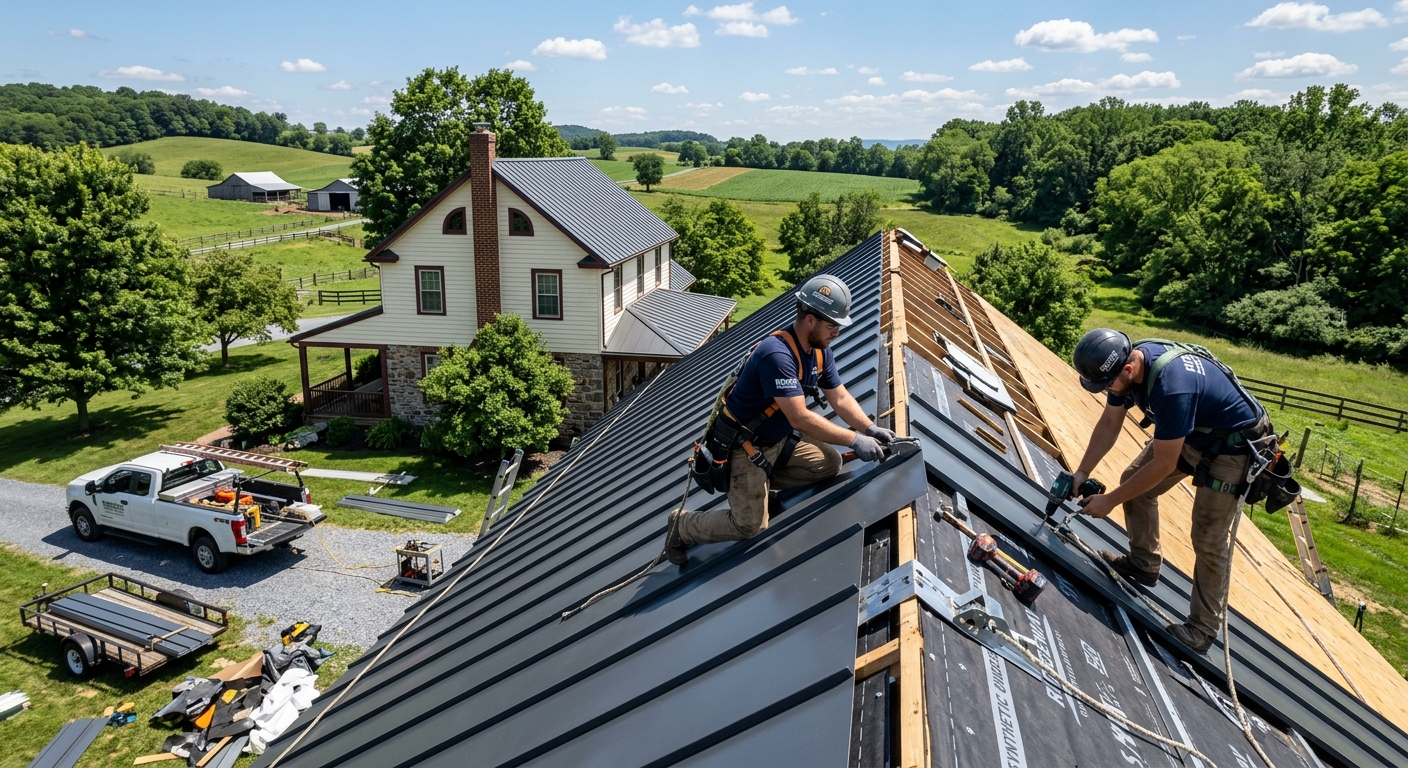
What roof replacement costs in Lower Burrell in 2026
If you own a home in Lower Burrell, getting a roof replaced is a sizable investment—and it pays to know what drives the numbers. With 82.8% of Lower Burrell’s homes being single-family properties and over 76% built before 1980 (U.S. Census Bureau, ACS 2024), demand for full roof replacement is consistently high. Many of the area’s roofs are on the second or even third life, with aging materials tested every year by heavy freeze-thaw cycles and hilly terrain.
This history tracks with Westmoreland County’s broader housing wave in Hempfield and North Huntingdon, where 1960s–1980s subdivisions led to large volumes of now-aging asphalt roofs. Homes in Lower Burrell reflect that legacy: you’re likely dealing with older deck boards, steep midslope pitches that drain fast but wear out shingles, and occasional surprises once the tear-off begins.
Here’s what to expect when budgeting a new roof or a serious repair in Lower Burrell:
| Material / Scope |
Lifespan |
Best for |
Price range (installed) |
| Asphalt shingles — architectural (30-yr) |
25–30 yrs |
Most Lower Burrell homes from the 1960s–1980s stock, budgets prioritizing value |
$9,500–$20,000 |
| Asphalt shingles — impact-resistant (Class 4) |
30+ yrs |
Ridge-line homes exposed to hail or strong wind off the river valley |
$15,500–$20,000 |
| Metal standing seam |
40–70 yrs |
Long-term holding, minimal maintenance, complex hips and valleys |
$23,000–$41,000 |
| Flat roof — TPO or EPDM |
15–25 yrs |
Shallow pitch ranches from mid-century subdivisions or low-slope porches |
$12,000–$24,000 |
| Roof repair — leak or isolated section |
n/a |
Emergencies, worn valleys, isolated storm damage |
$500–$1,900 |
Prices are estimates for a typical Lower Burrell home and vary with roof size, pitch, decking condition and material selection.
Checking out a roofer in Lower Burrell: what to verify
Lower Burrell homeowners should insist on clear documentation before hiring anyone for roofing work. Pennsylvania requires all contractors performing home improvements over $500 to have current Home Improvement Contractor (HIC) registration from the Office of Attorney General—verify any registration at hic.attorneygeneral.gov. If a contractor employs others, state law demands they carry active workers’ compensation insurance. Always confirm this through the WCAIS system (wcais.pa.gov).
Written contracts are mandatory for work above $500, with a 3-business-day right of cancellation under the Home Improvement Consumer Protection Act. For pre-1978 homes, federal EPA Lead RRP certification is required for any work disturbing painted surfaces—Lower Burrell’s high pre-1980 housing rate makes this especially important.
- HIC registration number—confirm at hic.attorneygeneral.gov
- Current certificate of workers’ compensation insurance—verify at wcais.pa.gov
- Physical business address (not a PO box)
- Written scope of work and contract (not just a handshake or email promise)
- EPA Lead RRP certificate if your home is pre-1978
- Proof of liability insurance (request certificate from their insurer)
- Detailed line-item estimate, not just a lump sum
- References from Lower Burrell or Westmoreland County jobs
- Warranty documentation—manufacturer and workmanship
- Clear payment schedule; deposit under 15%
- No demand for cash only or full payment before work
- Cleanup and disposal plan in writing
Specific red flags for Lower Burrell: out-of-town firms with no local references, door-knockers after hail or wind events, refusal to show HIC registration, offering to “waive your insurance deductible,” and vague quotes hiding material or disposal details. Metro Pittsburgh’s roofing market attracts both reliable pros and short-term operators—do your homework before signing anything.
What insurance covers on a Lower Burrell roof
After a hailstorm or wind event in Lower Burrell, the first step is to document your roof’s condition before any cleanup starts. Take clear, date-stamped photos from multiple angles—even if you have to shoot from a ladder or attic window. Notify your insurer and get a written scope of loss before choosing a contractor. Most policies in this area provide either actual cash value (ACV) or full replacement cost value (RCV) coverage: ACV pays out your roof’s depreciated worth, while RCV covers the complete replacement after depreciation is recovered (usually after the work is finished and receipts are submitted).
Insurers will send an adjuster to evaluate, but you can (and should) get your own contractor’s detailed estimate for comparison. The written scope should itemize material, vents, flashing, and all related work. Under Pennsylvania’s Home Improvement Consumer Protection Act, you are entitled to a written contract for any job over $500 and have three business days to cancel.
If a roofing company says they'll “cover your deductible,” that’s a violation of state law. Waiving a homeowner’s insurance deductible is prohibited in Pennsylvania—insurers see this as potential fraud, and you could be left with denied claims or unfinished work. Any upstanding Lower Burrell roofer will bill you (not your insurer) for your policy’s deductible, and should never suggest otherwise. Always get both your insurance paperwork and contract in writing. Cutting corners here can lead to more hassle—and costs—down the road.
Lower Burrell homes and their roof lines
Lower Burrell is shaped by the housing boom that hit Westmoreland County from the 1960s through the 1980s, which, combined with 76.3% of homes built before 1980, defines the roofs you’ll see today. Most are medium-to-steep pitch gables or hip roofs from a time when houses were framed with dimensional lumber and plank or 1/2" plywood decking. Multiple roof layers are common: codes at the time allowed up to two layers, so your tear-off may uncover both old shingles and wave-prone deck boards.
Ice and water barrier wasn’t required locally until the adoption of the current model code, so expect to install new ice shield at the eaves, valleys, and penetrations when replacing a roof. Many homes still have original step or aluminum flashing, which must be examined for corrosion or improper overlap. If you own a split-level, ranch, or brick two-story, odds are your roofline is straightforward—but deeper eaves and porch roof tie-ins often need careful leak proofing. “Short cuts” taken 40–60 years ago show up today as improper ventilation, decking rot at overhangs, and inadequate gutter size for the hill-runoff Lower Burrell’s landscape brings.
Altogether, you’re looking at visible age and likely hidden issues—so a thorough inspection and line-item quote protect your investment, not padding the estimate but ensuring nothing is missed for the next 25–30 years.
Roofing permits in Lower Burrell: what you need before work starts
In Lower Burrell and Westmoreland County, roofing work that goes beyond simple repairs—such as full tear-offs, structural changes, or replacement involving more than 25% of the roof—requires a permit. The applicable code is the Pennsylvania Uniform Construction Code (UCC), which is based on the IRC and enforced locally by your municipality, unless they have opted out (in which case the PA Department of Labor & Industry takes over).
Your roofer must show proof of Home Improvement Contractor (HIC) registration for any contract over $500. As a homeowner, you can verify their registration at hic.attorneygeneral.gov and check active workers’ compensation policies—required for all employers in Pennsylvania—at wcais.pa.gov. Always ask to see a copy of their insurance certificate, and for pre-1978 homes, confirm they have an EPA Lead RRP certificate (searchable at certifiedrenovatorsearch.epa.gov).
Simple roof repairs that do not alter the structure or involve major decking or new penetrations might not require a permit, but always confirm with your municipality’s code enforcement before work begins. The key step is this: if your home is in a subdivision or older city section, don’t assume you can skip permits—your mortgage company or buyers will want proof down the line. Insider tip: never pay more than 15% down before you have the permit in hand and verification from the above registries.
Material comparison for Lower Burrell homeowners
In Lower Burrell, the choice of roofing boils down to how your house and climate interact. The regional ground snow load is 30 psf, and winter design temperatures can hit 8 °F—meaning snow shedding, ice dam prevention, and wind resistance actually matter. Asphalt architectural shingles remain the most common because they balance cost, 25–30 year service, and reasonable reliability against these conditions. For most homes built during the 1960s–1980s suburban surge, this is the “default roofing”—it’s what fits structurally and keeps insurance rates reasonable.
Metal standing seam is favored for long-term owners—metal sheds snow better than any other roofing and shrugs off repeated freeze/thaw, but at $23,000–$41,000 installed, many Lower Burrell homeowners choose asphalt instead. Class 4 impact shingles hold up best on exposed ridge lines prone to Ohio Valley wind and occasional hail, but the upgrade only pays off if your policy or past storm losses justify it.
Flat roof membranes (TPO/EPDM) are best used only for genuine low-slope sections. Installing them on steeper roofs is wasteful here. Unless you plan to stay for 40+ years or have a very complex roof, architectural asphalt remains the sensible middle ground in Lower Burrell’s market.
| Material |
Installed cost |
Lifespan |
Cold-climate performance |
Maintenance |
| Asphalt architectural |
$9,500–$20,000 |
25–30 yrs |
Withstands freeze-thaw, moderate snow shedding |
Annual gutter and moss check |
| Asphalt Class 4 impact-resistant |
$15,500–$20,000 |
30+ yrs |
Best hail/wind roof for Lower Burrell ridge lines |
Low once installed properly |
| Metal standing seam |
$23,000–$41,000 |
40–70 yrs |
High—quick snow shed, best freeze-thaw endurance |
Inspect fasteners and seams every 5 years |
| TPO / EPDM membrane |
$12,000–$24,000 |
15–25 yrs |
Best for flat/very low pitch only; resists ponding |
Annual field seam and penetration check |
What a proper Lower Burrell roofing quote contains
A trustworthy Lower Burrell roofing estimate spells out every cost and contingency. Look for roof size stated clearly (in squares, with the pitch), a line item for tear-off and disposal (number of layers, dumpster fee), and a product list that covers underlayment, ice and water shield, and new flashing or vent boots. For older homes, a contingency price per sheet of decking is standard, since hidden rot is common. The warranty section must list manufacturer and workmanship coverage separately. Payment should be no more than 15% up front, with the rest due on completion and after final inspection—never all cash or a big deposit.
If an estimate just gives you a lump number and a start date, walk away. It hides labor shortcuts, lower-grade shingle substitutions, skipping ice barrier, or not including dumpster charges. Only a detailed, apples-to-apples quote lets you make an informed decision.
| Line item |
What to look for |
Red flag if… |
| Roof area |
stated in squares, with pitch |
no measurement given |
| Tear-off and disposal |
number of layers, dumpster included |
bundled into one figure |
| Underlayment |
product type and coverage |
listed only as 'felt' |
| Ice and water shield |
coverage height at eaves |
omitted entirely |
| Decking |
per-sheet contingency price |
no allowance at all |
| Warranty |
workmanship years stated separately |
only the shingle warranty |
| Payment |
deposit under 15%, balance on completion |
large upfront cash |
Frequently asked questions — roofing in Lower Burrell
Are there historic district rules affecting roofing in Lower Burrell?
Lower Burrell does not have historic district overlays like some Pennsylvania cities, so most roofing projects here are governed by the same Pennsylvania Uniform Construction Code as elsewhere in Westmoreland County. You’re not forced into expensive custom materials, nor do you face lengthy design reviews. Most homes here are single-family, built mid-century to late-20th-century, with no preservation board. Still, if your house is unusually old or in a part of town with character homes, always double-check with the city code office before changing materials or colors. If you stick to mainstream roofing materials like architectural asphalt shingles, your job will fall in the $9,500–$20,000 range, unless deck repair or specialty architectural work is needed. Always get written approval for major exterior changes, but for most Lower Burrell homeowners, complications are minimal.
What if my insurer denies my roof claim?
Insurers in Pennsylvania, including those serving Lower Burrell, occasionally deny roof claims for reasons like "age-related wear" or alleging improper installation. If your claim is denied, request the denial reason in writing and retain all communication. Next, get a second opinion from a trusted local roofing contractor—especially for repairs in the $500–$1,900 band. Documentation from an experienced pro can sometimes challenge a denial, especially for legitimate storm or wind damage. If there’s disagreement on cause or estimate, consider hiring an independent public adjuster (licensed in Pennsylvania) to review the scope of loss. Don’t be pressured by "free roof" offers—stick to the legal process. Under the Home Improvement Consumer Protection Act, you’ve always got three business days to cancel any contract, which gives you breathing room.
How long do architectural shingles last compared to 3-tab?
In Lower Burrell, most homeowners opt for architectural shingles for good reason. While classic 3-tab shingles (which you’ll still find on pre-1980 homes here) are rated for 18–22 years and often fade or crack even sooner in this climate, modern architectural shingles last 25–30 years, resisting freeze-thaw cycles and wind gusts common in the hilly terrain. A new architectural shingle roof typically runs $9,500–$20,000, while 3-tab is less but rarely installed new here anymore. The added lifespan and thicker profile of architectural shingles make them the local standard for all but the lowest-budget projects. If you’re replacing a 3-tab roof, expect clear performance gains from the upgrade.
Does Lower Burrell get enough hail to justify Class 4 shingles?
While Westmoreland County sits in the Ohio Valley hail and wind corridor, most Lower Burrell homeowners experience only occasional damaging hail—certain years can be bad, but it’s not an annual event. Class 4 impact-resistant shingles, with pricing from $15,500–$20,000, are worth considering for exposed ridge-line homes that catch every weather front or for those who want the maximum possible insurance discount. For homes protected by neighboring trees, or if your insurer doesn’t offer a rate break, Class 4 upgrades may not pay for themselves. If your roof was last replaced after a storm, ask your insurance agent about discounts. Otherwise, mainstream architectural shingles usually offer plenty of protection at a lower cost.
How do I find a reputable roofer in Lower Burrell?
Start by verifying Home Improvement Contractor (HIC) registration at hic.attorneygeneral.gov for anyone quoting roofing jobs in Lower Burrell. Ask to see their workers’ compensation certificate (checkable at wcais.pa.gov) and proof of liability insurance. A reputable roofer should give you clear references from other Westmoreland County jobs, a detailed line-item estimate, and never pressure you for cash up front. Ignore anyone who promises to “waive your deductible”—that’s illegal in Pennsylvania. For a typical replacement, look for transparent pricing from $9,500–$20,000 for architectural shingles. The best roofers put everything in writing: scope, products, warranty, and a payment schedule that never requires large upfront payments.
How long should a roof last in Lower Burrell?
Most Lower Burrell homes get 25–30 years from architectural shingles, less if previous installs were “roofed over” old layers. With freeze-thaw weather, shingle and deck life depends on proper underlayment, attic ventilation, and regular maintenance. High-end metal roofs can push 40–70 years, but architectural asphalt is by far the area standard, priced $9,500–$20,000 installed. Flat (TPO/EPDM) roofs hold up 15–25 years, but require strict attention to seams and drainage. The key to hitting (or beating) the upper end of these ranges is a thorough install and annual checks for blocked gutters or moss—especially on roofs shaded by trees or facing north.
How long does a roof replacement take in Lower Burrell?
A standard two-story asphalt shingle re-roof in Lower Burrell typically takes one to three days once work starts, depending on weather and roof complexity. If your home’s decking needs unexpected repairs, or you have multiple layers to tear off—a common case given locally allowed double-roof overlays—the job can stretch by a day or two. Flat roof projects or metal installations run longer, especially at the high end of projects, such as a large ranch with valleys and penetrations. Most contractors price these jobs in the $9,500–$20,000 (asphalt shingle) to $23,000–$41,000 (metal standing seam) bands, and timelines are longer in busy spring and fall seasons. Always get a written schedule and penalty clause for missed finish dates.
Why is my Lower Burrell roofing quote higher than the online average?
Roofing bids in Lower Burrell can top many national “average” figures for several reasons. Local homes have a high share of pre-1980 construction, so labor includes extra layers to remove, plank or thin plywood decking that needs patching, and detailed ice barrier install not always needed elsewhere. Hilly terrain means some jobs need more safety rails and scaffolding, raising the cost. If your home has a complex roof shape or many valleys, expect to be quoted toward the upper end—often $15,500–$20,000—for architectural shingles. National averages rarely reflect these regional specifics, so always compare apples-to-apples by requesting a line-item quote.
How much does a flat roof replacement cost in Lower Burrell?
Flat or low-slope roofs in Lower Burrell—generally seen on ranches, porches, or commercial structures—require membrane systems like TPO or EPDM. These are engineered to resist ponding and thrive under the 30 psf snow loads seen in Westmoreland County. Replacement runs $12,000–$24,000 depending on area, number of penetrations, and required insulation or deck repairs. Expect jobs on the upper end for old or leaking decks, or where tie-ins to steep roof sections are needed. Avoid cheap roll roofing or patchwork—local freeze-thaw and heavy snow will test any shortcut within a few years. Demand a written warranty and line-by-line breakdown for these jobs.