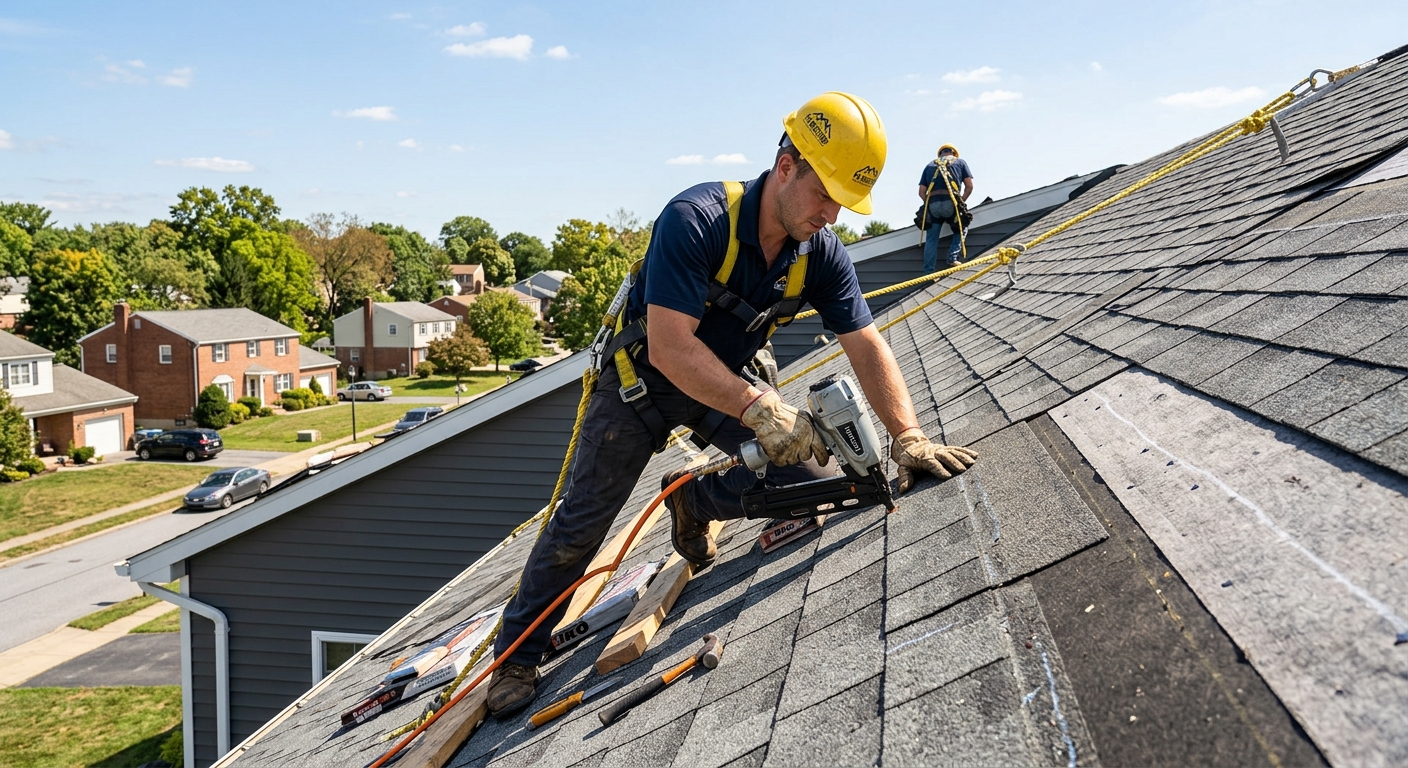
What roof replacement costs in Hamilton in 2026
Hamilton’s roof replacement costs in 2026 reflect both the local cost of living and the aging housing stock unique to this part of Franklin County. Here, most homeowners live in single-family properties, and with a homeownership rate of 86.0% (U.S. Census Bureau, ACS 2024), preventative maintenance is a priority for households planning to stay for the long term. Nearly half of the homes in Hamilton were built before 1980, which means there are many roofs nearing the end of their original service life. Large stretches of postwar development lead to many single-layer roofs reaching their last useful years at the same time—creating surges in neighborhood replacement activity every storm cycle.
For most Hamilton households, architectural asphalt shingles are still the most common choice because that’s what local subdivisions were originally designed for. Metal roofing is an option for those willing to pay more upfront, particularly where ridge-line winds are an ongoing threat. Flat roof TPO and EPDM systems are generally found on additions or smaller footprint structures. Repair work is more likely during busy replacement seasons, when contractors encounter isolated leaks or damage triggered by freeze-thaw cycling.
| Material / Scope |
Lifespan |
Best for |
Price range (installed) |
| Asphalt shingles — architectural (30-yr) |
25–30 yrs |
Standard Franklin County homes |
$9,900–$21,000 |
| Asphalt shingles — impact-resistant (Class 4) |
30+ yrs |
Homes exposed to ridge-line winds/hail |
$16,000–$21,000 |
| Metal standing seam |
40–70 yrs |
Wind-prone areas, low-maintenance preference |
$24,000–$43,000 |
| Flat roof — TPO or EPDM |
15–25 yrs |
Low-slope additions/porches |
$12,500–$25,000 |
| Roof repair — leak or isolated section |
n/a |
Local storm or water intrusion |
$500–$2,000 |
Prices are estimates for a typical Hamilton home and vary with roof size, pitch, decking condition and material selection.
What gets discovered after tear-off in Hamilton
Plenty of Hamilton homeowners are surprised by what turns up after the first row of shingles is pried away. The years between 1950 and 1980 saw rapid homebuilding here, but it was rarely done with today’s ventilation, flashing, or deck protection in mind. Once the shingles come off, it’s common to find rotted or spongy roof decking, especially at eaves and valleys—an extra $700–$2,200 for sheet replacement on a typical home. The degree of attic ventilation in Hamilton’s freeze-thaw climate matters a lot: insufficient venting can cause ice dams in winter that lead to plywood rot and, more critically, voided manufacturer warranties. Upgrading ridge vent and soffit venting during reroofing usually runs $750–$1,500 depending on how much new vent is needed.
Flashings around chimneys, valleys, and wall intersections are almost always discovered to be undersized, corroded, or previously sealed with roofing cement. Replacement of step or counter-flashing costs $350–$800 per detail, which most reputable contractors will put into the written change order. Aging vent boots can crack in a single winter; swapping these for new, higher-quality boots runs about $100–$300 each. Most Hamilton roofs built before the mid-80s lack required drip edge along eaves—a mistake for code and water management—so adding drip edge brings a cost of $350–$650 for an average home. If the existing roof doesn’t have a ridge vent, expect $450–$850.
No one likes facing extra costs, but a straight-over replacement often just covers up old failures waiting to reappear. In Hamilton, old wood and out-of-date detailing nearly always add something to the tab.
Filing a roof claim after a Pennsylvania storm
Heavy wind and ice can result in real roof damage anywhere between South Mountain and the Blue Ridge ridge-line, and Hamilton isn’t immune. If you suspect storm damage, take detailed photos of the roof, gutters, attic, and any water entry before any cleanup. The first key step is documenting the condition of the property—even if the damage seems minor at first pass. Next, request a written scope of loss from your insurance adjuster. This document lists exactly what they’ll pay for, and is the basis for comparing contractor estimates.
Understand the difference between actual cash value (which pays you the depreciated value of your roof) and replacement cost (which pays the full cost for a new roof, less your deductible). Most Franklin County home insurance policies are now written for replacement cost, but confirm what you have.
Under Pennsylvania’s Home Improvement Consumer Protection Act, your contractor must provide a written contract for any work over $500, and you have a three business-day right to back out. Any offer to “cover” or “waive” your insurance deductible is prohibited—don’t bite if you hear this; it’s illegal in Pennsylvania and a common marker of a contractor willing to cut corners or risk your coverage. A legitimate roofer should also be able to supply their Home Improvement Contractor (HIC) registration number, which can be verified at hic.attorneygeneral.gov—never skip this, especially after a storm when itinerant crews may flood the area. If your home was built before 1978 and the storm exposes paint or wood, the federal EPA Lead RRP Rule applies for safe work practices.
Once the adjuster has written the scope, you can compare this to your chosen contractor’s estimate before signing a contract. Do not let anyone start tear-off or repairs until you’ve agreed on the actual scope and understand your deductible responsibility in full.
Water management on a Hamilton roof
On a Hamilton home, water doesn’t just threaten your shingles—it tests your gutter system, downspout discharge, and yard grading every time it rains or freezes. Replacing your roof without updating failing gutters is only half a job. Even the best roof in Franklin County can’t protect against a basement leak if that water lands at your foundation. Here, discharge that isn’t sent five or six feet away is famous for showing up in crawlspaces and basements, especially when snow melt refreezes or rainfall is heavy along our ridge lines.
Current roof warranties often require that drainage systems carry water well away from the home—if your gutters or downspouts can’t handle the volume, or if they send runoff to a low spot, you may void your coverage. Seamless aluminum gutters sized at 5" or 6" with matching downspouts are standard for this part of Franklin County. When replacing a roof in Hamilton, full gutter replacement runs $2,000–$3,800 installed for most homes, depending on home size and number of stories, while gutter guards (often requested due to all the neighboring mature trees) add another $900–$2,200.
Quality drainage isn’t just about keeping your soffits from rotting—it’s about keeping your living space dry year-round.
Roofing permits in Hamilton: what you need before work starts
Hamilton homeowners operate under the Pennsylvania Uniform Construction Code (UCC), based on the IRC, with local enforcement in Franklin County. Work that triggers a building permit in Hamilton is specific: In the Borough of Chambersburg, any roof replacement involving changes to the underlying sheathing or framing requires a building permit. If your project in Hamilton stops at a direct shingle replacement and does not disturb the decking, it’s often done without a permit in most surrounding townships.
Permit issuance is handled by each municipality or by the Pennsylvania Department of Labor & Industry in municipalities that have opted out. Franklin County townships manage their own code or zoning offices; be sure to ask your contractor to clarify which applies at your address.
Under state law, any contract over $500 must involve a Home Improvement Contractor (HIC) registered with the Pennsylvania Office of Attorney General. You can—and should—look up any roofer’s registration at hic.attorneygeneral.gov before signing anything. Pennsylvania mandates workers’ compensation coverage for all employers, which you can verify via the WCAIS system (wcais.pa.gov). Do not take a verbal assurance on insurance; request a current certificate and double-check for yourself.
These requirements are designed to keep Hamilton homeowners out of trouble and ensure your new roof is installed to code and covered by your policy.
Checking out a roofer in Hamilton: what to verify
Before you sign any contract for a Hamilton roof replacement or repair, take the time to check that your contractor actually holds Home Improvement Contractor (HIC) registration from the Pennsylvania Office of Attorney General. This is the single most important step and is easily verified at hic.attorneygeneral.gov for all contracts over $500. Confirm that they carry valid workers’ compensation coverage through the WCAIS system at wcais.pa.gov—this protects you from liability if someone is injured on your property.
Ask to see a copy of their written contract, and make sure it lays out details on scope, cost, materials, warranty, and your right to cancel within three business days as protected by Pennsylvania law. For homes built before 1978, check their EPA Lead RRP certification at certifiedrenovatorsearch.epa.gov, especially if any painted surfaces may be disturbed.
- Verify HIC registration at hic.attorneygeneral.gov
- Get proof of workers’ compensation at wcais.pa.gov
- Request a written contract, not just an estimate
- Confirm three-day cancellation rights
- Check for EPA Lead RRP certification for pre-1978 homes
- Ask for a local reference job completed within the past year
- Request their certificate of general liability insurance
- Review scope of work for hidden charges or open “T&M” lines
- Get warranty terms in writing, not verbally
- Look for clear language about decking, flashing, and ventilation contingencies
- Expect clear, established business contact info and actual address
- Check for prompt, consistent communication before contract signing
Red flags to watch out for in Hamilton’s market: contractors with no local address or those who refuse to give a registration number, vague bids that leave out flashing or ventilation details, requiring oversized deposits, and out-of-town crews offering “same-day” replacements. The rural fringe here means some crews travel south from Harrisburg–Carlisle and may add surcharges—lack of a real footprint in Franklin County should always give you pause.
Workmanship vs manufacturer warranty
When you replace a roof in Hamilton, you receive two separate warranties, and it pays to know what’s covered. The manufacturer warranty covers the shingles or roofing material against manufacturing defects. These warranties are usually prorated—if there’s a defect, you receive less back as the roof ages—and require registration after installation. If you layer new shingles over old or allow poor ventilation to persist (which is easy to do in an older Franklin County home), you’ll void this warranty without recourse.
The workmanship warranty comes from your contractor and is only as reliable as the company’s track record. A 25-year labor warranty from a business that has only existed for two years is less meaningful than 10 years from a firm that’s been working under the same name for two decades. Workmanship warranties cover real-world mistakes during installation—nails blown through the shingle or flashing done incorrectly, for example. For transferability at resale, both the material and labor warranties may require a simple written notice after closing; failing to do so can leave a new homeowner with zero coverage.
Be sure to ask for written warranty terms and a registration card or online record. Don’t rely on assumptions: in Hamilton’s aging housing stock, flashing corrections, deck repairs, and ice dam details can mean the difference between a claim being honored and your expenses coming out of pocket.
Frequently asked questions — roofing in Hamilton
Why is my Hamilton roofing quote higher than the online average?
Hamilton roofing prices often run higher than figures you’ll see online for a few reasons specific to this area. Much of the housing stock was built between 1950 and 1980, so roofers frequently deal with single-layer tear-offs that reveal rot or outdated ventilation, which aren’t included in national estimates. Franklin County's thinner rural market means travel surcharges for jobs located south of Chambersburg are common, and not every square foot of roof has the same pitch or accessibility as a “sample” internet project. For an architectural asphalt shingle replacement, the 2026 local band is $9,900–$21,000, which reflects real supply, labor, code, and local weather exposures here, not a generic national average.
Do I need a permit to replace a roof in Hamilton?
Permit requirements vary within Franklin County. In the Borough of Chambersburg, if your roof replacement will disturb the sheathing or structural framing, you’ll need a permit. However, in most surrounding townships (covering Hamilton addresses outside borough lines), a direct shingle-for-shingle replacement that leaves the roof deck untouched generally does not require one. Always verify with your contractor which rules apply at your address, and make sure they’re working under the Pennsylvania Uniform Construction Code (UCC). Remember, a reputable contractor for any job over $500 must provide a written contract and register with the state.
What is the difference between TPO and EPDM?
TPO (Thermoplastic Polyolefin) and EPDM (Ethylene Propylene Diene Monomer) are both flat roof membranes seen on Hamilton homes, especially on porches, additions, or low-slope sections. TPO is a white, heat-welded membrane that reflects sunlight and resists algae, while EPDM is a black synthetic rubber excellent at resisting freeze-thaw cracking—a real plus for Franklin County’s cycling winters. EPDM tends to perform better on irregular surfaces and needs less precise installation, whereas TPO offers slightly better energy efficiency. Both types have replacement bands locally at $12,500–$25,000.
How do I find a reputable roofer in Hamilton?
Start by verifying that your roofer is registered with the Pennsylvania Office of Attorney General as a Home Improvement Contractor (HIC)—a must for any work over $500. Check this at hic.attorneygeneral.gov. Ask for a written, itemized contract and proof of active workers’ compensation insurance from the WCAIS system. Consider contractors with local references, stable business addresses in Franklin County, and a track record in this climate. Be wary of crews that only appear after storms or whose proposals don’t address code upgrades, attic ventilation, or water management specific to Hamilton’s older housing stock.
How much snow load can a Hamilton roof handle?
Most Hamilton roofs must meet the Pennsylvania Uniform Construction Code’s minimum ground snow load of 30 pounds per square foot (psf), which is what’s enforced by the local code office and is enough for our average winter. This doesn’t mean every roof handles drifting the same way—a 1970s truss and a new stick-built frame may perform differently over time. If you’re concerned, especially with an older roof nearing end-of-life, keep in mind that a timely replacement (typically $9,900–$21,000 for architectural shingles) can also involve deck evaluation and strengthening.
How can I tell if my roof decking is rotted?
In Hamilton, roofs built before 1980 are prone to hidden rot, especially around eaves or valleys where ventilation was often poorly done. Signs include sagging lines, visible dips, sponginess underfoot if you (or your roofer) step on the surface, and musty attic smells. Sometimes, water stains or mold can show up on your ceiling without obvious leaks. The only sure way is after tear-off—so expect that your estimate may rise by $700–$2,200 if widespread decking replacement is needed. Always ask your contractor to document these discoveries with photos and to get your approval before any extra charges.
What happens if it rains mid-replacement?
Hamilton’s mixed climate—where thunderstorms can pop up on a clear forecast—means that experienced roofers plan for weather. If rain threatens mid-job, contractors will securely tarp over exposed decking, underlayment, and attic openings to prevent water intrusion. This isn’t just convenience: a wet underlayment can void manufacturer warranties or cause hidden rot. Some tarping is built into local bids, but large-scale or emergency tarping can run an additional $500–$1,000 depending on roof size and access. Your contract should spell out how weather delays and emergency tarping are handled before work begins.
Can a contractor cover my insurance deductible in Pennsylvania?
No. In Pennsylvania—including Hamilton—waiving or “covering” your insurance deductible on a roof claim is prohibited by state law (under the Home Improvement Consumer Protection Act). Any contractor who claims otherwise is not just tempting a fine—they’re risking your claim and future coverage. Offers like these often signal a contractor willing to inflate invoices or cut corners elsewhere. Stick with pros who answer this question directly and don’t shy away from a written, transparent bid. Remember, your homeowner’s out-of-pocket deductible is required for proper payment on any claim, whether for repair ($500–$2,000) or full replacement.
How much does a flat roof replacement cost in Hamilton?
For a typical Hamilton home with a flat or low-slope roof, replacing with a membrane system such as TPO or EPDM in 2026 costs between $12,500–$25,000. Most of these installations serve porches, garages, or additions rather than entire house footprints. Evaluating roof deck condition, adding insulation, and ensuring proper water drainage all influence the final price. Unlike asphalt shingle replacements, flat roof jobs usually take more labor per square foot due to the specialty materials and flashing details required by the local code. Always ask for a written scope so there are no surprises after tear-off.