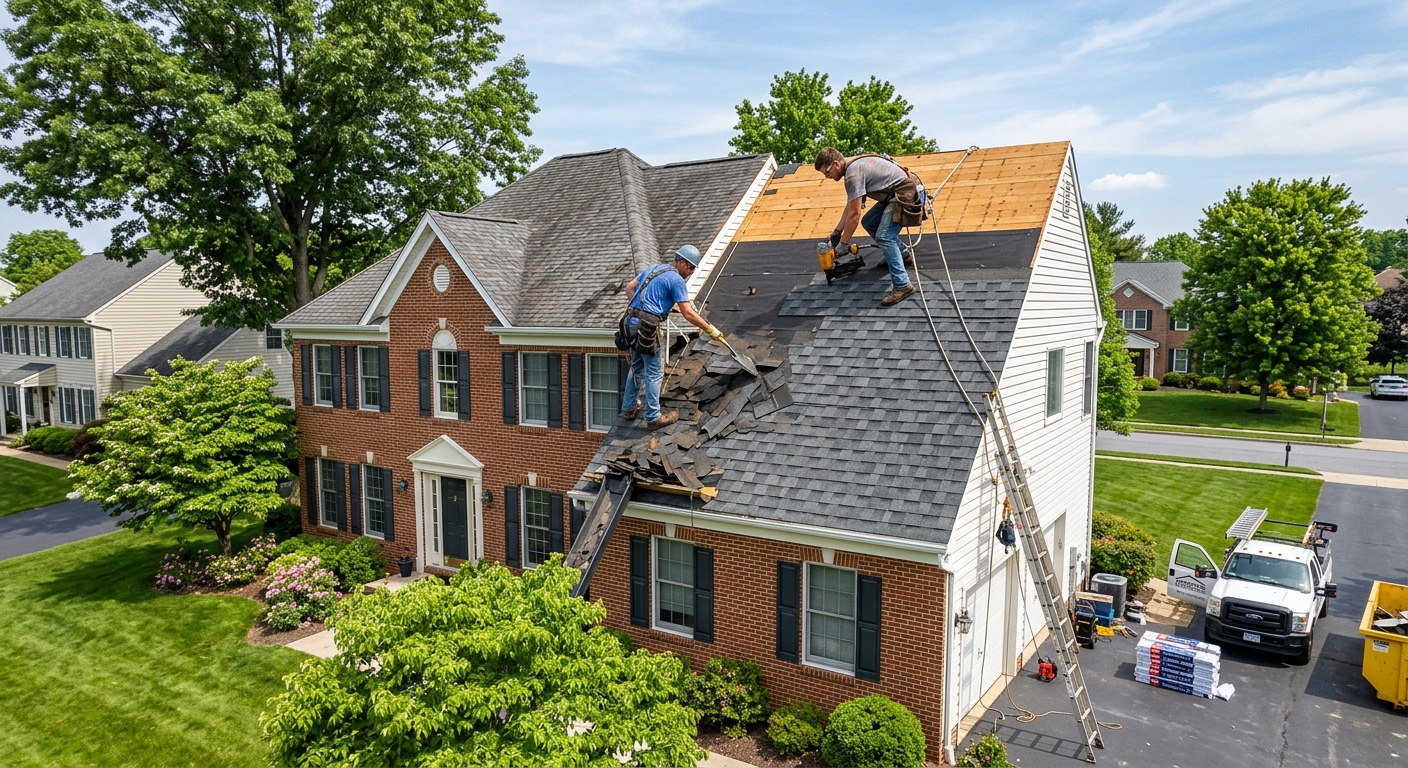
Hatfield roofing prices by material and scope — 2026
Hatfield’s mix of older homes and steady homeownership shapes roof replacement needs in a way you will not see in every Pennsylvania town. With a homeownership rate above 65% and more than half of local houses built before 1980 (U.S. Census Bureau, ACS 2024), roof replacements in Hatfield aren’t a “someday” project—they’re a present concern. Many area roofs have powered through their original lifespan, especially those in tract neighborhoods with houses from the post‑World War II building boom. In nearby Abington and Cheltenham, that same era’s surge in development hit here as well, driving high demand for architectural asphalt shingle replacements as original roofing systems reach their limits.
In these Hatfield neighborhoods, the original builder-grade roofs often used basic 3-tab shingles with 20-year lifespans, but most replacements now specify architectural shingles for improved durability. Flat roofs are also common over porches or additions—especially on older single-families—and these areas carry separate cost and system considerations from the main pitched roof. Metal roofing is still the outlier, but interest ticks up among homeowners planning to stay long term, wanting to get out of the replacement cycle. Here’s what you can expect for a full replacement or targeted repair in Hatfield:
| Material / Scope |
Lifespan |
Best for |
Price range (installed) |
| Asphalt shingles — architectural (30-yr) |
25–30 yrs |
Most single-family homes in post-war subdivisions |
$10,000–$21,500 |
| Asphalt shingles — impact-resistant (Class 4) |
30+ yrs |
Homes exposed to severe wind or hail |
$16,500–$21,500 |
| Metal standing seam |
40–70 yrs |
Permanent replacement, energy efficiency upgrades |
$24,500–$43,500 |
| Flat roof — TPO or EPDM |
15–25 yrs |
Porches, additions, low-slope rear sections |
$13,000–$25,500 |
| Roof repair — leak or isolated section |
n/a |
Repair of a small area, flashings, or a single leak |
$550–$2,000 |
Prices are estimates for a typical Hatfield home and vary with roof size, pitch, decking condition and material selection.
The scope items Hatfield homeowners don't budget for
In Hatfield, good contractors will list every component on your roof estimate, but there are a few items in this market that bump up the final invoice after work starts. Rotted plywood—called “decking”—is a prime culprit, lurking undetected beneath old shingles until tear-off. For each sheet of decking replaced, expect an additional $75–$150. Given that over half of Hatfield’s houses are pre-1980 (U.S. Census Bureau, ACS 2024), sudden discoveries are common, especially where old roof leaks or chronic attic moisture have gone unseen.
Ventilation is another hidden cost that can’t be skipped in southeastern Pennsylvania’s freeze-thaw climate. Poor attic ventilation is a main driver for winter ice damming here, especially on north-facing slopes. If your last shingle warranty was voided for this very reason, a new system—gable vents, ridge vent, or additional soffit intake—can run $500–$1,200 all-in, but it’s a real investment against both efficiency loss and ice damage. Replacing worn vent boots and adding modern drip edge runs $20–$40 per opening or linear foot, but these stop a lot of future leaks. Chimney and wall flashing replacement, best installed new with a roof, typically adds $350–$800 depending on brickwork and access.
None of these extras make contractors in Hatfield happy—they’re time and material risks we’d rather avoid. But skipping them is just a way to guarantee bigger trouble on your next storm. If your estimate is missing these items, ask why.
Repair or replace? A decision guide for Hatfield roofs
For Hatfield homeowners, the right move isn’t always the most expensive one. If your roof is young—under 15 years old—and a falling branch or a windblown shingle leaves a single leak, a targeted repair is all you need. But more than half the homes here are over 40 years old, meaning original roofs and even many first replacements are beyond their prime. When you’re dealing with two or three leaks and your system is pushing 20–25 years, continuing to patch is just pouring money into a roof you’ll still need to replace within a few seasons.
Here’s a real scenario: Two repairs a year at $1,300 apiece adds up to $2,600—that’s already more than 10% of a full roof replacement at $16,500. Do that twice and you’ve paid for a third of a new system, but you’re still living under patchwork. For original post-war or 1970’s Hatfield roofs, if you’re at the 25-year mark and getting new leaks after every storm, it’s simply money wasted to keep fixing.
| Situation |
Recommendation |
Typical cost |
Reasoning |
| Under 15 years, one isolated leak |
Repair |
$550–$2,000 |
Shingles or membrane are still within design life; local fix is cost-effective |
| 15–25 years, several leak points |
Replace |
$10,000–$21,500 |
Widespread failure; patching is throwing good money after bad |
| 25+ years, any active leak |
Replace now |
$10,000–$21,500 |
Total system at end of life; deck and underlayment likely compromised |
| Storm damage, wind or hail |
Document, claim, replace |
$10,000–$21,500 |
Insurance may cover if documented; scattered patching usually not durable |
| Flat roof ponding or blistering |
Replace membrane |
$13,000–$25,500 |
Water intrusion will worsen; repair doesn't address underlying cause |
| Active leak entering winter |
Emergency repair, schedule replacement |
$550–$2,000 |
Quick patch now, full replacement soon; prevents damage during freeze/thaw |
The cost drivers behind a Hatfield roof replacement
Roof bids in Hatfield can diverge sharply, and that’s not just about who you call—your home’s age, design, and even its location in Montgomery County matter. Roof size is always the first factor, measured in “squares” (100 sq ft of roof surface each), but homes here often have cut-up layouts or porches with low-pitch or flat sections that can double the material count and labor time. Remember, houses built during the post-war boom in Hatfield and the region are now seeing their first or second replacement, and these usually require full tear-off.
Pitch also drives the quote. Hatfield’s moderate winter snow load (30 psf) means proper ice barrier at eaves is non-negotiable, especially on north-facing slopes or where homes see more wind off the Schuylkill River valley. If your home is two or three layers deep due to previous roof-overs, disposal and labor costs can add $500–$1,500 for each extra layer removed.
Decking surprises are common with older plywood—rot or delamination revealed at tear-off is a real cost here. Replacing bad sheets means an extra $75–$150 per 4x8 panel. The material you choose influences price—architectural shingles are strongest value, but splurging for Class 4 impact-resistant adds $500–$2,500 and only pays off where wind and hail are frequent. Add-ons like ridge vent or ice shield typically run a few hundred but protect against the freeze-thaw we see each winter.
| Factor |
Why it matters here |
Cost impact |
| Roof size in squares |
each square is 100 sq ft of roof surface |
primary multiplier |
| Pitch and access |
steep pitches need harnesses and slow the crew |
+20–30% labour |
| Existing layers to tear off |
two or more layers means full tear-off and disposal |
$500–$1,500 per layer |
| Decking condition |
rot is found during tear-off, not before |
$75–$150 per sheet |
| Ice barrier at eaves |
required where ice damming has a history |
$300–$800 |
| Material grade |
3-tab vs architectural vs Class 4 impact-resistant |
$500–$2,500 |
Low-slope and flat roofs in Hatfield
Flat or low-slope roofs are everywhere in Hatfield: porch covers, kitchen additions, or rear sections on single-family homes. The main mistake I see here is someone quoting shingles on a roof with less than a 3/12 pitch—especially the common 2/12 slopes on older homes. Shingles are never reliable on low slopes in this climate. Water runs slow, pools more easily, and Hatfield’s humid summers and freeze-thaw cycles turn those puddles into leaks.
Instead, look for a dedicated membrane system: TPO or EPDM. Both are made for ponding water and resist rot much better than rolled roofing or modified bitumen. Expect 15–25 years of service if installed properly. Pricing for a flat membrane roof in Hatfield falls in the $13,000–$25,500 range, depending on square footage and complexity (parapet walls, scuppers, tie-ins with the main roof). Repairs rarely last more than another season or two once blistering starts or water sits for days. If you get a quote for shingles on a 2/12 pitch, that contractor is either cutting corners or doesn’t know southeastern PA rules—a red flag not to ignore.
Roofing permits in Hatfield: what you need before work starts
Roofing in Hatfield falls under the Pennsylvania Uniform Construction Code (UCC), which is based on the International Residential Code (IRC). Every municipality in Montgomery County enforces these rules directly, not through the county. In Norristown, replacing more than 25% of an existing roof typically requires a building permit, while minor shingle repairs under one square of area in Lower Merion Township do not trigger a permit. Check which scenario your project fits in before scheduling your job—even in the same county, township rules vary.
Pennsylvania requires every contractor entering into a roofing contract over $500 to have Home Improvement Contractor (HIC) registration, issued by the Office of Attorney General. You can (and should) verify a contractor’s HIC number at hic.attorneygeneral.gov before hiring. Workers’ compensation insurance is also mandatory for every Pennsylvania roofing employer. Request proof and verify a contractor’s active insurance in the Workers’ Compensation Automation and Integration System (WCAIS) at wcais.pa.gov.
Written contracts are required by state law for all roofing work over $500, and you have a three business-day right of cancellation. It is illegal for a roofer to offer to waive your insurance deductible. Lead paint rules (EPA RRP) apply if your Hatfield home was built before 1978, so check the renovator’s certification at certifiedrenovatorsearch.epa.gov for any tear-off or work that disturbs siding, soffit, or walls.
Water management on a Hatfield roof
Roofing isn’t really finished in Hatfield until your water management system is dialed in. Gutters and downspouts, drip edge, and grading all work together to keep water away from your foundation. Swapping shingles without rethinking the gutters is common, but every time you see standing water at the base of a wall or foundation, you’re witnessing this shortcut bite back. Downspout discharge that’s too close to the foundation is one of the main triggers for basement moisture—even more so on Hatfield’s post-war homes, many of which predate modern drain tile and sump installations.
Most reputable roofers in the area will recommend full gutter and guard replacement alongside a new roof—especially when existing runs are bent, rusted, or undersized. Expect to pay an additional $2,200–$4,500 for aluminum seamless gutters and basic guards with a typical roof job. Many shingle warranties also require adequate drainage to remain valid, so skimping here can cost you in the long run. After decades on these roofs, I can say: skip new gutters, and you’ll soon be calling for a basement fix instead.
Frequently asked questions — roofing in Hatfield
How much does a flat roof replacement cost in Hatfield?
Flat roof replacements in Hatfield are a distinct project from pitched roof jobs and come with their own cost structure. Whether you’ve got a low-slope porch, an addition, or a rear flat section that ties into your main roof, the systems used—TPO or EPDM—are chosen specifically to handle ponding water, which shingles never can. For 2026, the average flat roof replacement in Hatfield runs in the $13,000–$25,500 range, covering new membrane, insulation if specified, proper flashing at walls and penetrations, and disposal of the old surface. Patch repairs are possible, but if you’re seeing standing water, splits, or seam failure, full replacement is almost always longer-lasting and more cost-effective. Factor in local labor and material preferences, especially since more than half of Hatfield’s homes were built before 1980—older decks sometimes need more repairs during the project.
What warranty should a Hatfield roofer offer?
In Hatfield, any reputable roofer should offer both a manufacturer’s warranty (typically 25–30 years for architectural shingles) and a clear workmanship warranty, which is what covers leaks caused by installation errors. Manufacturer coverage means little if the installer is cutting corners, so watch for the fine print—many warranties are voided if proper decking and attic ventilation aren’t installed, a key concern in Hatfield’s freeze-thaw, humid climate. On a $10,000–$21,500 architectural roof, expect 10 years as a minimum workmanship term, but the best contractors will put their name on the work for life—not just until the check clears. Always get any warranty in writing as part of your contract, and make sure it spells out both labor and material coverage.
What does it mean if my shingles are curling or losing granules?
Curling shingles and granule loss are classic signs of aging or heat-stressed roofs—a common sight on Hatfield homes built in the ’50s, ’60s, and ’70s. Granules protect shingles from UV and weather, so once they start wearing off in your gutters or downspouts, your roof is on limited time. Curling at the edges means loss of flexibility, which follows years of southeastern Pennsylvania’s freeze-thaw cycles and humid summers. If your roof is over 20 years old and you’re spotting these symptoms after only patch repairs, it’s a clear indicator you’re headed for replacement, not continued fixes. Most full replacements in Hatfield fall into the $10,000–$21,500 range this year.
Can I install new shingles over old ones in Pennsylvania?
In Pennsylvania, the Uniform Construction Code generally allows a second layer of shingles over a single existing layer, but it’s rarely the best option in Hatfield. Most homes here already had this done in the past, meaning you could have up to two or even three layers by now—every layer adds weight and traps heat, making leaks and premature aging more likely. Tear-off is the standard in Montgomery County if you want full warranty coverage and a roof that lasts through all four seasons. Adding a third layer is never recommended and might push project costs higher in the long run due to required deck and flashing repairs later on. Full replacement with proper tear-off now runs $10,000–$21,500, but saves headaches down the line.
Will filing a roof claim raise my premium?
Filing a residential roof claim in Hatfield may result in a premium increase, but it depends on your insurer and claim history. One weather-related claim—such as for wind or hail damage, which isn’t rare in Norristown or Upper Merion given local storm exposure—usually has a smaller effect than repeated claims or a pattern of maintenance neglect. If your roof repair or replacement costs more than your deductible (which, on a full architectural shingle roof, can be $10,000–$21,500), you should still document all damage and speak to your agent before proceeding. Remember, Pennsylvania law prohibits contractors from waiving or “eating” your deductible. Always work with a contractor who understands the difference between repairing storm damage versus system failure due to lack of upkeep.
How much does a new roof cost in Hatfield?
For a full architectural asphalt shingle roof replacement in Hatfield, expect to see quotes in the $10,000–$21,500 range for a typical single-family home, with most falling around the $16,500 mid-point. Prices vary based not just on size but on condition of old decking, number of stories, pitch, and any extras like ridge venting or upgraded flashing—often needed in homes built well before 1980 (U.S. Census Bureau, ACS 2024). Metal standing seam roofs are growing in popularity for homeowners planning to stay long-term, but these start around $24,500 and often reach $43,500. Always ask if your estimate includes tear-off of old layers and any decking or ventilation upgrades discovered during the project.
What causes ice dams on Hatfield roofs?
Ice dams on Hatfield roofs come down to a mix of climate and construction history. Southeastern Pennsylvania’s moderate ground snow load (30 psf) and regular freeze-thaw cycles mean melting snow refreezes at the eaves if attics are poorly ventilated or poorly insulated. This is a frequent challenge on older Hatfield homes where original venting is either inadequate or compromised by past roof-overs. Hot air rises, melts rooftop snow, and water backs up under the shingles as soon as it hits the cold edge, leading to leaks or interior stains. Fixing this means two things: better attic insulation and continuous ridge/soffit venting, both of which should be addressed with a full roof replacement or targeted upgrade—often adding $500–$1,200 to the project, but saving costly water damage after the next winter storm.
How long does a roof replacement take in Hatfield?
Most standard asphalt shingle roof replacements in Hatfield are finished within two to four days, depending on roof size, pitch, and weather. Unpredictable summer thunderstorms or high humidity, common to this region, may span the project over several days to keep crews and your property safe. Some complicated jobs—multi-story homes, flat roof tie-ins, or projects discovering rotten decking during tear-off—can add another day or two and a few hundred dollars in contingency costs. For a typical roof in the $10,000–$21,500 range, expect set-up, tear-off, minor wood repairs, underlayment, new shingles, and flashing within one work week. If the forecast is clear and the access is reasonable, three days from start to finish is more the norm.
Is metal roofing noisy in rain?
Metal roofing on a Hatfield home is no noisier in the rain than asphalt shingles when installed over solid decking and underlayment—which is standard practice on houses here. Old myths about tin roofs come from open framing or barns with no insulation, but Montgomery County building practices for residential installations always include solid sheathing. A properly installed standing seam metal roof, which runs $24,500–$43,500, will not amplify rain or hail noise any more than a conventional shingle roof. In fact, most homeowners are surprised how quiet it is once the roof is fully assembled, and the added benefit is durability—metal stands up well to Hatfield’s occasional severe storms and offers decades of low-maintenance service.