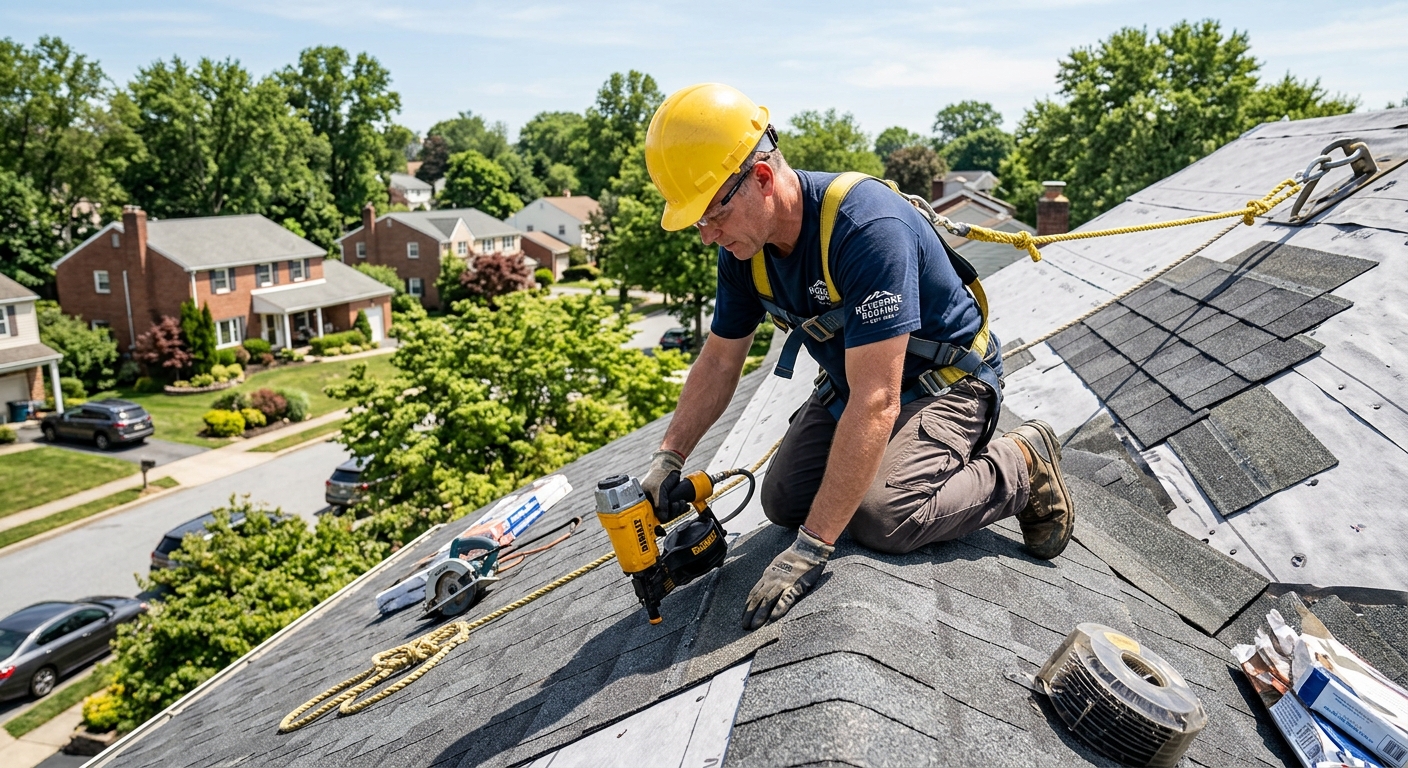
Lehman roofing prices by material and scope — 2026
In Lehman, Pike County, nearly nine out of ten homes are single-family residences—reflecting the area’s high homeownership rate and making roof work a distinctly personal investment for most residents (U.S. Census Bureau, ACS 2024). Asphalt shingles are the material of choice here, driven by accessibility to Scranton-area supply yards and cost control for families working within Pike County’s median household income. What's changing is that large developments sprung up near Dingman’s Ferry in the 1980s–1990s now face the natural replacement cycle of their original roofs. Many homes went up in a surge, so now whole blocks of asphalt roofs are reaching the end together—meaning roofers and suppliers see waves of full replacements, not just patchwork repairs. If you live outside these subdivisions or in an older part of Lehman, your timeline may differ, but most replacements now involve stripping at least a second layer of shingles and repairing areas of weakened decking from snow, ice, and prior leaks.
This table covers what Lehman homeowners can expect to pay for the most common materials and scopes.
| Material / Scope |
Lifespan |
Best for |
Price range (installed) |
| Asphalt shingles — architectural (30-yr) |
25–30 yrs |
Standard residential replacement |
$9,000–$19,000 |
| Asphalt shingles — impact-resistant (Class 4) |
30+ yrs |
Areas with frequent wind or hail exposure |
$15,000–$19,000 |
| Metal standing seam |
40–70 yrs |
Sheds snow/ice, longest service life |
$22,000–$39,000 |
| Flat roof — TPO or EPDM |
15–25 yrs |
Low-slope sections, garages, additions |
$11,500–$23,000 |
| Roof repair — leak or isolated section |
n/a |
Patching affected area, typical for single leaks |
$475–$1,800 |
Prices are estimates for a typical Lehman home and vary with roof size, pitch, decking condition and material selection.
Choosing a roofing material for Lehman's climate
Lehman’s winters are no joke: snow loads here push 40 pounds per square foot and the frost line drops to 36 inches, with winter design temps at 4°F. That climate punishes roofs that can’t deal with snow and freeze/thaw cycles. Architectural asphalt shingles are the norm because they offer the reliability locals need at a price that fits with Pike County’s income profile. They hold up reasonably well to the Delaware River valley’s ridge-line winds and are simple to source and repair thanks to Scranton-area distribution. Metal standing seam roofing is the undisputed snow champ—its slick surface sheds drifts and resists ice-dam damage—but the upfront cost is steeper and it only pays off if you plan to stay in your home for decades or want as little maintenance as possible.
Impact-resistant shingles, rated Class 4, are a niche upgrade for homes repeatedly slammed by high winds or close to the river ridge, but most Lehman properties get by fine with standard architectural types. If a contractor tries pushing metal on every job, read the fine print—unless you have a low-sloped roof that traps snow or plan to age in place, it’s rarely cost-effective. Flat membrane roofs (TPO/EPDM) are mostly for low-slope additions or porches. For standard gables, architectural asphalt remains the best value overall for Lehman’s mix of climate, age of home, and resale market expectations.
| Material |
Installed cost |
Lifespan |
Cold-climate performance |
Maintenance |
| Asphalt architectural |
$9,000–$19,000 |
25–30 yrs |
Good; manages ice, repairable after wind |
Inspect biannually, occasional shingle replacement |
| Asphalt Class 4 impact-resistant |
$15,000–$19,000 |
30+ yrs |
Very good; more durable in wind/hail |
Low; holds up better to falling branches/hail |
| Metal standing seam |
$22,000–$39,000 |
40–70 yrs |
Excellent; sheds snow, resists ice dams |
Minimal; check fasteners and seams |
| TPO / EPDM membrane |
$11,500–$23,000 |
15–25 yrs |
Good for low-slope; weak to sharp ice debris |
Annual seam check, clear drains |
Reading the warranty on a Lehman roof
Every roof job in Lehman comes with two overlapping warranties, but most homeowners only think about the first: the manufacturer’s material warranty. This covers defects in the shingles, metal, or membrane itself—typically for 25 or 30 years on architectural shingles. Most are prorated, meaning the fine print subtracts for every year of use. These warranties are sometimes “lifetime,” but will place heavy responsibility on the installer for proper ventilation, single-layer installation, and timely registration. Forget to register a new roof with the manufacturer within the required period after install—sometimes 30 or 60 days—and you risk losing out on major coverage.
The second warranty is for workmanship: how the roof was put on. This is offered by the company doing the work, not the shingle or metal manufacturer. Terms range, but in Lehman, contractors often promise 5–10 years—and while a 25-year labor warranty may sound good, it isn’t worth much if the company is only two years old or runs crews in from out of county. An established roofer with community roots is actually more reliable than a paperwork-only promise. Most warranties will void if there’s inadequate attic ventilation, if shingles are layered over old roofs, or if you sell and fail to register the warranty transfer with the product manufacturer. If you’re planning on selling, check transferability within the first few years—it’s relatively common but not automatic.
Storm damage and insurance claims in Lehman
In Lehman, when wind tears tabs from your roof or ice dams force water under your shingles, your insurance company expects an orderly process for claims. First, take clear photos of every affected area before a tarp or cleanup—insurance adjusts your claim from what shows up in writing, not word of mouth. Your contractor should write a detailed scope of loss after inspection so that when the adjuster comes (and they will), your household and the insurer are working from the same facts. Most policies cover roof damage as “replacement cost” but cut back to “actual cash value” if your roof is past its typical lifespan—so an older 25-year shingle can leave you making up a large gap for depreciation.
Critical for Pike County: Pennsylvania’s Home Improvement Consumer Protection Act requires a written contract for roofing jobs over $500, and you get a three-business-day right of cancellation. Offers to “waive your deductible” are illegal in Pennsylvania—if a roofer promises to “eat your deductible,” that’s a bright red flag. Not only does this violate state law, it puts your policy at risk and could void a claim. Document everything, do not sign blank scope forms, and remember: insurance wants proof, not promises. Lehman homes, especially along the wind-prone Delaware River valley, see enough storm claims that adjusters expect organized records; good contractors don’t shortcut this process.
When to book roofing work in Lehman
Lehman’s roofing calendar is driven by two things: weather that can shift quickly in the Poconos, and a sparse contractor pool. May through early October gives the best window for shingle replacements—ambient temps hit the 40°F mark needed for new asphalt to seal properly. Labor Day to Columbus Day is a sweet spot for scheduling: crews aren’t yet backed up from storm rushes, and kids are in school, making site access easier. By late fall, every good roofer is hustling to catch up before the first big snow—slotting in only emergency repairs and quick patches. If you wait until after Thanksgiving, expect to pay premium rates for emergency work, especially on complex jobs like full roof deck replacements.
Remember, Pike County’s market is thin and rural—most roofing contractors commute in from Scranton–Wilkes-Barre, so lead times can stretch to three or four weeks during peak fall. Emergency work in February, when everything is snow-covered and shingle tabs are brittle, will be costlier than a scheduled replacement in September. Plan your booking in spring if you want first pick of schedule, and don’t bank on getting same-week service once the first snow melts. When a real emergency hits, costs can spike, and your options will shrink to whoever is still available.
What a proper Lehman roofing quote contains
If you’re comparing roofing estimates in Lehman, demand clear specifics. The quote should state your roof’s area in squares (one square equals 100 sq ft) and specify the pitch. Tear-off should detail how many layers will come off and if a dumpster is included. Underlayment and ice shield must be named by product and coverage—“15 lb felt” is not the same as a modern synthetic underlayment, and “ice and water shield” must state how high it runs up from the eaves. Decking, the wood under your shingles, should be priced per sheet as a contingency—rot under old nailing can’t always be seen ahead, but you need to know what a replacement costs per sheet. Flashing and vent boots should be checked or replaced. Always see manufacturer and workmanship warranties listed separately, and payment terms split into modest deposit with balance on completion.
A lump sum quote without a square count or line items is a red flag—you can’t compare it to anything else and you may end up paying for shortcuts. Look for a breakdown, not just totals, so you can see what you’re buying and catch any missing pieces before signing.
| Line item |
What to look for |
Red flag if… |
| Roof area |
stated in squares, with pitch |
no measurement given |
| Tear-off and disposal |
number of layers, dumpster included |
bundled into one figure |
| Underlayment |
product type and coverage |
listed only as 'felt' |
| Ice and water shield |
coverage height at eaves |
omitted entirely |
| Decking |
per-sheet contingency price |
no allowance at all |
| Warranty |
workmanship years stated separately |
only the shingle warranty |
| Payment |
deposit under 15%, balance on completion |
large upfront cash |
Permits and code requirements in Lehman
The residential roofing code in Lehman follows the Pennsylvania Uniform Construction Code (UCC), based on the International Residential Code, and enforced locally by township permitting offices or by the PA Department of Labor & Industry in areas that have opted out. In nearby Milford Borough, replacing more than 25% of your roof deck—meaning the actual wood beneath the shingles—requires pulling a building permit. In places like Dingman Township, small repairs under one roofing square using the same shingles can often be done without any permit. Full replacements or structural work will almost always need permitting through your local office.
All contractors offering jobs over $500 must have Home Improvement Contractor (HIC) registration from the Pennsylvania Office of Attorney General. You can check a roofer’s registration directly at hic.attorneygeneral.gov. For insurance, workers’ compensation is mandatory for all employers in Pennsylvania, with verification available via the WCAIS system at wcais.pa.gov. If you own a pre-1978 home, federal EPA Lead RRP Rule applies on work disturbing paint—verify certification with certifiedrenovatorsearch.epa.gov. Lehman has no trade license for roofers; only HIC registration is required, so don’t be swayed by claims of extra credentials not named here.
Frequently asked questions — roofing in Lehman
What happens if it rains mid-replacement?
In Lehman, crews are always watching the radar—rain squalls can pop up fast in Pike County’s hills. If the roof is mid-strip and a storm rolls in, most reputable contractors will only tear off what they can protect the same day. The exposed decking is tarped tightly or covered with synthetic underlayment until dry conditions return. On rare occasions where rain gets through, insurance and written documentation are key, since any water staining or drywall damage should be logged for your claim. The cost of emergency tarping or extra mitigation is usually built into repair quotes (think $475–$1,800 for a fast-response leak patch or temporary cover). The important thing for Lehman homeowners: don’t push your roofer to finish in marginal weather, as rushed installation is where leaks get baked into new roofs.
What is the difference between replacement cost and actual cash value?
Many Piper County insurance policies, including for homes in Lehman, cover roof damage at “replacement cost” for the first 10-20 years of a roof—meaning you get enough for a new roof of similar kind and quality, such as an architectural asphalt job in the $9,000–$19,000 range. Once your roof is near or past its life expectancy, however, the insurer shifts to “actual cash value” (ACV). ACV subtracts depreciation for age and condition—so a 25-year-old roof, even if damaged by a storm, won’t be paid out at full replacement price. That often leaves Lehman homeowners making up the difference from their own savings, especially if you want to upgrade to a better material or if wear-and-tear is the main cause of the leak.
What should a roofing quote include in Lehman?
In Lehman, a proper roofing quote should lay out your roof dimensions (in “squares”), the number of layers to be demolished, the specific products used for underlayment and ice/water shield, and a contingency price for any deck replacement. You’ll also want each warranty named—manufacturer’s material and local installer’s labor warranty—plus a payment schedule that never asks for more than a 15% deposit. For example, on an architectural asphalt replacement in the $9,000–$19,000 range, look for a line-by-line breakdown and square count rather than just a lump sum. Any quote without these details is tough to compare and may hide shortcuts or upsells that hit you only after the tear-off starts.
How long do architectural shingles last compared to 3-tab?
Most roofs installed in Lehman today use architectural shingles, which give a real-world service life of 25–30 years under Pike County’s snow and wind conditions. Older homes may still have 3-tab shingles from the 1980s or 1990s cycles, and those rarely hold out past 18–22 years in local weather, often failing early due to wind uplift or ice-dam damage. The jump in price for architectural shingles—a typical $9,000–$19,000 replacement—gets you a thicker, heavier product that stands up to wind and sheds water better than the obsolete 3-tab style. It’s a smart investment, especially if you plan to stay in your home longer than five years.
Can I inspect my own roof safely?
Regular walkaround inspections are a smart move for Lehman homeowners, as spotting blown-off shingles or moss early can save a lot of money in repairs, keeping issues in the $475–$1,800 range for a patch rather than a full tear-off. You don’t need to climb up if you’re uncomfortable—use binoculars from the yard, check your attic for leaks after big storms, and look for shingle granules in the gutters. Roofs with a higher pitch or multiple layers can be dangerous; on these, consider hiring a local pro. If you do go up, use a harness, secure ladder, and never try it in icy or wet conditions—our snow load and valleys make for slippery surfaces much of the year.
Why is my Lehman roofing quote higher than the online average?
Many online averages are pulled from suburban or urban areas with high contractor density and less severe winters. In Lehman, every roof is subject to the region’s 40 psf snow load and ridge-line wind. That means more robust ice/water shield, better underlayments, and careful labor. Thin local competition—most roofers commuting in from Scranton—also drives up labor. Plus, homes built in the 1980s–1990s replacement cycle may need two or even three shingle layers stripped before new roofing can go on. All of this is factored into the $9,000–$19,000 range for asphalt shingle replacements here. Quotes higher than national averages are more about local code, climate, and labor than upcharges.
How do I confirm a roofer carries workers' compensation?
In Pennsylvania, including Lehman, workers’ compensation is compulsory for any employer offering roofing services. Before signing a contract—especially for a larger replacement job in the $9,000–$19,000 range—ask your roofer for their insurance certificate. You can confirm it online for Pennsylvania by searching the WCAIS system at wcais.pa.gov. If a contractor dodges the question or can’t provide proof, look elsewhere. No workers’ comp coverage puts you at risk of liability if injuries occur on your property during the job. It’s a required protection for both the homeowner and the crew.
Does attic ventilation matter in Lehman's climate?
Proper attic ventilation is crucial in Lehman due to our heavy snow loads and cold winters. Without venting, warm air from inside the house melts snow on the roof—creating ice dams that force water back under the shingles. This dramatically shortens your roof’s life, even if you invested in a high-end system like an architectural asphalt job in the $9,000–$19,000 band. Poor or blocked ridge/soffit vents can also void both your manufacturer’s and installer’s warranties. Insist on a contractor who checks and upgrades ventilation as part of any major roof replacement or repair.
Does roof pitch affect the price in Lehman?
Yes—roof pitch is a big factor for Lehman homes, many of which were built in subdivisions with mid-to-steep slopes to shed our region’s heavy snow loads. Steeper pitches are harder and more dangerous to work on, requiring safety rigging and slowing labor, which pushes up both the timeline and cost within the $9,000–$19,000 range for a full asphalt roof. On low-slope or flat sections, you may also need specialized membranes, which come with their own price band ($11,500–$23,000). Always make sure your quote lists the pitch being bid—otherwise, you aren’t getting an honest comparison.