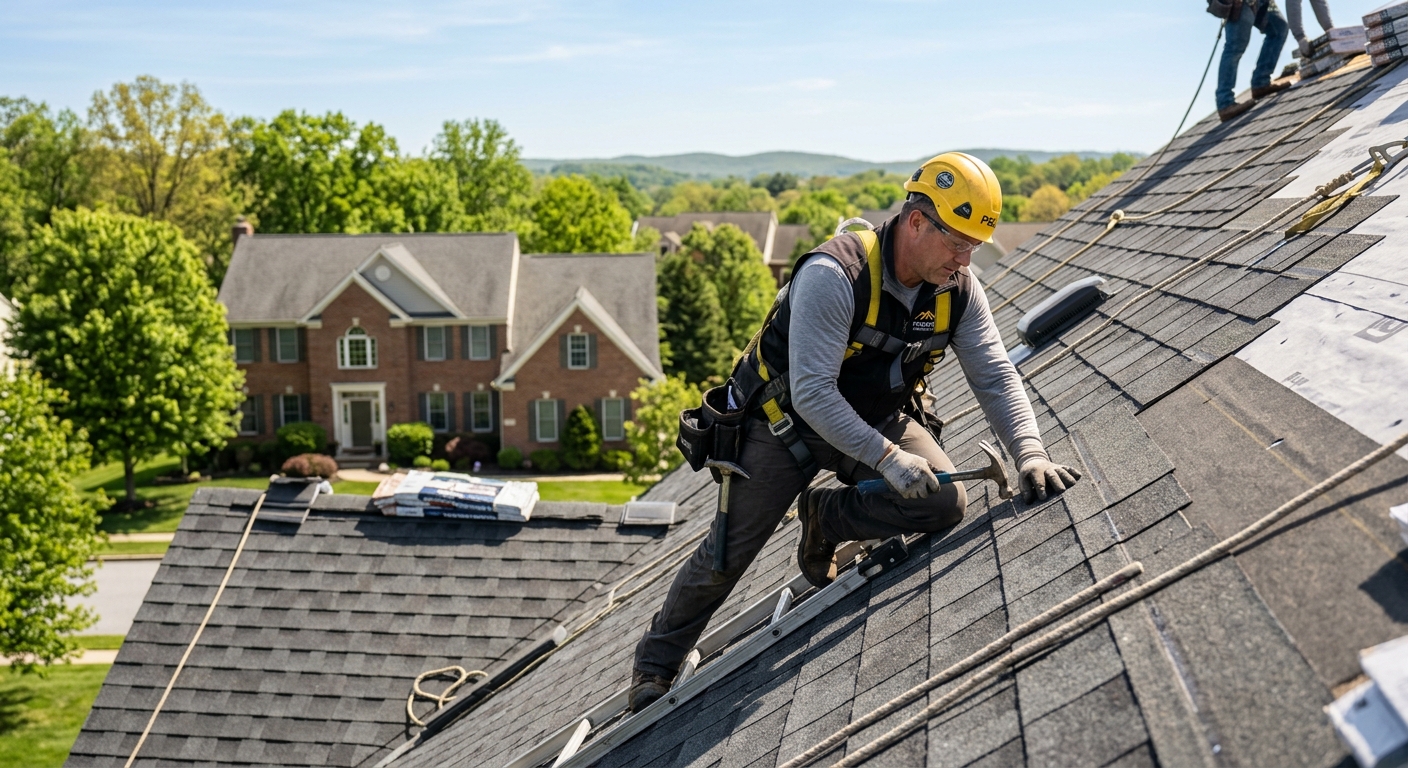
Roofing Replacement & Repair costs in Murrysville — 2026
Murrysville’s homeowner market is distinct in Pennsylvania, with nearly 90% homeownership and a high median income (U.S. Census Bureau, ACS 2024). This means many in Murrysville choose complete roof replacements rather than temporary patch jobs, focusing on longevity and resale. Over half the homes here were built before 1980, so plenty are coming due for second or even third roofs—not just quick repairs.
Much of Murrysville’s housing stock is similar to nearby Hempfield and North Huntingdon, which both boomed from the 1960s to the 1980s through subdivision sprawl. Those homes leaned heavily into 3-tab and early architectural asphalt, many now pushing or past the end of their useful life. In Murrysville, a roof replacement is rarely just shingles—unexpected decking and venting work is common, and insurance is a bigger player than in newer, denser boroughs. If you’re budgeting, expect repairs and replacements here to be driven by real-life local precedent, not generic national averages.
| Material / Scope |
Lifespan |
Best for |
Price range (installed) |
| Asphalt shingles — architectural (30-yr) |
25–30 yrs |
Most single-family homes pre-2000 |
$10,000–$21,000 |
| Asphalt shingles — impact-resistant (Class 4) |
30+ yrs |
Homes with wind/hail exposure on open ridgelines |
$16,500–$21,000 |
| Metal standing seam |
40–70 yrs |
Premium upgrades, homes with low-pitch or rural settings |
$24,000–$43,000 |
| Flat roof — TPO or EPDM |
15–25 yrs |
Additions, porches, low-slope rear ells |
$12,500–$25,500 |
| Roof repair — leak or isolated section |
n/a |
Spot repairs, minor leak diagnoses |
$550–$2,000 |
Prices are estimates for a typical Murrysville home and vary with roof size, pitch, decking condition and material selection.
Reading a roofing estimate line by line
An estimator in Murrysville should give you more than a lump sum: a clear breakdown protects you when the inevitable surprises of an older Westmoreland County roof come up. Your estimate should show roof area in “squares” (one square = 100 sq ft), with roof pitch noted. Look for tear-off and disposal as a separate line item—old homes from the 1960s–1980s in Murrysville often have two or more layers that need haul-off. Underlayment should be listed by specific product (such as synthetic versus felt), and ice and water shield should state how many feet up from the eave it runs—especially relevant for our freeze-thaw cycle. Decking replacements should be given as a contingency price per sheet, not a blanket guess. Any estimate worth considering will split the workmanship warranty (the installer's guarantee) from the manufacturer’s material warranty. Finally, watch the payment schedule: reputable companies here rarely ask for more than 15% down before materials land on site.
A vague, padded proposal with no detail on squares, product names, or contingencies can end up costing you thousands more after the tear-off. Here’s what you want to see line by line:
| Line item |
What to look for |
Red flag if… |
| Roof area |
stated in squares, with pitch |
no measurement given |
| Tear-off and disposal |
number of layers, dumpster included |
bundled into one figure |
| Underlayment |
product type and coverage |
listed only as 'felt' |
| Ice and water shield |
coverage height at eaves |
omitted entirely |
| Decking |
per-sheet contingency price |
no allowance at all |
| Warranty |
workmanship years stated separately |
only the shingle warranty |
| Payment |
deposit under 15%, balance on completion |
large upfront cash |
Decking, ventilation and flashing — the hidden roof costs
On most Murrysville jobs, initial bids focus only on visible surface items—shingles and underlayment. But as soon as tear-off starts, hidden extras can stack up fast. Rotted roof decking (plywood or plank beneath the shingles) is common in homes built before 1980. Each bad sheet replaced typically adds $100–$180 per sheet to your final bill, depending on access and wood cost. This is rarely avoidable if water entry has gone on for years.
Attic ventilation is not just for comfort: in southwestern Pennsylvania, poor ventilation is a root cause of ice damming and can void your shingle warranty outright. If code-minimum ridge vent or box venting is needed, expect to pay $600–$1,500. It’s cheaper than risking a fifty-foot ice dam.
Flashing—metal at chimneys, walls, and valleys—and vent boots can run another $300–$900 if extensive retrofit or wall re-flashing is required (think stonework or brick transitions). Don’t forget drip edge and proper ridge vent; our freeze-thaw cycles mean any shortcut here leads straight to future rot and ice trouble. If the numbers seem high, remember: in Murrysville’s aging subdivisions, repair call-backs cost far more than getting it right at replacement.
Pennsylvania code and Westmoreland County permit rules for roofing
Roofing work in Murrysville is governed by the Pennsylvania Uniform Construction Code (UCC), which is based on the international code standards. Local enforcement in Westmoreland County falls to the township or borough office involved—here, Murrysville handles its own permitting, while nearby Greensburg uses the City of Greensburg Planning and Development Department. For a typical residential roof replacement in Murrysville, a permit is required if new decking is being installed or if structural work is needed; a straightforward shingle overlay, without changes to structure, may not require a permit. Always call your local code office for specifics, since enforcement details do vary between jurisdictions in the county.
Contractors in Pennsylvania must hold Home Improvement Contractor (HIC) registration from the Pennsylvania Office of Attorney General for jobs over $500. You can verify any roofer’s registration at hic.attorneygeneral.gov. To confirm that a company carries workers’ compensation insurance—mandatory for every roofing employer in the state—look them up on the WCAIS system at wcais.pa.gov.
Be wary of anyone who dodges these checks, skips a permit when required, or asks you to pull it yourself. That’s trying to get you to bear their risk. If you’re not sure, check both state sites before you sign.
Roofing warranties in Murrysville: what's actually covered
A new roof in Murrysville comes with two distinct warranties, often confused by homeowners and blurred by less-than-straightforward contractors. The manufacturer warranty covers defects in the shingles or membrane itself. It is usually prorated after a decade, and requires that materials are registered—sometimes within weeks of install—or you lose coverage. Manufacturer coverage can also be voided if your attic ventilation is deemed inadequate, or if you layer new shingles over old ones. Transfer if you sell the house is usually possible only once and sometimes triggers a drop to basic coverage.
The workmanship warranty is the contractor’s promise to fix leaks or failures caused by their install practices (not defective materials). In Murrysville, this varies widely: ten years is standard from a reputable local company, but the value is only as strong as the business behind it. A 25-year promise from a company younger than your existing roof is just marketing. Look for established presence more than big numbers.
Bottom line: don’t trust a handshake. Get both warranties in writing up front, with transfer and claim steps spelled out by the installer, and record your registration with the manufacturer right after install.
Snow load, ice dams and wind in Murrysville
Murrysville sits in the Ohio Valley hail and wind corridor east of Pittsburgh, with a local ground snow load of 30 pounds per square foot and a winter design temp of 8°F. Roof upgrades here need to defend against both snow accumulation and cyclical freeze-thaw, not just “general weather.” Ice dams are a key risk: as snow sits on a poorly insulated or inadequately vented attic space, warmth from the house melts the lowest layer. This water runs down to the eave—where the roof is coldest—then refreezes, forcing water backward beneath shingles. The result: hidden moisture rot, ruined deck boards, and leaks that can require repairs from $550–$2,000 or, in severe cases, force premature roof replacement at $10,000–$21,000 for asphalt, simply because code-minimum precautions weren’t followed.
Hail in this corridor doesn’t always punch visible holes, but it does bruise asphalt granules, weakening waterproofing and leading to “blistering” leaks two or three years later. Murrysville’s exposed ridgeline homes are especially at risk. Insurance adjusters here know to look for this delayed damage. Wind here exploits old or improperly fastened edge shingles—why proper starter strip and ice barrier at eaves/rakes is non-optional under current code.
Don’t shortchange ice & water shield: in southwestern Pennsylvania, it needs to go at least 36 inches up from the eave for any roof slope under 8:12. A basic peel-and-stick patch is not enough in Murrysville’s landscape and market.
Storm damage and insurance claims in Murrysville
If a wind or hail event blows through Murrysville, the right first step is documentation—even before cleanup. Take clear photos of any shingle loss, lifted edges, dented metal, or water intrusion on ceilings. Once safe, call your insurance (not the roofer first) for claim instructions, and get a written scope of loss from the adjuster. Most policies here work on actual cash value (ACV)—depreciated for roof age—unless you upgraded with replacement cost value (RCV) coverage. Know which you’re getting paid; on older Murrysville roofs built in the 1970s or '80s, ACV payouts can be far short of the cost for a new install ($10,000–$21,000 for architectural asphalt or more for metal).
Your roofer’s job isn’t just to tarp or patch—though a quick emergency tarp (often $550–$2,000) is smart if more rain’s coming. Get their written estimate before work, so it lines up with the adjuster’s loss statement. Under the Home Improvement Consumer Protection Act (HICPA), all jobs over $500 require a written contract, and waiving your insurance deductible is illegal in Pennsylvania. A roofer promising to “cover your deductible” is trying to break the law and could drag you into a false claim, with fines or voided coverage as a result.
There is a mandated 3 business-day right of cancellation on any signed contract in Murrysville, so don’t let anyone rush you. Storm event or not, your best defense is documenting everything, confirming every promise in writing, and following up registration and insurance checks before work starts.
Frequently asked questions — roofing in Murrysville
Is a metal roof worth the extra cost in Murrysville?
Metal standing seam roofs in Murrysville cost from $24,000–$43,000, which is a significant step up from architectural asphalt. Whether it’s worth it depends on your situation. If you plan to be in the home for decades, want minimal maintenance, and your roof is exposed to the open ridgelines seen east of Pittsburgh, metal lasts 40–70 years and shrugs off hail and wind better than asphalt—an advantage unique to our area with frequent high-wind and hail events. Insurance sometimes even gives minor discounts for new impact-resistant metal. However, on a home where resale is in the next 10–15 years, you may not recoup the difference. In neighborhoods with mostly asphalt, a high-end metal roof can also be hard to value on appraisal and doesn’t always attract more buyers. For steeper roofs or those prone to ice dams, metal also sheds snow easily, making it more than just a style upgrade in our winter design climate.
How do I file a storm damage roof claim in Pennsylvania?
In Murrysville, after storm damage, document everything with clear photos before doing any cleanup. Notify your insurer—claims adjusters use local benchmarks to assess hail or wind loss, and a roof from the 1970s may be subject to actual cash value (ACV) calculations. Get a written scope of loss from the insurer before soliciting roofing estimates. A reputable roofer will provide an itemized estimate matching what your insurer sees, and handling the work through a written contract (required for jobs over $500 by HICPA). Pennsylvania law prohibits contractors from waiving your deductible, so be wary of anyone making that offer. The insurer may send an adjuster to the property to confirm damage, especially after storms affecting zip codes east of Pittsburgh’s main corridor. Retain all receipts, photos, and correspondence: local contractors and adjusters expect detailed documentation, and clear records speed up settlement and inspection.
How long does a roof replacement take in Murrysville?
Most asphalt shingle replacements in Murrysville, which fall in the $10,000–$21,000 range, take 1–3 days for a typical single-family home. Add another day if extensive decking or ventilation upgrades are discovered after tear-off. If you’re installing a metal standing seam system, expect the work to stretch out to 3–5 days, due to the extra fabrication and detail required—especially on multi-plane or hipped roofs found in many Murrysville subdivisions. Factors that extend timelines here include rain delays, delivery issues, or the need to schedule inspections (if required by township permit). During the busiest months—late spring to early fall—you might wait longer between contract signing and project start, especially after a storm passes through our part of Westmoreland County and local demand spikes.
How do I find a reputable roofer in Murrysville?
Start by verifying Home Improvement Contractor (HIC) registration at hic.attorneygeneral.gov for any roofer bidding on your Murrysville home—this is required for all jobs over $500 here. Check their workers’ comp status at wcais.pa.gov; plenty of local handymen will offer a “cheap job,” but can’t protect you if a worker is injured on your property. Ask for references in Murrysville itself, not just generic Pittsburgh suburbs. A trustworthy contractor will provide itemized quotes, use local permit language, and never pressure you into side deals or large up-front payments. Roofing is a major investment for the area’s older housing stock, so don’t be afraid to demand resumes, check past work addresses, and insist on both material and workmanship warranties in writing.
How can I tell if my roof decking is rotted?
In Murrysville—where many homes are pushing 40+ years—the odds of encountering rotted deck boards increase with every roof cycle. Warning signs include a spongy or uneven feel when walking the roof (only safe for professionals), visible sagging from the attic side, or stained, blackened areas where leaks have persisted. During a replacement in the $10,000–$21,000 range, pros will only know for sure once shingles come off. Many bids here will include a contingency of $100–$180 per sheet, as local homes often reveal at least a few soft patches along valleys or chimney lines. If you see water marks or persistent leaks on the ceiling below—or if the attic smells musty year-round—assume you need targeted decking replacement as part of a real-world scope of work.
What is the difference between TPO and EPDM?
TPO (thermoplastic polyolefin) and EPDM (ethylene propylene diene monomer) are both popular flat roof membranes in Murrysville, especially for porch roofs or low-slope rear additions on older homes. TPO is heat-welded at the seams, bright white to reflect sun, and is often specified on newer builds for its energy efficiency. EPDM is a black rubber sheet glued down in large pieces, famous for durability in our heavy freeze-thaw cycles. Both last 15–25 years, with installation prices for most area homes running $12,500–$25,500. TPO is slightly better at managing ponding water and reflecting heat, while EPDM tends to do better in shaded or tree-heavy lots. In the Murrysville climate, choice is often driven by roof layout, prior system type, and sun exposure—not just cost.
Does roof pitch affect the price in Murrysville?
Yes, roof pitch has a bigger impact on pricing here than many realize. Steeper roofs in Murrysville require additional safety setup, more staging, and usually more labor hours—especially since fall protection is non-negotiable under Pennsylvania code. For a typical replacement, the same footprint might price at $12,000 on a low-slope ranch, but $18,000 or more if your roof features hips, valleys, or pitches above 8:12, all common in Murrysville subdivisions built for character and resale. Steep slopes also tend to shed snow faster—an advantage in our snow load zone—but the tradeoff is higher install cost. Always make sure your written estimate notes the roof pitch and crew safety plans; vague proposals often hide shortcuts in these tougher jobs.
What causes ice dams on Murrysville roofs?
Ice dams are a chronic issue in our region, especially with Murrysville’s older housing stock. The main culprit is inadequate attic ventilation combined with insulation gaps—warm air reaches the roof deck, melts snow, and it refreezes at the cold eaves. This process is intensified in our winter design condition (8°F base temperature), forcing water back under shingles, rotting the deck, and causing leaks that require repair costs ranging from $550–$2,000 or premature roof replacement. Homes built before 1980 often lack modern ridge or soffit venting, making them particularly vulnerable. Modern re-roof projects should specify both continuous ridge vent and a proper eave ice barrier to minimize the risk; a shortcut here is a false economy in our climate.
How do I verify a roofing contractor is registered in Pennsylvania?
It's simple: look up the company on the Pennsylvania Office of Attorney General’s Home Improvement Contractor (HIC) registry at hic.attorneygeneral.gov. Any job over $500 in Murrysville requires this registration, and the lookup lists the business name, HIC number, address, and any disciplinary actions. For jobs involving workers, check the workers’ compensation registration at wcais.pa.gov to confirm active coverage. Never accept just a certificate handed over—the official state sites are the only sure way to check status. If a contractor refuses or their name doesn’t appear, walk away. In Westmoreland County, plenty of reputable roofers do it right, and using the registry is quick insurance against fly-by-night operators who might disappear when you need a callback.