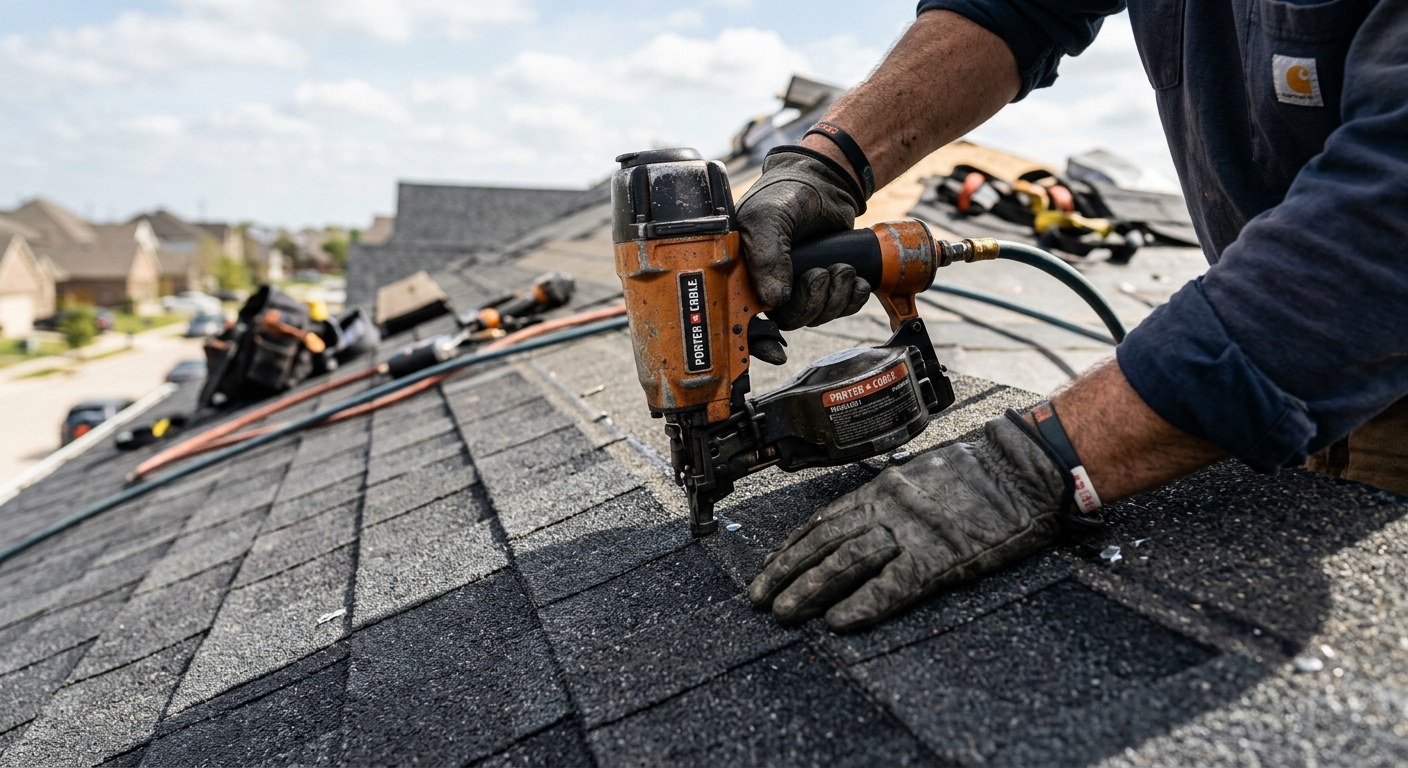
Spring roofing prices by material and scope — 2026
Spring homeowners face a very specific set of roofing costs due to our Centre County location. With 65.8% of local homes single-family and nearly half built before 1980 (U.S. Census Bureau, ACS 2024), much of the housing here uses the materials and assembly styles developed during major post-1960 Penn State–driven subdivisions. These neighborhoods, like those in and around State College, feature a large number of low-slope roofs—a detail that makes the average job more demanding than in many other parts of Pennsylvania. On a low-slope roof, waterproofing and membrane installation need extra care at every transition from roof to wall.
Also, heavy winters (with a local ground snow load of 40 psf) mean roofs here see more freeze-thaw cycling, so details matter. In practical terms, replacement costs are set not just by the size of your roof but by the expense of proper flashing, ice and water shield coverage, and the likelihood of discovering decking that’s gone soft. Below are the realistic price ranges you’ll encounter in Spring for the most common roofing materials and jobs, installed by professionals familiar with Centre County conditions:
| Material / Scope |
Lifespan |
Best for |
Price range (installed) |
| Asphalt shingles — architectural (30-yr) |
25–30 yrs |
Most Spring single-family homes, cost-effective with OK snow resistance |
$9,400–$20,000 |
| Asphalt shingles — impact-resistant (Class 4) |
30+ yrs |
Areas exposed to ridge-line winds along Bald Eagle or Nittany mountains |
$15,500–$20,000 |
| Metal standing seam |
40–70 yrs |
High-value upgrades, best snow shedding |
$22,500–$40,500 |
| Flat roof — TPO or EPDM |
15–25 yrs |
Low-slope and post-1960 subdivisions; durable and watertight |
$12,000–$23,500 |
| Roof repair — leak or isolated section |
n/a |
Patching, flashing leaks, or replacing blown-off shingles |
$500–$1,900 |
Prices are estimates for a typical Spring home and vary with roof size, pitch, decking condition and material selection.
Asphalt, metal or membrane — what suits a Spring roof
In Spring, Centre County, what matters most for roof longevity isn’t just what material costs upfront—it’s how well your roof stands up to 40 pounds per square foot of snow in a winter where 2 °F is the local baseline. Metal sheds snow with ease and shrugs off ice dams, which is a big win in our climate. Membranes like TPO and EPDM are the right call for low-slope roofs, which are common here due to decades of Penn State–era subdivision construction. Asphalt shingles, particularly architectural and Class 4 types, dominate because they are cost-effective for the large single-family homes built in this era and can be installed efficiently on both steeper and moderately pitched roofs.
Asphalt architectural shingles have become the dominant material here simply because they provide a reliable balance of price and cold-weather durability that fits the budgets and roof styles of most Spring homes. The more expensive Class 4 impact-resistant shingles or metal roofs make sense if your home is in a spot regularly hit by ridge-line winds, but the upgrade isn’t always worth it if storm exposure is average and your underlying attic ventilation is poor—an issue in many local older houses. Membrane roofs are non-negotiable on low-slope or flat sections. Below is a practical head-to-head comparison of how these materials stack up for Spring’s real climate:
| Material |
Installed cost |
Lifespan |
Cold-climate performance |
Maintenance |
| Asphalt architectural |
$9,400–$20,000 |
25–30 yrs |
Good for moderate snow, ice backup possible without proper ventilation |
Yearly check for granule loss, standard ridge and eave care |
| Asphalt Class 4 impact-resistant |
$15,500–$20,000 |
30+ yrs |
Handles wind and hail better, same snow vulnerability as standard architectural |
Low; inspect after major storms |
| Metal standing seam |
$22,500–$40,500 |
40–70 yrs |
Excellent snow shedding; no granule loss or ice backup issues |
Minimal, check fastener tightness every few years |
| TPO / EPDM membrane |
$12,000–$23,500 |
15–25 yrs |
Excellent for low-slope, no shingle blowoff, but seam failure possible over decades |
Annual seam and flashing inspection |
How to vet a Spring roofing contractor
When hiring a roofer in Spring, you want peace of mind—and that means seeing paperwork, not just a truck and a handshake. Pennsylvania requires any contract over $500 to be with a Home Improvement Contractor registered with the Office of Attorney General. Check their registration directly at hic.attorneygeneral.gov. For companies with employees, workers’ compensation is mandatory statewide—verify coverage using the state’s WCAIS system at wcais.pa.gov. If your home is pre-1978, federal law requires EPA Lead RRP certification for tear-offs—look this up at certifiedrenovatorsearch.epa.gov.
- Check HIC registration at hic.attorneygeneral.gov
- Confirm written contract language per the Home Improvement Consumer Protection Act
- Verify workers’ compensation coverage via WCAIS
- Ask for proof of insurance (liability and workers’ comp—not just a card, but insurer contact)
- If your roof is pre-1978, check EPA Lead RRP certification
- Ask for previous addresses and completed jobs in Centre County
- Request a sample contract and warranty in writing
- Demand a permit if required (State College Borough: more than 25% of roof area replaced)
- Review contingency line items (decking, flashing) in the estimate
- Specify payment schedule—no large upfront cash
- Confirm the physical business address—avoid only a PO box or out-of-town listing
- Be wary of vague references (“manufacturer’s warranty covers everything”)
Red flags in the Spring market: contractors with no local address (common in our thin rural service area), no written contract, no HIC registration, cash-only deals, or “storm chasers” who show up after wind events along the Nittany or Bald Eagle ridges, pressuring for quick, uninsured repairs.
What gets discovered after tear-off in Spring
A roof replacement in Spring rarely ends up being just shingles and underlayment. Once tear-off starts, previously hidden issues common in Centre County start to show, especially in homes from the postwar boom and Penn State–era expansions. Rotted or soft roof decking is the most frequent surprise, particularly on low-slope roof areas where water can pond or ice backs up. Replacing decking typically adds $60–$125 per sheet (4x8 feet) to your final cost. Another find is attic ventilation problems: blocked soffits or undersized ridge vents drive ice damming in our sub-zero winter design, which can void shingle warranties or lead to leaks. Some jobs need a complete ridge vent install, running $700–$1,300 for a typical Spring ranch.
Chimney and wall flashing often needs complete rebuilding, especially if earlier layers were tarred over or pieced together without soldering. Proper flashing can add $400–$1,000 depending on the detail and number of penetrations. Expect at least a few new vent boots ($40–$120 each), drip edge ($350–$650 for a whole roof), and attention to the ridge cap and sidewall step flashing ($400–$800). These are not “extras” but critical steps in making your roof last through seasons of snow loading, freeze-thaw, and high winds.
Workmanship vs manufacturer warranty
Many Spring homeowners are surprised to learn their roof comes with two warranties: the manufacturer’s, covering shingle or membrane defects, and the contractor’s, covering how well everything was installed. Manufacturer warranties are generally prorated after year 10 or 15 and require registration soon after the job. Most cover defects, not leaks, unless an “enhanced” or “system” warranty is registered (and every detail is installed to spec). Poor attic ventilation, layering new shingles over old, or skipping specified underlayments can void this coverage—all common issues in Spring’s post-1960 homes.
The workmanship warranty is only as good as the business backing it. Twenty-five years means little from a crew who started last spring and may not be around for next winter. Ten years from an established contractor is far more reliable. Most are transferable on resale, but read the fine print—some must be transferred within 30–60 days and require a fee. If in doubt, insist on separate written warranty documents for both installation and material, and keep your attic properly vented and roof maintained for coverage to stick.
What a proper Spring roofing quote contains
In Spring, a reliable roofing quote will show the actual number of “squares” (100 sq ft), roof pitch, clear scope of tear-off and disposal (including how many layers), underlayment type, and the exact brand and model of ice and water barrier. Look for a separate per-sheet price for deck replacement—this lets you budget for what might show up after tear-off. Flashing and vent boots should be itemized; so should both warranties (workmanship and manufacturer), not blurred into one. The payment schedule should never require large upfront cash. If a quote just lists a lump sum, or omits measurements and contingency pricing, you’re being prevented from making a fair comparison—or worse, being set up for “change orders” later.
| Line item |
What to look for |
Red flag if… |
| Roof area |
stated in squares, with pitch |
no measurement given |
| Tear-off and disposal |
number of layers, dumpster included |
bundled into one figure |
| Underlayment |
product type and coverage |
listed only as 'felt' |
| Ice and water shield |
coverage height at eaves |
omitted entirely |
| Decking |
per-sheet contingency price |
no allowance at all |
| Warranty |
workmanship years stated separately |
only the shingle warranty |
| Payment |
deposit under 15%, balance on completion |
large upfront cash |
Roofing permits in Spring: what you need before work starts
Roofing projects in Spring fall under the Pennsylvania Uniform Construction Code (UCC), based on the IRC, as overseen by the PA Department of Labor & Industry. In State College Borough, replacing more than 25% of your roof’s surface requires a building permit, while small repairs (a few shingles) in College Township usually don’t. Each municipality handles its own code enforcement, so double-check with your local office before work starts.
You can and should verify your roofer’s Home Improvement Contractor (HIC) registration at hic.attorneygeneral.gov before signing any contract over $500. For workers’ compensation coverage, go directly to WCAIS at wcais.pa.gov; this is mandatory for any contractor with employees on site. Written contracts are also required under the Home Improvement Consumer Protection Act, with a 3-business day right of cancellation. Don’t accept offers to waive your homeowner’s deductible—this is illegal under state rules. For older homes (built pre-1978), check for EPA Lead RRP certification at certifiedrenovatorsearch.epa.gov to comply with federal hazardous material laws.
Frequently asked questions — roofing in Spring
How much does it cost to repair a roof leak in Spring?
In Spring, Centre County, the typical cost for a professional roof leak repair falls between $500–$1,900. Factors affecting the price include the leak’s location, accessibility, and what’s needed to restore the flashing or underlayment. If you have an older Spring home—almost half here were built before 1980—expect that a small leak may uncover bigger issues, especially around chimneys or low-slope additions. Unlike some larger cities, roofers here typically charge fair rates and work based on established local reputation. Always ask the contractor to specify whether the quoted price covers just the surface fix or includes new flashing/vent boot if needed. Minor repairs (just a few shingles, no sheathing replacement) will end up near the low end of the band, but don’t be surprised if the real cost goes higher if rot or hidden damage is discovered during the process.
Does attic ventilation matter in Spring's climate?
Yes—attic ventilation is a big deal here in Spring and across Centre County. With a typical ground snow load of 40 psf and a winter low design temperature of just 2 °F, poor attic airflow can cause ice dams, which are more than a nuisance; they can destroy the roof deck and void your shingle warranty entirely. Even on newer homes, blocked or ineffective vents can turn a well-built roof into a repair magnet. If you’re re-roofing, expect to see a line item for ridge and soffit vent improvements or repairs, which might add $700–$1,300 to the bill, but is absolutely worth it for avoiding major water damage and warranty cancellations in the future.
What if my insurer denies my roof claim?
Insurance denials are common in Spring for older roofs, especially if there’s evidence of workmanship mistakes, neglected maintenance, or long-term ventilation issues—problems found more often in homes built before 1980. If your claim is denied, get a thorough inspection from an independent, local contractor willing to provide photographic documentation of damage and repair needs. Sometimes a small repair ($500–$1,900) can get you through the season, instead of a full replacement, especially if your policy excludes "wear and tear" but does cover accidental storm or tree damage. Always push your insurer for the actual written denial and review their language; you may have limited appeal or recourse, but detailed roofer notes from another party help greatly if you try again.
Do I need to leave my house during a roof replacement?
For most Spring homeowners, you do not have to leave your house during a roof replacement—especially if you’re using asphalt shingles, which is the most common material here. That said, the process is noisy and there will be significant vibration, especially if deck repairs are involved (sometimes adding $60–$125 per sheet). If you work from home or have pets, you might want to relocate for a day or two. It’s always best to clear the driveway and move cars out of debris range, as disposal dumpsters and falling shingles are part of every job in Centre County. Children’s safety is the highest priority; make sure everyone knows to stay clear.
Is a metal roof worth the extra cost in Spring?
A metal standing seam roof runs between $22,500–$40,500 in Spring and is often worth the extra expense if you plan to stay in your home long-term or value minimal upkeep. Metal sheds our heavy, wet snow loads far better than asphalt and doesn’t suffer the granule loss or ice damming seen frequently in older Spring subdivisions. For homes exposed to the highest winds on local ridges, metal is the clear winner. However, if you don’t plan to stay in your house for decades, or if resale is a question in just a few years, you may not recover the extra up-front cost in a market dominated by asphalt roofs.
What does it mean if my shingles are curling or losing granules?
In Spring’s climate, curling or granule loss almost always signals that the shingles have reached the end of their useful life, typically 20–30 years for standard asphalt. These symptoms are often hastened by inadequate attic ventilation and sustained snow loads, which our area is known for. Curling edges can invite wind-blown rain and snow, fast-tracking leaks and deck rot. If your roof is showing these signs, a full roof replacement is probably in your near future, likely in the $9,400–$20,000 range for architectural shingles. Get a local roofer to confirm what’s happening—sometimes isolated issues can be fixed, but widespread curling almost never means “just a repair.”
Are there historic district rules affecting roofing in Spring?
In most areas of Spring, historic district roofing rules are not a factor. However, if your home is in Bellefonte or certain borough areas, you may have to use specific materials, profiles, or colors to keep with historic appearances. In practice, such rules are more likely in Bellefonte proper than in the post-1960 Spring subdivisions. Always check with your local municipal office before any major roofing project. If you are required to use a certain material or style, expect architectural shingles ($9,400–$20,000) to be allowed in most cases, but verify before you sign a contract, as improper installation can mean costly tear-offs and delay.
How much deposit should I pay a roofer upfront?
Pennsylvania’s Home Improvement Consumer Protection Act prohibits large upfront deposits. In Spring, reputable roofers will usually ask for 10–15% upfront, or enough to cover materials on order. Paying more than that is a red flag—especially in our market, where out-of-town crews sometimes take cash and never return. For a standard asphalt shingle replacement priced at $15,500, expect a deposit between $1,500 and $2,000, with the remainder due upon satisfactory completion and municipal inspection, if required. Always keep a signed contract; never pay large sums in cash without a receipt and written agreement.
What is the best roofing material for Spring's climate?
For most Spring homes, architectural asphalt shingles strike the best balance—proven durability for our 40 psf snow load, good performance in local freeze-thaw cycles, and moderate cost ($9,400–$20,000 installed). Metal standing seam wins for the ultimate snow-shedding, but is best justified if you’re in a high-wind corridor or plan to be in the home long-term. TPO or EPDM membrane is unmatched on low-slope roofs, which are widespread in post-1960 subdivisions here. The “best” material depends on your roof’s slope, exposure, and budget, but shortcuts on ventilation or flashing will undermine any material you pick in our climate.