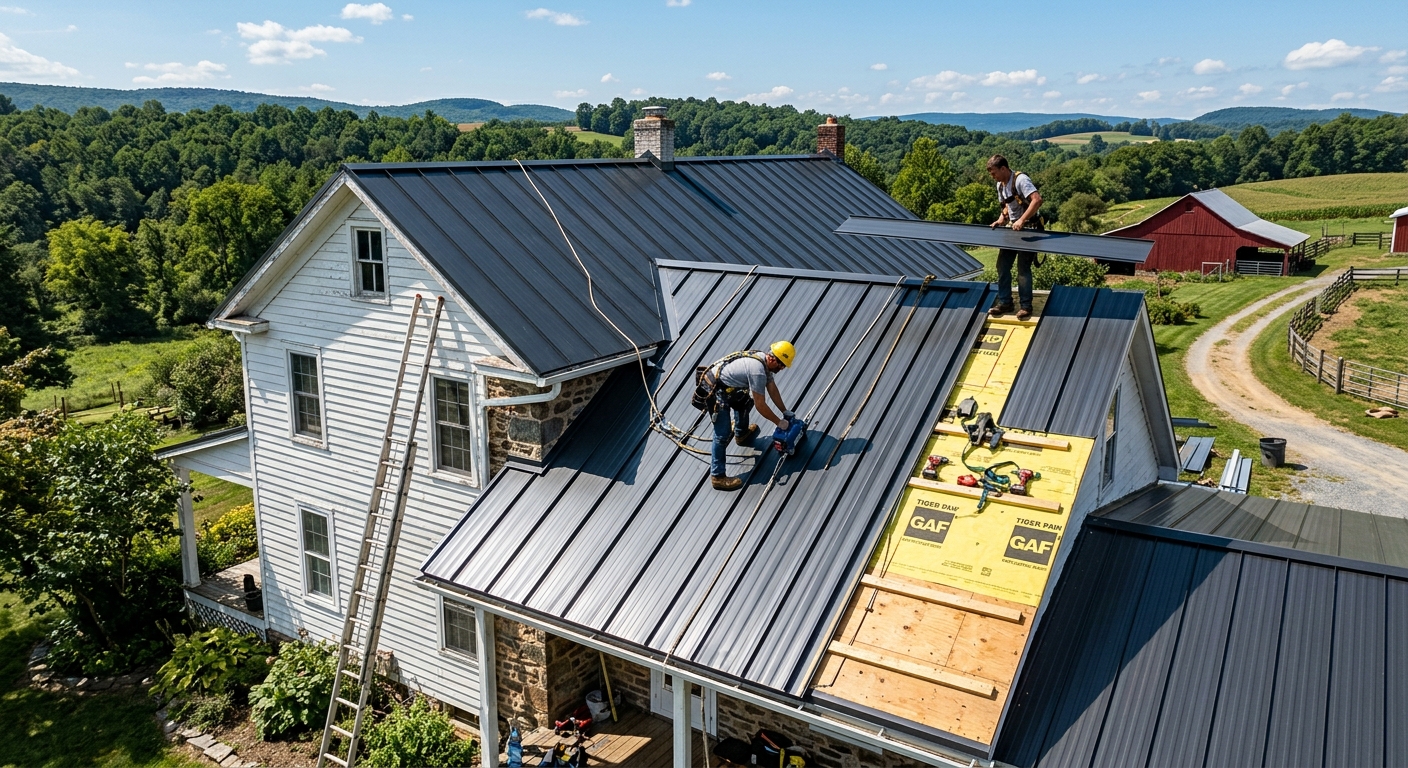
What roof replacement costs in North Strabane in 2026
In North Strabane, most roofs are replaced on single-family homes where 86.3% of residents own their properties (U.S. Census Bureau, ACS 2024). This high rate of homeownership leads to local homeowners looking for longevity and resale value in their roofing investments. With 41.3% of homes built before 1980, many properties are now overdue for new roofing, while the cluster of post‑1960 split-levels and ranches shapes the typical project here: broad, uncomplicated roof faces, easily accessible pitches, and generally straightforward tear-offs.
Suburban growth in Peters and North Strabane means first-time roof replacements are common, especially in developments from the 1970s into the 1990s. These structures typically have one or two existing shingle layers and plywood decking rather than older plank boards, simplifying tear-off and installation. Most homeowners here opt for architectural asphalt shingles, reflecting the dominance of this material due to supply network depth in Washington city and the postwar era’s favored home designs.
The table below outlines typical price ranges for roofing work in North Strabane for 2026:
| Material / Scope |
Lifespan |
Best for |
Price range (installed) |
| Asphalt shingles — architectural (30-yr) |
25–30 yrs |
Most North Strabane homes, first or second replacement |
$10,000–$21,000 |
| Asphalt shingles — impact-resistant (Class 4) |
30+ yrs |
Hail- and wind-exposed homes |
$16,500–$21,000 |
| Metal standing seam |
40–70 yrs |
Long-term owners, snow-shedding, modern aesthetics |
$24,500–$43,500 |
| Flat roof — TPO or EPDM |
15–25 yrs |
Low-slope porches, additions, commercial |
$12,500–$25,500 |
| Roof repair — leak or isolated section |
n/a |
Targeted leak fixes, newer roofs with minor issues |
$550–$2,000 |
Prices are estimates for a typical North Strabane home and vary with roof size, pitch, decking condition and material selection.
North Strabane homes and their roof lines
North Strabane’s housing is shaped by the post‑1960 suburban growth boom, which means that the rooflines you see around town differ from older housing pockets in the county. Here, split-levels, ranches and bi-levels dominate, most built with moderate-pitch gable or hip roofs typical of the late 20th century. Instead of tedious layers of original plank decking, you’ll generally find plywood or OSB beneath the shingles — a relief when replacing, since decking surprises (and add-on costs) are rarer than in the county seat’s prewar housing stock.
With 41.3% of local homes built before 1980 (U.S. Census Bureau, ACS 2024), plenty of roofs are well into their second or third covering. Yet developments from the 1980s and 1990s are only now cycling into first major replacements. These structures were seldom built with ice and water barriers at the edges, so homeowners should expect this upgrade in their next roof, especially for longer-term peace of mind. Most homes have had only one previous layer removed, so if you’ve not yet replaced your roof since purchasing, check for evidence of more than two layers, which would need full tear-off for code.
Homes from this era also tend to have adequate soffit and ridge venting, but older ones may not. When bidding a replacement, it’s worth checking attic airflow and considering small upgrades now, especially given North Strabane’s freeze-thaw cycles and heavy rainfall. The good news: Large overhangs and uncluttered roofscapes make the job straightforward in most cases.
Roofing warranties in North Strabane: what's actually covered
Homeowners in North Strabane should be clear: there are two types of roofing warranties. First, the manufacturer’s warranty covers defects in the shingle or metal panels themselves. These warranties, especially for architectural asphalt shingles, are typically prorated after a decade or so and don’t cover poor installation, missed nails, or improper flashing work. Most require you to register the materials within a window after install, or else the warranty reverts to minimal coverage and may not be transferable at resale.
The second warranty is provided by the roofing company for their workmanship. This typically covers the labor and installation problems but can be short-lived if you pick a startup firm. In this market, a so-called “25-year labor warranty” from a business less than five years old is worth less than a modest 5- or 10-year warranty from a company with a true track record. Transferability is also limited — most local contractors offer “lifetime” coverage for original owners only, or restrict the warranty if the house is sold.
Keep in mind: improper attic ventilation, layering new shingles over old ones, or failing to register the warranty can all void coverage. Always insist on the warranty certificate and document registration details at the close of the project. Don’t count on leaflets in the bid packet — if it isn’t in writing, you don’t have it.
How to vet a North Strabane roofing contractor
To avoid headaches, homeowners should lean hard on the common-sense verifications Pennsylvania requires, starting with contractor registration for work over $500. The right contractor in North Strabane must have Home Improvement Contractor (HIC) registration from the Pennsylvania Office of Attorney General; you can (and should) verify them at hic.attorneygeneral.gov. Next, every employer in Pennsylvania who hires a crew is required to carry workers’ compensation insurance, and you can confirm their coverage at WCAIS (wcais.pa.gov).
With roofing, paperwork is only the start. Look for proof of address and portfolio of similar jobs within Washington County’s I-79 corridor. If your home was built before 1978, ensure the company is EPA Lead RRP certified; check this at certifiedrenovatorsearch.epa.gov. Other checklist items include:
- HIC registration from the PA Office of Attorney General
- Active workers’ compensation insurance (verify on WCAIS)
- General liability insurance certificate with your name/address on it
- Written contract (required over $500)
- Clear scope of work and detailed materials list
- No demand for full payment up front; reasonable deposit
- Physical office address in or near Washington County
- Evidence of past work on similar North Strabane homes
- No attempt to waive your insurance deductible (illegal under HICPA)
- EPA Lead RRP cert for pre-1978 homes
- Strong reviews from local homeowners, not just elsewhere
- Willingness to pull permits if required
Red flags in the North Strabane market include: door-knocking crews after wind/hail events, high-pressure sales tactics with "today only" pricing, companies that change names frequently, lack of a known local address, and firms unwilling to show workers’ comp proof (especially with out-of-state plates on vehicles). These are real risks with so many roofers competing along the I-79 corridor.
Roofing permits in North Strabane: what you need before work starts
For a full roof replacement (including tear-off) in North Strabane, a building permit is typically required — this falls under the Pennsylvania Uniform Construction Code (UCC), based on the IRC, and is enforced by your local municipality. Minor asphalt shingle repairs, such as a small patch or sealing a leak on a single-family home, usually do not require a permit in most Washington County boroughs. Always check with your township or borough, especially if you might change the roof’s structure, deck, or ventilation.
The permit is issued by the code authority for your local government; in North Strabane, that’s your township’s building code department, not a countywide office or state-level agency (unless your municipality has opted out, in which case the PA Department of Labor & Industry takes over). Before signing a contract, verify your roofer’s HIC registration at hic.attorneygeneral.gov and check for active workers’ compensation coverage with WCAIS (wcais.pa.gov).
Every contract over $500 must be in writing under Pennsylvania’s Home Improvement Consumer Protection Act, and you have three business days to cancel without penalty. Ask for proof of both insurance and registration before permitting work on your home — these are not optional, and any reputable roofing contractor in North Strabane will provide them as a matter of course.
Material comparison for North Strabane homeowners
Choosing the best roofing material in North Strabane means factoring in southwestern Pennsylvania’s reality: 30 pounds per square foot (psf) ground snow load, a winter design temperature of 8°F, and plenty of freeze-thaw cycles that push building materials hard. Architectural asphalt shingles — dominant here — thrive because they hit the sweet spot for cost, durability, and wide availability thanks to supply chains in nearby Washington city. Most homes in the region were designed for this kind of roof, making structure and ventilation upgrades simple if needed.
Metal standing seam costs much more up front, but it excels at shedding snow in our hilly subdivisions and lasts two to three times longer if you plan on staying put for decades. However, it’s often overkill unless you really want the modern look or are set on never roofing again. Membrane (TPO/EPDM) is strictly for low-slope additions or commercial spaces — not typical for North Strabane’s split-levels or ranches, but sometimes seen on porches or garages.
Class 4 impact-resistant asphalt is worth considering if your property regularly takes a pounding from hail (the Ohio Valley wind corridor hits Washington County harder than the more sheltered Appalachian counties). But for many, standard architectural shingles make the most sense for their balance of price and reliable performance.
| Material |
Installed cost |
Lifespan |
Cold-climate performance |
Maintenance |
| Asphalt architectural |
$10,000–$21,000 |
25–30 yrs |
Good, reliable sealing if fall-installed |
Yearly inspections, moss control |
| Asphalt Class 4 impact-resistant |
$16,500–$21,000 |
30+ yrs |
Handles hail better, sheds snow well |
Low but still needs regular inspection |
| Metal standing seam |
$24,500–$43,500 |
40–70 yrs |
Sheds snow fast, avoids ice dams |
Minimal — paint touchup and fastener checks |
| TPO / EPDM membrane |
$12,500–$25,500 |
15–25 yrs |
Great for flat roofs, not for steep slopes |
Annual seam/flashing inspections |
Timing a roof replacement in North Strabane
In North Strabane, the roofing season typically kicks off in late March once freeze-thaw cycles stabilize, and prime shingle work runs through early November. Shingles need daytime temperatures above 40°F to seal properly, so spring and fall are ideal for quality installs. Most local contractors stack their schedules in May, June, and September — the busiest time, due to both demand and favorable weather.
Summers can bring pop-up storms that complicate tear-offs, but by late October, weather risks shift to cold snaps and job delays. Emergency calls spike in winter, but if you need a leak fixed fast in February, you’ll pay more — frozen shingles and icy roofs make for slower, riskier work, and material costs can be higher with urgent setups.
Washington County’s dense contractor pool along the I-79 corridor means you can usually get bids quickly, but prime weeks fill up months ahead. Booking early in spring or late summer secures better pricing and your pick of contractors, while leaving things to chance when storms roll through can stick you with a chancy or out-of-town crew. Bottom line: Plan ahead to avoid delays and high winter surcharges, but don’t let a real leak wait for “roofing season.”
Frequently asked questions — roofing in North Strabane
What does roof replacement cost per square in North Strabane?
For North Strabane homes, roof replacement costs depend on the type of shingle or roofing material you choose, but most architectural asphalt shingle jobs in 2026 price out between $10,000–$21,000 all-in for a typical split-level or ranch. Per “square” (a 100 square foot section), you’re looking at roughly $500–$950 installed — including tear-off, underlayment, and disposal. Class 4 impact-resistant shingles (for hail-prone properties) run at the top of the band: $16,500–$21,000 total. Metal roofing or low-slope membrane options cost more, but few owner-occupied homes here require them. Always insist on a detailed breakdown by square and factor in deck repairs if your home is among the 41.3% built before 1980 (U.S. Census Bureau, ACS 2024), since older decking sometimes surprises even experienced crews.
How long does a roof replacement take in North Strabane?
A typical asphalt shingle tear-off and replacement in North Strabane can be finished in 1–3 days for most single-family homes, especially those built during the post‑1960 suburban expansion. The wider, straightforward rooflines common here make the process faster than on much older or taller structures. If you need extensive decking repairs — sometimes the case with those 41.3% of homes built before 1980 (U.S. Census Bureau, ACS 2024) — you might add a day. For metal standing seam, expect up to a week, especially if custom flashing or complex valleys are involved, and low-slope membrane work usually stays within 2–4 days for the typical addition. Contractors here are used to lining up crews efficiently, but storm season or labor shortages can bump timelines, so book ahead during peak periods to avoid waiting several weeks between contract and completion.
Is a metal roof worth the extra cost in North Strabane?
Metal roofs—usually standing seam—carry an installed cost of $24,500–$43,500 in North Strabane, well above even premium asphalt. They last far longer (40–70 years) and are best chosen by owners who plan to stay put for the long haul or want maximum resale value on a top-tier home. Metal sheds snow rapidly on our hilly lots (ground snow load here is 30 psf) and resists the freeze-thaw damage that afflicts cheap shingles. For most single-family homes built during the post‑1960 boom, architectural asphalt delivers the right mix of value and performance for under $21,000. But if you hate the idea of ever re-roofing or are dealing with regular ice damming, the steeper up-front expense of metal can be justified here.
Will filing a roof claim raise my premium?
In Pennsylvania, making a claim for storm or hail damage to your roof can lead to a premium hike at renewal, although insurer practices do vary. If the claim is for widespread, well-documented hail or wind damage—a real risk in North Strabane’s stretch of the Ohio Valley corridor—many insurers treat it as an “act of God” and may not surcharge you individually. However, if your insurer sees frequent claims from your address, or if cosmetic rather than structural damage is the reason, a spike is more likely. Before filing, get a roofer’s opinion and a detailed scope of damages: a quality repair for $550–$2,000 is often worth paying out of pocket on a newer roof to avoid a claim on your record. Every policy is different, and local agencies can give guidance on how claims may impact premiums in Washington County.
Is a sagging roof line an emergency?
Sagging roof lines on North Strabane homes—especially those built before 1980—may signal a deck or framing problem that needs urgent attention, but it’s not automatically an emergency unless rapid change or water intrusion is visible. If the sag appeared suddenly after a heavy snow or wind event, or there’s evidence of leaks or cracked rafters, call a roofer the same day: temporary stabilization may be needed and repairs could range from a basic section fix ($550–$2,000) to a full re-roof. Gradual, longstanding sags are often due to underbuilt structures or multiple shingle layers and should be examined at the next inspection. Don’t ignore them if selling—lenders may require repairs before close in this market.
Do I need a permit to replace a roof in North Strabane?
In North Strabane, a permit is required for full roof replacements (including tear-off and new shingles) under the Pennsylvania Uniform Construction Code (UCC), enforced by your township—so don’t let a contractor tell you otherwise. Minor shingle repairs (like patching a small section) usually do not trigger a permit requirement in this section of Washington County. The contractor is responsible for pulling the permit, and you should verify their Home Improvement Contractor registration at hic.attorneygeneral.gov and check workers’ comp insurance at WCAIS (wcais.pa.gov). It’s your protection—both against shoddy work and code violations that can block resale or insurance claims down the road.
How much snow load can a North Strabane roof handle?
North Strabane homes are built to withstand a ground snow load of 30 psf, as called for in southwestern Pennsylvania’s code data. This suffices for nearly all winter conditions experienced here, including those occasional heavy, wet storms that can blanket the area. If your home is a post‑1960 split-level or ranch, you’re likely fine—unless decks have decayed or prior owners removed supports. Steeper-pitched roofs (common here) shed snow faster than low-slope designs, reducing long-term weight. If you’re concerned about sagging, ice dams, or have seen drifting over valleys and behind dormers, have it checked at your next replacement or during an annual roof inspection, which is a prudent move at less than the cost of a minor repair ($550–$2,000).
What is the best roofing material for North Strabane's climate?
For most North Strabane homes, architectural asphalt shingles strike the best balance of cold-weather performance, cost, and durability. They’re designed to handle the 30 psf ground snow load and frequent freeze-thaw cycles here. That’s why you see them on the vast majority of homes in the area—supplier networks and suburban developers have made this standard since the post‑1960 boom. Metal roofs shed snow even faster and resist hail but are pricier ($24,500–$43,500) and often chosen for long-term or specialty applications. For the typical single-family ranch or split-level, asphalt will give you 25–30 years of reliable service if installed right, making it the clear winner for most owners.
How do I find a reputable roofer in North Strabane?
The safest way to find a trustworthy roofer in North Strabane is to start by verifying their Home Improvement Contractor (HIC) registration at hic.attorneygeneral.gov and confirm active workers’ comp insurance at WCAIS. Ask neighbors for recommendations—local contractors with experience on homes just like yours are common here given the I-79 contractor cluster. Demand a written contract (required by law for work over $500), a physical address in Washington County, and refusal to waive your insurance deductible (illegal under HICPA). Door-knocking after a storm or companies who rush, demand large deposits, or lack local references are immediate red flags in this market.