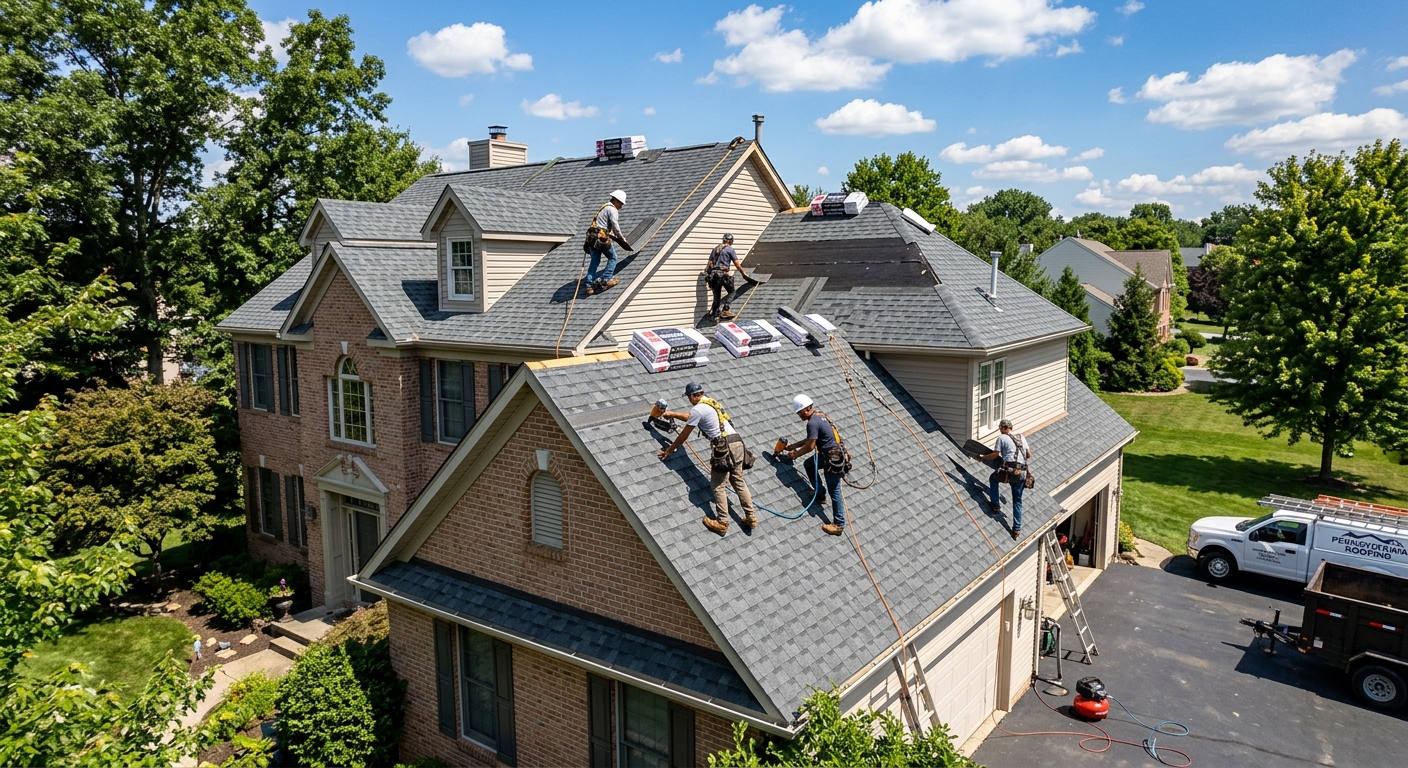
What roof replacement costs in Duryea in 2026
Duryea has a long history of homeownership, with 72.4% of residents owning their homes and most properties—over three-quarters—built before 1980 (U.S. Census Bureau, ACS 2024). This matters when budgeting for a roof, because older roofs in Luzerne County tend to hide ventilation and decking issues that are only revealed during a full reroof. Most Duryea homes are single-family, wood-framed structures, matching patterns seen in Wilkes-Barre and Hazleton, where early-1900s row and twin construction means steeper pitches, multiple layers, and a higher likelihood of underlying repairs during shingle tear-off. These homes drive more frequent re-roofing and force many projects to include upgrades to attic ventilation or ice dam controls that a newer suburb might not need. If your property fits this profile, expect more line items on your quote than you’ll see for new construction in another region.
The dominance of asphalt shingles in this market isn’t just about cost—it’s also about matching the build style of these older homes. You’ll pay more here for certain code-mandated upgrades (like ice barrier underlayment), but it’s usually justified by the local weather and aging housing. Below is what you can expect in 2026 for roof jobs in Duryea:
| Material / Scope |
Lifespan |
Best for |
Price range (installed) |
| Asphalt shingles — architectural (30-yr) |
25–30 yrs |
Most single-family homes, cost-efficient |
$9,200–$19,500 |
| Asphalt shingles — impact-resistant (Class 4) |
30+ yrs |
Storm-prone zones, hail or wind exposure |
$15,000–$19,500 |
| Metal standing seam |
40–70 yrs |
Premium homes, snow/ice shedding |
$22,500–$39,500 |
| Flat roof — TPO or EPDM |
15–25 yrs |
Porches, low-slope sections, row homes |
$11,500–$23,000 |
| Roof repair — leak or isolated section |
n/a |
Spot fixes, small storm damage |
$475–$1,850 |
Prices are estimates for a typical Duryea home and vary with roof size, pitch, decking condition and material selection.
What moves the price of a roof in Duryea
If you compare roofing quotes in Duryea, you’ll see real price swings—not just because of material choices, but due to conditions in our local market and housing stock. Many Duryea homes, especially those built before 1980, have steep roofs and, much like those in Wilkes-Barre and Hazleton, may have multiple shingle layers and unvented attics. Removing two layers instead of one can add $500–$1,500 per layer, since Luzerne County crews must haul debris and properly dispose of the old roofing.
Snowbelt characteristics matter here. Northeastern Pennsylvania’s ground snow load is 40 pounds per square foot, which means insurance companies and code inspectors want to see sturdy decking and ice barriers. This often results in extra labor—especially on houses where easy access is impossible due to close neighboring properties or tight lot lines. Steep pitches, common in our older Duryea stock, slow crews and increase safety costs by up to 20–30%.
Winter design temperature and ridge-line winds that track along the Wyoming Valley have a real effect on roof scopes. Wind exposure in Wilkes-Barre and Kingston drives upgrades like Class 4 impact-resistant shingles, which cost about $15,000–$19,500 for a typical re-roof here. Decking surprises during tear-off are frequent given the age of homes, and sheets to repair rot add yet another cost. Below is how the biggest variables hit your budget:
| Factor |
Why it matters here |
Cost impact |
| Roof size in squares |
Each square is 100 sq ft of roof surface |
Primary multiplier |
| Pitch and access |
Steep pitches need harnesses and slow the crew |
+20–30% labour |
| Existing layers to tear off |
Two or more layers means full tear-off and disposal |
$500–$1,500 per layer |
| Decking condition |
Rot is found during tear-off, not before |
$75–$150 per sheet |
| Ice barrier at eaves |
Required where ice damming has a history |
$300–$800 |
| Material grade |
3-tab vs architectural vs Class 4 impact-resistant |
$500–$2,500 |
Choosing a roofer in Luzerne County
Duryea homeowners should demand real documentation before signing any contract. In Pennsylvania, any roofing contract above $500 must be backed by a Home Improvement Contractor (HIC) registration—verify this on the Attorney General’s official HIC lookup (hic.attorneygeneral.gov). The contractor’s written estimate should state their HIC number. For any work with employees, workers’ compensation insurance is mandatory—ask for current proof and check it via the WCAIS system (wcais.pa.gov) if you’re unsure. For homes built before 1978, make sure to confirm EPA Lead RRP certification at the federal site (certifiedrenovatorsearch.epa.gov); this is not just a formality if paint is disturbed during tear-off.
- Check HIC registration with the Attorney General’s registry
- Review contract terms (required for any job over $500 by state law)
- Get proof of workers’ compensation insurance and verify through WCAIS
- Ask for recent references from Luzerne County, not just out-of-town jobs
- Pin down who will be on site—subcontractors need to have HIC and WC, too
- Confirm written start and end dates, and what happens if there’s a delay
- Require a detailed scope—shingle brand, underlayment, flashing, ventilation
- Do not pay up front—deposit should be modest and clearly described
- If your home is pre-1978, demand proof of EPA Lead RRP certification
- Check that warranty paperwork is filled out by the contractor
- Ask for job site photos—before, during, and after work
- Insist on a local office address and local references
Be wary of storm chasers who only provide a cell phone, contractors who pressure you to sign during a crisis, companies without an HIC number, and anyone offering to “take care of the deductible”—that’s illegal in Pennsylvania and a sign you’re dealing with a bad actor. A saturated contractor market in our metro area means high-pressure sales and out-of-town crews can be a problem right after big storms.
Snow load, ice dams and wind in Duryea
The combination of northeastern Pennsylvania’s 40 pounds per square foot ground snow load and a winter design temperature of just 4°F creates real roofing headaches in Duryea. When heavy snow accumulates on your roof, attic heat can melt the underside of the snowpack, sending water toward the eaves where it quickly re-freezes. This is how ice dams form, backing water under the shingles and into the wood deck—causing leaks that might result in a $475–$1,850 repair, or, if ignored, a full replacement in the $9,200–$19,500 range.
The Poconos and Wyoming Valley don’t just get big snow—they see wind-driven snow and funneled ridge-line gusts, especially over Wilkes-Barre and Kingston. Shingle loss from wind isn’t always visible immediately; sometimes the wind lifts the tabs just enough to break their seal, and the next good storm strips half a slope. Because of this, local code and homeowner’s insurers often require Class 4 impact-resistant shingles and robust underlayment systems—ice & water shield at eaves and valleys is standard, not optional, here. Hail isn’t frequent, but when it does hit, it tends to bruise shingle mats on older roofs, leading to granule loss, premature cracking, and a need for replacement years ahead of schedule. The physics—and cost—are both driven by our climate’s specifics, not a generic “bad winter.”
Gutters, drainage and roof longevity in Duryea
In Duryea, gutters aren’t an afterthought—they’re a core part of your roof’s ability to last. When snow melts or heavy rain pounds an asphalt or metal roof, proper gutters collect the runoff and route it through downspouts well away from the house. Ignore the downspout discharge and you risk saturating the ground near your foundation, leading to basement seepage—a chronic complaint in Luzerne County’s older homes. Many roofing manufacturers won’t honor a full-system warranty if water can back up beneath shingles or pond at vulnerable seams, so proper drip edge and sound grading around your property are necessary, not optional, when you invest in a new roof.
If you’re budgeting for a roof replacement, factor in that full gutter system replacement alongside a new shingle roof in Duryea generally lands in the $2,500–$5,200 range, depending on house size and accessories like leaf guards. Addressing drainage and gutters at the same time is almost always the best value, since it avoids duplicate labor, scaffolding, and prevents water problems before they start.
Pennsylvania code and Luzerne County permit rules for roofing
Pennsylvania roofs are governed by the Uniform Construction Code (UCC), drawn from the International Residential Code, and enforced locally or by the Pennsylvania Department of Labor & Industry where municipalities opt out. For Duryea homes, a full roof replacement—including deck repairs—triggers a permit in Wilkes-Barre, but in places like Hazleton, patching under one roofing square typically proceeds without a permit.
Every roofing contract over $500 must be written and the contractor must present a valid Home Improvement Contractor (HIC) registration, available for verification at hic.attorneygeneral.gov. If you have workers tearing off or installing the roof, Pennsylvania law requires workers’ compensation insurance—ask for a certificate and verify current coverage on the WCAIS system (wcais.pa.gov).
The state prohibits contractors from waiving your insurance deductible, and you’re also entitled to a three-day right of cancellation on contracts above $500. For homes built before 1978, federal EPA Lead RRP rules apply and you can check certification at certifiedrenovatorsearch.epa.gov. There is no state trade license specific to roofing, no mold or restoration license, and electrical, plumbing, and HVAC work is solely permitted at the municipal level outside Philadelphia and Pittsburgh.
Roofing season and lead times in Luzerne County
Duryea’s roofing calendar depends on more than just temperature—it’s about snow, soil thaw, and backlogs caused by storm clusters or last-minute repairs. Crews in Luzerne County usually book out solid from May through October, when conditions let shingles seal properly and underlayments adhere as designed. November through March is riskier: cold snaps mean adhesives won’t bond well and snow cover can delay work for weeks, especially with the 40 psf snow load in this part of Pennsylvania. If you need a new roof in February, expect not just a higher price, but that you’ll compete with emergency calls and storm damage tarping.
Because Luzerne County sits within a dense contractor market—shared with Wilkes-Barre, Scranton, and Hazleton—demand surges after wind or hail bring a wave of out-of-area crews and push local lead times out by several weeks. Booking a planned replacement in late summer or early fall keeps you away from both the spring scramble and the mid-winter price hikes. Aim to get on a schedule by late winter if you want to avoid emergency markups and have the best pick of experienced local crews.
Frequently asked questions — roofing in Duryea
How much does it cost to repair a roof leak in Duryea?
Roof leak repairs in Duryea generally cost between $475–$1,850, depending on the severity of the leak, the age of your roof, and whether the underlying deck has sustained water damage. Homes in Duryea, a borough where most properties date to pre-1980 construction, often have multiple layers of shingles and underlying wood rot, so what starts as a small leak may require deck or flashing repair. Spot fixes for newer roofs without structural issues will fall near the lower end of the range, while leaks in older homes—especially if caused by ice damming or missing shingles from the Wyoming Valley’s wind exposure—can quickly move toward the higher end. Always insist on a thorough inspection since hidden damage is common in northeastern Pennsylvania housing.
How can I tell if my roof decking is rotted?
In Duryea, given the high percentage of homes built before 1980, roof deck rot is a frequent find—especially under valleys and near eaves with ice dam history. Visible sagging between rafters, soft spots you can press with a broom handle from the attic, or musty odors are strong indicators. On top, if you notice spongy feeling underfoot or obvious dips after a storm or leak, that’s a sign that the wood beneath is compromised. Most reliable diagnosis comes during tear-off, when the old shingles are removed: at that point, expect a roofer to quote per-sheet repairs, which typically cost $75–$150 per sheet. Addressing rot promptly is crucial, since hidden deck failures can lead to much costlier structural repairs down the line.
How do I confirm a roofer carries workers' compensation?
Pennsylvania law requires every employer, including roofers working in Duryea, to carry workers’ compensation insurance. Do not rely on a paper copy alone—ask for the insurer’s certificate with your address listed. You can (and should) double-check the status by searching the employer’s coverage via the WCAIS system at wcais.pa.gov. This step matters: uninsured contractors expose you—the homeowner—to medical liability if someone is hurt on your job. Responsible roofing contractors in Luzerne County are used to this request; anyone reluctant or making excuses is waving a red flag. Even for a small roof repair costing $475–$1,850, always verify before starting the job.
How long does a roof replacement take in Duryea?
For a typical single-family home in Duryea, a roof replacement with asphalt shingles usually takes 2–4 days, weather and crew size permitting. Delays can happen if wood rot or poor ventilation is discovered—common in the area’s older homes—so clear scheduling in your contract matters. Climate also plays a role in project length: during October's rain, May’s wind, or under a heavy snow load, crew availability or weather delays can add extra days. More complex projects, like metal or flat roof replacements, may take up to a week. Fast-tracked emergency jobs, such as after an ice dam leak, may start on short notice but still cost premium rates—expect $9,200–$19,500 for standard shingle options.
What underlayment should be used on a Duryea roof?
Duryea’s location in northeastern Pennsylvania—with frequent ice damming and a 40 psf ground snow load—demands better-than-basic underlayments. For all shingle installations, an ice & water shield membrane is recommended along eaves and valleys, where freeze–thaw cycles create water backup. Synthetic underlayment or 30-pound felt is used up the slope, but proper membrane coverage is especially important here. Lightweight underlayments often used in milder states simply don’t cut it for Luzerne County winters. While these add a modest cost—typically $300–$800 for full eave coverage—they’re a cost-effective defense against water intrusion and winter leaks.
Is a metal roof worth the extra cost in Duryea?
For Duryea homeowners planning to stay in their home long-term—especially in older, steeper houses typical of the borough—a standing seam metal roof can be a smart investment. Metal sheds snow faster, is less likely to suffer wind uplift, and resists ice damming better than shingles. The main consideration is up-front price: metal ranges from $22,500–$39,500 versus architectural shingle’s $9,200–$19,500. If you plan to move soon, you might not recoup the premium. But for minimizing maintenance, avoiding repeat ice issues, and adding value in a challenging climate, many Duryea owners find metal worth the initial cost.
Why do roofs fail faster in northeastern Pennsylvania?
Roofs in Duryea and the surrounding Luzerne County area face a unique combination of weather and building age. The 40 psf snow load stresses older rafters and decks, and repeated ice damming on houses with insufficient ventilation leads to leaks and rotted plywood. Ridge-line winds exposures, particularly over Wilkes-Barre and Kingston, flip or unseal shingles entirely, shortening their lifespan. These stresses are especially harsh on older homes, which make up over three-quarters of Duryea’s housing stock. Because of these factors, you may replace a roof every 20–25 years instead of the maximum 30, and repairs costing $475–$1,850 for leaks are more common after each winter.
Are storm-chasing roofers a problem in Duryea?
After major wind or hail events in Luzerne County, storm-chasing contractors—usually with out-of-town plates or no permanent address—do show up in Duryea neighborhoods. With the Scranton–Wilkes-Barre–Hazleton metro being a crowded roofing market, these crews offer fast repairs or roof replacements but often cut corners and may leave before warranty issues arise. These contractors may push contracts on your doorstep or offer to “waive your deductible”—which is illegal in Pennsylvania. Prices may mirror local rates (such as the $9,200–$19,500 range for shingle replacements), but the risk is poor-quality work and no recourse for callbacks. Always check HIC registration at hic.attorneygeneral.gov and ask for local references.
Does homeowner's insurance cover roof replacement in Duryea?
Homeowner’s insurance in Duryea usually covers roof replacement when sudden, accidental events—like wind damage or a fallen tree—are the cause. Insurance rarely covers replacement for wear-and-tear, deferred maintenance, or gradual leaks, which are common in Duryea’s older homes. If your policy approves full replacement, you’ll typically be reimbursed a fixed amount, minus your deductible, with most architectural shingle jobs falling in the $9,200–$19,500 band. Pennsylvania law prohibits contractors from waiving your deductible. Always work with a contractor who knows how to document storm damage for claims and submits legitimate estimates reflecting local conditions.