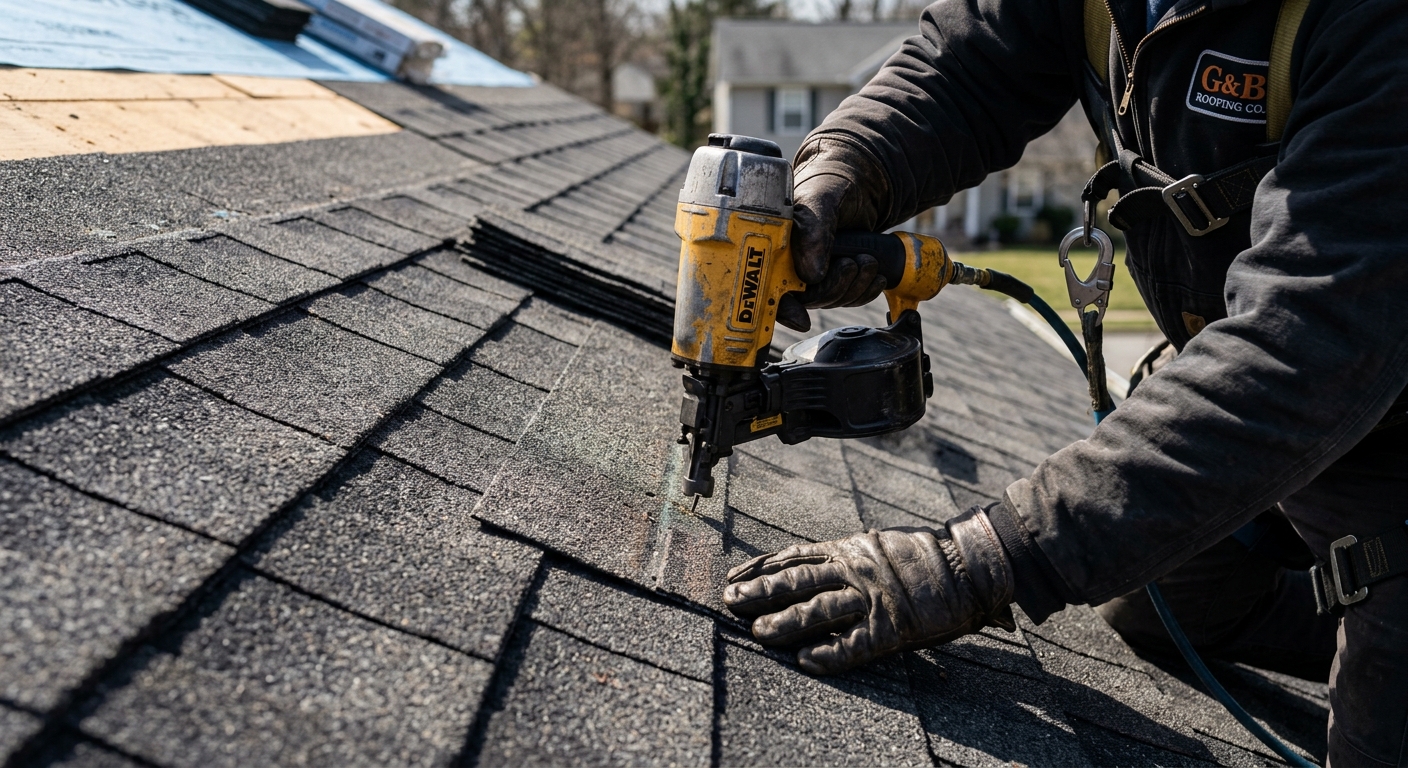
Polk roofing prices by material and scope — 2026
Polk homeowners face roofing costs shaped by the realities of Monroe County: over 83% of households here own their home, and with 91.6% of the area’s properties being single-family, the local demand revolves around full roof replacements rather than urban patchwork. Because neighboring Pocono Township and Coolbaugh Township developed rapidly with large subdivisions in the 1980s–2000s, most roofs in Polk are hitting their first replacement window right now. These homes, often built with cost-effective architectural shingles, are due for their first major overhaul after 25–30 years of exposure to ridge-line winds and cyclical snow loads.
You don’t pay Philadelphia rates here, but you won’t find bargain work either—especially not anything that lasts. Asphalt shingle roofs remain the practical go-to for most Polk residents, but metal and membrane roofs are chosen when longevity or flat surfaces matter. In this table, you’ll find Polk’s realistic 2026 price ranges for the most common roofing scopes and materials—averaging both smaller starter homes and the larger second-wave subdivisions along the plateau:
| Material / Scope |
Lifespan |
Best for |
Price range (installed) |
| Asphalt shingles — architectural (30-yr) |
25–30 yrs |
Standard pitched roofs, subdivisions |
$9,400–$20,000 |
| Asphalt shingles — impact-resistant (Class 4) |
30+ yrs |
Wind-prone lots, insurance premium reductions |
$15,500–$20,000 |
| Metal standing seam |
40–70 yrs |
Longevity, snow shedding in exposed areas |
$23,000–$40,500 |
| Flat roof — TPO or EPDM |
15–25 yrs |
Low-slope additions, porches |
$12,000–$24,000 |
| Roof repair — leak or isolated section |
n/a |
One-off leak or minor storm repair |
$500–$1,900 |
Prices are estimates for a typical Polk home and vary with roof size, pitch, decking condition and material selection.
Patching vs full replacement in Polk
Deciding between patching and full roof replacement in Polk is about doing the math, not just reacting to a leak. If your roof is under 15 years old and you’ve got just one trouble spot, a repair is sensible; most subdivision-era roofs here will outlast any single patched shingle. But once a roof starts to leak in more than one area—or if you’re living under a 25-year-old original roof from the 1990s building boom—chasing leaks quickly overtakes the value of replacement.
For context, if you repair the same roof three or four times over two seasons at $1,200 per visit, you’re out $3,600–$4,800 with nothing new overhead. At that point, you could have put that money toward a typical replacement at $9,400–$20,000 and stopped worrying altogether. Especially with Polk’s mixed stock of pre-1980 homes and newer subdivision spreads, the roof’s age and leak count are your best guides: 15–25 years and multiple leak points usually signals the end.
| Situation |
Recommendation |
Typical cost |
Reasoning |
| Under 15 years, one isolated leak |
Repair |
$500–$1,900 |
Roof likely has plenty of life left; fix only the problem spot. |
| 15–25 years, several leak points |
Replace |
$9,400–$20,000 |
Widespread shingle wear is likely; repairs won’t hold long in Polk’s wind and snow. |
| 25+ years, any active leak |
Replace now |
$9,400–$20,000 |
Original roof is at end of life, especially from 1980s–90s subdivisions. Delaying will cost more in the end. |
| Storm damage, wind or hail |
Document, claim, replace |
$9,400–$20,000 |
Insurance will often cover replacement; storms here regularly rip shingles on exposed ridges. |
| Flat roof ponding or blistering |
Replace membrane |
$12,000–$24,000 |
Local climate destroys flat membranes once they begin to fail; patching is temporary. |
| Active leak entering winter |
Emergency repair, schedule replacement |
$500–$1,900 |
Get through winter with a patch if you must, but plan for a full job. |
What Polk's housing stock means for your roof
Polk’s roof problems track closely to its periods of construction. Pocono Township and Coolbaugh Township’s subdivision boom in the 1980s through 2000s means a large chunk of the area is filled with homes built using plywood or OSB decking—typically fastened over trusses at moderate or steep pitches. If your home falls in this era, odds are your roof is now reaching its first replacement cycle, with the original architectural shingle nearing the end of its intended 25–30 year life. In these houses, you’ll usually find a single layer of shingles up there (since subdivision rules and lenders usually barred second layers), but flashing and underlayment may not meet today’s ice barrier codes, which is a serious issue given local ice dam exposure.
For the 51.5% of Polk homes built before 1980, you may be dealing with plank decking, lower roof slopes on ranches or capes, and sometimes multiple layers of shingles—even up to three in rare cases. Older roofs may never have seen a peel-and-stick ice barrier, which wasn’t required until much later, and leaks can follow complex paths thanks to how old valleys and dormers were flashed. Tear-offs here are messier and often uncover more rot due to the age and deck type. Whether your home is post-subdivision or vintage, the rules for roofing scope are set not by appearance, but by what’s actually layered up there and how that substrate has fared in the face of Monroe County’s punishing winters and ridge-line winds.
What moves the price of a roof in Polk
In Polk, no two roof quotes are ever exactly alike—mostly because of specific, local factors that don’t show up on generic price calculators. Roof size is the base multiplier, but Poconos snow load (40 psf) and ridge-line wind exposure often push local contractors to recommend and install more expensive underlayment and ice barriers than you’d see in southern Pennsylvania.
If your house sits in one of those larger 1990s subdivisions, you might see bids cluster near the typical $15,500 mark for a full tear-off using quality architectural shingles. But add steep pitch—a common feature here for snow shedding—and costs for labor can jump 20–30%. Two or more layers needing removal, often found in homes built before 1980, tacks on $500 to $1,500 per extra layer, since disposal isn’t cheap in Monroe County. After that, hidden rot in the decking—more likely in older homes—inflates costs even further ($75–$150 per plywood sheet). Don’t overlook the ‘Polk factor,’ either: rural travel surcharges sometimes show up, as contractors have to move crews and dumpsters up from denser areas.
| Factor |
Why it matters here |
Cost impact |
| Roof size in squares |
Each square is 100 sq ft of roof surface common in Polk subdivisions |
Primary multiplier |
| Pitch and access |
Steep pitches need harnesses and slow the crew; typical in Poconos-era homes |
+20–30% labour |
| Existing layers to tear off |
Two or more layers means full tear-off and disposal, common pre-1980 |
$500–$1,500 per layer |
| Decking condition |
Rot is found during tear-off; plank or OSB/ply can both be affected |
$75–$150 per sheet |
| Ice barrier at eaves |
Required where ice damming has a history; the Poconos are notorious |
$300–$800 |
| Material grade |
3-tab vs architectural vs Class 4 impact-resistant upgrades |
$500–$2,500 |
Roofing warranties in Polk: what's actually covered
There are two warranties to watch for in Polk roofing jobs, and they’re very different: the manufacturer’s warranty and the workmanship warranty from your contractor. Manufacturer coverage applies to shingle defects and is usually prorated after 10–15 years—meaning the payout drops eventually. Most will transfer on resale if you register the new owner within set deadlines, but forget to do so and it vanishes. Workmanship warranties, meanwhile, only matter as long as the installer is still in business. A “lifetime” shingle warranty does not mean your roof is covered for all causes for 30 years—neither shoddy installation nor skipped ventilation inspections will be paid out by the material maker.
Faults like bad deck prep, missed flashings, and nailing shortcuts are only covered under the contractor’s own labor warranty. And in Polk, beware a 25-year promise from a crew who just opened shop: it’s only worth the ink if they’re still around in a decade. Coverage is almost always voided if you roof over old shingles or skip ventilation. Always require a written warranty, and don’t rely just on what you hear at the estimate.
When to book roofing work in Polk
Polk’s roofing season runs tight around Monroe County’s climate. Materials like architectural shingles require warm weather—installation season usually runs April through October, when night temps stay above 40°F and the shingles can seal properly. Contractors here, stretched thin by both rural travel and dense midseason bookings, start their spring calendars in January and may be locked up by late March. Summer sees big jobs in the subdivisions and longer timelines as crews catch up.
Book in late summer or early fall if you want the best deal and a smooth schedule—many Polk homeowners get quoted at the average $15,500 mark in September for asphalt replacements. Winter emergencies, though, come at a premium: doing roof work in February brings extra charges for temporary heat, ice removal, and slow production in single-digit weather. In the Poconos, plan ahead if possible, as last-minute spring slots are snapped up by neighbors whose roofs are at the same stage of life.
Pennsylvania code and Monroe County permit rules for roofing
Roofing work in Polk falls under the Pennsylvania Uniform Construction Code (UCC), based on the IRC. The State’s Department of Labor & Industry oversees the code, but in Monroe County, each township—including Stroudsburg Borough—has its own enforcement office. In Stroudsburg, for example, any replacement of roof covering over structural decking requires a building permit, while minor leak patching on existing shingles is typically permit-free unless large areas are involved.
Before you hire, Pennsylvania requires contractors doing more than $500 of work to hold Home Improvement Contractor registration from the Office of Attorney General. You can—and should—verify their registration at hic.attorneygeneral.gov before signing any contract. Insurance is nonnegotiable: all employers must have workers’ compensation coverage. Check a roofer’s current coverage status in the statewide Workers’ Compensation Automation and Integration System (WCAIS) at wcais.pa.gov. If your home was built before 1978, federally-mandated EPA Lead RRP rules also apply—meaning your contractor should have that certification on record for safety.
Be wary of anyone offering to do a roof job under-the-table or waiving your insurance deductible—it is prohibited under the Home Improvement Consumer Protection Act. Get a written contract, as required by state law.
Frequently asked questions — roofing in Polk
How much does it cost to repair a roof leak in Polk?
If you spot a single roof leak in Polk, most honest repairs fall in the $500–$1,900 range. The bottom end covers straightforward shingle or flashing patches—a common fix for wind-driven rain that sneaks through older ridge caps or vent pipe flashings after our ice-heavy winters. If the leak’s caused decking rot, or it’s in a hard-to-access part of an old roof, you may creep up to the top of that range. Keep in mind: repeated repairs on a roof with multiple leaks can quickly surpass the cost of full replacement, especially on the 1980s–2000s subdivision homes common here. Make sure the contractor checks the attic and provides photo documentation. Avoid anyone who can’t show an active Home Improvement Contractor registration for Pennsylvania.
Are storm-chasing roofers a problem in Polk?
They can be. Polk and the rest of Monroe County get their share of wind and occasional hail events, especially along exposed ridgelines. After storms, you may see out-of-area crews passing through, some looking to sign insurance work. These crews aren’t always licensed locally—though in Pennsylvania, the only thing required for roofing is Home Improvement Contractor registration, not a trade license. Stick with a local firm who can prove their registration at hic.attorneygeneral.gov and provide local references. A true professional will provide a written contract and never offer to “waive your deductible”—which is illegal under Pennsylvania’s Home Improvement Consumer Protection Act. For any storm damage replacement, expect costs in the $9,400–$20,000 range, sometimes covered by insurance if properly documented.
Do metal roofs shed snow better in Polk?
Yes—metal standing seam roofs are chosen in Polk precisely because they shed snow faster than an asphalt shingle roof, which helps prevent dangerous ice damming on Poconos ridgelines. Our climate sees frequent heavy, wet snows and a ground snow load of 40 psf. On a well-flashed metal roof, snow slides off almost entirely after a sunny day or freeze-thaw, reducing the weight load and chance of leaks. However, you’ll pay for that performance: a metal standing seam roof here runs $23,000–$40,500 installed, much more than asphalt. Many homeowners choose metal for barns, cabins, or their forever home, but it’s not strictly necessary unless your roof design or exposure makes snow accumulation a constant concern.
What does roof replacement cost per square in Polk?
Roofing is estimated by the square (100 square feet) and in Polk, the installed price for a quality architectural asphalt shingle replacement typically runs $430 to $570 per square, lining up with the overall $9,400–$20,000 range. The final cost depends on how many squares your roof includes: subdivision homes here often run 18 to 30 squares, but steep pitch, two-story access, and tear-off of old layers can push the cost per square higher. Flat and low-slope roofs (like TPO or EPDM) generally come in higher per square due to more expensive materials and specialty labor. Always get a written, line-item quote showing your home’s specific square count.
Can a contractor cover my insurance deductible in Pennsylvania?
No—they cannot. In Pennsylvania, including Polk, it’s illegal for a roofer to waive, cover, reimburse, or “eat” your homeowner’s insurance deductible after a storm claim. The Home Improvement Consumer Protection Act bars this, and reputable contractors won’t even offer to do it. If someone pitches you this as a way to “get a free roof,” you’re likely dealing with a storm chaser or worse—someone who skips critical work to make up the margin. Legitimate storm replacement claims in Polk usually run $9,400–$20,000 for a typical home, and you’re expected to pay your share. Insist on a proper contract and receipts; otherwise, you may be complicit in insurance fraud, and lose future claim rights.
Does Polk get enough hail to justify Class 4 shingles?
Polk and Monroe County see more wind-related damage than hail, but Class 4 impact-resistant shingles can pay off in exposed locations or for insurance discounts if your policy allows. Hail events aren’t as common as in western Pennsylvania, but ridge-top homes facing regular tree debris or wind-driven storms might benefit. These shingles cost more—expect a roof in the $15,500–$20,000 range—but can last longer under rougher weather. If your insurance agent won’t offer a real discount, and the roof’s not battered yearly, spending extra on Class 4 may not add up. Consider them if you’re on an exposed lot or hate the thought of repeated shingle replacement.
Is a sagging roof line an emergency?
In Polk, a visibly sagging roof line often signals advanced rot in the decking or even failed rafters—especially common in older homes built before 1980 with plank decks. If it’s sagging enough to notice from the street, don’t wait. Water may already be penetrating through insulation and risking structural damage, mold, or even partial collapse under our substantial snow loads. Repairs range widely: minor structural fixes might start around $1,200, but full replacement with sheathing or framing could be $9,400–$20,000. Call a roofer with experience in structural work as soon as possible, and ask for attic photos and a written assessment. Sagging is never cosmetic in this climate.
How do I confirm a roofer carries workers' compensation?
Always ask any contractor in Polk for a current certificate of insurance, then verify it. In Pennsylvania, workers’ compensation for employers is mandatory, not an optional add-on. The only authoritative source for this is the Workers’ Compensation Automation and Integration System (WCAIS) at wcais.pa.gov, where you can search by company name or registration number. This protects you from liability if a worker is injured—and it’s the first thing your insurance company will ask for if a claim is filed during a job. If the contractor won’t show proof, walk away, no matter what price they offer. Roofing replacement in Polk isn’t worth risking your homeowner’s policy or a lawsuit to save a few hundred dollars on a $15,500 job.
Do I need to leave my house during a roof replacement?
In Polk, you do not have to vacate your home during a standard roof replacement. Most crews work outside, with access limited to the roof and, sometimes, the driveway for materials and debris. Expect early noise (tear-off starts around 7–8 am) for 1–3 days depending on home size—a straightforward shingle replacement, say $15,500, is wrapped up fast in this region. If you work from home or have pets sensitive to banging, you may want to arrange an offsite day during the initial tear-off and shingle nailing. Roofers should never need interior access except to check attic vents or address severe leaks. Always ask your contractor if they foresee any reason for indoor entry before signing.