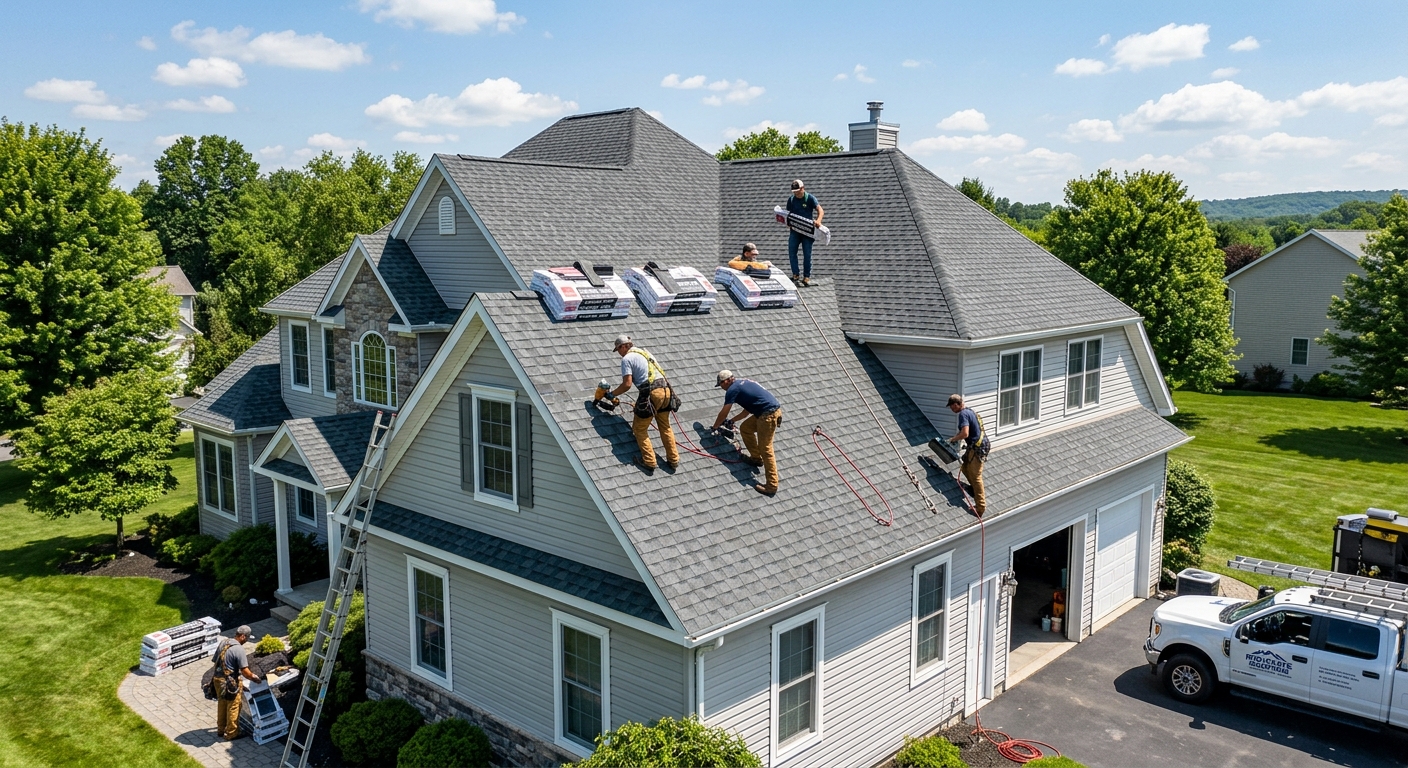
State College roofing prices by material and scope — 2026
State College, as the county seat of Centre County, sees roofing costs shaped both by the challenging local climate and by housing built during Penn State’s post-1960 growth. With just 2,976 owner households out of a population of over 40,000 (U.S. Census Bureau, ACS 2024), roofers here serve a market where many homes were built before 1980—meaning older decking, low slopes, and frequent leaks. Subdivisions from the 1960s onward introduced large volumes of low-slope and combination roofs: while these homes look straightforward from the ground, reroofing often requires more detailed work to ensure flat sections drain properly and don’t develop ponding or ice dams.
Local builders commonly mixed steeper asphalt-shingle fields with flat or low-slope sections. If the underlying low-slope parts aren’t addressed with the right membrane (not just shingles), expect repeated leak calls and shorter lifespans. Wind exposure, especially along the Nittany and Bald Eagle ridges, sometimes requires Class 4 shingles on houses most exposed to snow and gusts. Installed prices here reflect not only labor and materials but also detailing for freeze-thaw, older roof decks, and access challenges common in Centre County’s established neighborhoods.
| Material / Scope |
Lifespan |
Best for |
Price range (installed) |
| Asphalt shingles — architectural (30-yr) |
25–30 yrs |
Standard pitched roofs, most State College homes |
$8,900–$18,500 |
| Asphalt shingles — impact-resistant (Class 4) |
30+ yrs |
Exposed sites, ridgeline wind, insurance discounts |
$14,500–$18,500 |
| Metal standing seam |
40–70 yrs |
Long-term upgrade, snow-shedding, modern look |
$21,500–$38,500 |
| Flat roof — TPO or EPDM |
15–25 yrs |
Low-slope sections, rowhouses, porch roofs |
$11,000–$22,500 |
| Roof repair — leak or isolated section |
5–10 yrs |
Spot repairs, emergency fixes |
$475–$1,750 |
Prices are estimates for a typical State College home and vary with roof size, pitch, decking condition and material selection.
Workmanship vs manufacturer warranty
Homeowners in State College often think the “warranty” on a new roof is a single guarantee, but it’s always two separate promises. The manufacturer warranty covers defective materials, almost always on a prorated schedule. In most cases, unless you register the job with the shingle manufacturer within a set deadline after installation, coverage defaults to the basic level—usually just 10 years non-prorated, then rapidly dropping after that. Upgrades for longer material coverage sometimes require extra documentation, photos, or an inspection fee. If you’re selling the home, check if the warranty transfers: most manufacturers allow a one-time transfer within 10–15 years, but you or your buyer will have to follow their process exactly.
The workmanship warranty is what your local roofer puts in writing for their labor—meaning if something leaks due to poor installation, they fix it for free within the promised period. These warranties are only as strong as the contractor’s reputation and likelihood to be in business for the duration. A 25-year workmanship warranty from a two-year-old company is worth less in practice than 10 years from a reputable roofer with decades in Centre County. Most workmanship coverage is voided if roof ventilation is poor, if you have new shingles layered over old ones, or if you modify the roof afterward. Get confirmation of both warranties, and never ignore the registration paperwork.
Roofing permits in State College: what you need before work starts
In State College, building permits are required for roof replacements exceeding 25% of your roof’s area. This threshold means most full re-roofs, especially for older homes needing new underlayment or rebuilt low-slope sections, will need permitting. If you’re just replacing a handful of damaged shingles—such as a minor wind repair in College Township—no permit is typically required. Permits for larger jobs in the borough are issued through the State College Office of Community Engagement and Planning. In other Centre County townships, each office handles its own enforcement under the Pennsylvania Uniform Construction Code (UCC), which is based on the IRC.
Your chosen contractor should be registered as a Pennsylvania Home Improvement Contractor (HIC) for jobs over $500. You can check contractor registration status at hic.attorneygeneral.gov. Insurance is just as crucial: Pennsylvania requires all roofing companies with employees to carry workers’ compensation, which you can verify instantly through the state’s WCAIS database at wcais.pa.gov. Always ask to see proof of active registration and comp insurance before you sign anything—no legitimate State College roofer will hesitate to provide both.
Low-slope and flat roofs in State College
Many State College homes, especially those built after 1960, were designed with at least one low-slope or flat section—often on a rear addition, porch, or mid-century modern wing. These sections can’t be properly protected by shingles, no matter what anyone tells you. Shingles rely on gravity and overlap, meaning they quickly fail on slopes lower than 3/12. Water ponds, ice dams form, and leaks appear at transitions.
Flat and low-slope roofs here need a true membrane system—usually TPO (thermoplastic polyolefin) or EPDM (rubber) roofing. These materials are installed in wider sheets, fully adhered or mechanically attached, with seams heat-welded or taped. A typical flat roof membrane job on a State College home runs $11,000–$22,500, depending on size and condition underneath. Properly installed, TPO and EPDM can survive 15–25 years—but ponding water, poor drainage, and freeze-thaw cycles steadily shorten their life if detailing is sloppy. If a roofer quotes shingles for a 2/12 pitch, they’re telling you they don’t know—or don’t care—about what lasts here.
Choosing a roofer in Centre County
In Centre County, clear vetting steps matter because roofing crews may not always be local and the rural suburbs around State College attract traveling contractors during busy seasons. Always confirm the roofer’s Home Improvement Contractor (HIC) registration through the Pennsylvania Office of Attorney General lookup. Require written proof of workers’ compensation, which you can also check at WCAIS. In Borough jobs, check that the permit matches what the State College Office of Community Engagement and Planning would issue for your address.
- Check Pennsylvania HIC registration at hic.attorneygeneral.gov
- Verify current workers’ compensation certificate at wcais.pa.gov
- Request a written contract, as required by law over $500
- Require a physical local address, not just a PO box
- Ask for proof of manufacturer certification for shingle/metal brands
- Obtain and check recent local references, not just photos
- Demand a fixed written estimate—not an open-ended “allowance”
- Review specifics of both material and workmanship warranties
- Ask who is on-site daily: company crew or subcontractors?
- Require permit documentation for jobs exceeding 25% of roof area
- Ask for a cleanup and inspection plan before final payment
- Insist on lien waivers if you’re paying in stages
Red flags: crews arriving from far outside Centre County, out-of-state license plates, high-pressure sales tactics (especially after storms), refusing to provide a written contract, or a contractor unwilling to let you verify HIC and insurance. In thin rural markets, fly-by-night operators are more likely than in denser metro areas—local track record is your first line of defense.
When to book roofing work in State College
Centre County’s long, cold winters and short, humid summers set the calendar for roofing. Asphalt shingles require daytime temperatures ideally over 45°F to seal properly, which means most full replacements are booked April through late October. September is the sweet spot—crew schedules are less slammed than in July, materials are still pliable, and you’re beating the rush before freeze-up. Emergency repairs in February or March (especially after an ice dam event) will cost more, since roofers have to work around snow removal and schedule disruptions, and materials can be harder to handle.
The moderate suburban market in State College–Bellefonte is surrounded by thinner rural areas, so local roofers often fill up fast in spring and fall. Wait times for a quality full replacement can stretch three to six weeks during peak months. You’re less likely to get “slot in tomorrow” service (like in a big metro), but also less likely to get random storm-chaser crews knocking your door. If your roof is showing end-of-life symptoms, plan ahead—booking early in the season saves you from winter crisis pricing and ensures proper installation.
Gutters, drainage and roof longevity in State College
In State College, your roof is just one part of a home’s water management system. Gutters, downspouts, drip edge, and ground grading all work together to keep water away from your foundation and siding. Replacing a roof without checking or upgrading gutters is asking for trouble: ice dams can build up, and water can backtrack under new shingles if the gutter edge isn’t handled right. Poor downspout discharge—where water dumps right next to the foundation—can quickly lead to a wet basement or crawlspace, which is a recurring headache in our freeze-thaw climate.
Many roof warranties require that water drains off the roof and away from the foundation. At minimum, have your gutters cleaned or replaced when re-roofing. Replacement seamless aluminum gutters and downspouts typically run $2,200–$4,800 for an average State College home when done alongside the roof—guards add more if you want clog-free operation. Don’t let anyone talk you into a roof job without a hard look at the drainage path first.
Frequently asked questions — roofing in State College
Are impact-resistant shingles worth it in State College?
Impact-resistant (Class 4) shingles are more expensive up front than standard architectural shingles, usually landing in the $14,500–$18,500 range for a typical State College roof. Their value here depends on your home’s exposure. Centre County’s ridge-line winds along Bald Eagle and Nittany Mountains can stress even well-nailed shingles, especially on open lots or unshielded subdivisions. If your house has a history of losing tabs or getting “cupped” shingle corners, impact-rated shingles do hold up better to both wind and hail. You may also qualify for a modest insurance discount. For homes surrounded by mature trees and shielded from direct west winds, the extra cost isn’t always returned in resale. But for exposed sites, or if you plan to stay long-term, it’s often a smart investment—especially with rising storm events seen in State College.
How do I find a reputable roofer in State College?
The best way to find a trustworthy roofer in State College is to check their Home Improvement Contractor (HIC) registration at hic.attorneygeneral.gov. Ask neighbors for referrals, verify recent work done on similar homes (not just new builds), and insist on seeing a physical address—not just a local phone number. Proper insurance and a written contract are non-negotiable. Don’t let price be your only guide: low bids may skip critical work, and in Centre County’s thin market, there are out-of-town crews who chase insurance jobs. For a repair, expect a legitimate quote in the $475–$1,750 range, not a verbal ballpark. Any hesitancy to provide documentation or direct you to the registration lookup is a red flag here.
What causes ice dams on State College roofs?
Ice dams form on State College roofs mainly because of our long cold spells, high snow loads, and older homes with inconsistent attic insulation and ventilation. When warm air leaks up from below, it melts snow from underneath—water runs down to the eaves, refreezes, and blocks proper drainage. This process is especially common in homes built before 1980, which is the majority in State College. Once a dam forms, water can back up under the new shingles or even a high-end membrane, causing leaks regardless of how new your roof is. Repairing water damage from ice dam leaks can run $475–$1,750 if caught early. Addressing both attic insulation and roof ventilation will do more than any type of shingle here for long-term protection.
How do I know if my State College roof needs replacing?
Watch for curling or cupped shingles, missing tabs, exposed black mat in the shingle surface (“balding”), or significant granule wash-off at the ends of your downspouts. For homes in State College with low-slope sections, persistent leaks along interior walls or at roof transitions are a strong signal—especially if previous contractors tried to patch with tar. If your current roof is over 20–25 years old, and repairs start to climb into the $1,100–$1,750 range more than once, you’re usually better off budgeting for a full replacement, which starts at $8,900–$18,500 for asphalt. Having a reputable roofer perform a simple walk-over and show you photos of wear is a smart first step.
Do I need my own inspection before the adjuster visits?
It’s a good idea in State College to have an independent roofer perform a roof condition report before your insurance adjuster arrives, especially after a storm. Some adjusters are unfamiliar with our prevalent low-slope details or older installations and may miss damages around flashing or flat sections. A roofer can give you photos and a written estimate (in the $475–$1,750 band for most initial inspections or minor repairs) to help guide the insurance process. Their input also helps ensure nothing gets overlooked in a payout, which is especially helpful as many Centre County homes have mixed roof types that require more detailed attention.
Is a metal roof worth the extra cost in State College?
Metal standing seam roofs cost significantly more than even the best shingles—installed, expect $21,500–$38,500 for an average State College home. For folks who plan to stay in their home long-term and want bulletproof snow-shedding, metal is a solid bet. It resists moss, sheds snow quickly after our 40 psf snow loads, and stands up to the freezing winters common here. If resale is in a few years or the home is surrounded by thick trees (risking denting from falling branches), the payback is longer. But for low-maintenance and energy-efficiency over the long State College heating season, it’s hard to beat a properly detailed standing seam roof.
Do I need a permit to replace a roof in State College?
Yes—if the roof replacement in State College covers more than 25% of the total roof area, the Borough requires a building permit before starting work. This applies to almost every full reroof and all flat roof membranes. Minor repairs, like replacing a few blown-off shingles (often costing $475–$1,750), typically don’t require a permit unless you’re in a historic district. Permits are issued by the State College Office of Community Engagement and Planning, and your contractor should handle the application. Surrounding townships mostly follow the same rules, though College Township allows minor repairs without a permit. Always double-check with your local code office if you’re unsure.
Will the crew damage my landscaping or driveway?
Roofing in State College, especially in older neighborhoods with close lot lines and mature landscaping, poses real risks for flowers, shrubs, and driveways. The best crews lay down plywood and tarp vulnerable areas, and use rollers or magnets to catch nails. If you’re having a full replacement, expect some scuffing or minor flattening in grass and mulch beds, but serious damage is rare when precautions are followed. If scaffolding or dumpsters are on-site, ask how they protect your surfaces. For longer jobs (metal or flat roof, in the $11,000–$38,500 range), confirm what clean-up and re-seeding is included before final payment. Any crew that just shrugs off your concerns is either too rushed or inexperienced for proper State College work.
Why is my State College roofing quote higher than the online average?
State College roof quotes are often higher than generic “national averages” you see online for several reasons. Our labor and permit costs are set locally, and the high share of homes built before 1980 means there’s almost always extra work—decking fixes, flat roof tie-ins, or old chimney flashing. Local climate demands better underlayment, thicker ice shields, and careful attention to attic ventilation. Plus, many roofs in Centre County are not simple rectangles, but multiple slopes and valleys, which adds cost. For a straightforward architectural shingle replacement, quotes start at $8,900–$18,500, but complex or low-slope homes push higher. The online averages rarely account for these State College specifics.