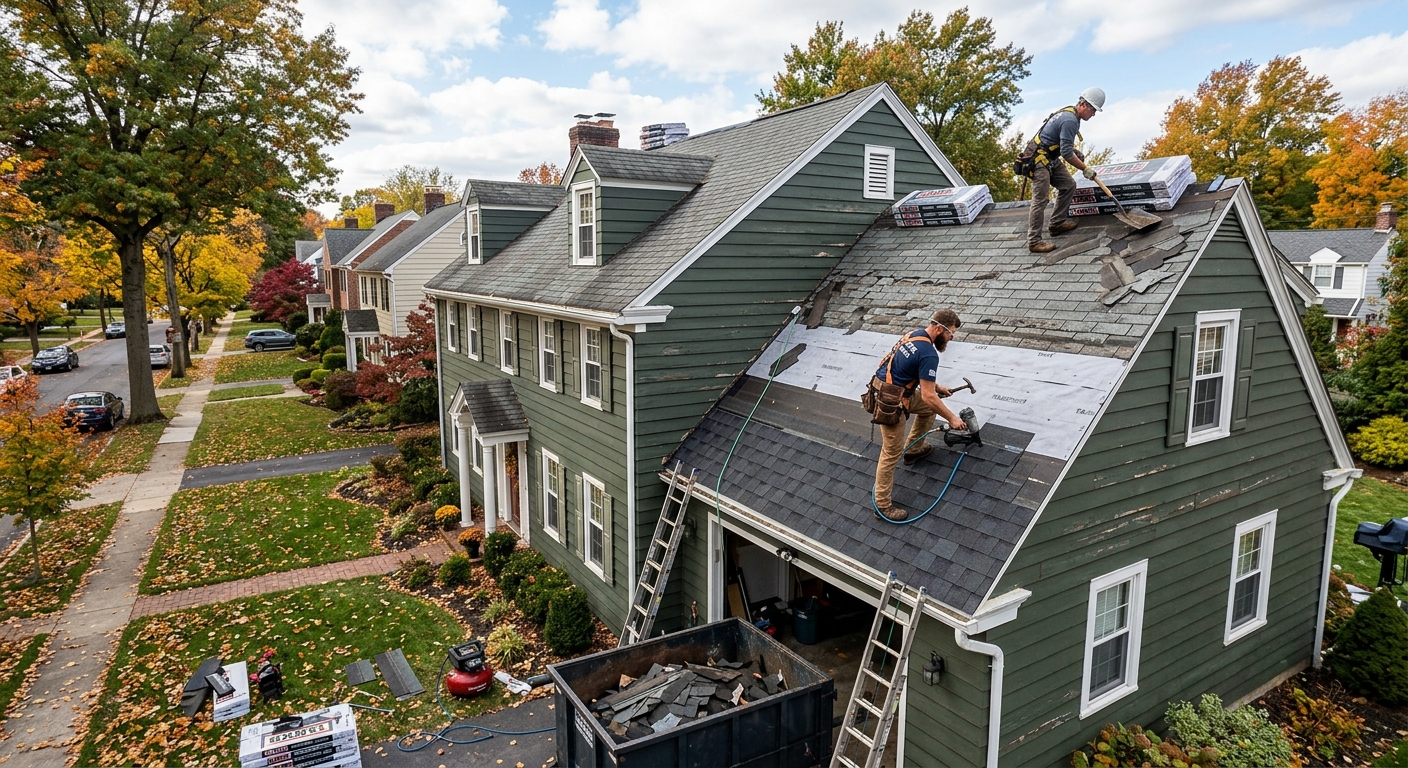
Upper Makefield roofing prices by material and scope — 2026
Upper Makefield stands out in Bucks County for its high homeownership rate and larger single-family homes, as seen in the 93.6% owner-occupied figure and the dominance of detached properties (U.S. Census Bureau, ACS 2024). This means most roofs here are larger and steeper than what you see in many older, attached housing tracts. Asphalt shingles make up the majority by far, a legacy of the big push of postwar construction in the Philadelphia suburbs.
Many Bucks County homes, especially in nearby Falls and Bristol townships, were built in the 1950s Levittown boom—roofing from this era is now well into its replacement window. While Upper Makefield developed differently, plenty of its houses were also built before 1980, and those structures are coming due for major work. This often means more than just swapping out shingles: it frequently uncovers the need for new underlayment or repairs to aging decking.
Today’s typical new roof in Upper Makefield, especially for a 30-year architectural shingle, falls into the mid to upper bracket. Class 4 impact-resistant shingles are seeing more interest due to wind and hail exposure from summer storms in the Delaware River valley. If you’re eyeing a metal roof or have a flat section, use the table below to set realistic budget expectations.
| Material / Scope |
Lifespan |
Best for |
Price range (installed) |
| Asphalt shingles — architectural (30-yr) |
25–30 yrs |
Typical Upper Makefield subdivision and split-levels |
$12,000–$25,500 |
| Asphalt shingles — impact-resistant (Class 4) |
30+ yrs |
Wind- and hail-prone exposures |
$19,500–$25,500 |
| Metal standing seam |
40–70 yrs |
Historic homes and modern new builds |
$29,000–$52,000 |
| Flat roof — TPO or EPDM |
15–25 yrs |
Porches, sunrooms, low-slope additions |
$15,000–$30,500 |
| Roof repair — leak or isolated section |
n/a |
Flashing, small valleys, skylight surrounds |
$650–$2,400 |
Prices are estimates for a typical Upper Makefield home and vary with roof size, pitch, decking condition and material selection.
Why gutters get replaced with the roof
In Upper Makefield, the roof and gutter system work as one package to keep water away from your foundation, protect landscaping, and prevent leaks. If you only replace the shingles, you’re leaving half the job undone. Gutters are often dented, out of slope, or pull away from the fascia over the years, especially if ice backs up or downspouts clog. When the old system can’t carry storm runoff away from your house, water can pool at the foundation and seep into basements—a particular issue here thanks to our clay soils and seasonal freeze-thaw cycles.
When we replace a roof, we recommend inspecting and usually upgrading the gutters and downspouts at the same time, especially since newer shingles often call for a wider drip edge that won’t fit behind old gutter brackets. It’s also common for manufacturer warranties and insurance requirements to insist on adequate drainage. Overlooking gutter condition might void that coverage or leave you with water marks on brand new fascia.
Expect gutter and downspout replacement alongside a roof to add $2,500–$6,000 for a typical Upper Makefield home. Gutter guards can add another $1,800–$3,200 depending on the system. It’s money well spent if you want the new roof to last and your basement to stay dry.
Reading a roofing estimate line by line
A good roofing estimate for an Upper Makefield home spells out exactly what you’re getting—and what you’re not. First, roofers should spell out the roof area in “squares” (each square is 100 square feet) and name the roof pitch. This isn’t just jargon: a steep or cut-up roof dramatically bumps labor costs and affects the whole price. Tear-off and disposal should list how many layers will be removed and who handles the dumpster.
A trustworthy bid lists the actual underlayment—synthetic, ice and water shield (and how many feet up from the eaves), and specific brands if possible. Don’t accept a quote that just says “felt.” Decking replacement is a contingency item—nobody can see the plywood until the old shingles are up, so the quote should price decking by the sheet in case of rot. Warranties must separate material coverage from workmanship, and only the latter is the roofer’s responsibility. Payment should be staged. Pennsylvania law bars big upfront payments.
If any estimate glosses over the square count, buries material specs, or ignores possible decking repairs, you can’t compare it to another or know what’s included. That’s where homeowners tend to get burned on change orders once the tear-off starts.
| Line item |
What to look for |
Red flag if… |
| Roof area |
stated in squares, with pitch |
no measurement given |
| Tear-off and disposal |
number of layers, dumpster included |
bundled into one figure |
| Underlayment |
product type and coverage |
listed only as 'felt' |
| Ice and water shield |
coverage height at eaves |
omitted entirely |
| Decking |
per-sheet contingency price |
no allowance at all |
| Warranty |
workmanship years stated separately |
only the shingle warranty |
| Payment |
deposit under 15%, balance on completion |
large upfront cash |
Choosing a roofer in Bucks County
Before you sign anything in Upper Makefield, confirm that your roofer has Home Improvement Contractor (HIC) registration from the Pennsylvania Office of Attorney General. You can verify this at hic.attorneygeneral.gov. Any contract over $500 must be in writing, and you get a three-business-day right to cancel. Don’t take a handshake or a “we’ll fill it out later.”
Contractors with employees must carry workers’ compensation; check compliance with the WCAIS system at wcais.pa.gov. A reputable roofer should also be able to provide insurance certificates showing liability coverage. For homes built before 1978, make sure you’re dealing with a lead-safe certified renovator, which you can look up through certifiedrenovatorsearch.epa.gov.
- Look up the contractor’s HIC registration at hic.attorneygeneral.gov
- Request a copy of current liability insurance
- If there are employees, verify workers' compensation at wcais.pa.gov
- Get a detailed, signed contract (required over $500)
- Check for a physical business address in Bucks County or nearby
- Ask for at least three recent, local references
- Confirm permit handling and code compliance
- Never agree to “waive your deductible”—it’s illegal
- For pre-1978 homes, confirm lead-safe certification
- Ask specifically about how decking repairs are handled
- Require all warranty paperwork in writing
- Never pay more than 15% upfront
Beware of companies that don’t list addresses or those that solicit after storms with high-pressure sales tactics—a side effect of the crowded Philadelphia-area roofing market. Other red flags: no HIC number, refusing to document insurance, large cash asks before work, or any offer to “eat” your deductible.
Pennsylvania code and Bucks County permit rules for roofing
All residential roofing replacements and structural repairs in Upper Makefield fall under the Pennsylvania Uniform Construction Code (UCC), which is based on the International Residential Code (IRC). The code authority is the Pennsylvania Department of Labor & Industry; enforcement is carried out by your local municipality unless it has opted out—in that case, Labor & Industry itself handles permits and inspections.
If you’re replacing only a few shingles—less than a minor repair—permits aren’t usually required. Full tear-offs, major repairs, or re-roofing with different materials do require a permit. Make sure your contractor is handling this; a permit is your protection if there’s ever a resale or insurance dispute.
Always verify that your roofer holds an active Home Improvement Contractor (HIC) registration (search at hic.attorneygeneral.gov). If your contractor brings workers, check their workers’ compensation coverage through WCAIS (wcais.pa.gov). Pennsylvania law also gives you a three-business-day right of cancellation for contract jobs over $500, and requires a written contract—no back-of-the-envelope deals.
For homes built before 1978, the federal EPA Lead Renovation, Repair and Painting (RRP) Rule applies. You can check renovator certification at certifiedrenovatorsearch.epa.gov. Roofing contractors aren’t licensed by trade in Pennsylvania, so registration, insurance, and written contracts are your protections.
What moves the price of a roof in Upper Makefield
In Upper Makefield, the size and complexity of your roof are the primary drivers of cost—larger, steeper roofs common here increase both labor and material. Many local homes were built before 1980 (U.S. Census Bureau, ACS 2024), and some still have original decking, so tear-off often uncovers hidden repairs. If rot or narrow plank boards are found, you’ll see a line item for replacement, usually $75–$150 per sheet.
Regions like Upper Makefield, with the Delaware River valley's summer storms, see a meaningful uptick in requests for Class 4 impact-resistant shingles. Upgrading just the material can add another $500–$2,500 to a full roof price. Our snow load of 30 psf and freeze-thaw cycles mean ice barrier at eaves is wise insurance—a $300–$800 add-on that’s well worth the outlay in this climate.
Quotes jump considerably for steep roofs, difficult setups, or multi-layer tear-offs. If you have two old layers of roofing, add at least $1,000–$3,000 across the job. Finally, the crowded contractor market in Bucks County means bid ranges can look wild—but low-ball offers usually cut corners somewhere.
| Factor |
Why it matters here |
Cost impact |
| Roof size in squares |
each square is 100 sq ft of roof surface |
primary multiplier |
| Pitch and access |
steep pitches need harnesses and slow the crew |
+20–30% labour |
| Existing layers to tear off |
two or more layers means full tear-off and disposal |
$500–$1,500 per layer |
| Decking condition |
rot is found during tear-off, not before |
$75–$150 per sheet |
| Ice barrier at eaves |
required where ice damming has a history |
$300–$800 |
| Material grade |
3-tab vs architectural vs Class 4 impact-resistant |
$500–$2,500 |
Upper Makefield homes and their roof lines
A significant share of Upper Makefield homes—over 41%—were built before 1980, and you see the era’s handiwork on the roof. Most houses from that period have 4/12 to 6/12 pitched roofs and nearly all use plywood or, in some cases, 1x6 plank decking under the shingles. Ice barrier and synthetic underlayment weren’t required by code when these homes were built, so if you haven’t re-roofed since original construction, expect to add those into your next job.
Multiple roofing layers aren’t unusual in these houses. In Bucks County, it’s routine to tear off two or more rounds of shingles, which ups both labor and disposal costs on any full replacement. There’s also a good chance for finding water stains or soft spots in older roof decking, and replacing a few sheets of plywood is commonly part of the project—plan for the possibility so you’re not surprised by change orders.
Newer suburbs in Upper Makefield—if your home was built in the 1990s or early 2000s—are often on their first or second roof cycle. These tend to have single layers and better sheathing but still benefit from upgraded underlayment and thicker architectural shingles, given Upper Makefield’s freeze-thaw winters and storm-prone summers.
Frequently asked questions — roofing in Upper Makefield
What if my insurer denies my roof claim?
If your insurance company denies your roof claim in Upper Makefield, start by reading the denial letter—they’re required to state the specific reason. Insurers here will commonly reject claims for roofs judged “worn out” or previously patched, especially if the damage is tied to old age rather than a single storm. In Bucks County, hail and wind claims spike after major thunderstorms off the Delaware River, but coverage is rarely approved for poor maintenance.
If you believe storm damage caused your problem and they’re claiming otherwise, ask your contractor to provide detailed photos, a written assessment, and a repair estimate—typically $650–$2,400 for a localized leak. Appealing with this evidence sometimes works, but know that many insurers stand firm unless there’s clear evidence of a sudden event. You have the right to hiring your own adjuster, but don’t throw good money after bad on a hopeless claim; some roofs don’t qualify.
Does roof pitch affect the price in Upper Makefield?
Absolutely—the steeper the roof, the higher the labor cost in Upper Makefield. Many homes here, especially those built pre-1980, have pitches in the 6/12 to 10/12 range, which require harnesses, special staging, and slow the crew. This isn’t just a “safety upcharge” but reflects the real extra time and labor for every shingle installed and every piece of flashing bent in place. For a typical home, going from a low- to moderate-pitch to a steep-pitch roof can push a replacement from $19,500 to the upper end of $25,500. Always confirm that the quote spells out both the area in squares and the pitch, so you know what’s in the price.
Do I need a permit to replace a roof in Upper Makefield?
Yes—if you’re doing a full tear-off, major repair, or substantial re-roof, you’ll need a permit in Upper Makefield. All such work falls under the Pennsylvania Uniform Construction Code (UCC), enforced locally or by the Pennsylvania Department of Labor & Industry (if your municipality opted out). Minor repairs, such as fixing a few shingles, are the exception and usually don’t require a permit. Always make sure your roofer is handling the permit, because not doing so can lead to trouble with resale, insurance, or code compliance. Be aware: contractors must hold valid HIC registration (verified at hic.attorneygeneral.gov) and, if they have employees, compliant workers' compensation (check at wcais.pa.gov). These rules protect you, and a reputable company won’t hesitate to show proof.
What does it mean if my shingles are curling or losing granules?
Curling shingles or bare spots where granules have washed away are clear signals that your roof is approaching the end of its service life. In Upper Makefield, this is especially common for roofs installed in the 1990s or earlier using early-generation asphalt shingles. Curling often means the shingle mat has dried out, while granule loss can leave the underlying asphalt exposed, leading to leaks after a season or two of hard sun or heavy rain. At this stage, spot repairs rarely buy you much time; most homeowners are better off planning for a full replacement, typically in the $12,000–$25,500 range for architectural shingles. If just a small area is affected, a localized repair in the $650–$2,400 band can make sense, but be wary of “roof tune-ups” sold as a substitute for real replacement.
How far ahead should I book a roofer in Upper Makefield?
Most reputable roofers in Upper Makefield book 2 to 8 weeks out, depending on the season, current weather, and supply chain issues. After major storms, there’s often a run on materials and crews, thanks to Bucks County’s dense contractor market. If you want a spring or fall install—the best times, weather-wise—aim to get on a schedule by January or February. For full replacements (in the $19,500–$25,500 range for most houses here), waiting until the last minute can mean you either pay more or land a spot with whoever’s free, which isn't always the right call. Emergency repairs ($650–$2,400) can typically be scheduled faster, but full replacements need lead time.
What does roof replacement cost per square in Upper Makefield?
One “square” is 100 square feet of roofing. For architectural asphalt shingles, the going installed price band in Upper Makefield falls between $550–$850 per square, or roughly $12,000–$25,500 for most single-family homes depending on complexity. Metal roofing usually sits at $1,200–$2,200 per square given the materials and labor. Prices run higher if you need decking replaced mid-project or if your roof is steep and cut-up. Always get your quote written out in squares so you can compare apples to apples—never trust a roofer who gives you just a lump sum with no breakdown.
What causes ice dams on Upper Makefield roofs?
Ice dams form when heat escapes from your home and melts snow near the ridge, which then flows to the cold eaves and refreezes. Upper Makefield’s winter design temperature of 14°F and moderate freeze-thaw cycles create perfect conditions, especially on roofs without adequate insulation or air sealing in the attic. If your house was built before the 1980s, it likely lacks an ice barrier in vulnerable valleys or lower pitches. Installing ice and water shield at the eaves—at a modest cost of $300–$800 on a typical roof—can go a long way toward preventing water backup under the shingles. Addressing attic ventilation and insulation is just as crucial, but most contractors will recommend the membrane as a “belt and suspenders” approach in our climate.
What underlayment should be used on a Upper Makefield roof?
For Upper Makefield homes, synthetic underlayment is now standard on nearly all new roof installs—a big step above the old 15- or 30-lb felt. It’s light, repels water better, and stands up to our humid summers without curling at the edges. At the eaves and other leak-prone spots, an ice and water shield is wise (and often required by code for roofs exposed to snow and ice). Expect your roofer to specify both in your quote; if they only list “felt,” press for the brand and type. Upgrading to top-shelf synthetic and proper ice barrier adds only a couple hundred dollars to most projects but can prevent thousands in water damage down the line. On a full replacement in the $19,500–$25,500 band, these choices are worth the small premium.
What should a roofing quote include in Upper Makefield?
A complete roofing quote in Upper Makefield should include: the roof area in squares (with pitch), tear-off and disposal by number of layers, underlayment and ice barrier by brand or type, flashing and vent boots, per-sheet decking replacement costs, material and workmanship warranties (separated), permit handling, and a payment schedule. Deposits should be under 15%, with the bulk due on completion, as required by the Home Improvement Consumer Protection Act. For a typical replacement in the $19,500–$25,500 band, vague or lump-sum quotes almost always hide shortcuts or set you up for “extras” after work starts. Don’t sign any proposal that doesn’t clearly spell all of this out.