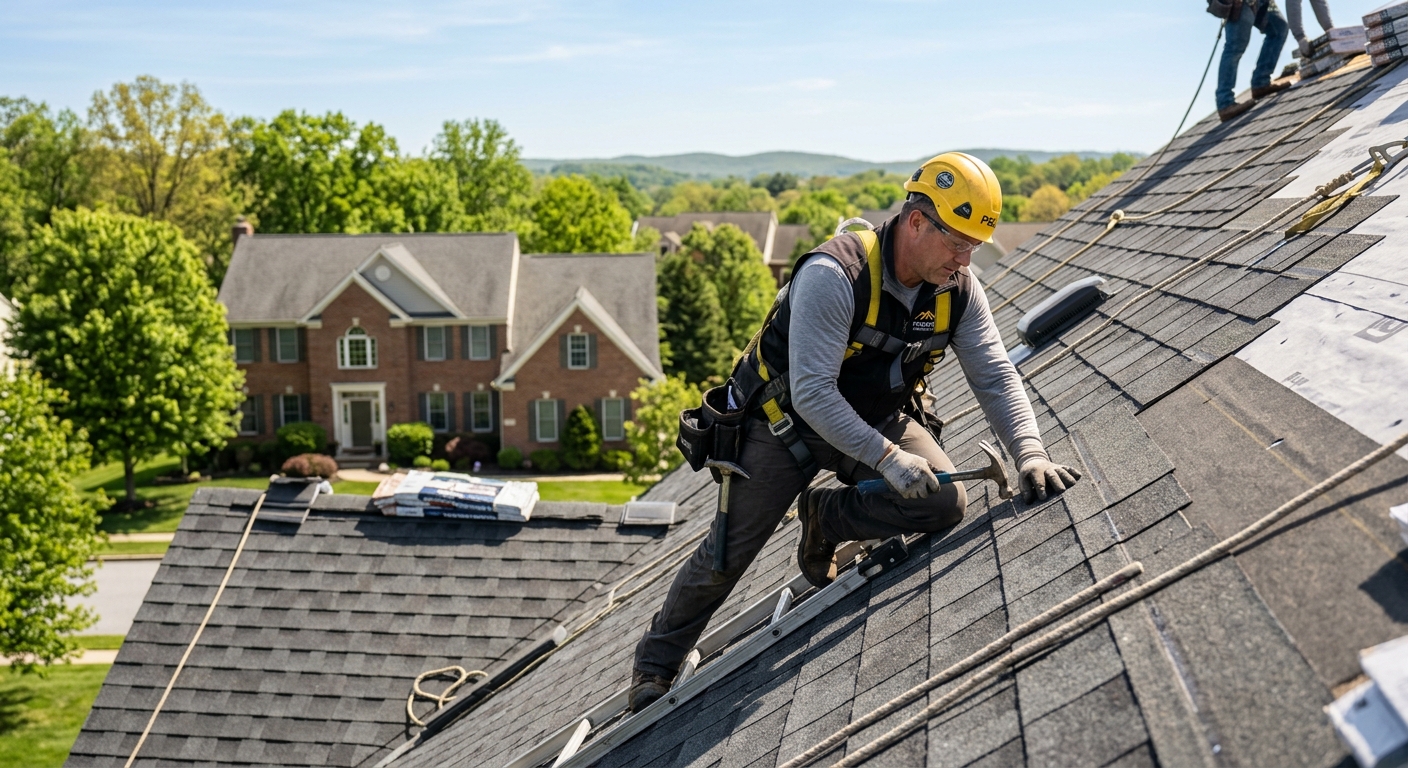
What roof replacement costs in East Norriton in 2026
In East Norriton, roofing costs in 2026 reflect both the township’s high homeownership rate and the age of its single-family homes (U.S. Census Bureau, ACS 2024). Most of the houses here, built before 1980 and owned by residents invested in preserving property value, are sitting under aging roofing systems reaching the end of their service life. That brings a steady, visible cycle of full roof replacements, especially among the 60.3% of homes that are single-family structures. Much of this demand traces back to a wave of post-war tract housing in neighboring Abington and Cheltenham, which is mirrored in East Norriton by similar construction eras and mass-developed subdivisions. The practical effect is neighborhood roofs coming due for replacement in clusters, with wear patterns and costs that are largely predictable within each development phase.
Given this context, architectural asphalt shingles remain the material of choice—not simply for cost, but for HOA conformity and resale. Metal standing seam and flat membrane systems are less common but seen on homes with additions or low-slope areas. Roof repairs, on the other hand, typically address leaks on the original structure or patched work from previous decades. Below is what you can expect to pay for these main project types in East Norriton:
| Material / Scope |
Lifespan |
Best for |
Price range (installed) |
| Asphalt shingles — architectural (30-yr) |
25–30 yrs |
Single-family, HOA-compliant homes |
$10,000–$21,500 |
| Asphalt shingles — impact-resistant (Class 4) |
30+ yrs |
Areas prone to hail or wind, insurance discounts |
$16,500–$21,500 |
| Metal standing seam |
40–70 yrs |
Long-term value, distinctive look, low maintenance |
$24,500–$44,000 |
| Flat roof — TPO or EPDM |
15–25 yrs |
Sunrooms, low-slope additions |
$13,000–$25,500 |
| Roof repair — leak or isolated section |
n/a |
Spot repairs, storm response |
$550–$2,000 |
Prices are estimates for a typical East Norriton home and vary with roof size, pitch, decking condition and material selection.
Decking, ventilation and flashing — the hidden roof costs
The initial price you hear for a new roof in East Norriton rarely includes every cost that might surface once the old shingles come off. Homes built before 1980—still the majority here—often conceal rotted or water-stained sheathing beneath the surface. If your roof deck turns out to be sagging or soft after tear-off, local replacement runs $500–$2,000 or higher, depending on the square footage of damaged decking.
Poor attic ventilation is another silent culprit. In this southeastern Pennsylvania climate, where winter lows routinely hit 14 °F and the freeze-thaw cycle is real, lack of ridge and soffit venting lets heat escape into the attic, warming the underside of the roof. That melts snow at the ridge, which can refreeze and create ice dams at the eaves—a primary reason shingle warranties get voided. Correcting attic ventilation by adding baffles, ridge vent, or adjusting existing louvers typically adds $900–$1,900 to your project.
Flashing and vent boots, often outdated or improperly installed on homes from earlier decades, require careful inspection and may need to be fully replaced. Expect to pay $400–$1,200 for full chimney and wall flashing replacements, and an additional $150–$450 for new vent boots, drip edge, and counterflashing at roof-to-wall intersections. These are not optional costs—skipping them is how leaks start or reappear. If your estimate doesn’t specifically mention these items, be prepared for your final invoice to climb after work begins.
Timing a roof replacement in East Norriton
Roofing season in East Norriton kicks off in April and runs through early November, bracketed by the temperatures needed for proper shingle sealing and safe working conditions. Shingle adhesives require consistent daytime highs above 40 °F, leaving late fall and the winter months—especially February—as poor candidates for planned re-roof jobs. In this region, trying to force replacement during cold snaps can result in improperly sealed shingles that never bond, setting you up for wind lift later.
From June to October, most reputable contractors’ schedules fill up with neighborhood-wide replacements, a product of the saturated Philadelphia-metro roofing market and the recurring wave of first-time roof replacements on post-war stock. In September, crews are busy but the weather is prime: less rainy than spring, not yet into the cold, yielding the best combination of availability and quality outcome. Emergency replacements or storm repairs in the dead of winter not only come with higher labor premiums but may require temporary tarping, which adds unplanned cost—see the repair range of $550–$2,000 just for immediate response.
If you know your roof is coming due, booking in late spring for a summer or early fall slot is typically your best bet for price and availability in East Norriton. Waiting until an emergency in February will cost more and could snowball into further damage if left exposed.
Pennsylvania code and Montgomery County permit rules for roofing
Roofing work in East Norriton—and more broadly in Montgomery County—falls under the Pennsylvania Uniform Construction Code (UCC), based on the International Residential Code (IRC). This is enforced by local municipalities or, in some cases, the PA Department of Labor & Industry if the municipality has opted out. In Norristown, for example, replacing more than 25% of an existing roof surface generally requires a building permit. Conversely, minor shingle repairs under one roofing square in Lower Merion Township often happen without needing a permit—it’s best to check with your specific township office before starting any project.
Contractors taking jobs over $500 must be registered as a Home Improvement Contractor (HIC) with the Pennsylvania Office of Attorney General. Homeowners can and should verify this registration at hic.attorneygeneral.gov. For worker protection, Pennsylvania mandates that all employers maintain workers’ compensation insurance (no exceptions), which you can independently verify using the state’s WCAIS system at wcais.pa.gov.
State law requires a written contract for all home improvement jobs over $500, giving homeowners a three-day right of cancellation. You should never proceed on an oral agreement alone, and any offer by a contractor to “waive your insurance deductible” is not just unethical—it’s illegal in Pennsylvania.
East Norriton homes and their roof lines
East Norriton’s neighborhoods are shaped by the same wave of post-World War II tract housing that defines much of neighboring Abington and Cheltenham. Over 65% of local homes went up before 1980 (U.S. Census Bureau, ACS 2024), which is the era that still dominates the local landscape. These homes typically feature low-to-moderate roof pitches, designed for quick subdivision build-out rather than architectural flourish. Original roof decking from this period is usually 1x6 plank or early plywood—not OSB—so repairs for rot or delamination are common when replacing old roofs now.
Ice and water barrier was not code-mandated during most of this building boom, so the first layer at the eaves is often just felt, now brittle or deteriorated. Many homes also have two or more layers of shingles up there, as re-roofing over the original was favored for cost savings in decades past. Stripping down to the deck to ensure a proper install is usually necessary today—especially to correct years of accumulating weight and cover the occasional missed soft spot. While you won’t find steep or complex roof lines in these neighborhoods, the shape and material choices are a programmed match with resale expectations and HOA rules, which keeps most replacements in the architectural asphalt shingle bracket.
Storm damage and insurance claims in East Norriton
If you suspect storm damage to your roof in East Norriton—whether from thunderstorm winds coming up the Schuylkill River valley or sudden downpours—step one is to document everything before any emergency cleanup. Use a phone to capture exterior and interior photos that show shingle displacement, water stains, and debris fields. Next, contact your insurer to file a claim and schedule an adjuster visit. The adjuster will usually write a “scope of loss” detailing what the insurance covers, based on actual cash value (depreciated) or replacement cost (restores you to pre-loss condition)—know which your policy provides.
It’s vital to choose a local, registered contractor for your repairs. Pennsylvania’s Home Improvement Consumer Protection Act requires they provide a written contract on any job over $500, and offers you a three-business-day cancellation period. Also, if a contractor promises to “cover your deductible” or work with your insurer so you pay nothing out of pocket, that’s a red flag—in Pennsylvania, waiving a homeowner’s insurance deductible is illegal, and accepting such an offer can void your policy or trigger insurance fraud consequences.
After your adjuster has signed off on the scope, get the agreement in writing and choose a contractor based on clear, documented estimates. Expect spot repair costs to fall in the $550–$2,000 range if you’re fixing an isolated section; for full replacement, use your insurance proceeds plus your deductible as your budget guideline.
Snow load, ice dams and wind in East Norriton
East Norriton’s specific location along the Schuylkill River valley brings enhanced thunderstorm wind exposure compared to western Montgomery County, making wind-driven shingle failures and ridge line leaks an ongoing concern. Add to this the regional ground snow load of 30 psf and a winter design temperature of 14 °F, and it’s clear why certain details matter so much here.
Ice dams are the classic local roof failure: warm attic air melts snow at the ridge, which then runs down to the colder eaves and refreezes. This traps water behind the dam, forcing it under shingles and into the house. For Montgomery County, skipping modern ice and water barriers during replacement is a mistake—a section of upgraded underlayment at the eaves (costing about $400–$700 for a straightforward job) will pay for itself every time freeze-thaw season hits. Hail bruises are less common but do happen when storm systems ride up the river valley; bruised shingles may not have visible holes but can lose granules, aging the roof prematurely and often justifying insurance-paid repairs in the $550–$2,000 range.
Unlike northern Pennsylvania, our snow loads are moderate—but improper ventilation or deck repairs here leads to costly ice dam leaks that can run the price up to a complete shingle replacement in the $10,000–$21,500 bracket. That’s why attention to these mechanisms is not optional in East Norriton—it’s the smart homeowner’s defensive move.
Frequently asked questions — roofing in East Norriton
How do I file a storm damage roof claim in Pennsylvania?
If your roof in East Norriton suffers storm damage, start by thoroughly documenting everything with clear photos—both exterior and inside if leaks are present. Don’t begin any cleanup that disturbs the evidence before an adjuster sees it. Contact your insurer to report the claim, and have your chosen contractor present when the adjuster visits to ensure the full scope of damage is recognized. Pennsylvania law requires your contractor to be registered, provide a written contract, and not offer to waive your deductible—an illegal practice. Actual repair costs can run from $550–$2,000 for small jobs upward to full roof replacement if severe. Always ensure you receive, accept, and retain a detailed scope of loss from the insurer before work starts.
Is a sagging roof line an emergency?
In East Norriton, a sagging roof line is rarely just a cosmetic issue—it’s a symptom of underlying rot, structural failure, or prolonged leaks. Houses here, many built before 1980, are more likely to have plank decking that has deteriorated. Emergency action is warranted if the sag is sharp or worsening, since delay can mean more costly deck and framing repairs. While not every sag necessitates full replacement, getting a contractor out fast for an assessment is wise. Expect an initial repair to run between $550–$2,000, but if major decking or rafter repair is needed, you might quickly enter the full roof replacement range of $10,000–$21,500. Don’t let it slide—early intervention is the smart move.
How much does it cost to repair a roof leak in East Norriton?
For a typical roof leak repair in East Norriton, the cost falls within $550–$2,000. Most roof leaks here stem from worn flashing around chimneys, compromised vent boots, or damage from recent wind events that are common in the Schuylkill River valley area. The era of local homes means you could also be looking at hidden rot, especially in older plank or plywood decking. A good contractor will include inspection, flashing upgrade, and patching as part of the job, but be prepared for the higher end of the range if access is tight or the leak has caused interior damage. Never ignore leaks in this climate—freeze-thaw cycles can quickly turn small repairs into much bigger problems if left unchecked.
What underlayment should be used on a East Norriton roof?
In East Norriton, best practice demands two layers of protection: a self-adhered ice and water barrier along the eaves (where ice dams can form), and synthetic or high-quality felt underlayment over the rest. The local winter design temp of 14 °F and that moderate freeze-thaw cycle mean regular felt may not cut it—using modern high-temp ice and water shield with at least 3 feet up from the gutter line is smart insurance. On a typical local roof, this detail might add $400–$700 to the cost, but skipping it could lead to far greater water intrusion or mold remediation costs. Good ventilation should always go hand-in-hand with upgraded underlayment, especially on pre-1980 homes.
What happens if it rains mid-replacement?
If rain hits during your roofing job in East Norriton, any responsible contractor will halt work and fully tarp exposed areas. This emergency tarping—common during our unpredictable spring and summer storms—prevents costly deck saturation and interior leaks. Depending on how much area is exposed, emergency protection typically runs in the $550–$2,000 repair price band. After the storm passes and materials dry, installation resumes. The key is pre-planning: contractors here monitor forecasts and won’t start with rain in the 48-hour window, but pop-up storms still happen. Confirm with your contractor beforehand that emergency protection is included in the estimate (it should be, given local conditions).
How many quotes should I get for a roof in East Norriton?
In East Norriton, where the roofing contractor market is saturated due to proximity to the Philadelphia metro, get at least three written quotes. This ensures you see the full range of detail: some estimates will list out decking, flashing, and ventilation contingencies, others will try to leave those items out to land the job on price. With prices ranging from $10,000–$21,500 for an architectural asphalt roof, the difference can be thousands for the same scope. Beyond price, compare who actually inspects the attic, explains decking replacement policies, and spells out permit acquisition. Never rely on verbal quotes in Pennsylvania—state law requires a written contract.
How do I verify a roofing contractor is registered in Pennsylvania?
Pennsylvania requires roofing contractors working on jobs over $500 to register as Home Improvement Contractors (HIC) with the Office of Attorney General. Verification is simple: go to hic.attorneygeneral.gov and search the contractor’s name or registration number. Also check for workers’ compensation coverage—mandatory for all roofing crews in East Norriton—by searching at wcais.pa.gov. These checks take minutes and protect you from liability if someone is hurt on your property. Don’t sign any contract for new roofing (which costs anywhere from $10,000–$21,500 up to $44,000 for metal) without verifying these credentials directly.
How much snow load can a East Norriton roof handle?
Roofs in East Norriton are built to a regional ground snow load of 30 pounds per square foot, per the local code and climate data. That’s adequate for most snowfalls seen in this area, which don’t approach the accumulations that stress roofs in the northern part of Pennsylvania. The key issue isn’t so much weight as what happens when snow melts and refreezes, creating ice dams that can damage shingles and deck beneath. If your roof is leaking after a heavy snow, spot repairs usually fall in the $550–$2,000 range, unless long-term ponding has led to larger deck repairs or total replacement. Keeping your attic well-insulated and ventilated is essential to avoid problems stemming from prolonged snow load in our climate.
How much does a new roof cost in East Norriton?
For a standard asphalt architectural shingle replacement on a typical East Norriton home, expect to pay $10,000–$21,500 in 2026. These prices reflect local factors: the high proportion of pre-1980 homes, complex old decking, and the cost of compliance with township permits. Upgrading to impact-resistant shingles or metal will push costs higher—up to $44,000 for metal standing seam on larger or more detailed roofs. Most full replacements here fall right in the middle for a one-story, single-family house. Always insist on a detailed, written estimate with deck and ventilation contingencies called out, as the real final cost is set after tear-off.