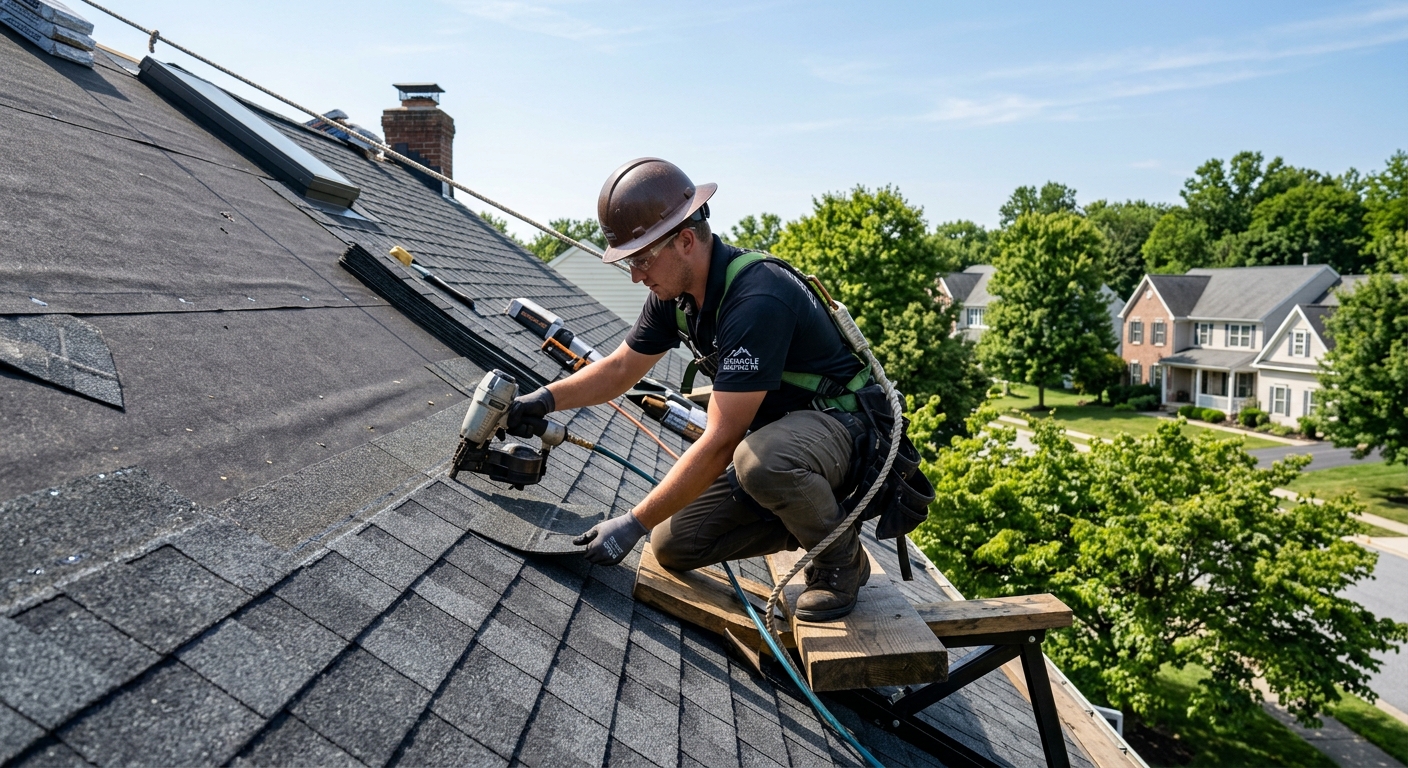
Roofing Replacement & Repair costs in Upper Moreland — 2026
In Upper Moreland, roof replacement and repair costs reflect the area’s older housing stock and owner-occupied homes. With over 86% of homes here built before 1980, many roofs have reached the end of their serviceable life (U.S. Census Bureau, ACS 2024). The owner-occupancy rate of 60.7% means the vast majority of local households are responsible for their own roof maintenance and replacement.
The dominance of post‑World War II tract homes in nearby Abington and Cheltenham is also true in Upper Moreland, where large developments from that era mainly used 3-tab or architectural asphalt shingles. These subdivisions create wide streets lined with nearly identical rooflines—so most jobs here involve sizable, single-family homes with doable access, but aging structures. For many homeowners, replacing an asphalt shingle roof means addressing wear that’s gone decades past its original design life.
Table below summarizes 2026 installed price ranges for the most common jobs on Upper Moreland’s residential roofs:
| Material / Scope |
Lifespan |
Best for |
Price range (installed) |
| Asphalt shingles — architectural (30-yr) |
25–30 yrs |
Most Upper Moreland homes, balanced cost and durability |
$10,000–$21,000 |
| Asphalt shingles — impact-resistant (Class 4) |
30+ yrs |
Homes prone to occasional wind or hail storms |
$16,500–$21,000 |
| Metal standing seam |
40–70 yrs |
Long-term value, steep or simple gable roofs |
$24,500–$43,500 |
| Flat roof — TPO or EPDM |
15–25 yrs |
Porches, additions, or mid-century low-slope designs |
$12,500–$25,500 |
| Roof repair — leak or isolated section |
n/a |
Leak response, small worn-out areas, minor flashing |
$550–$2,000 |
Prices are estimates for a typical Upper Moreland home and vary with roof size, pitch, decking condition and material selection.
Timing a roof replacement in Upper Moreland
Upper Moreland’s climate has specific windows for roof work—usually March through early December. Asphalt shingle installation is optimal when daytime highs are 50°F or above, since the self-sealing strip needs a few days of sun and warmth to activate. Replacing a roof in January or February risks poor adhesion, as our winter design temperature drops to 14°F, and Upper Moreland routinely sees freeze-thaw cycles that can prevent proper sealing.
Because Montgomery County is part of the busy Philadelphia metro, reputable roofing crews book up quickly for prime months. September through November is peak season: not brutally hot for the crew, yet warm enough for shingles to seal before winter. By late summer, a homeowner needing a replacement can face multi-week lead times, especially after summer storms that send everyone scrambling for repairs. The combination of homeowner demand and experienced contractors—who are often juggling multiple jobs in this saturated market—means it pays to book early if you want fall work.
Emergency repairs in February, especially after freeze-induced leaks or ice dam water intrusions, come at a premium price. Expect charges near the upper end of the
$550–$2,000 repair range for tarping or mid-winter spot fixes, both because of risk and slower work pace in the cold. By contrast, a planned September replacement allows for better crew scheduling and typically lands closer to the median replacement cost.
The scope items Upper Moreland homeowners don't budget for
In Upper Moreland, most roof replacements on older homes come with hidden extras that are rarely included in basic quotes. Rotted decking is a prime example—nearly nine out of ten homes here were built before 1980, and plywood or plank roof decks often have unseen water damage. Once old shingles are torn off, any soft or delaminated decking must be replaced, usually at
$75–$150 per sheet.
Attic ventilation is another frequent surprise. This part of Montgomery County sees moderate freeze-thaw cycles, and poor attic airflow encourages condensation and even small-scale ice damming at the eaves. If your roofing contractor finds old-style gable vents or blocked soffits, expect to spend
$350–$1,200 for new ridge vent systems or vented drip edge—this can be a warranty requirement for modern shingles, too.
Old flashing at chimneys and wall transitions is often reused by budget roofers, but that’s false economy around here. Historic brickwork and deep siding details mean new step and counterflashing is essential to keep out wind-driven rain. In most jobs, new flashing runs
$300–$600 for each chimney, and wall intersections may cost
$250–$500 per wall.
Finally, don’t overlook rubber vent pipe boots (
$50–$110 each), new aluminum drip edge (
$350–$700 for an average home), and the labor to seal critical joints. These items, if skipped, can cut years off your expensive new roof.
What moves the price of a roof in Upper Moreland
Upper Moreland roofing quotes can vary substantially, even for homes that look identical from the street. Part of this comes from the region’s housing age and the fact that most homes here are standard single-family layouts—but even among neighbors, roof costs diverge. For example, an 1,800-square-foot ranch with a simple gable roof will cost far less to strip and reroof than a similar-sized split-level with two layers of old shingles. Every roof’s price is anchored to its “square” count—each 100 square feet increases both material and labor costs.
Pitch and access matter, too. Steeper roofs common in parts of Upper Moreland slow the crew, require harnesses and more staging time, and can raise your installation price by 20–30%. Tear-off is another major mover: Roofing codes in Montgomery County require full removal of all previous layers for proper installation, and each added layer costs
$500–$1,500 for removal and disposal. With so many pre-1980 homes here, double layers are not rare.
Decking condition is the wild card—rot is only visible after tear-off, and each sheet replaced will run
$75–$150. The local climate, with its 30 psf snow load, means code now demands an ice barrier at eaves where past ice damming has been an issue. Ice barrier runs
$300–$800 extra. In this market, architectural shingles are standard, but upgrades to Class 4 impact-resistant products for better hail and wind performance can add
$500–$2,500 to a typical home.
| Factor |
Why it matters here |
Cost impact |
| Roof size in squares |
Each square is 100 sq ft of roof surface; typical single-family homes here are 22–32 squares |
Primary multiplier |
| Pitch and access |
Steep pitches need harnesses and slow the crew; common on original post-war capes and colonials |
+20–30% labor |
| Existing layers to tear off |
Two or more layers means full tear-off and disposal, required by code |
$500–$1,500 per layer |
| Decking condition |
Rot is found during tear-off, not before; older homes, especially with leak history, are at risk |
$75–$150 per sheet |
| Ice barrier at eaves |
Required where ice damming has a history—see deeper eaves on 1950s–60s ranches |
$300–$800 |
| Material grade |
3-tab vs architectural vs Class 4 impact-resistant; HOAs in Upper Dublin often require architectural |
$500–$2,500 |
Pennsylvania code and Montgomery County permit rules for roofing
All residential roofing work in Upper Moreland is governed by the Pennsylvania Uniform Construction Code (UCC), which is based on the International Residential Code (IRC). Here in Montgomery County, each township enforces the UCC through its own code enforcement office. That means building permits for roof work are issued locally by the township, not the county as a whole.
Typically in Montgomery County, replacing more than 25% of a roof’s surface triggers a permit requirement. If you’re only doing a small shingle repair—say, under one roofing square—most local townships, such as Lower Merion, allow you to proceed without a permit. But for replacements or major structural repairs, you are required to have a permit on file before work begins.
Pennsylvania requires any contractor performing home improvement work over $500 to be registered with the Attorney General’s office under the Home Improvement Contractor (HIC) registration program. It’s simple to verify a roofer’s registration at hic.attorneygeneral.gov. Don’t just take their word for it—unregistered contractors working on your home put you at risk of voided warranties and limited legal recourse.
Workers’ compensation insurance is mandatory for all employers in Pennsylvania. You can verify contractor coverage through WCAIS at wcais.pa.gov. Hiring uninsured roofers is a risk not worth taking. For any home built before 1978, federal EPA Lead RRP certification is also required for disturbing painted surfaces. Always check credentials before you sign a contract.
Snow load, ice dams and wind in Upper Moreland
Upper Moreland roofs face physical forces that matter—most notably, a 30 psf ground snow load, moderate freeze-thaw cycles, and the wind exposure that comes with proximity to the Schuylkill River valley. When snow builds on the roof and outdoor temperatures hover below freezing—normal in our 14 °F winter design days—heat escaping from poorly-insulated attics melts that bottom snow layer. The meltwater trickles down to the unheated eaves, where it refreezes and forms an ice dam.
Ice dams are more than an inconvenience: water backs up under shingles and causes leaks directly into your attic and living space. Fixing this type of water damage, as well as installing or replacing proper ice barrier, can run an extra
$300–$800 on the job. It’s not optional where eaves have a history of ice problems, which is common in mid-century ranches and split-level homes here.
Montgomery County isn’t formally in Pennsylvania’s “hail alley,” but remnants of coastal storms and summer thunderstorms do occasionally bring hail big enough to bruise shingles. The damage isn’t always visible—hail can crack the shingle mat and knock off granules, shortening shingle life in ways not obvious from the ground. Opting for Class 4 impact-resistant shingles, at a premium of
$16,500–$21,000 on a full roof, can be justified on high-exposure homes but is usually not needed for most standard installations here.
Finally, winds funneled up the Schuylkill valley can dislodge poorly-secured shingles and flashings. It’s part of why modern architectural shingles and proper fastening are now standard for Upper Moreland homes.
Material comparison for Upper Moreland homeowners
Choosing a roofing material in Upper Moreland isn’t just about price—it’s about matching what works with our moderate snow load, humid summers, and freeze-thaw cycles. Architectural asphalt shingles dominate because they offer reliable performance at a lower installed cost (
$10,000–$21,000 for most homes) and are favored by HOA covenants in townships like Upper Dublin. They hold up well under our 30 psf snow load and shrug off moderate winds, making them a practical fit for local tract housing.
For homeowners concerned about hail, impact-resistant Class 4 asphalt shingles bring added protection but carry a higher installed price (
$16,500–$21,000). With hail not a routine event in Montgomery County, most Upper Moreland roofs don’t justify the upgrade unless the property is in an exposed area or has a history of storm claims.
Metal standing seam roofs outperform shingles for shedding snow and standing up to wind. The initial investment is steep (
$24,500–$43,500), and these roofs make the most sense on simple rooflines or when a homeowner wants to avoid further replacements for decades—especially in custom or upper-range renovations.
Flat roofing (TPO or EPDM membrane,
$12,500–$25,500) is best limited to low-slope additions, porches, and mid-century homes. Membrane roofs don’t belong on the classic gable and hip main houses that dominate the neighborhood.
For most homeowners here, architectural asphalt is the logical default. Spend more on metal only if you expect to stay for decades, or if a flat roof is your only geometry.
| Material |
Installed cost |
Lifespan |
Cold-climate performance |
Maintenance |
| Asphalt architectural |
$10,000–$21,000 |
25–30 yrs |
Good sealing, moderate snow load capacity |
Inspect every 2–3 yrs; replace seals/boots |
| Asphalt Class 4 impact-resistant |
$16,500–$21,000 |
30+ yrs |
Better hail/wind resistance, otherwise similar |
Same as above |
| Metal standing seam |
$24,500–$43,500 |
40–70 yrs |
Sheds snow; rarely ices at eaves |
Clean gutters; inspect screws every 5 yrs |
| TPO / EPDM membrane |
$12,500–$25,500 |
15–25 yrs |
Withstands ponding, but not for pitched roofs |
Check seams and drains annually |
Frequently asked questions — roofing in Upper Moreland
Is ice barrier underlayment required in Upper Moreland?
Current Pennsylvania code requires ice barrier underlayment at roof edges wherever a history of ice damming or potential for ice backup exists. In Upper Moreland, with frequent freeze-thaw cycles and a 30 psf snow load, this means most reroof projects include an ice and water shield at least two feet up from the eave. Not installing it risks both code citations and future interior leaks. Expect this underlayment to add $300–$800 to a standard asphalt shingle replacement—but that’s well worth it given the number of local water-damage calls traced back to ice dam failures each spring.
Does Upper Moreland get enough hail to justify Class 4 shingles?
Upper Moreland is not in one of Pennsylvania’s major hail corridors, but summer thunderstorms and the occasional coastal storm can bring damaging hail, especially on exposed corners of Montgomery County. If your home has a history of hail claims or sits in a particularly open area, upgrading to Class 4 impact-resistant shingles can reduce future insurance headaches. That upgrade comes with a premium—full installation tends to run $16,500–$21,000 locally. For most Upper Moreland homeowners, standard architectural shingles suffice, but ask your insurance agent if recent claims could tip the scale.
What does it mean if my shingles are curling or losing granules?
Curling and granule loss are classic signs of asphalt shingle aging or underlying ventilation trouble—both common in Upper Moreland’s older housing stock. Roughly 86% of local homes were built before 1980, so many roofs are on their second or even third layer. Curling indicates lost flexibility and possible water ingress, while heavy granule loss leaves the underlying mat exposed to ultraviolet decay. In these cases, repair costs often near $550–$2,000, but on a roof over 20 years old, partial patching is rarely money well spent. Replacement is usually the better option if systemic wear is showing.
Will filing a roof claim raise my premium?
Home insurance policies in Pennsylvania often treat wind and hail roof claims as “acts of nature,” but multiple claims over a few years—even for legitimate storm damage—can prompt your carrier to raise rates or refuse renewal. In Upper Moreland, where storms do cause leaky roofs some summers, only file a claim if damage is significant. For isolated repairs (under $2,000), paying out of pocket may be smarter. Never let a contractor “eat” your deductible; that is prohibited by state law under the Home Improvement Consumer Protection Act.
How do I find a reputable roofer in Upper Moreland?
Always start by verifying registration at hic.attorneygeneral.gov—the Attorney General’s HIC program confirms legitimate Pennsylvania contractors. Ask for current workers’ compensation proof (check via WCAIS), and see if past jobs in Upper Moreland are available for reference. Montgomery County has a crowded market, so a steady local track record matters more than a slick website or a stacked Google page. A real pro will offer a transparent contract, warranty details, and an itemized scope—especially if a job is in the $10,000–$21,000 range.
What underlayment should be used on a Upper Moreland roof?
For most Upper Moreland homes, a synthetic underlayment is now standard—better tear resistance than old asphalt felt, and it speeds installation across the tract housing layouts that predominate here. In areas prone to ice damming, the first three to six feet from the eave should always be an ice and water shield. On low-slope porch additions, a self-adhered membrane may cover the entire deck. These upgrades add $300–$800 to a project, but dramatically reduce future leak risk. Be cautious of bargain bids skipping these code-minimum protections.
How much does a flat roof replacement cost in Upper Moreland?
Flat roof replacement—usually with TPO or EPDM membrane for rowhouse additions or low-slope wings—runs between $12,500–$25,500 for a typical Montgomery County home in 2026. Total price depends on size, whether the old roof must be fully stripped, and any repairs to deck or parapet walls. These systems are essential for low-pitch roofs that can’t shed snow readily. If a roofer offers to “recoat” instead of properly replacing, get a second opinion—most membranes here are at the end of their lifespan after 15–25 years.
Is a metal roof worth the extra cost in Upper Moreland?
Metal standing seam roofs cost roughly double what an architectural asphalt shingle installation does—installed at $24,500–$43,500 for most medium-sized homes. In Upper Moreland, metal’s real value is for homeowners planning to stay decades or seeking deep snow shedding with nearly zero maintenance. For tract homes, ROI is debatable unless you want a lifetime roof and have simple gable lines. If you’re selling in five years, stick with architectural shingles; if you’re building the house you’ll retire in, metal is worth considering.
Will the crew damage my landscaping or driveway?
A responsible Upper Moreland roofer will use plywood sheets to shield walkways and tarps to protect foundation beds. Still, expect some minor scuffs—especially with older driveways or tight lot lines typical in Upper Moreland’s post‑war neighborhoods. The biggest risk is to shrubs and flower beds directly under the eaves, where debris falls during tear-off. Fencing these areas or asking the crew to tarp in advance is worthwhile. Clean-up is part of what you’re paying for in a $10,000–$21,000 replacement—don’t accept a bid that dismisses this as “part of the job.”