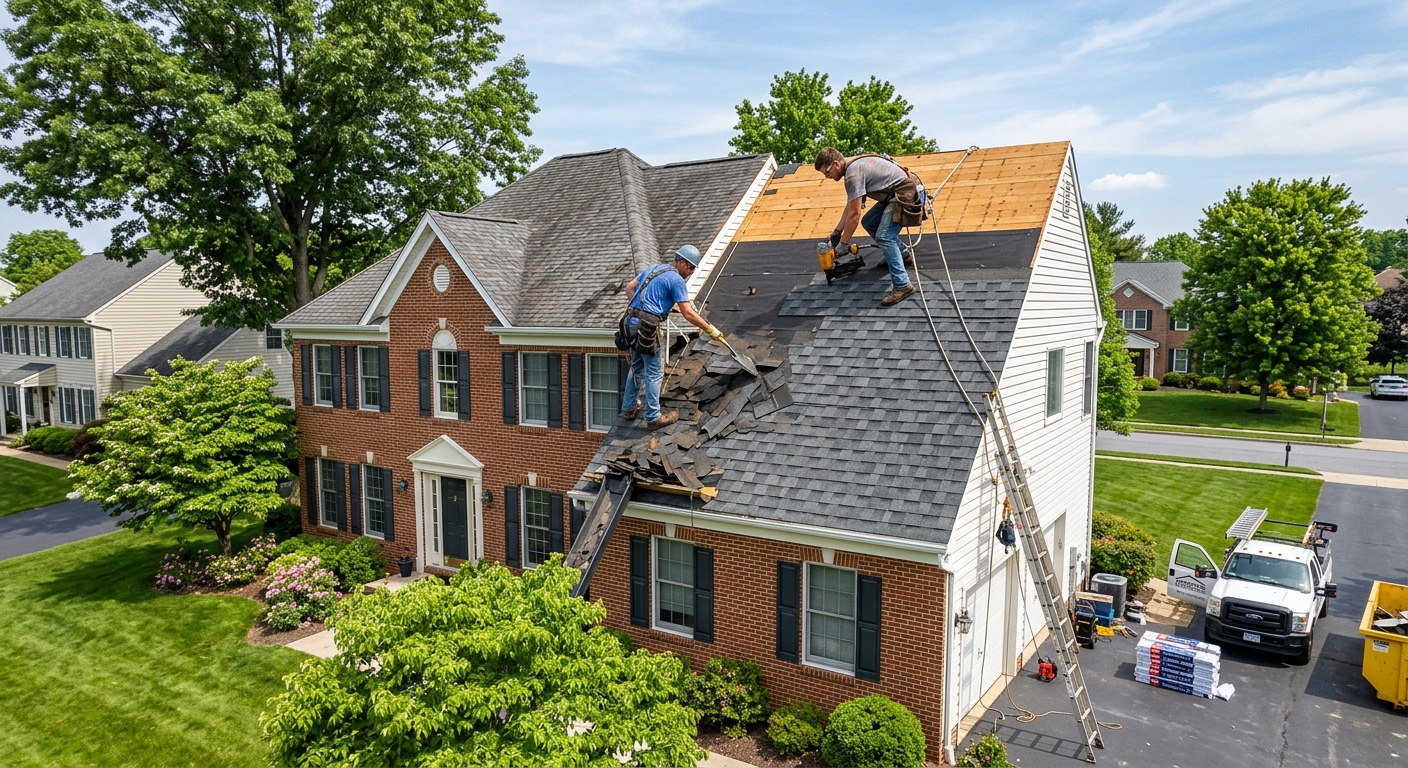
Roofing Replacement & Repair costs in East Nottingham — 2026
East Nottingham homeowners typically face roof replacement or major repairs as homes age, especially in this part of Chester County. With a population of 8,987 and a high homeownership rate of 88.6% (U.S. Census Bureau, ACS 2024), most roofs here belong to single-family houses, often with larger roof surfaces and greater repair demands. Decades-old subdivisions like those in West Goshen and Uwchlan set the tone: wide runs of asphalt shingle roofs installed in the 1980s and 1990s are now reaching the end of their service life. For East Nottingham homeowners, this means “roof replacement” frequently covers much more than just a square or two—it often involves full-home scopes, attic ventilation fixes, and updated flashing.
Expect the price to reflect Chester County’s suburban scale. Roofers here are experienced with replacing entire roofing systems, not just patching, as full-scale replacements are routine for these aging developments. Many homes were built before 1980, increasing the chance of older decking or lead paint concerns under the existing shingles. Below is a breakdown of common roofing materials and repair scopes with realistic price ranges for local homes:
| Material / Scope |
Lifespan |
Best for |
Price range (installed) |
| Asphalt shingles — architectural (30-yr) |
25–30 yrs |
Suburban homes, HOA compliance, good value |
$11,000–$23,000 |
| Asphalt shingles — impact-resistant (Class 4) |
30+ yrs |
Wind-exposed areas, hail risk, insurance discounts |
$18,000–$23,000 |
| Metal standing seam |
40–70 yrs |
Long-term owners, low maintenance, durability |
$26,500–$47,500 |
| Flat roof — TPO or EPDM |
15–25 yrs |
Sunrooms, additions, low-slope areas |
$14,000–$28,000 |
| Roof repair — leak or isolated section |
n/a |
Local leaks, storm patching, flashing fixes |
$600–$2,200 |
Prices are estimates for a typical East Nottingham home and vary with roof size, pitch, decking condition and material selection.
Storm damage and insurance claims in East Nottingham
In East Nottingham, wind-driven storms and fast-moving weather off the South Valley Hills frequently damage roofs—especially on exposed ridges. If you suspect storm damage, start by taking clear photos and videos of the affected areas before any cleanup. Insurers expect this documentation and may reduce settlements for missing evidence.
Next, if you plan to file a claim, request your adjuster provide a written, detailed scope of loss and clarify whether your policy pays actual cash value (depreciated amount) or full replacement cost. Many Chester County homeowners discover the real gap when their settlement falls short of a modern replacement, particularly on older roofs. Insurance adjusters almost always visit in person to inspect storm claims; expect to walk through the damage with them.
Consumer protections apply: under Pennsylvania’s Home Improvement Consumer Protection Act, your roofer must provide a written contract for any job above $500 and you’re entitled to a 3 business-day right of cancellation. Be aware—state law prohibits waiving or covering a homeowner’s insurance deductible. If a contractor in East Nottingham offers to “absorb your deductible” or promises you a free roof with no out-of-pocket cost, walk away. That’s not just a breach of state regulations; it flags a contractor willing to game the system at your risk.
Finally, don’t sign over insurance checks until you see the finished scope in writing. Local contractors in this saturated market know the drill, but you’re still the gatekeeper for your repairs.
How southeastern Pennsylvania's weather shapes roofing here
Southeastern Pennsylvania’s roof failures don’t happen by accident: physical stress from weather is the culprit, and East Nottingham’s exposure is central. Ridge-line wind events along the South Valley Hills and Chester Valley routinely sweep through, leaving missing shingles and torn ridge vents in their wake. That puts architectural shingles under particular stress. On a typical replacement here, you could see price impacts from these local wind events: a leak repair after a ridge blow-off can cost $600–$2,200 depending on the area affected.
Our ground snow load is 30 psf, and the winter design temperature drops to 14 °F. This isn’t the snowbelt, but those values mean ice dams are a regular hazard at the eaves. Warm air leaking into the attic causes snowmelt higher up the roof, which then refreezes on cold, unheated overhangs. The resulting ice dam traps more water, which can back up under shingles. Water-intrusion damage from this pattern can turn a routine roof job into a sheathing replacement, jumping your bill from a shingle-only replacement ($11,000–$23,000) to a partial or full-deck replacement as well.
Hail is less frequent here than west of the city, but when it does hit, hail can bruise shingles—damaging the core even if the surface looks intact. Insurance adjusters know this: they’ll focus on soft bruises more than obvious holes, which can determine whether you’re looking at a repair ($600–$2,200) or a full replacement settlement.
What gets discovered after tear-off in East Nottingham
Once the old roof is stripped, surprises can drive the price up for East Nottingham homeowners. Rotted or delaminated roof decking—often found where leaks went unnoticed or in older homes (about 30% here were built before 1980)—can add $2,000–$4,000 on a large home to swap out plywood or boards. If the previous roof system lacked proper attic ventilation, especially vital in this humid, moderate-freeze region, there’s a strong chance of mold or persistent winter ice dams. Remediation and ventilation upgrades might run $1,200–$2,400 for baffles, new ridge vent, and additional intake vents.
Metal flashing at walls, chimneys, or valleys is another area where hidden costs lurk. If your last roofer reused old flashing, you may need fresh, properly integrated pieces at $500–$900 per section to comply with modern standards and prevent future leaks. Cracked vent boots or deteriorated drip edge—often found in these aging subdivision homes—typically add $300–$700 if discovered after the job starts.
These are not rare “gotchas.” In Chester County’s older, humidity-vulnerable homes, they’re routine. Many crews will flag these issues for same-day approval so you’re not hit by change orders after the job is already underway.
Roofing season and lead times in Chester County
Roofing crews in Chester County work according to the region’s climate, and in East Nottingham, the real calendar begins in late March and runs to early November. Shingles require daytime temperatures above 40 °F to form a long-term bond, so March and November installs can risk poor sealing. June through early October is prime time for high-output crews—especially with so many roofs in the suburbs due for replacement at once.
Thanks to Chester County’s place in the saturated Philadelphia metro market, more companies are available than in rural towns, but summer lead times still swell. In peak September, expect a 2–5 week wait for larger projects—even longer after damaging storms. Booked crews may bump your emergency to the top, but you’ll typically pay more for winter jobs: an urgent February repair or complete replacement can cost 10–15% above September pricing, especially if tarping or heat-cured adhesives are involved.
For lowest hassle, schedule replacement jobs for spring and fall when labor is steadier and you can avoid the summer backlog or the cold-weather premium. That’s the sweet spot for most East Nottingham homeowners.
Roofing permits in East Nottingham: what you need before work starts
East Nottingham follows the Pennsylvania Uniform Construction Code (UCC), which is based on the IRC and enforced by municipalities, unless a township opts out. For most homes in Chester County, a building permit is required for full roof replacement if it includes structural deck repair. Like-for-like shingle repair—especially if limited to under one roofing square—can usually be completed without a permit in line with common practice in West Chester Borough.
Permits are issued either by your local municipal office or, if your township has opted out, by the PA Department of Labor & Industry. Always ask your contractor to clarify which office will process the permit for your project.
Before signing anything, verify the contractor’s Pennsylvania Home Improvement Contractor (HIC) registration for any job over $500 using the state’s hic.attorneygeneral.gov online search. Insurance verification is equally important—demand a certificate of coverage and back it up with a workers’ compensation status check at wcais.pa.gov.
For homes built prior to 1978, confirm the roofer’s EPA Lead Renovator credentials (certifiedrenovatorsearch.epa.gov) if any lead paint disturbance is likely; this is a real risk in older East Nottingham housing stock.
Choosing a roofer in Chester County
A good roofer in Chester County won’t just promise the lowest price—they’ll back up their words with real credentials and paperwork you can check. Always verify Pennsylvania Home Improvement Contractor (HIC) registration at hic.attorneygeneral.gov. Ask for an up-to-date workers’ compensation certificate and confirm it directly via the WCAIS system (wcais.pa.gov). For homes built before 1978, check the company's EPA Lead Renovator status online. Do not rely solely on references or word of mouth; in a dense regional market, paperwork matters.
- Check HIC registration at hic.attorneygeneral.gov
- Request and verify workers’ comp at wcais.pa.gov
- Get a written, detailed contract before work (over $500)
- Confirm the company address and that they have a local presence
- Demand proof of liability insurance
- Request photos and references from recent local jobs
- Ask if the quote includes all flashing, ventilation, and deck repairs
- For pre-1978 homes, verify EPA Lead Renovator status
- Make sure the permit (if needed) is pulled in your name/address
- Never pay more than 1/3 upfront before materials delivery
- Understand warranty coverage—in writing, not just spoken
- See the actual shingle and manufacturer being used
Red flags in Chester County’s saturated roofing market: contractors knocking door-to-door after storms, vague quotes that don’t spell out deck or flashing costs, refusal to show HIC or insurance paperwork, proposals to "cover your deductible" (illegal here), or companies listing only out-of-area PO Box addresses. Avoid anyone who won’t walk your roof or tries to sign you during the first visit.
Frequently asked questions — roofing in East Nottingham
How can I tell if my roof decking is rotted?
In East Nottingham, with many roofs at the 30- to 50-year mark, rotted or spongy decking is common after past leaks or poor attic ventilation. Inside the attic, look for dark stains, sagging, or areas where nails are visibly rusted—these are frequent signals under older asphalt roofs in our area. From the outside, bounce when you walk the roof can mean the plywood is delaminating or soft. Ultimately, the clearest signs come at tear-off: if your roofer lifts old shingles and sections of wood crumble, decking replacement is a must. Repairs here typically add $2,000–$4,000 to a Chester County job depending on the surface area. If you suspect rot, budget for it—East Nottingham homes built before 1980 (about one in three) run a higher risk.
What's the cheapest way to replace a roof in East Nottingham?
The most cost-effective approach for East Nottingham homeowners is often a straightforward architectural asphalt shingle replacement. Staying with 30-year architectural shingles—well accepted by HOA standards in the region—keeps costs at $11,000–$23,000 for most homes. Avoid unnecessary upgrades like high-profile metal or specialty shingles unless you have very specific insurance or longevity needs. Be realistic: skipping essential repairs like bad decking or flashing will lead to bigger, pricier problems within a year or two, especially in our freeze-thaw climate. If funds are tight, stick with mainstream materials, verify a proper installation and attic ventilation, and avoid contractors who promise work “cheaper than insurance” or offer to “waive your deductible”—those are strong warning signs in Pennsylvania.
How long does a roof replacement take in East Nottingham?
For most East Nottingham homes with standard asphalt shingles, a roof tear-off and replacement takes 1 to 3 days once the crew is onsite—assuming no weather delays and no major surprises with the decking or structural repairs. Large homes or complex roofs (with steep pitches, multiple dormers, or additions) can stretch to 4–5 days, especially if hidden damage is found. In peak season (late summer), local crew availability may push your start date out several weeks due to high demand in Chester County’s dense suburban market. Emergency winter replacements move faster, but you may pay a premium compared to planning ahead for a September install in the $11,000–$23,000 range.
How much does a new roof cost in East Nottingham?
A full roof replacement in East Nottingham, using architectural asphalt shingles, usually falls between $11,000–$23,000 for a typical single-family home (the most common house type here, per local stats). Go with impact-resistant (Class 4) shingles and you’ll be at the upper end—worth considering if your property is exposed to wind or hail. If you add metal standing seam or opt for a flat roof membrane (TPO/EPDM), your costs rise significantly, up to $47,500 for a larger metal job. Always budget 10–20% extra for hidden repairs under the shingles, common in older local homes.
How do I find a reputable roofer in East Nottingham?
Start with Pennsylvania’s official HIC registration at hic.attorneygeneral.gov—any contractor working jobs over $500 must have this, and you can verify it online. Cross-check workers’ compensation coverage at wcais.pa.gov for insurance status. Local references matter, but don’t stop there: ensure you have a written contract, not just a handshake, and check for a local address (not just a PO Box). In East Nottingham’s part of Chester County, avoid any company that refuses to provide paperwork, proposes “free roofs” by absorbing your deductible, or pushes you to decide on the spot. Most reputable local roofers price within the $11,000–$23,000 band for standard shingle jobs—and give you documentation at every step.
Is metal roofing noisy in rain?
Modern standing seam metal roofs installed in East Nottingham do not sound like a barn in a thunderstorm. When installed over solid sheathing and with proper attic insulation—which is the standard for Chester County homes—you’ll hear only a dull patter, similar to heavy rain on asphalt shingles. If you’re replacing an old asphalt roof, the difference in indoor noise is minimal. The benefit is longevity: metal can triple your roof life (40–70 years), but you’ll see a much higher upfront price tag of $26,500–$47,500 compared to shingles. If noise is a must-have issue for you, ask your contractor about adding an acoustic barrier, but for most local homes, it’s not needed.
How do I confirm a roofer carries workers' compensation?
Pennsylvania requires every roofing contractor employing workers in East Nottingham to maintain active workers’ compensation insurance. Ask for their insurance certificate, but don’t stop there: verify their coverage directly at the state’s official WCAIS online system (wcais.pa.gov). It takes a minute. This matters because, without valid coverage, you—the homeowner—could be on the hook if a worker is injured on your property. Given the number of contractors servicing Chester County, it’s not enough to take anyone’s word for it. Workers’ comp is required regardless of job size, whether you’re paying for a leak repair ($600–$2,200) or a full reroof.
What if my insurer denies my roof claim?
If your East Nottingham roof claim is denied, get a clear written explanation from your adjuster—especially whether they cited wear and tear, improper installation, or a lack of storm event documentation. Don’t rely on phone calls; everything needs to be in writing for appeal. Consider having a second, reputable roofer inspect and document the condition with photos and measurements; local companies are used to providing detailed inspection reports for just this purpose. Sometimes a denial is the end of the road, but for borderline claims, especially after significant ridge-line wind events, a thorough second opinion (often costing the same as a minimum repair—$600–$2,200) can help. If you still face a dead end, Pennsylvania’s consumer protection laws require contractors to give you a written contract and disclosures—use that documentation when discussing options with your insurer.
Does East Nottingham get enough hail to justify Class 4 shingles?
While southeastern Pennsylvania, including East Nottingham, doesn’t get hail as regularly as counties farther west, we do get occasional hailstorms that leave behind bruised and shortened shingle life. Wind-driven impacts are more frequent here due to local ridge-line storms. Impact-resistant (Class 4) shingles cost more—usually in the $18,000–$23,000 range for a full replacement—but can yield a discount on some homeowners’ insurance and better performance against both hail and flying roof debris. For properties exposed to open wind or with previous hail damage, Class 4 is worth considering, but if your current roof has lasted decades without impact issues, the mainstream architectural shingle remains the more economical choice.