What roof replacement costs in Upper St. Clair in 2026
Upper St. Clair’s homes, where the homeownership rate is close to nine in ten and the typical household income is well above the county average (U.S. Census Bureau, ACS 2024), tend to see roofing investments reflect not just necessity, but a desire for long-term, low-hassle solutions. In this township, an overwhelming 70.7% of properties were built before 1980. That means many roofs have already seen multiple replacements—sometimes with original decking materials or patch jobs stacked over time. Much of Allegheny County’s housing dates to 1900–1950, so in Upper St. Clair roofers are often tearing off several layers and encountering plank boards instead of plywood or OSB, driving up labor and sometimes surprise deck repair work. This makes “basic” replacements here almost always a complete tear-off, rarely just a reshingling.
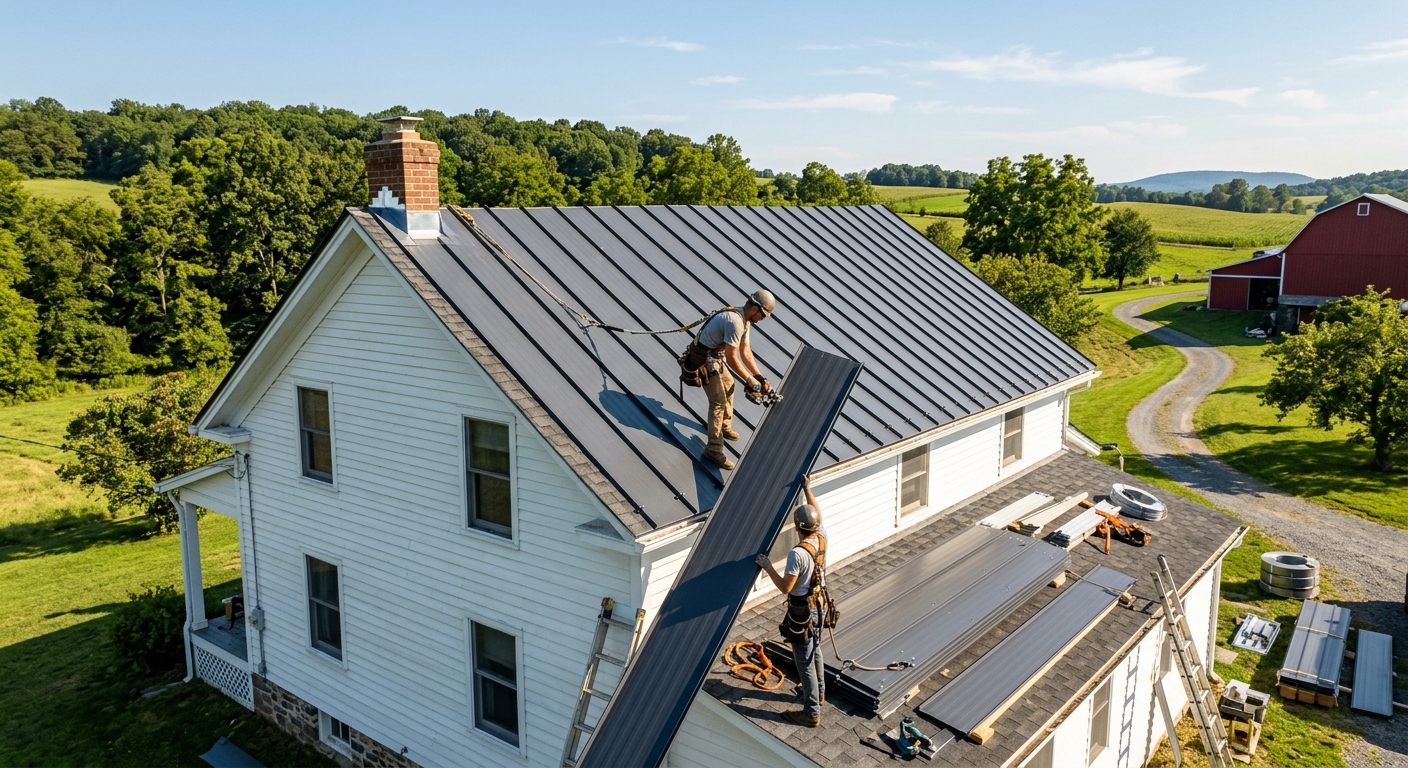
Architectural asphalt shingles dominate because they hold up during the Ohio Valley’s winter freeze-thaw sequence and erratic storm patterns. But residents considering standing seam metal are also on solid ground: in a community where most homes are detached and high-value, investing in longevity usually pays back in peace of mind. Flat roofs—often found on porch additions—require different materials, and many estimates miss these. Below, see what an honest replacement or repair costs on a typical Upper St. Clair home in 2026:
| Material / Scope |
Lifespan |
Best for |
Price range (installed) |
| Asphalt shingles — architectural (30-yr) |
25–30 yrs |
Detached homes, main slope |
$10,500–$22,000 |
| Asphalt shingles — impact-resistant (Class 4) |
30+ yrs |
Tree-heavy lots, hail zone |
$17,000–$22,000 |
| Metal standing seam |
40–70 yrs |
High-value, low-maintenance homes |
$25,500–$45,000 |
| Flat roof — TPO or EPDM |
15–25 yrs |
Porch/addition/low-slope sections |
$13,000–$26,500 |
| Roof repair — leak or isolated section |
n/a |
Minor storm or aging issues |
$550–$2,100 |
Prices are estimates for a typical Upper St. Clair home and vary with roof size, pitch, decking condition and material selection.
Storm damage and insurance claims in Upper St. Clair
If your Upper St. Clair roof is hit by wind or hail, your first move should always be documentation—photos of the damage, interior and out, before any cleanup. Once you’ve captured the evidence, contact your insurer to open a claim and ask for a written scope of loss. The adjuster will calculate actual cash value (what your roof is worth after age) versus replacement cost (what it’ll take to make you whole). You should expect a site visit from their adjuster before any work begins.
Once your claim is in process, get a written estimate from a registered contractor that spells out the exact work to be done. Under Pennsylvania’s Home Improvement Consumer Protection Act (HICPA), any roofing contract over $500 must be in writing and you are guaranteed a 3-business-day right to cancel—so never sign anything on the spot under pressure. Importantly, Pennsylvania prohibits roofers from waiving or "eating" your insurance deductible. If you’re offered a deal where the contractor says they’ll cover your deductible, that’s not a favor—it’s a red flag of insurance fraud that can come back on you and will void protections under HICPA.
The local frequency of severe weather means these rules get tested regularly. Because storm-tracking from the Ohio Valley rolls right through Allegheny County, insurance adjusters are familiar with common damage patterns here—dislodged shingles, dented gutters, and punctured flat roof membranes. A reputable roofing contractor in Upper St. Clair should recognize these patterns, handle the insurance paperwork, and meet with your adjuster if needed. But never let the contractor steer the claim behind your back—this is your financial protection, not theirs.
Roofing permits in Upper St. Clair: what you need before work starts
All substantial roofing work in Upper St. Clair is governed by the Pennsylvania Uniform Construction Code (UCC), based on the International Residential Code. Enforcement is handled at the municipal level or by the Pennsylvania Department of Labor & Industry in cases where a municipality opts out. Replacement of more than half your roof area typically requires a building permit for Upper St. Clair homes, in line with the rules used countywide. However, if you are having minor shingle repairs done to a small area—think a handful of tabs after a windy night—a permit typically is not required.
Before signing any contract, you should verify that the contractor is registered as a Home Improvement Contractor through the Pennsylvania Office of Attorney General. Use the public registry at hic.attorneygeneral.gov and check workers’ compensation insurance via WCAIS (wcais.pa.gov) to confirm valid coverage. This is not just belt-and-suspenders thinking: workers' compensation is mandatory for all employers in Pennsylvania, including roofers, for exactly the kind of injury risks present on steep Upper St. Clair roofs.
There’s no specialty state trade license for roofing in Pennsylvania—only the Home Improvement Contractor registration—so these public records are your main verification tool. If a company can’t show up in both places (registration and insurance), move on. And never let work begin before the permit is in hand if your project qualifies.
What Upper St. Clair's housing stock means for your roof
Upper St. Clair roofs tend to share a few telling features thanks to the township’s development pattern. Since more than 70% of homes here predate 1980, many homeowners face aging plank roof decking beneath the shingle surface—a product of early- to mid-century construction when plywood was rare and modern underlayments were not yet code. These homes were rarely built with ice or water shields at the eaves, so older roofs are extra vulnerable to freeze-thaw cycles and water backup, both common in our local climate.
Typically, you’ll see steeper pitches (7/12, even 10/12) on original structures, meaning tear-off labor can be higher. It is not uncommon for three or more layers of roofing to be discovered atop these old decks—every past owner shingling over instead of stripping down to the boards. For any full reroof today, code and common sense require a full tear-off to bare wood, both to inspect for rot and to meet warranty requirements from shingle manufacturers.
On homes built later—there are pockets of late 1970s and some 1990s construction—decking is usually plywood or OSB, and you often find only the original layer. If this is your first roof replacement, now is the time to add ice and water shield as required by code, particularly because our local heavy snow load and winter cold (ground snow load 30 psf, winter design temp 8°F) demand it. In any event, knowing the construction era helps your roofer anticipate—and price—the surprises waiting underneath.
Repair or replace? A decision guide for Upper St. Clair roofs
In Upper St. Clair, roofing age and local construction history create a clear decision path for most homes. If your shingle roof is less than 15 years old and you’ve developed just one small leak—maybe from flashing or a branch strike—repair is reasonable and will typically run between $550–$2,100. But for houses built before 1980 (over 70% here), once a roof hits the 20- to 25-year mark, repeated leaks or multiple patched spots signal it’s time for replacement. Repairing the same aging roof two or three times in five years might add up to $4,000–$6,000—nearly half the cost of a full replacement, all while leaving old decking and underlayment untouched. For severe storm damage, insurers generally require a full section or entire roof replacement if shingles are missing across wide swaths.
Flat roofs, common over additions, almost always require replacement once water begins to pond or blisters appear, as patching buys little time. Heading into winter, any active leak is a priority: emergency tarping and repair will run $550–$2,100, but should be followed by a planned replacement when weather allows.
| Situation |
Recommendation |
Typical cost |
Reasoning |
| Under 15 years, one isolated leak |
Repair |
$550–$2,100 |
Roof is young, isolated damage, deck intact |
| 15–25 years, several leak points |
Replace |
$10,500–$22,000 |
Multiple failures, likely underlying issues from age |
| 25+ years, any active leak |
Replace now |
$10,500–$22,000 |
Most materials and underlayments at end of service life |
| Storm damage, wind or hail |
Document, claim, replace |
$10,500–$22,000 |
Insurers require section or complete replacement if widespread |
| Flat roof ponding or blistering |
Replace membrane |
$13,000–$26,500 |
Membrane system integrity compromised, patching won't hold |
| Active leak entering winter |
Emergency repair, schedule replacement |
$550–$2,100 |
Limit water damage now, plan full fix in spring |
Flat roof sections: the part most quotes get wrong
Many homes in Upper St. Clair, especially those with additions or enclosed porches, have a flat or low-slope roof section connected to a steeper main slope. This isn’t just a design quirk—it calls for a totally different roofing system. Shingles are not designed for anything under a 3/12 pitch, and installing them on a low slope (think 2/12 or less) will lead to leaks, trapped ice, and rot, especially after the rough freeze-thaw cycles we see every winter.
Flat roof sections here should be covered with a membrane system like TPO or EPDM, which are engineered to handle standing water and resist breakdown for 15–25 years. Quotes for these jobs should fall between $13,000–$26,500 for typical replacement. Since ponding is a chronic issue on these flat areas—and our clay-heavy Allegheny County subgrade means wet yards and poor roof drainage—it’s critical your roofer gets not just the material right, but the installation details.
If your roofing estimate suggests architectural shingles for a 2/12 porch, it’s a signal that the contractor either doesn’t know the code, or is cutting corners. Only proper membrane systems will keep your flat sections dry through Pittsburgh winters.
Reading a roofing estimate line by line
A roofing estimate in Upper St. Clair should do more than show a total—it should itemize every detail. Check first for a clear statement of roof area, given in squares, including the exact pitch. Tear-off and disposal must note the number of layers (all too often, two or three for houses built before 1980), and whether a dumpster is included. Underlayment and ice barrier are non-negotiable in this climate: your quote should name product types, not just say “felt,” and specify the height of ice and water shield up the eaves.
Decking replacement—likely if your house is from the first half of the twentieth century—should be priced per sheet, as a line item, not hidden in a lump sum. Flashing, vent boots, and all penetrations need detail. Workmanship and manufacturer warranties should be separated, since only the former covers installation errors. Finally, never pay more than 15% up front. The balance should wait until work is complete and you’re satisfied.
A vague lump-sum proposal with no roof measurement, layers, or materials fully described is not a real estimate—you can’t compare it to anything or defend it if problems crop up later.
| Line item |
What to look for |
Red flag if… |
| Roof area |
stated in squares, with pitch |
no measurement given |
| Tear-off and disposal |
number of layers, dumpster included |
bundled into one figure |
| Underlayment |
product type and coverage |
listed only as 'felt' |
| Ice and water shield |
coverage height at eaves |
omitted entirely |
| Decking |
per-sheet contingency price |
no allowance at all |
| Warranty |
workmanship years stated separately |
only the shingle warranty |
| Payment |
deposit under 15%, balance on completion |
large upfront cash |
Frequently asked questions — roofing in Upper St. Clair
How do I file a storm damage roof claim in Pennsylvania?
In Pennsylvania, including Upper St. Clair, start your storm damage claim by taking thorough photos of all damage and any affected interior areas. Contact your insurance company to open a claim and request a written scope of loss after their adjuster visits. Hire only a contractor registered as a Pennsylvania Home Improvement Contractor—verify this at hic.attorneygeneral.gov. Any contract to repair or replace must be in writing if the job is over $500, with a 3-business-day right to cancel. Be aware that contractors are not allowed to waive your deductible. Typical repair costs for isolated storm damage here run $550–$2,100, but severe damage may trigger full replacement in the $10,500–$22,000 range. Your roofer can assist with paperwork, but you should control the process and make sure all paperwork matches the actual work needed.
Why is my Upper St. Clair roofing quote higher than the online average?
Roofing quotes in Upper St. Clair nearly always run above “national averages” you’ll find online for two reasons. First, local homes are frequently older—over 70% date before 1980—so replacements often require a full tear-off down to plank decking, labor to strip multiple layers, and sometimes repairs to old wood. Second, professional contractors here carry the required Pennsylvania Home Improvement Contractor registration and full workers’ compensation, and these protections add legitimate cost. If you’re quoted $17,000–$22,000 for an architectural shingle roof, you’re seeing the impact of local code, real labor, and a higher material standard needed for Ohio Valley storms, not padded pricing. Always compare detailed estimates—cheap usually means corners are being cut on old homes like ours.
Do I need a permit to replace a roof in Upper St. Clair?
For most roof replacements in Upper St. Clair, yes—a permit is required when more than 50% of your roof area is being replaced. This is enforced under the Pennsylvania Uniform Construction Code by the local municipality or, if they’ve opted out, the Department of Labor & Industry. Permits ensure that tear-off is done, old decking is inspected, and that ice and water shield is properly installed should your home need it. Small, like-for-like shingle repairs may not require a permit if they’re under a minimal area. But if your roofing work tips into full replacement—say, $10,500–$22,000—it’s nearly always permitted. Ask your contractor for a copy and verify registration at hic.attorneygeneral.gov before any work begins.
How much deposit should I pay a roofer upfront?
In Upper St. Clair and throughout Pennsylvania, the deposit structure is consumer-protected under HICPA. Never pay more than 15% of the contract or $1,000, whichever is less, upon signing—no reputable roofer will ask for more. The bulk of the payment should be made only after the work is complete and you are satisfied. On a typical architectural shingle reroof—say, $17,000–$22,000—the upfront should be modest and itemized on your written contract. If a roofer insists on a large cash payment or more than the legal maximum, it’s time to find another. This policy protects both you and your investment in your Upper St. Clair home.
What causes ice dams on Upper St. Clair roofs?
Ice dams form when heat from your Upper St. Clair home melts snow on the upper roof, letting water flow down to the colder eaves, where it refreezes and creates a dam. Water then backs up under the shingles and leaks inside. This is especially common in older houses with less insulation, plank decking, and original ventilation schemes common in local homes prior to 1980. The solution always involves better attic insulation and ventilation, not just bashing away at the ice. If you need emergency repairs for leaks caused by damming, expect costs in the $550–$2,100 range, but long-term fixes target the underlying attic conditions. A full reroof with modern ice and water shield is usually the right time to address the problem.
How long should a roof last in Upper St. Clair?
Depending on the material and installation, a roof in Upper St. Clair should last 25–30 years for architectural asphalt shingles—provided decking is sound and attic ventilation is adequate. If you opt for metal standing seam, you can often expect 40–70 years, making it a one-time investment for most homeowners. For flat roof membranes like TPO or EPDM, 15–25 years is standard before replacement in local climate conditions. If you see patchwork or repeated leaks before these milestones, it signals either poor installation on your last roofing job or that your house’s pre-1980 construction is accelerating wear. Replacement usually means $10,500–$22,000 for shingles and $25,500–$45,000 for metal, with repairs costing much less if the problem is limited.
Is a metal roof worth the extra cost in Upper St. Clair?
Standing seam metal roofs, with installed prices of $25,500–$45,000, cost more upfront than shingles. But in Upper St. Clair—where many homeowners plan to stay long-term and homes are high-value—the payoff is longevity and less maintenance. Metal sheds snow better, stands up to hail, and resists wind uplift from those sudden Ohio Valley storms. If you don’t plan to move for at least 20 years, or want a “one and done” solution, the metal premium is reasonable. For older homes, metal can sometimes require extra prep or woodwork, so make sure your roofer writes a detailed scope. Still, for most single-family houses owned by their long-term residents, metal offers genuine peace of mind.
Do metal roofs shed snow better in Upper St. Clair?
Yes—standing seam metal roofs are excellent at shedding snow, especially on the steeper-pitched homes typical of Upper St. Clair’s older neighborhoods. The smooth surface and concealed fasteners let snow slide before ice dams can form, making it one of the best defenses against the major freeze-thaw pattern here. While metal roofs cost between $25,500–$45,000 to install, the savings on long-term water damage and lower maintenance often offset the higher price over a few decades. If snow slides off a little too quickly, snow guards can be added above entryways and walkways. For homeowners who’ve had repeat ice dam issues, metal is usually the last roof you’ll need.
What is the best time of year to replace a roof in Upper St. Clair?
In Upper St. Clair, the sweet spot for roof replacement runs from late March through early November, when weather is reliable and temperature extremes are rare. Spring gives you a head start against storms, while fall lets you button up before harsh winter freeze-thaw cycles and heavy snows (ground snow load here is 30 psf). Homeowners replacing a roof in these months can expect full crews, short delays, and better shingle adhesion. Emergency jobs—say, a spring hailstorm—can be handled any time, though you may pay a premium ($550–$2,100 for rapid repairs). If your contractor pushes for a full reroof in December or January, ask about temperature limits on their materials and what precautions are being taken—cold weather installation is possible but trickier, especially for adhesives.