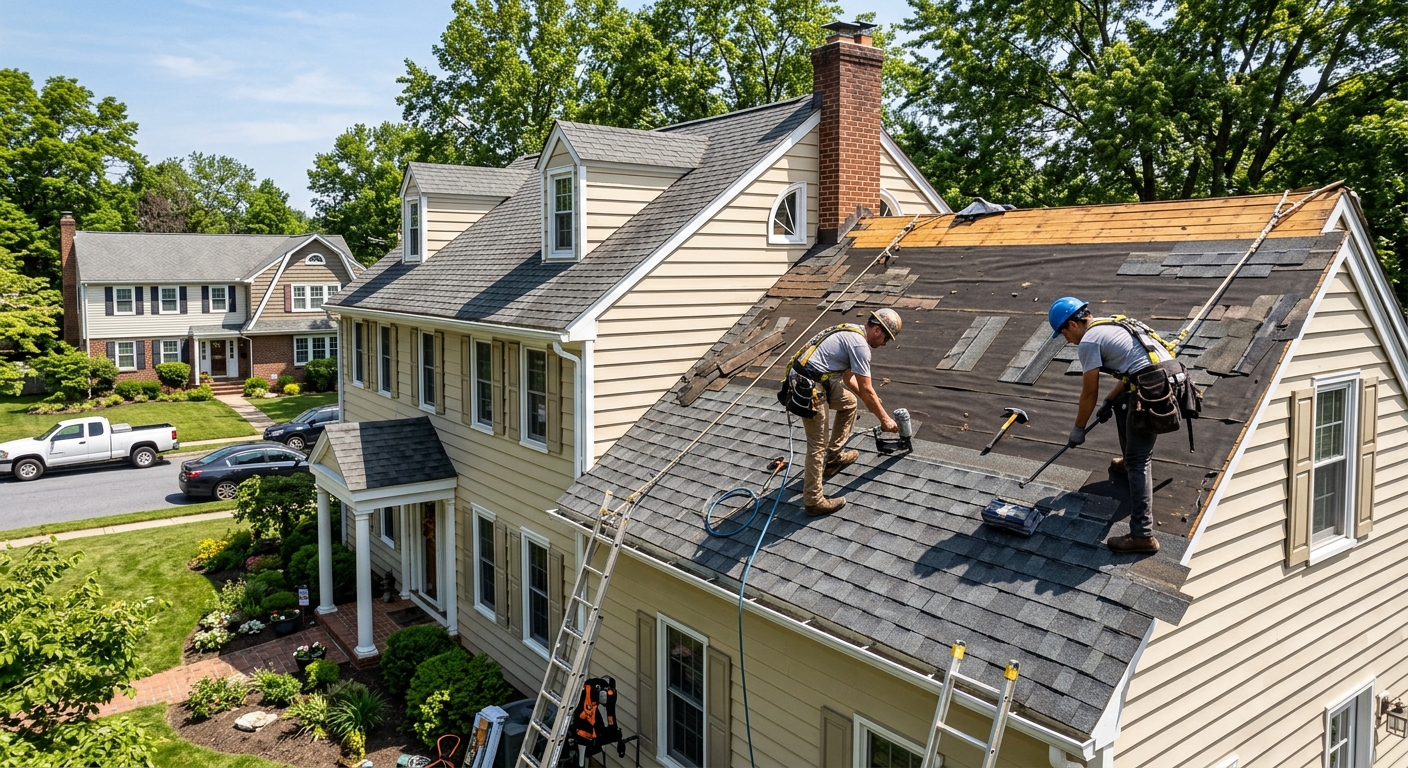
New Cumberland roofing prices by material and scope — 2026
In New Cumberland, most roofing projects reflect the character of its 7,515 residents and predominance of single-family homes, with 68.8% homeownership (U.S. Census Bureau, ACS 2024). The area’s housing market is dominated by post‑1950 suburban tracts—especially in nearby Hampden and Silver Spring Townships—leading to predictable reroof cycles as asphalt shingle developments age out in waves. For homeowners here, this means it’s common to see whole rows of roofs replaced within a year or two of each other, since most of these homes were built to similar standards and timelines.
In practical terms, this also means roofing crews here work at scale: large, efficient replacements are the norm, and knowing what your neighbors are paying can give you a powerful point of comparison. Because the majority of this housing was built before 1980, roofers here often find themselves dealing with decking and details from older construction practices—which may increase total costs if repairs are needed under the shingles.
Here’s what you can expect to pay in New Cumberland for different materials and scopes in 2026:
| Material / Scope |
Lifespan |
Best for |
Price range (installed) |
| Asphalt shingles — architectural (30-yr) |
25–30 yrs |
Suburban homes, best value |
$9,400–$20,000 |
| Asphalt shingles — impact-resistant (Class 4) |
30+ yrs |
Storm-prone ridges, insurance savings possible |
$15,500–$20,000 |
| Metal standing seam |
40–70 yrs |
Long-term ownership, snow shedding, farmsteads |
$23,000–$40,500 |
| Flat roof — TPO or EPDM |
15–25 yrs |
Additions, porches, low-slope segments |
$12,000–$24,000 |
| Roof repair — leak or isolated section |
n/a |
Active leaks, minor storm/tree damage |
$500–$1,900 |
Prices are estimates for a typical New Cumberland home and vary with roof size, pitch, decking condition and material selection.
Filing a roof claim after a Pennsylvania storm
In Pennsylvania, especially around New Cumberland, filing a roof claim is a step-by-step process that starts before any cleanup begins. If wind or hail has damaged your roof, immediately take clear photos and videos of all affected areas, including shingles, gutters, and any interior staining. Do not throw away materials or begin cleanup before documenting everything, as a thorough record strengthens your insurance claim and avoids disputes later.
Next, contact your insurance company and request a written scope of loss—a detailed summary outlining what the adjuster finds. Policies typically pay either the actual cash value (ACV)—which subtracts for age and wear—or replacement cost value (RCV), where you may need to submit final invoices to recover depreciation. In Cumberland County, it’s routine for an insurance adjuster to inspect the property in person, especially for roof claims.
Under Pennsylvania’s Home Improvement Consumer Protection Act (HICPA), any contract for roof repairs or replacements over $500 must be in writing, and you have a 3-business-day right to cancel after signing. Never agree to let a contractor "cover" or "waive" your insurance deductible. This is prohibited in Pennsylvania and is considered insurance fraud—you could jeopardize your coverage, and any roofer offering it is not acting in your best interest. Stick with reputable roofers who work by the book, and always insist on a detailed contract before work begins.
Checking out a roofer in New Cumberland: what to verify
Vetting a roofing contractor around New Cumberland means more than just a handshake and a business card. Start by ensuring the contractor’s Home Improvement Contractor (HIC) registration is current—every job over $500 requires it, and you can check this at hic.attorneygeneral.gov. For any crew with employees (not just 1099 laborers), valid workers’ compensation coverage is mandatory in Pennsylvania; verify current coverage via WCAIS (wcais.pa.gov) before work starts. Insist on a written contract—this is more than smart, it's state law under HICPA for all jobs over $500.
If your home was built before 1978, the federal EPA Lead RRP Rule applies. You can verify a contractor’s lead certification at certifiedrenovatorsearch.epa.gov. While there’s no trade license for roofing in Pennsylvania, legitimate contractors will happily provide these credentials and offer proof of local experience. Here’s a practical checklist for New Cumberland homeowners:
- HIC registration number checked at hic.attorneygeneral.gov
- Workers’ compensation verified at wcais.pa.gov
- Written contract with detailed scope and price
- EPA Lead RRP certification for pre-1978 homes
- Physical address with a local presence (not just a PO box)
- Proof of insurance—liability and workers’ comp certificates
- Itemized estimate (not a hand-written lump sum)
- References from actual New Cumberland or county jobs
- Manufacturer credentials for installed roofing products
- Clear warranty terms described in writing
- No offers to “waive your deductible” or skirt insurance rules
- Completion timeline and payment schedule spelled out
In a saturated market like Cumberland County, watch for out-of-town storm chasers, crews with no local example jobs, vague pricing, door-knocking sales pitches, and pressure to sign immediately as the most common red flags.
When to book roofing work in New Cumberland
New Cumberland’s climate—with pronounced freeze-thaw cycles, moderate snowfall, and a winter design temperature around 12°F—means roofing schedules follow the weather as much as the calendar. The ideal window for most roof replacements is April through early November, when daytime temps allow asphalt shingles to self-seal and crews can finish jobs without risk of ice buildup or raw decking being exposed to snow. Summer and early fall, especially September, see the heaviest demand as homeowners want work wrapped before cold sets in.
Cumberland County is a saturated suburban market, so reputable crews are often booked several weeks out during peak season. If you wait until a sudden leak in February, expect to pay a premium for emergency repairs, since mobilizing a crew in freezing weather or after a storm costs more—sometimes adding $500–$1,900 for urgent response alone.
Booking a planned replacement for late spring or fall is your best bet for competitive pricing and good workmanship. Contractors here rarely face material shortages since regional suppliers are well-stocked, but lead time and fair weather are worth more than a “discount” job squeezed in during the off-season. If your roof is aging or showing signs of wear, it pays to plan ahead and secure your slot before the seasonal rush.
Permits and code requirements in New Cumberland
All roofing work in New Cumberland falls under the Pennsylvania Uniform Construction Code (UCC), derived from the International Residential Code (IRC). The code authority here is the Pennsylvania Department of Labor & Industry; in municipalities like those in Cumberland County, code is enforced locally unless a township has opted out. In practice, full roof replacements almost always require a permit, while minor repairs—such as a few replaced shingles or patching a small leak—typically do not.
Before hiring any roofer for a job over $500, verify their Home Improvement Contractor (HIC) registration at hic.attorneygeneral.gov. For jobs with employees on site, Pennsylvania requires valid workers’ compensation coverage—confirm this through WCAIS (wcais.pa.gov) before any labor begins. Written contracts are mandatory on roofing contracts exceeding $500, and you should receive clear documentation and a right to cancel within three business days.
Permits are issued by the appropriate local municipal office, not the state. You’ll want to ask your contractor to show a copy of the actual permit and ensure your address appears on it. Good contractors expect you to ask and will never hesitate to provide documentation. There’s no state trade license for roofing, only the HIC registration, so skip anyone who dodges that basic check.
What New Cumberland's housing stock means for your roof
New Cumberland’s housing stock, with 93.7% of homes built before 1980 (U.S. Census Bureau, ACS 2024), presents a distinct set of roofing priorities. Most homes here feature the roof pitches and attic configurations common to post-war suburbia—moderate slopes, not the steep gables of older eastern cities, and typically large attic spaces. Decking is often a mix: late 1950s and 1960s homes may still have plank or board sheathing in parts, but most 1970s-era homes were constructed with plywood. By the time OSB became standard in this market, most local developments had already filled in.
Ice barrier membrane was not required under the original code at the time most New Cumberland homes were roofed, so older layers may be missing modern underlayment details. Many homes here are on their second or even third roof, so it’s not unusual to find more than one layer of old shingles at tear-off. Contractors should always check if the existing deck is solid—and be prepared to quote for partial or full redecking if past leaks have led to rot.
If you live in one of the post-1950 subdivisions around Hampden or Silver Spring Townships, your roof is probably approaching its second replacement cycle: the original shingle lasted 20–25 years, with early 2000s replacements now aging out. This means it’s worth budgeting for not just new shingles but for essential upgrades like ridge venting and ice barrier to bring your roof up to today’s standards.
What gets discovered after tear-off in New Cumberland
On older homes in New Cumberland, surprises can hide beneath the shingles. The most common issue is rotted decking—boards or plywood gone soft after decades of slow leaks or condensation. Once the crew tears off old roofing, any rotten decking must be replaced, typically at $60–$85 per sheet added to your invoice. Since many local homes never had modern attic ventilation systems installed, it’s also common to find insufficient ridge or soffit venting. Poor attic airflow in this region’s cold winters leads to ice damming: water backs up behind ice at the eaves, then finds its way inside, causing damage and sometimes voiding the last shingle warranty. Upgrading attic vents runs $400–$1,500 depending on the needed configuration.
Florida-style flashing and boot details were rare in local mid-century builds, so most New Cumberland roofs require new step and counter flashing at chimneys and wall transitions—expect $300–$900 added for proper metal work. Chimney cricket installation is priced separately for wood-backed structures. Worn vent boots, missing drip edge, and rusted or missing ridge venting are all frequent finds. Each of these can tack on $100–$500 apiece. While honest estimates account for the most likely add-ons, only a full tear-off uncovers all the repairs needed to ensure your new roof lasts its full lifespan.
Frequently asked questions — roofing in New Cumberland
Are impact-resistant shingles worth it in New Cumberland?
Impact-resistant (Class 4) shingles can be worth considering in New Cumberland, especially for homes exposed to ridge-line winds and hail that funnel through the Cumberland Valley. While standard architectural shingles last 25–30 years, impact-resistant versions extend that to 30+ years and better protect against storm damage. Insurance companies sometimes offer discounts, but that varies, so ask your carrier. You’ll pay more up front—typical replacement runs $15,500–$20,000, compared with $9,400–$20,000 for regular architectural—but if your home is in a high-exposure spot or you plan to stay long-term, the extra investment can be worthwhile. For a solid midblock house with plenty of tree cover, basic shingles may be the more cost-effective choice. As always, get bids on both so you can compare the real-world price difference for your roof’s size and slope.
How do I confirm a roofer carries workers' compensation?
In Pennsylvania, every employer with workers on your property must carry workers’ compensation, including roofers in New Cumberland. The easiest way to verify this is through the WCAIS database at wcais.pa.gov, where you can search a contractor’s business name to confirm active coverage. This is not a small detail: if a worker is hurt on your property and there’s no coverage, you could be exposed to liability. Ask any roofer bidding your job for their certificate and then double-check it in the state database. Reputable contractors here expect this question from homeowners, and anyone who can’t provide proof or who tells you “it’s just my guys helping me” should be crossed off your list immediately. Protect yourself and your home—never take their word for it. The small effort now can prevent big headaches later, especially on full replacements costing $9,400–$20,000 or more.
How much snow load can a New Cumberland roof handle?
In New Cumberland, roofs are built for a ground snow load of 30 pounds per square foot, as set by Pennsylvania’s building code for this region. For most single-family homes here, that standard more than handles typical winter snowfalls. What matters more in this area is not deep snow, but cycles of freeze and thaw. Ice damming—not the weight of snow—is what causes most local leaks. So if you’re worried about collapse, it’s unlikely unless unusual drifting occurs. Focus your energy on keeping gutters clear and ensuring your attic is properly vented, both to prevent ice backs and support your roof’s longevity. If your roof is older or underinsulated, talk to your roofer during a replacement—spending $400–$1,500 to improve ventilation is money better spent than hiring someone to remove snow in all but the rarest storm scenarios.
What's the cheapest way to replace a roof in New Cumberland?
The least expensive way to replace a roof in New Cumberland is with basic architectural asphalt shingles and by planning the work for late spring or early fall, when crews are less overwhelmed. Expect to pay at least $9,400–$20,000 for a typical single-family home—roofing is just not a small-ticket item in this county given the average house size from its post-1950s building wave. Some roofers may offer a "layover"—installing new shingles right over old ones—but this often masks underlying deck issues and is not recommended on homes built before 1980, where multiple layers or water damage are common. Skimping on ventilation or flashing is a false economy in this freeze–thaw climate. Always get three itemized bids and avoid any contractor pushing a deal far below this range; it nearly always means corners cut or legal risks.
How long does a roof replacement take in New Cumberland?
A typical roof replacement on a New Cumberland single-family home can be completed in 1 to 3 days, weather permitting, thanks to efficient crews and suburban lot layouts. Complications—like extensive decking repairs or correcting previous poor ventilation—can add a day or two. Most jobs are scheduled for midweek to avoid weekend weather swings common in this part of Cumberland County. Emergency replacement after storm damage can often be done faster, with crews prioritized for urgent leaks, but expect to pay a premium—especially if it’s midwinter, when costs can reach $15,500–$20,000 for a basic shingle install. For best results, lock in your slot weeks ahead during the heavy spring and fall rush and ask your contractor for a clear start and projected finish date in your contract.
How much deposit should I pay a roofer upfront?
Under Pennsylvania law, most reputable roofers in New Cumberland will ask for a deposit upfront, but it should never exceed one-third of the total contract price. For a roof replacement in the $9,400–$20,000 range, this means no more than $3,100–$6,700 as a down payment, with the balance due upon satisfactory completion. Never pay in full before work starts, and avoid any contractor pushing for a larger deposit—that’s a red flag. A clear payment schedule protects both parties, and your contract should spell out when each payment is due and under what circumstances. Large deposits are rarely necessary, since crews source materials on account from local suppliers. If a contractor can’t cover basic materials up front, look elsewhere.
How do I know if my New Cumberland roof needs replacing?
If your roof in New Cumberland shows curling shingles, missing granules, visible tar patches, or dark streaks where leaks have occurred, it’s usually time to consider replacement. Most homes here have had at least one reroof since they were built, but with 93.7% pre-1980 construction, there’s a good chance your current shingles are past their prime—especially if it’s been more than 20–25 years since the last replacement. Pay attention to interior ceiling stains after heavy rain or ice damming: these are warning signs. For minor leaks or isolated damage, repair might be possible—often in the $500–$1,900 range—but if your contractor finds multiple layers of old shingles or rotten decking, it’s more cost-effective to fully replace rather than patch up ongoing problems. Always get a proper inspection and honest assessment before spending big money.
How much does it cost to repair a roof leak in New Cumberland?
For a typical New Cumberland home, repairing a roof leak—patching an isolated area, replacing a few shingles, or correcting small flashing problems—generally costs $500–$1,900. This range covers most spot repairs needed after local storms or years of freeze-thaw driven wear. Beware of any contractor pushing for a full replacement for a minor leak: a reputable roofer will explain the extent of the damage and provide photos or video. If several leaks are found or if there’s evidence of widespread rot, you may be looking at replacement numbers, but most single-location repairs can be handled promptly by any credible local company. Always insist on an itemized proposal and documentation before work begins to avoid unwelcome surprises.
Can a contractor cover my insurance deductible in Pennsylvania?
No—contractors in New Cumberland, and anywhere in Pennsylvania, cannot legally “cover” or “waive” your insurance deductible. State law prohibits this practice under consumer protection statutes. Any offer to pay, rebate, or otherwise offset your deductible is insurance fraud and a clear warning sign that a roofer is not operating above board. If you’re filing a storm or hail claim, your insurance will require proof that you paid your deductible amount out-of-pocket. Getting involved in schemes to avoid this puts your claim and even your policy at risk. Agree only to contractors who require standard payment of your deductible and always insist on a written contract—as required for all jobs over $500 in Pennsylvania.