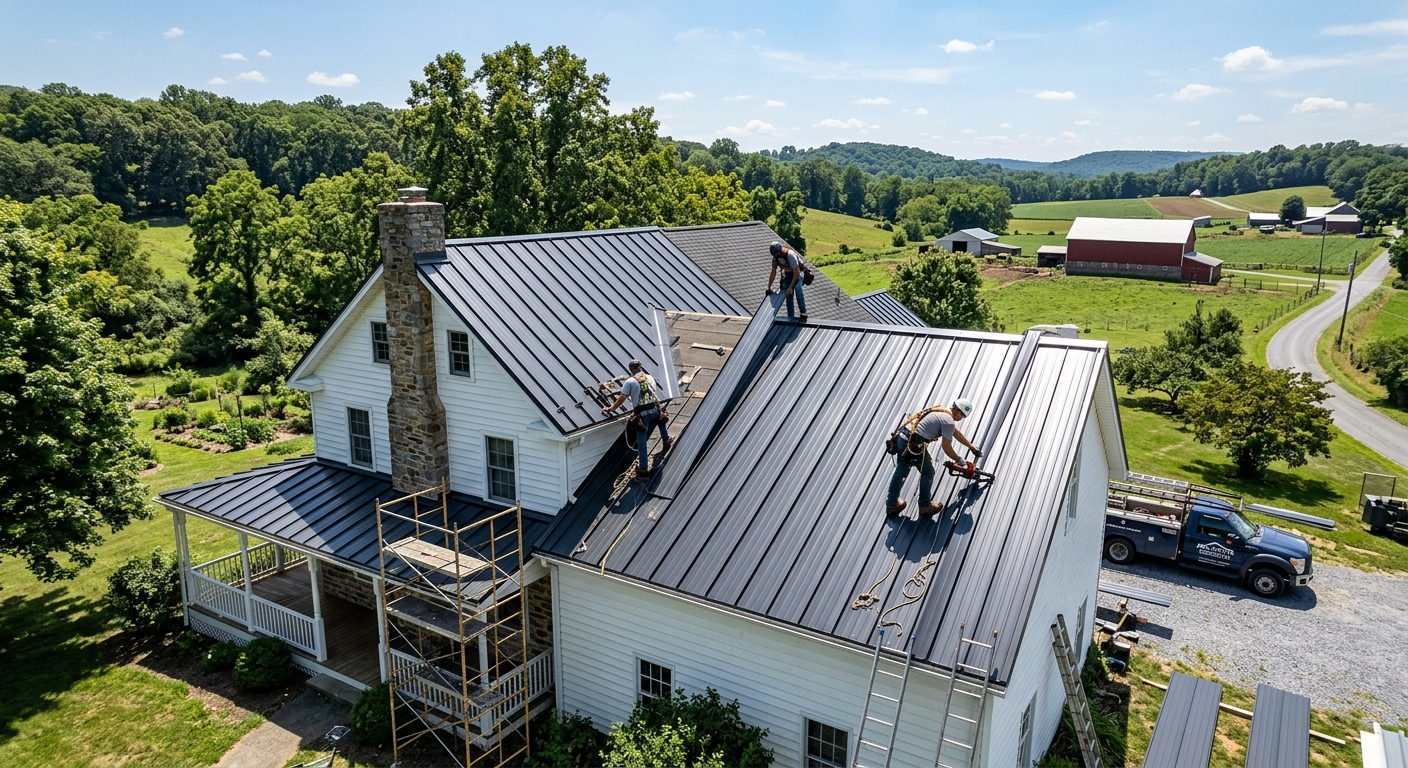
What roof replacement costs in West Donegal in 2026
If you own a home in West Donegal, expect roofing costs to mirror the reality of Lancaster County’s older, established neighborhoods. With a homeownership rate of 67.8% and a solid median household income of $95,909 (U.S. Census Bureau, ACS 2024), many residents here lean toward full replacements, not incremental patching, due to the typical roof age. Most roofs in West Donegal were put on steep-framed houses built before modern code standards, and it’s common to encounter two or even three shingle layers during tear-off. That drives labor and disposal costs higher, and surprises aren’t rare when the old layers come off.
Lancaster County’s housing stock trends pre-1950, which means lots of steep-pitched roofs with plank decking and plenty of previous upkeep—sometimes by Amish and Mennonite crews who favored architectural shingles for value. All that history adds complexity when scoping a true replacement, particularly with the need for decking repairs and special attention to flashing, ventilation, and proper underlayment.
| Material / Scope |
Lifespan |
Best for |
Price range (installed) |
| Asphalt shingles — architectural (30-yr) |
25–30 yrs |
Classic, cost-effective, fits decks with old repairs |
$10,000–$21,000 |
| Asphalt shingles — impact-resistant (Class 4) |
30+ yrs |
Hail-prone or tree-shaded pitches, better insurance savings |
$16,500–$21,000 |
| Metal standing seam |
40–70 yrs |
Low maintenance, sheds snow well on steep pitch |
$24,000–$43,000 |
| Flat roof — TPO or EPDM |
15–25 yrs |
Rowhomes, porches, additions with flat/low slope deck |
$12,500–$25,500 |
| Roof repair — leak or isolated section |
n/a |
Patch small leaks or damage on sound roofs |
$550–$2,000 |
Prices are estimates for a typical West Donegal home and vary with roof size, pitch, decking condition and material selection.
Permits and code requirements in West Donegal
Any significant roofing work in West Donegal is governed by the Pennsylvania Uniform Construction Code (UCC), which is based on the International Residential Code (IRC). In Lancaster County’s townships (including West Donegal), minor roof leak repairs—such as swapping out a handful of shingles—can often be handled without a permit, as long as there’s no sheathing or structural replacement. Full roof replacements, especially where decking (“sheathing”) or framing work is expected, require a building permit. These permits are managed by the local municipal code enforcement office, as each township operates its own authority rather than relying on the county or the state’s Department of Labor & Industry.
Before signing any contract worth over $500, Pennsylvania’s Home Improvement Contractor (HIC) registration is mandatory. Homeowners can and should verify a roofer’s registration easily at hic.attorneygeneral.gov. The same state law, the Home Improvement Consumer Protection Act, requires a written scope of work and provides you a 3 business-day right to cancel after signing.
For your protection, every roofer employing anyone must carry workers’ compensation insurance—no exceptions. You can check for proof via the WCAIS system (wcais.pa.gov). Lastly, while some online directories mention roofing “licenses,” Pennsylvania does not issue a specific roofing trade license; HIC registration is the only current requirement. That makes double-checking registration and current insurance even more important.
Gutters, drainage and roof longevity in West Donegal
In West Donegal, simply replacing the shingles and leaving failing gutters is a false economy. On older Lancaster County homes, shingle runoff has to move quickly—otherwise, water backs up at the eaves or empties too close to the foundation, undermining basements and crawl spaces. It’s common here for gutters to clog, sag, or discharge within a foot or two of the foundation, especially on homes built before downspout extensions and proper grading became standard. Over years, that’s a recipe for wet basement walls and frost heaving foundation cracks.
Quality roofers in West Donegal will recommend seamless aluminum gutters sized for your roof’s square footage and pitch, often bundled with screen guards. Expect full replacement to run $2,100–$3,800 alongside a shingle job, depending on corners and downspout count. Most manufacturer warranties clarify that water must not pond or overshoot: if gutters dump right beside the house, shingle warranties can be voided on technicality, especially if ice or rot damages the deck. Don’t believe any roofer who says gutters are “just an add-on” in this climate—here, it’s part of the system.
What a proper West Donegal roofing quote contains
A legitimate roofing estimate in West Donegal isn’t just a lump sum. It should list your roof’s area in squares (10x10 foot sections) and the measured pitch, both critical in Lancaster County due to steep historic rooflines. Tear-off and disposal must show how many layers will be removed—old shingle layers are a wildcard in homes built before 1950. The underlayment and ice barrier should be called out by the specific product and its coverage, not just “felt.” Given the common plank sheathing, decking replacement should be priced per sheet as a clear contingency, not buried in the fine print. Line items for chimney flashing, vent boots, and drip edge should be explicit.
Warranties split into two columns: one for the shingle manufacturer and one for the roofer’s own labor—don’t confuse the two. Payment terms should call for a deposit under 15%, with the final balance once the work is done, protecting both parties.
If you receive a vague quote with no square count or a bundled “full roof” price, assume they’re hiding something—these are never truly comparable, especially in this market.
| Line item |
What to look for |
Red flag if… |
| Roof area |
stated in squares, with pitch |
no measurement given |
| Tear-off and disposal |
number of layers, dumpster included |
bundled into one figure |
| Underlayment |
product type and coverage |
listed only as 'felt' |
| Ice and water shield |
coverage height at eaves |
omitted entirely |
| Decking |
per-sheet contingency price |
no allowance at all |
| Warranty |
workmanship years stated separately |
only the shingle warranty |
| Payment |
deposit under 15%, balance on completion |
large upfront cash |
Decking, ventilation and flashing — the hidden roof costs
Where West Donegal roofs go over budget is rarely in the shingle line—decking and details drive up the invoice. Plank decking was the norm in Lancaster County before modern plywood and OSB; when we tear off two or three shingle layers, we often find rot or splitting, especially after decades of freeze-thaw cycles. You should expect to pay $90–$175 per sheet for decking replacement, and the contingency should be explicit in your contract.
Attic ventilation is not optional here. Without adequate airflow, this climate’s freeze-thaw cycle means heat collects at the ridge, snow melts, and refreezes at the eave, forming ice dams. Poor ventilation voids most shingle warranties for good reason—it’s a failure mechanism, not just an energy penalty. Upgrading with a continuous ridge vent and code-compliant soffit intake often adds $950–$2,800, but it protects you from leaks and premature shingle failure.
Flashing and vent boots are another hidden cost. Chimney and wall flashings, especially on steep pitches, need to be replaced or properly counter-flashed for a lasting job, running $600–$1,500. Neglecting these details is why water often shows up years later behind walls or ceilings, long after the shingle warranty is forgotten. Skipping these items to save up front always costs more in repairs.
What West Donegal's housing stock means for your roof
West Donegal’s homes, like the rest of Lancaster County, skew older, with 34.3% having been built before 1980 (U.S. Census Bureau, ACS 2024). This construction era delivered steep pitches and plank sheathing, making asphalt shingle overlays popular and multiple roof layers common. Chances are, your attic’s original deck is 1x6 or 1x8 planking, which may not be up to today’s fastening standards, and may mask water damage between layers. Ice and water barriers were not code-required on older homes, so you may not have any at your eaves or valleys.
When it comes to tear-off, expect at least one prior layer under your visible shingles—two is not uncommon on these classic structures. This makes the labor and debris fees in West Donegal a real line item, not window dressing. If your home is in the post-1980 bracket, you likely have plywood or OSB sheathing and will be facing your first real full roof replacement now. For these newer homes, venting, insulation, and waterproofing detail matter just as much, but it’s less likely you’ll need extensive structural correction.
The point is: Lancaster County’s housing mix means no two projects unfold the same way, so don’t expect a new home or an 80-year-old farmhouse to bid or build the same.
Snow load, ice dams and wind in West Donegal
In West Donegal, roof wear and weather risk don’t mirror Berks or the Poconos, but they aren’t mild either. The ground snow load is 30 psf and the winter design temp is 12 °F—enough that ice damming is common on unvented eaves and low-pitched dormers. Here, freeze-thaw conditions are pronounced, and the Susquehanna River valley exposes many homes to sudden thunderstorm wind bursts, not the deep drifts or lake-effect seen a county to the north.
The physical mechanism is clear: snow builds up, attic heat leaks out, and as meltwater flows down to a cold eave, it freezes into an ice dam that backs water up under shingles. This concentrates leaks at wall/roof intersections, which is why code-compliant ice and water shield (not just “30-lb felt”) at the eaves is non-negotiable—skip this detail, and you may face repairs in the $550–$2,000 range when spring arrives.
On the thunderstorm front, sudden wind bursts can lift shingles and peel up ridge cap on the most exposed homes. Hail associated with these storms can bruise the mat of architectural shingles—leaving no holes but breaking the shingle’s structure, reducing its effective lifespan and justifying full replacement in the $10,000–$21,000 range even when the roof “looks fine” from the ground.
So, in West Donegal, it’s essential to insist on ice barrier, quality flashing, and proper nailing—and to factor sudden storm-driven repairs into your long-term roofing plan. A dollar saved up front can easily become a costly repair after a single wind burst or freeze event.
Frequently asked questions — roofing in West Donegal
Do I need a permit to replace a roof in West Donegal?
Homeowners in West Donegal must know the difference between minor repairs and full roof replacements. If you’re just replacing a handful of shingles—no new sheathing or structural repairs—Lancaster County townships, including West Donegal, typically do not require a permit. However, if your roofing project involves new sheathing (“decking”) or any work on the structural elements of your roof, a permit is mandatory. The regulating authority for this area is your local township code enforcement office under the Pennsylvania Uniform Construction Code (UCC). When in doubt, check with your local office before work starts. If a roofer tells you no permit is needed for a full tear-off and deck replacement, that’s a red flag. The process takes paperwork and a little time, and contractors know that. Permit costs are usually a small fraction of the overall job, typically under $700 on a standard roof replacement, well below the main installation price band of $10,000–$21,000.
What warranty should a West Donegal roofer offer?
In West Donegal, a reputable roofer should spell out two distinct warranties: the manufacturer’s product warranty (typically on the shingles or membrane) and the contractor’s own workmanship warranty. Shingle manufacturers like CertainTeed, GAF, or Owens Corning provide 25–50 year limited warranties on architectural shingles, but these only cover material defects, not installation errors or leaks from poor flashing or ventilation. Your contractor should separately guarantee their labor for at least five years—sometimes more. Be sure your agreement is in writing, as required by the Home Improvement Consumer Protection Act for jobs over $500. No handshake deals. Remember, Lancaster County’s steep, older roofs demand careful flashing and venting, so workmanship matters as much as the shingle brand. In this market, with typical roof replacements running $10,000–$21,000, a solid labor warranty adds real value. Avoid bids where only the shingle warranty is mentioned and “workmanship” is silent; that invites trouble down the line.
How much does it cost to repair a roof leak in West Donegal?
Roof leak repair in West Donegal usually rings in at $550–$2,000. The range comes from the realities of Lancaster County homes: two or three shingle layers, steep pitches, and older flashing detail mean some leaks are simple fixes while others involve extensive detective work and careful replacement of decking or flashing. For a quick fix on a single-story ranch, you’re likely at the lower end; for a two-story 1920s Colonial with slate or triple-layer shingles, or a complex leak around a legacy chimney, costs climb. Always expect your contractor to find, not just cover, the source. Sometimes a leak points to bigger problems—if pronounced sheathing rot or attic moisture from an old ice dam is discovered, be prepared for a discussion about full replacement in the $10,000–$21,000 band.
How do I know if my West Donegal roof needs replacing?
In West Donegal, age and prior repairs tell the story. Lancaster County’s classic steep-pitch homes often have two or three shingle layers, meaning visual clues—like cracked, curling, or missing shingles—can indicate trouble, but seldom tell the whole story. Have an experienced roofer lift a few shingles and check your decking for rot, especially if your home was built before 1980 (highly likely here). If there’s granule loss in gutters, daylight at the ridge, moss on north-facing slopes, or you see persistent ice dams at the eaves, your roof is beyond simple repair. Remember, a patch job at $550–$2,000 can buy you time, but with asphalt shingle replacements costing $10,000–$21,000, it pays to get a detailed inspection before deciding. Ask your roofer to show you photos and explain each issue—they should have nothing to hide.
What is the difference between TPO and EPDM?
TPO (thermoplastic polyolefin) and EPDM (ethylene propylene diene monomer) are the two common flat roof membranes seen on porches, additions, and the occasional mid-century home in West Donegal. TPO is a bright white, heat-welded seam system, better for reflecting sun and keeping attic spaces cooler in the summer. EPDM is black, rubbery, installed with glue or tape seams, and has a long track record for leak resistance under pooled water and freeze-thaw stress—important for this climate. Both systems in West Donegal run roughly $12,500–$25,500 for replacement depending on size and access. If your home is pre-1950 with a worn-out modified bitumen, either TPO or EPDM is a major upgrade, but TPO tends toward commercial-style appearances. Ask your contractor to show you details at walls, chimneys, and edge metal—installation more than brand drives durability here.
What causes ice dams on West Donegal roofs?
Ice dams result from a specific sequence: attic heat escapes (often due to poor ventilation or insulation), snow melts near the ridge, and water travels down to the unheated eave, refreezing into a ridge of ice. This backs up meltwater under the shingles, soaking decking and insulation, and creates leaks that don’t show up until the thaw. In West Donegal, our pronounced freeze-thaw cycles make this much more common than in counties farther south. Steep pitch and older plank decks exacerbate the risk, and homes without modern ice barrier underlayment are especially vulnerable. Fixing damage from an ice dam can easily exceed $550–$2,000 for limited repairs. That’s why any reroof in this township should include both adequate soffit/ridge venting and at least 3 feet of ice and water shield at the eaves. Don’t let anyone tell you ice dams are “just part of winter”—they’re a sign the roof system wasn’t designed for Lancaster County’s climate.
Can a contractor cover my insurance deductible in Pennsylvania?
No, a contractor cannot legally pay, rebate, “forgive,” or cover your homeowners insurance deductible for any roof or storm damage claim in Pennsylvania, including West Donegal. The Home Improvement Consumer Protection Act and related insurance regulations make this a prohibited act statewide. If a roofing company offers to “eat” your deductible—whether it’s $500 or $2,000—they are operating outside the law and exposing you to possible insurance fraud. Any legitimate repair, even a modest fix in the $550–$2,000 range, must be properly invoiced, with your share paid out of pocket. Watch for wording like “no out-of-pocket cost to you”—if a roofer says this in West Donegal, move on. A proper contract, matching scope to claim, not only keeps you out of trouble but ensures your repair holds up under future inspection from your insurer.
What is the best time of year to replace a roof in West Donegal?
The optimal time for roof replacement in West Donegal is late spring through early fall (late April to October). This window brings steady days without the snow, ice, or sharp freeze-thaw swings that cause complications for tear-off and shingle sealing. Scheduling then reduces the risk of weather delays and ensures new shingles bond properly. In Lancaster County, winter roof work isn’t impossible, but you’ll contend with cold materials, harder tear-offs, and higher labor costs—especially if temporary tarping (at $550–$2,000) is needed between storms. For flat roofs (TPO/EPDM), warm-weather installations help adhesives and seam welds cure right. If you must do emergency work in winter, expect longer timelines and sometimes premium pricing, especially once the first snowfall hits. Booking early with a reputable local crew means you can beat the seasonal backlog and get the best workmanship guarantees.
Does roof pitch affect the price in West Donegal?
Yes—roof pitch is a major cost driver in West Donegal, more so because so many homes predate 1950 and were built with steep, high gables. The steeper the pitch, the harder and slower the installation: equipment is more involved, safety lines are mandatory, and laborers must move cautiously. For example, a walkable 4/12 pitch costs much less per square than a daunting 12/12 or even steeper Victorian. This shows up directly in your price band. An average asphalt architectural shingle replacement on a modest slope might be at the low end, near $10,000; the same area, steep, with multiple dormers and layers, easily runs $16,500–$21,000. Always ensure your quote states both area and pitch—it’s the only way to fairly compare options in this market. Don’t let a contractor “eyeball” your roof; in Lancaster County, that shortcut is nearly always to your disadvantage.