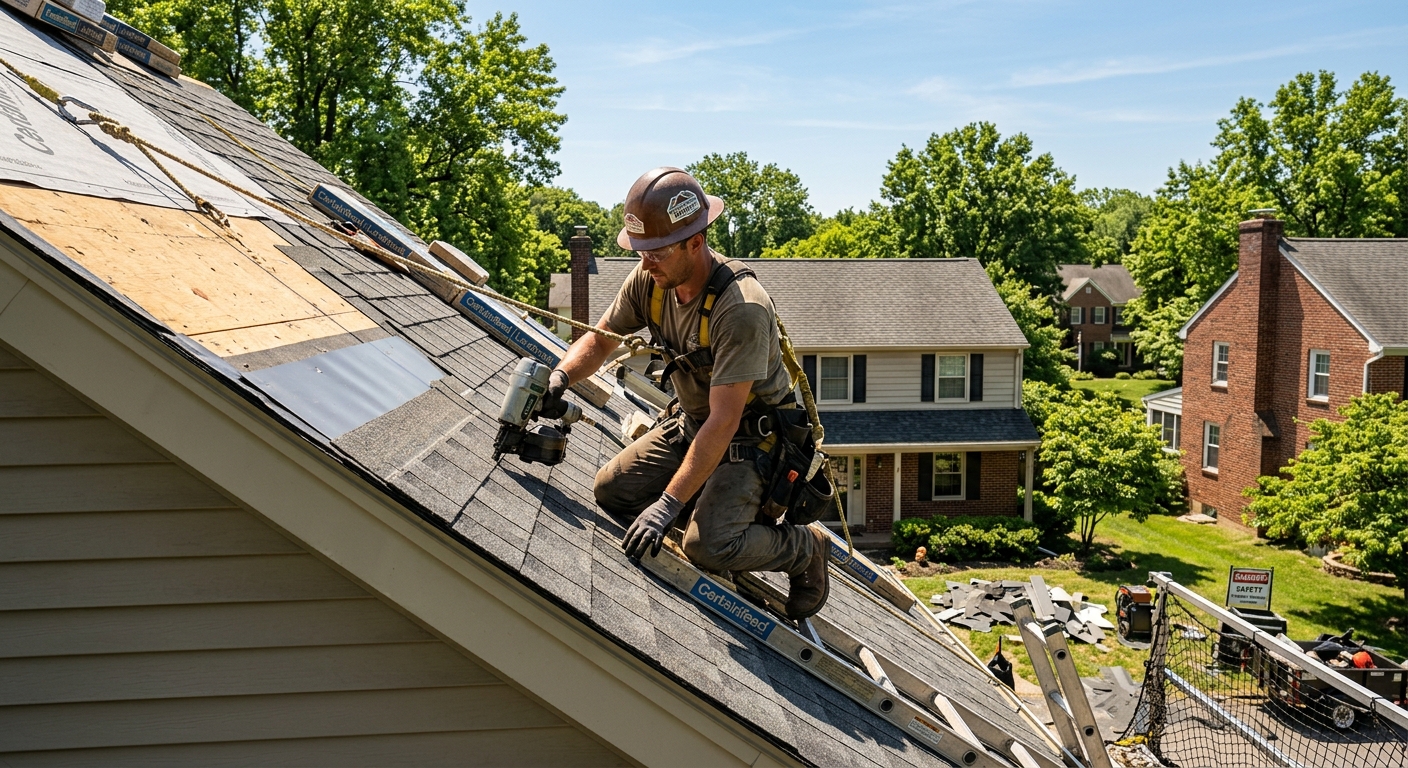
Brecknock roofing prices by material and scope — 2026
Brecknock homeowners, most of whom live in single-family houses according to recent figures, face unique roofing realities tied to this area. With 42.8% of homes built before 1980 (U.S. Census Bureau, ACS 2024), you see steeper pitches, older decking, and plenty of roofs sporting one or more layers of prior shingles. In practice, this means roof replacements here often involve more labor—removing multiple layers and dealing with plank decking rather than modern OSB or plywood. It impacts cost and sometimes stretches timelines, especially on those bigger, older farmhouses. If you’re on a block with prewar homes, expect tear-off and decking work to be factored in even for a "standard" roof project. Amish and Mennonite roofing crews keep shingle installation competitive across Lancaster County, but complex roofs or those needing decking repairs trend toward the higher end of local price bands.
| Material / Scope |
Lifespan |
Best for |
Price range (installed) |
| Asphalt shingles — architectural (30-yr) |
25–30 yrs |
Most Brecknock homes, especially pre-1980 frames |
$9,900–$20,500 |
| Asphalt shingles — impact-resistant (Class 4) |
30+ yrs |
Homes exposed to Susquehanna valley thunderstorms |
$16,000–$20,500 |
| Metal standing seam |
40–70 yrs |
Farmhouses, longevity upgrades, steep or simple roofs |
$24,000–$42,500 |
| Flat roof — TPO or EPDM |
15–25 yrs |
Low-slope additions, porches, garages |
$12,500–$25,000 |
| Roof repair — leak or isolated section |
n/a |
Spot repairs, failed flashing, chimney leaks |
$500–$1,950 |
Prices are estimates for a typical Brecknock home and vary with roof size, pitch, decking condition and material selection.
Permits and code requirements in Brecknock
Roofing work in Brecknock follows the Pennsylvania Uniform Construction Code (UCC), enforced by either the local township or, in cases where a township has opted out, the PA Department of Labor & Industry. In most Lancaster County townships, including Brecknock, minor repairs—like replacing a handful of shingles—usually don’t trigger a permit. But if your project involves roof replacement with new sheathing or structural work, you will need a building permit.
Before signing any contract, verify that your contractor holds a Home Improvement Contractor (HIC) registration. This is mandatory in Pennsylvania for any job over $500. You can confirm a contractor’s HIC registration number using the state’s system at hic.attorneygeneral.gov. Also, ask for proof of workers’ compensation insurance; you can check coverage status using the WCAIS database at wcais.pa.gov. This is not optional—every Pennsylvania employer must provide it, protecting both worker and homeowner from potential liability.
For homes built before 1978, federal lead-safe renovation rules (EPA Lead RRP Rule) apply, which can add requirements when disturbing painted surfaces. You can confirm that your contractor is certified at certifiedrenovatorsearch.epa.gov. For all roofing contracts over $500, Pennsylvania’s Home Improvement Consumer Protection Act requires a signed contract and gives you a three-business-day right to cancel. It’s also illegal for a contractor to offer to "waive" your insurance deductible. Keep documentation for your own protection.
Workmanship vs manufacturer warranty
It’s easy to confuse the two types of roofing warranties, but they’re fundamentally separate protections. The manufacturer’s warranty covers the shingles or membrane itself—meaning, any factory defect in the product. Most architectural shingles offer a limited lifetime warranty, but it’s prorated after the first decade or so, and it doesn’t cover installation mistakes. For this coverage to remain valid, you typically can’t have multiple shingle layers, and you must register the warranty within a few months of installation. Poor attic ventilation or skipping registered installation are the quickest ways to have future claims denied.
The workmanship or labor warranty covers errors in how your roof is installed. This is a promise from your roofing contractor, not the product manufacturer. Transferability matters: some contractor warranties transfer if you sell, others don’t, or they shorten for the next owner. There’s no magic number here—a 25-year workmanship warranty from a new outfit doesn’t carry the weight that 10 years from a 30-year-old local company does. If the contractor goes out of business, their warranty goes with them, so always consider company reputation and history in Lancaster County. A manufacturer’s warranty, if properly registered, can outlast the installer but will still require evidence of proper installation and ventilation (which is why so many warranty claims end up denied).
How to vet a Brecknock roofing contractor
Start by verifying the contractor’s Home Improvement Contractor (HIC) registration number through the official attorney general’s portal at hic.attorneygeneral.gov. Ask the company for proof of active workers’ compensation insurance, and double-check coverage through Pennsylvania’s WCAIS database at wcais.pa.gov. For homes built before 1978, ensure your roofer is EPA Lead RRP certified using certifiedrenovatorsearch.epa.gov. Any contract for over $500 must be in writing—this is a non-negotiable under state law.
- Validate HIC registration at hic.attorneygeneral.gov
- Request a certificate of workers’ compensation; check at wcais.pa.gov
- For pre-1978 homes, confirm EPA Lead RRP certification
- Ask for a written contract before work begins
- Check the company’s in-business years and local references
- Require up-front disclosure of manufacturer and workmanship warranties
- Get addresses of recent jobs to inspect workmanship
- Confirm local office/address—not a PO box or out-of-county
- Ask for roofing supplier references (for reputation with distributors)
- Clarify whether decking repair costs are explicitly stated in the proposal
- Require a daily cleanup plan in writing
- Never pay more than 1/3 up front (per Pennsylvania law)
Red flags in Lancaster County’s saturated metro market include: contractors knocking on doors after storms, “we’ll waive your deductible” offers, refusal to provide HIC or insurance proof, out-of-area phone numbers with no local address, and high-pressure sales tactics tying your price to “today only” deals.
Gutters, drainage and roof longevity in Brecknock
A roof in Brecknock isn’t just shingles—it’s part of a drainage system that includes gutters, downspouts, grading, and drip edges. If you replace the roof but leave undersized or rusted gutters in place, you set up the new shingles and your foundation for problems. Downspouts discharging too close to old Pennsylvania limestone basements lead to seepage and future headaches. Some manufacturer warranties even require evidence of proper water management, including functioning gutters and secure drip edge, or they reserve the right to deny claims for premature aging and staining.
When planning a roof replacement, ask for gutter and downspout options—most homes in Brecknock can have new seamless aluminum gutters installed for $2,100–$3,800 when done with the roof. Add gutter guards for another $1,200–$2,200 depending on type and house size. It’s rarely worth patching sections if your old system is rusted or undersized. Pooled runoff can undermine grading and drive water toward your foundation, especially on the older homes that dominate the local housing stock.
Brecknock homes and their roof lines
Brecknock’s housing stock reflects Lancaster County’s pattern: lots of homes built pre-1980—42.8% to be exact (U.S. Census Bureau, ACS 2024). These older roofs routinely feature higher, steeper pitches that shed snow well but add complexity and labor for roofers. You’ll often find plank decking instead of plywood or OSB underneath, and historical practices mean there’s a good chance ice barriers were never installed except on recent additions. Dual or multiple shingle layers are more rule than exception, and sometimes you’ll find odd patchwork solutions hidden away—meaning a simple re-roof can turn into a full tear-off down to the rafters.
Later 20th-century houses in newer clusters generally have lower pitches and plywood decking, with modern ventilation and eave protection more likely to be in place. But replacement is still rarely “layer and go”: many local homes need old nails removed and deck repairs before new shingles or metal can go on. Comprehensive proposals factor in both the visible roof and what’s likely underneath based on the age—skipping this step only leads to discovery (and upcharges) during the job. If your house predates 1980, plan for a roofer to budget for plank repair, extra tear-off labor, and the possible need for a first-ever ice barrier.
What gets discovered after tear-off in Brecknock
Brecknock contractors see certain surprises time and again after tearing off old roofing. On homes built before 1980, rotted decking—especially under valleys and along eaves—shows up regularly. If you’re dealing with original plank decks, plan for possible replacement sections that can add $600–$2,000 to a project depending on area and lumber. While prepping the new roof, many discover poor attic ventilation—plugged, undersized, or absent vents—which voids most shingle warranties and is a major ice damming risk here due to freeze-thaw cycles. Upgrading or cutting in ridge and soffit vents can cost $750–$2,200 more but prevents repeat failure.
Flashings often need full replacement; old tar, aluminum, or makeshift chimney flashings are infamous leak points. Installing new metal flashing at walls, valleys, and chimneys can add $400–$1,200 depending on complexity. Vent boots (where plumbing pipes exit) and drip edge are frequently brittle or missing—both must be replaced for code and warranty compliance. Ridge vent upgrades are now standard on new installs, adding under $700–$1,000 but paying off every winter with better attic performance. Each of these is a common hidden cost in Brecknock—they don’t pad profit, they stop future leaks.
Frequently asked questions — roofing in Brecknock
Are impact-resistant shingles worth it in Brecknock?
Impact-resistant Class 4 shingles are specifically designed to withstand hail and wind-driven debris. In Brecknock, thunderstorm bursts from the Susquehanna River valley are more of a concern than heavy, lingering snow loads. If your home is situated with little windbreak or sees frequent strong storms, investing in an impact-rated shingle can make sense. The initial cost is higher—usually $16,000–$20,500 for full replacement—but can reduce repair calls and may even net insurance discounts from some carriers. On the other hand, if you’re sheltered in a wooded lot and have never lost shingles in a storm, the ROI is less compelling. Always factor in your house’s exposure and existing insurance deductibles before upgrading unnecessarily.
How can I tell if my roof decking is rotted?
Signs of rotted roof decking in Brecknock’s older homes might show up as a “soft” springy feel when walking in the attic, visible black mold, or sagging between rafters, especially near valleys and eaves where leak histories are common. However, most hidden rot is only discovered during tear-off. If your roof is original and built pre-1980, plan for possible deck repair—typical charges run $600–$2,000 extra, depending on severity. Leaks that go undetected beneath two or three layers of shingles will almost always result in some rotted wood. If you suspect issues, have a contractor probe suspect spots during your estimate with an awl or by carefully removing a shingle or two.
What is the best time of year to replace a roof in Brecknock?
In Brecknock, the optimal roofing season runs from late March through early November. Lancaster County’s pronounced freeze-thaw cycles mean early spring and late fall can be unpredictable, with roofers pausing due to morning frost or sudden storms. June to September offers the most stable weather, but it also means busier schedules and sometimes higher demand pricing. Some homeowners schedule replacements mid-spring or early fall for the best combination of contractor availability and weather windows. If possible, avoid December and January—shingle adhesives don’t seal well at low temperatures, and colder days can push beyond the typical install cycle. Emergency leak repairs, though, are priced $500–$1,950 and handled year-round.
Does homeowner's insurance cover roof replacement in Brecknock?
Homeowner’s insurance in Brecknock typically only covers roof replacement if the damage was caused by a covered peril—like a windstorm, falling tree, or hail event. Age, wear, and neglect aren’t covered, so if your asphalt shingle roof is just old (15–25 years) and wearing out naturally, most insurers won’t pay for a new one. If a specific storm event is the culprit, document all damage before cleanup or temporary tarping, and get a written estimate—full replacement costs here range $9,900–$20,500 for asphalt shingles. Pennsylvania law prohibits contractors from waiving deductibles, so steer clear of anyone who suggests otherwise; this is a common scam in markets like Lancaster County.
How much snow load can a Brecknock roof handle?
In south-central Pennsylvania, including Brecknock, the building code requires roofs to withstand a ground snow load of 30 pounds per square foot (psf). Most older homes, even those built before 1980, meet or exceed this standard because of steeper roof pitches and overbuilt framing. That said, past unpermitted alterations or attic conversions can sometimes reduce capacity. Heavy, wet snow accumulations are rare; what usually matters are quick thaws and rain-on-snow events. If you have an older plank-decked roof and are worried about sagging or leaks after a snowstorm, a structural and roof inspection—often running about $500–$1,950—can provide peace of mind.
How many quotes should I get for a roof in Brecknock?
Most Brecknock homeowners will do best gathering three written quotes. In a saturated market like Lancaster County—where crews range from established local companies to out-of-town operations hoping to pad schedules after major storms—you’ll see some wide price swings. A typical architectural shingle replacement here costs $9,900–$20,500, with most solid bids clustering between $14,000 and $18,000. More than three quotes can be confusing unless you have an unusually complex roof or want to compare metal and shingle options head-to-head. Make sure every quote specifies tear-off, deck repairs, flashing, ventilation, and gutters if you want an apples-to-apples comparison.
Can I install new shingles over old ones in Pennsylvania?
Pennsylvania code does allow one new layer of asphalt shingles to be installed over an existing layer, provided the old roof is lying flat and is in good condition. However, most roofs in Brecknock built before 1980 already have two or more previous layers, so local contractors will typically recommend a full tear-off. Skipping tear-off can void manufacturer warranties and hide decking rot—bad news in our climate, where freeze-thaw cycles quickly catch up with shortcuts. Full tear-off and replacement, typically $9,900–$20,500 for standard architectural shingles, is the best choice for longevity and legal compliance.
Why is my Brecknock roofing quote higher than the online average?
Online averages seldom reflect what’s actually going on with old, steep-pitch Brecknock and Lancaster County roofs. Most national estimates are based on simple, walkable roofs and don’t factor in labor-intensive tear-off (sometimes of two or three layers), repairs to plank decking, local disposal costs, and the higher complexity of valley flashing or dormers common in pre-1980 homes here. Factor in our storm exposure from valley winds, and you may see extra costs for impact-resistant shingles or ventilation upgrades as well. That’s why a local full roof might cost $16,000–$20,500 even when “U.S. average” prices seem much lower. The devil’s in the details—with old stock, those details are everywhere.
What does roof replacement cost per square in Brecknock?
In Brecknock, the cost per “square” (100 square feet) for a full asphalt shingle tear-off and replacement typically ranges from $530–$820 installed. The wide range depends on roof steepness, number of layers to remove, repairs to old plank decking, and complexity—like multiple valleys or dormers. Metal roofs run even higher: closer to $1,200–$2,000 per square, depending on details. Remember, these prices fit our area—pre-1980 homes, steep pitches, and a crowded local contractor market keep prices above national averages.