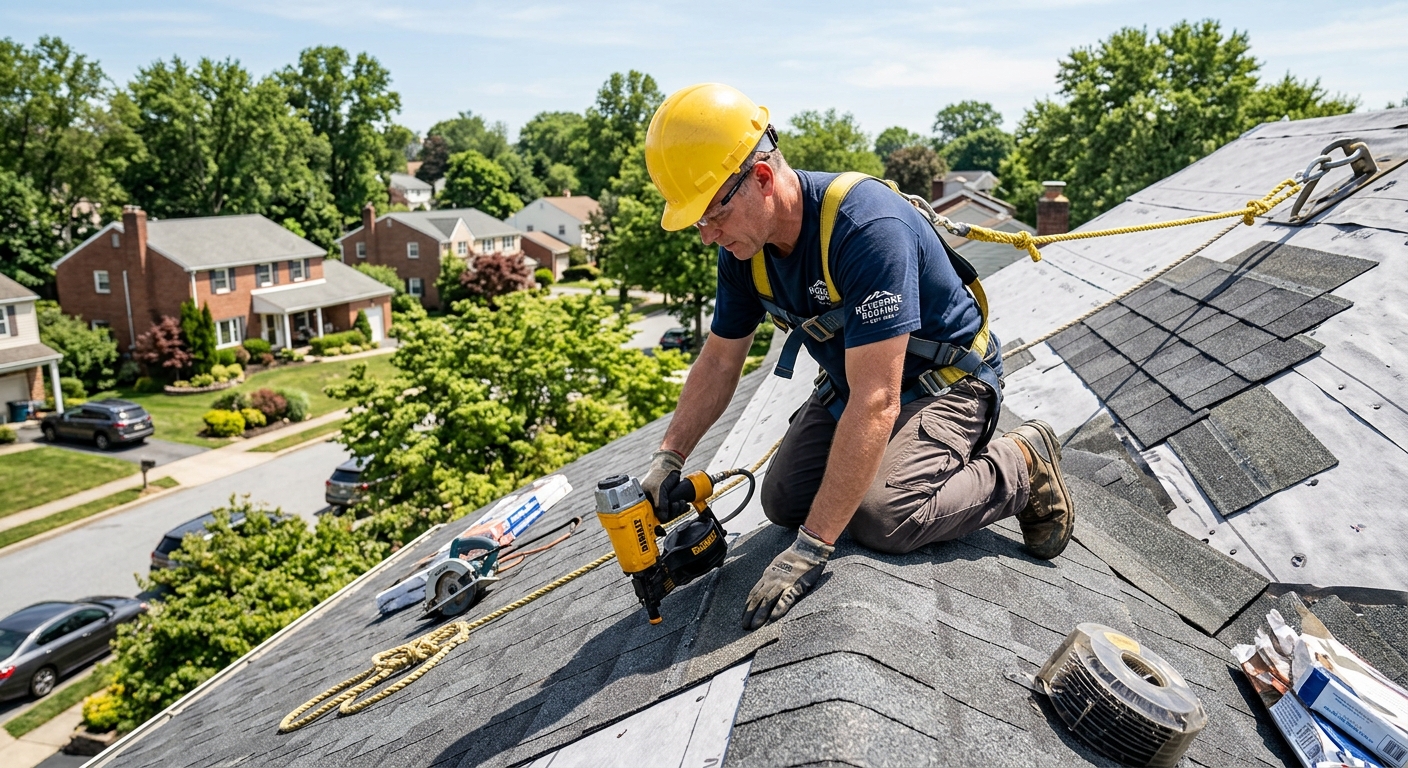
Butler roofing prices by material and scope — 2026
In Butler, where nearly 85% of homes are single-family (U.S. Census Bureau, ACS 2024), roofing projects shape up differently compared to larger cities or rural markets. The high homeownership rate here means roofs are often maintained with resale and long-term value in mind. Much of Wilkes-Barre and Hazleton’s housing is early-1900s row and twin homes, and Butler shares similar vintage stock. That era of construction leads to frequent full replacements rather than patch jobs, and it’s typical to find ventilation and insulation upgrades bundled into a re-roof, since ventilation was never a focus when these homes were built. For a homeowner in Butler, the dominant materials are still asphalt architectural shingles, a match for older wood-framed construction and the methods most local contractors have standardized around. If you’re budgeting for a new roof, you’ll find substantial differences in cost and quality between architectural shingles, impact-resistant shingles, and standing seam metal—but even basic architectural shingles hold up well to the region’s freeze-thaw cycle and moderate snow loads.
Up front, it pays to be realistic about pricing. A straightforward architectural shingle replacement typically falls at $16,000 for a standard Butler house, but larger or complex roofs—especially with multiple dormers or valleys—can push costs toward the higher end. Flat roof sections, common on additions and porch roofs, command their own price band since they require membranes like TPO or EPDM rather than shingles. For minor, isolated repairs, you’re looking at a much lower starting point, but repair makes sense only if your roof’s basic structure and membrane are still within their service life.
| Material / Scope |
Lifespan |
Best for |
Price range (installed) |
| Asphalt shingles — architectural (30-yr) |
25–30 yrs |
Standard pitched roofs, most detached homes |
$9,700–$20,500 |
| Asphalt shingles — impact-resistant (Class 4) |
30+ yrs |
Homes exposed to wind-driven storms, near the ridge line |
$16,000–$20,500 |
| Metal standing seam |
40–70 yrs |
Steep roofs, homes seeking lowest maintenance |
$23,500–$42,000 |
| Flat roof — TPO or EPDM |
15–25 yrs |
Rowhouse add-ons, porches, low-slope dormers |
$12,000–$24,500 |
| Roof repair — leak or isolated section |
n/a |
Small patches, flashing re-seal, minor shingle loss |
$500–$1,950 |
Prices are estimates for a typical Butler home and vary with roof size, pitch, decking condition and material selection.
Checking out a roofer in Butler: what to verify
When you hire a roofer in Butler, due diligence is non-negotiable. For contracts over $500, Pennsylvania law requires the contractor to be registered with the Home Improvement Contractor (HIC) registry, administered by the Pennsylvania Office of Attorney General. You can quickly check a roofer’s HIC registration at hic.attorneygeneral.gov. For all employers, workers' compensation is mandatory—verify insurance straight from the WCAIS system (wcais.pa.gov) rather than relying on a paper certificate. In pre-1978 homes, ask for their EPA Lead RRP certification (certifiedrenovatorsearch.epa.gov) if any painted surfaces will be disrupted during roof or deck work. Make sure you see and read the written contract, as required by Pennsylvania’s Home Improvement Consumer Protection Act, and remember that waiving your insurance deductible is explicitly prohibited.
- Verify Home Improvement Contractor registration at hic.attorneygeneral.gov
- Check workers' compensation compliance via WCAIS (wcais.pa.gov)
- Request current liability insurance paperwork
- Obtain a written contract for any job over $500
- Look up EPA Lead RRP certification for pre-1978 properties
- Ask for recent local references in Wilkes-Barre, Hazleton, or Kingston
- Confirm the company’s real local address, not a PO box
- Clarify the warranty in writing—labor and material periods
- Insist on itemized written estimates, not “ballpark” numbers
- Check for clear payment schedules with no excessive deposit
- Avoid any contractor offering to waive or “eat” your insurance deductible
- Be skeptical of out-of-town license plates on trucks, especially after storms
Red flags in Luzerne County’s saturated roofing market: unsolicited door-knockers after wind events, unregistered crews promising fast “insurance work,” cash-only pricing, contractors pushing for large deposits, and any hesitation to provide a real physical address or show written credentials. If you see these, move on.
Why two Butler roofing quotes can differ by 40%
Price gaps for the same roof in Butler often come down to scope, discovery during the tear-off, and the unpredictable costs that follow from our region’s housing stock. Nearly 38% of our homes were built before 1980 (U.S. Census Bureau, ACS 2024), so hidden decking rot, unvented attics, or previous over-layering are common finds as soon as the shingles come off. Even when two contractors quote the same size roof, one may estimate extensive wood replacement or proper ridge venting from the start—while another skims by and adds that upcharge when the job begins.
Snow load and wind exposure matter too. Luzerne County’s 40 psf ground snow load and the Wyoming Valley’s wind create a strong case for high-quality underlayment and ice barriers. Some crews will bid low by omitting these protections, but it can mean a “cheap” roof still costs you in repairs later when ice dams hit. Expect costs from $9,700–$20,500 for architectural shingles—quotes vary most on decking replacement, ice barriers, and material upgrade (like impact-resistant shingles).
Labor is driven by complexity. Steep Victorian slopes or hard-to-access row homes take longer and require extra safety gear, bumping up labor rates. Flat or walkable roofs are less costly per square, but flat-roof membranes themselves are pricier than basic shingles. Finally, removing extra layers (common in older homes) can add thousands to your final invoice—clarify in writing who pays if more than one layer is found.
| Factor |
Why it matters here |
Cost impact |
| Roof size in squares |
Each square is 100 sq ft of roof surface |
Primary multiplier |
| Pitch and access |
Steep pitches need harnesses and slow the crew |
+20–30% labor |
| Existing layers to tear off |
Two or more layers means full tear-off and disposal |
$500–$1,500 per layer |
| Decking condition |
Rot is found during tear-off, not before |
$75–$150 per sheet |
| Ice barrier at eaves |
Required where ice damming has a history |
$300–$800 |
| Material grade |
3-tab vs architectural vs Class 4 impact-resistant |
$500–$2,500 |
Pennsylvania code and Luzerne County permit rules for roofing
Pennsylvania’s Uniform Construction Code (UCC), based on the IRC, is the controlling standard for residential roofing work. In Luzerne County, permit requirements are not uniform across all towns. In Wilkes-Barre, you need a building permit for a full roof replacement and for any job involving replacement or repair of the decking. That permit is handled by the City of Wilkes-Barre Code Enforcement Office. Surrounding boroughs run their own permit offices, so check your local office for specifics, but expect to pull a permit for major work in these municipalities as well. In Hazleton, however, patching under a single roofing square is often done without a permit—small repairs fly under the radar there.
Pennsylvania doesn’t have a roofing trade license, but Home Improvement Contractor (HIC) registration is required for any job over $500. You can check a contractor’s registration status and complaint history at hic.attorneygeneral.gov. Workers’ compensation coverage is mandatory in Pennsylvania; the most reliable way to verify your roofer’s coverage is through the state-run WCAIS system (wcais.pa.gov), not just by asking for a certificate. For homes built before 1978, federal law requires that anyone disturbing painted surfaces have EPA Lead RRP certification, which you can look up at certifiedrenovatorsearch.epa.gov. Always require a written contract for work over $500, which is your right under state law, and never accept offers to “waive” insurance deductibles—this is not only illegal but also a sign the roofer isn’t playing by the rules.
TPO and EPDM on Butler homes
In Butler, it’s common for even traditional pitched-roof homes to have at least one flat section—think rear kitchen additions, porches, or the whole roof on an old rowhouse. These flat or low-slope areas cannot be reliably roofed with regular shingles. On any roof section lower than a 3/12 pitch, asphalt shingles will wick water, causing leaks and rapid rot at the decking. Ponding is another headache: snowmelt and rain linger, and seams on old rolled roofing eventually open up. That’s why modern flat roofs here nearly always use membrane systems like TPO or EPDM. These single-ply materials create a watertight seal, resist ponding water, and, when installed by a knowledgeable crew, can hold up for 15–25 years despite our freeze-thaw cycles.
If you’re quoted shingles for a flat or very low-slope section (under a 2/12 pitch), that’s a sign to get another bid. It means that contractor is ignoring local best practices—or doesn’t prioritize leak prevention. The price for a full flat membrane replacement in Butler usually lands between $12,000–$24,500 depending on size and complexity. Don’t skimp on drainage; keeping water moving and away from sidewalls is key to the membrane’s true lifespan.
Patching vs full replacement in Butler
Knowing when to patch and when to replace is a real budgeting decision in Butler. Our early-1900s homes and variable vintage mean roof ages are all over the map. If your asphalt shingle roof is under 15 years old and you have only one isolated leak—usually flashing or a single shingle issue—repair makes sense, and the typical outlay is $500–$1,950. Once a roof hits 15–25 years, especially on the standard architectural shingle installations, leaks tend to crop up in multiple spots, often because the underlying membrane or nails have aged out. At that stage, dropping several rounds of repairs can cost you nearly as much as a new roof—just two rounds at $1,200 each and you’ve already burned a quarter of the replacement price, often with no transferrable warranty on the old work. For anything over 25 years, the logic flips: any leak means the roof is on borrowed time, so commit to a full replacement and get a labor/material warranty.
Flat roofs here are even more binary—if you see ponding, blistering, or split seams, repair is rarely a lasting fix. Plan for a full membrane replacement at $12,000–$24,500. Emergency repairs do buy you a season if roof work has to wait for spring, but keep those repairs minimal; money is better put toward full system replacement.
| Situation |
Recommendation |
Typical cost |
Reasoning |
| Under 15 years, one isolated leak |
Repair |
$500–$1,950 |
Roof and membrane still within service life; cost-effective if flashing or minor shingle issue. |
| 15–25 years, several leak points |
Replace |
$9,700–$20,500 |
Underlying roof system likely compromised; patching quickly overtakes replacement cost. |
| 25+ years, any active leak |
Replace now |
$9,700–$20,500 |
Roof system at end of practical life; full replacement gives warranty and peace of mind. |
| Storm damage, wind or hail |
Document, claim, replace |
$9,700–$20,500 |
Storms routinely strip shingles; replacement is often insurance-covered if damage is significant. |
| Flat roof ponding or blistering |
Replace membrane |
$12,000–$24,500 |
Flat membranes rarely patch well; persistent ponding signals underlying failure. |
| Active leak entering winter |
Emergency repair, schedule replacement |
$500–$1,950 |
Short-term patch avoids interior water damage; full replacement ASAP. |
Gutters, drainage and roof longevity in Butler
In Butler, your roof, gutters, and drainage work as a unit—and skipping any part is a sure way to shorten your new roof’s lifespan. Properly sized gutters and downspouts protect not just the shingles but also the foundation and basement. In the old homes around Wilkes-Barre and Hazleton, it’s common to find sagging gutters, disconnected downspouts, or water dumping next to stone foundations—a recipe for basement dampness and freeze-thaw problems. Drip edge installed with the new roof keeps runoff away from fascia and stops “ice dam” leaks caused by water wicking backward under shingles. Many warranties, especially from big shingle manufacturers, require documentation of adequate drainage; a clogged or undersized system will be seen as homeowner neglect if a future claim arises.
Replacing your gutters alongside the roof is usually cost-effective: for a typical Butler house, expect to pay between $2,300–$4,600 for a full seamless aluminum system with new downspouts. Gutter guards can add $800–$1,500 depending on the product. When the crew is already on site with ladders and insurance in place, you avoid paying minimum labor charges twice. Always double-check that all downspouts drain well away from the house foundation—local soil and basement conditions don’t forgive this shortcut.
Frequently asked questions — roofing in Butler
Why do roofs fail faster in northeastern Pennsylvania?
Asphalt shingle and flat roofing materials age more rapidly in northeastern Pennsylvania because of the combination of heavy snow loads, freeze/thaw cycles, and wind exposure—especially here in Butler where the ridge-line winds coming down the Wyoming Valley can lift or loosen shingles. Ice dams form more often due to inadequate attic ventilation (common in our area’s early-1900s homes), and older homes are rarely insulated to modern standards. Repetitive melting and refreezing causes shingles to crack and sealant to lose grip. Compare this to milder climates and you’ll find roofs don’t last as long without proactive maintenance. That’s why an architectural shingle roof in Butler is expected to last around 25–30 years and it’s smart to budget $9,700–$20,500 for replacement when you hit that threshold, especially if you’ve started seeing multiple leaks or shingle loss after storms.
Do I need to leave my house during a roof replacement?
In most Butler homes, you do not need to leave your house during a standard shingle or flat roof replacement. Crews work outside and will let you know before stripping and re-roofing over areas like the attic or rooms with skylights—expect a fair amount of hammering and vibration for much of the day. If your roof structure is being replaced or major deck repairs are needed, you may wish to clear particularly fragile items off walls or shelves. For a typical asphalt shingle job at $16,000, the project is usually wrapped up in one or two days for an average-sized home. If you have small children, pets sensitive to noise, or home office requirements, you might want to schedule your day accordingly but most Butler homeowner families remain in place.
What is the best roofing material for Butler's climate?
For most Butler homes, architectural asphalt shingles are the best balance of cost, durability, and resale value. They handle our average 40 psf snow loads and keep out the rain during high-wind events common to Luzerne County. If you’re on the ridge line or in an especially exposed spot in Wilkes-Barre or Kingston, Class 4 impact-resistant shingles are worth the upgrade, coming in closer to $16,000–$20,500 but offering better resistance to wind and hail. If you want the lowest upkeep and plan to stay for decades, a standing seam metal roof will outlast everything else but will require an initial investment of $23,500–$42,000. Flat roof sections should always use TPO or EPDM. Going with anything less is asking for leaks.
How many quotes should I get for a roof in Butler?
It’s smart to get at least three written quotes for any roof replacement in Butler. The local market is saturated with contractors from the Scranton–Wilkes-Barre–Hazleton metro, so price spreads are meaningful—sometimes as much as a $4,000–$6,000 swing between similar scope bids. More quotes help you spot lowball tactics, catch missing code-compliant details (such as ice barrier at the eaves), and judge whether a contractor is including all deck repairs and warranty provisions. If you’re seeing one quote far below the others, check the HIC registry for red flags, and be on the lookout for signs of storm-chasing crews. Always require written, apples-to-apples comparisons for the same materials and scope.
Does roof pitch affect the price in Butler?
Yes, pitch is a significant cost factor in Butler. Many of our older homes have steep (sometimes 12/12) pitches, especially in Wilkes-Barre and Hazleton. Steeper roofs require full safety harnesses, often two ladders per worker, and extra labor time—this typically adds 20–30% to labor costs. For a standard replacement, what might run $16,000 on a walkable roof can easily climb to $20,000 or more if your roof is particularly steep or complex. Some roofers may also charge more for inaccessible roofs where dumpster or material setup is more complicated. Always make sure your quote spells out the pitch, so you know the price is justified.
How do I file a storm damage roof claim in Pennsylvania?
Start by documenting the damage with dated photos—shingle loss, dents, exposed decking, or water entry. Call your homeowner’s insurance claims line, not your agent, for initial advice. In Butler, with our history of windstorms funneling down the Wyoming Valley, insurers are familiar with shingle uplift claims. Your insurer may send an adjuster or allow you to submit a roofer’s written scope and estimate (typically $9,700–$20,500 for full replacement). Choose a contractor registered with the HIC registry and never accept an offer to “waive your deductible”—this is illegal. Don’t authorize work before insurer approval unless water is entering, in which case reasonable emergency tarping (at $500–$1,950) is reimbursable with receipts.
How much does it cost to repair a roof leak in Butler?
For a typical asphalt shingle roof in Butler, an isolated leak repair costs between $500–$1,950. That range covers items like flashing re-seal, a handful of tabs, minor chimney or vent leaks, or quick storm patching. However, for homes with multiple leaks or roofs over 20 years old, repairs may only buy a season of peace—beyond that, you’re often better off budgeting for full replacement ($9,700–$20,500). On flat roofs, temporary patches rarely last through freeze-thaw cycles, so pay for repairs with that in mind. Always ask for a detailed invoice so you know what was fixed.
Is ice barrier underlayment required in Butler?
Ice barrier (ice and water shield) is required by Pennsylvania code wherever there’s a history of ice damming—and that applies absolutely in Butler. Our climate, with severe freeze-thaw and 40 psf snow loads, means unprotected eaves can leak dramatically. Most local contractors will include a minimum of 3 feet up from the eaves or over all valleys. While some low bidders try skipping this line item to edge under $14,000 on a steep roof, it’s not worth the future repair bills. Check your written quote and ask for the brand and extent of ice barrier to be detailed; it’s not a place to cut corners.
Can I inspect my own roof safely?
You can visually inspect your roof from the ground or with binoculars in Butler, especially if you’re looking for missing shingles, popped nails, or visible flashing issues. Getting up on a steep or mossy roof is another matter; many homes here have pitches that require safety harnesses and professional ladders. If your home is older and you suspect rot or soft decking, walking the roof can be dangerous. For peace of mind, most contractors will do a basic inspection at little or no charge—especially if you’re a repeat customer or planning a full replacement (average $16,000). If you do go up, move slow and never do so alone. For flat roofs, a garden hose can be used for leak tracing—but again, stay safe and call a pro if anything feels uncertain.