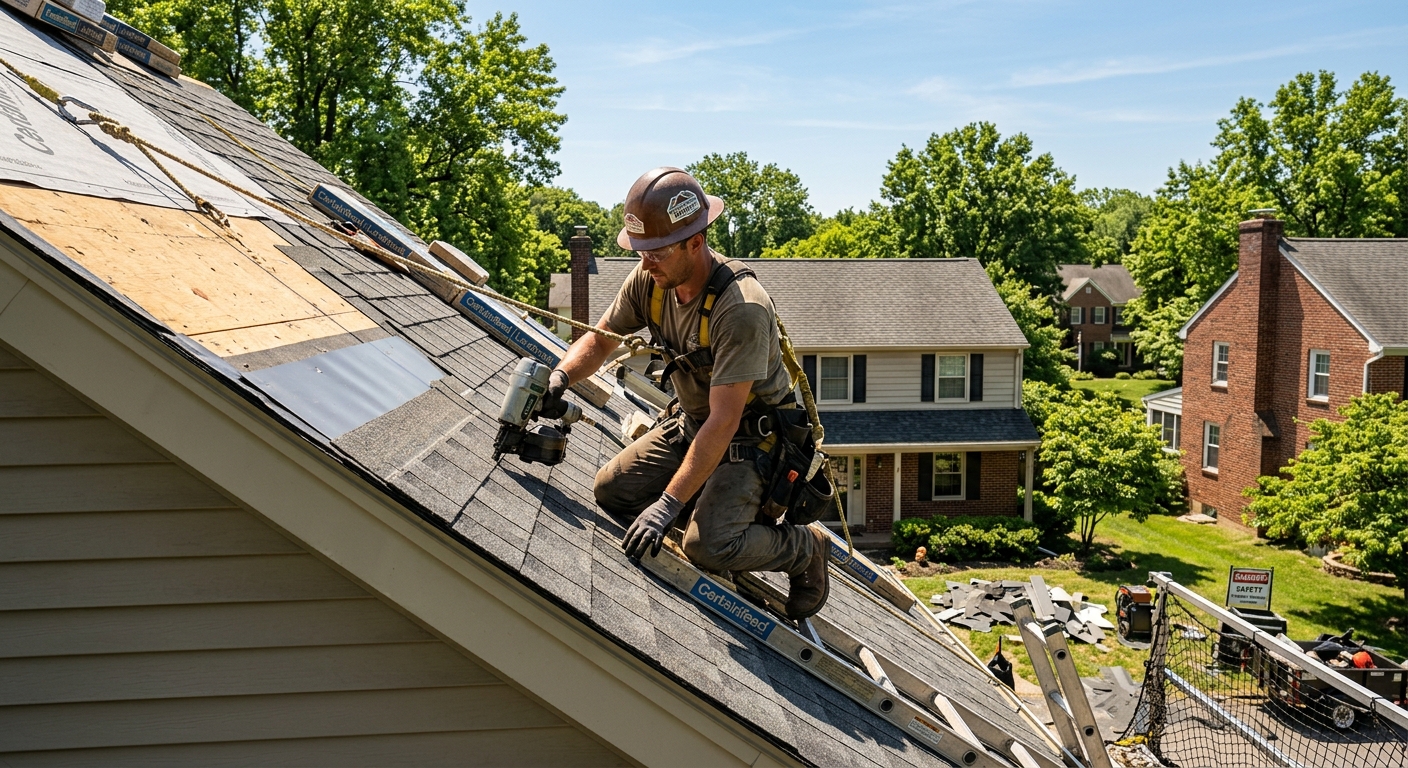
What roof replacement costs in Caln in 2026
If you’re a Caln homeowner planning for roof work in 2026, knowing exactly what to budget is crucial. Caln’s housing stock is mostly single-family, with a homeownership rate of 71.3% (U.S. Census Bureau, ACS 2024). That shapes both the roofing market and how contractors price jobs here. Nearly half of homes were built before 1980, so there’s a real spread in roof ages and types, especially in established neighborhoods.
Because Caln borders large subdivisions from the 1970s, 1980s, and 1990s in places like West Goshen and Uwchlan, there are a lot of aging architectural asphalt shingle roofs now reaching the end of their service. These tract homes used the same few roof types, so most replacements end up being full tear-offs rather than patch jobs, with wide runs and complex pitches. That means a typical replacement is rarely “just a few squares”—most contractors are bidding whole-house scopes. Add to that the recent ridge-line wind events central Chester County gets, and more replacements are happening as insurance claims after storm damage rather than just due to age.
Here’s how roof costs actually stack up in Caln—and what you get for the money:
| Material / Scope |
Lifespan |
Best for |
Price range (installed) |
| Asphalt shingles — architectural (30-yr) |
25–30 yrs |
Suburban homes, standard slopes |
$10,500–$22,000 |
| Asphalt shingles — impact-resistant (Class 4) |
30+ yrs |
Ridge-line wind exposure, storm risk |
$17,000–$22,000 |
| Metal standing seam |
40–70 yrs |
Low-maintenance, premium homes |
$25,500–$45,000 |
| Flat roof — TPO or EPDM |
15–25 yrs |
Low slope, additions, small commercial |
$13,000–$26,500 |
| Roof repair — leak or isolated section |
n/a |
Spot fixes, recent roofs |
$550–$2,100 |
Prices are estimates for a typical Caln home and vary with roof size, pitch, decking condition and material selection.
Pennsylvania code and Chester County permit rules for roofing
All roof replacement and most major roof repairs in Caln fall under the Pennsylvania Uniform Construction Code (UCC), which is based on the International Residential Code and enforced by either the local municipality or the PA Department of Labor & Industry if the municipality has opted out. If you live within West Chester Borough, full roof replacement involving structural deck repair almost always needs a building permit. If you’re only having like-for-like shingle repairs done—specifically areas under one roofing square—crews commonly perform this without a permit, but deck repairs or large sections will nearly always trigger one.
Before you sign any contract over $500, Pennsylvania requires that the contractor hold a Home Improvement Contractor (HIC) registration issued by the Office of Attorney General. You can check registration status at hic.attorneygeneral.gov. Written contracts are required over $500 and you always have three business days to cancel. For employer crews, workers’ compensation insurance is mandatory, and you can verify coverage through the WCAIS system (wcais.pa.gov). It’s your right to ask for both HIC and insurance verification, and any contractor resistant to this is not worth your time. There is no state trade license for roofing specifically in Pennsylvania—just the HIC registration for home improvement work.
How southeastern Pennsylvania's weather shapes roofing here
Storms hammer the Caln area in ways a Delco or Bucks County roof won’t see. Central Chester County, including Caln, gets frequent ridge-line wind events along the South Valley Hills and Chester Valley. These winds are strong enough to peel shingles—especially older, three-tab types—right off, exposing fasteners and sheathing. That type of wind damage can quickly escalate a repair into a full replacement, often pushing the bill toward $10,500–$22,000 for architectural asphalt.
Our region has a ground snow load of 30 psf, and the winter design temperature drops to 14 °F. What this means practically: Ice dams are not imaginary. Air leaking into a cold attic pools under the deck. When we get a post-snow warmup that doesn’t reach the eaves, melt water refreezes at the gutters, backing up under the shingles. If you don’t have a membrane underlayment at the eaves or proper attic ventilation, water ends up inside before you even see a single missing shingle. A $1,300 leak repair can quickly become a $10,500–$22,000 deck-and-shingle replacement if you wait it out.
Hail is less frequent, but when it does hit, it bruises asphalt granules without obvious holes. Over time, sun and rain open these bruises, which void shingle warranties and leave you with a full-price replacement. Unlike in snowbelt counties farther north, our snow never sits heavy enough for rafter collapse, so structure upgrades are rare, but edge ice damming and wind lift are regular causes of roof failure here—and both demand a roofing solution built for Chester County’s climate, not just “any old” shingle.
Choosing a roofing material for Caln's climate
When you pick a roofing material in Caln, you’re not just comparing prices—you’re accounting for how 30 psf of snow and single-digit winter days shape your roof’s job. Metal standing seam sheds snow and resists wind-lift better than any shingle, making it almost unbeatable for homes along exposed ridges, but the price—$25,500–$45,000—puts it out of reach for most tract homes. If you’ve got a flat roof or low pitch, TPO/EPDM membranes are the right solution, lasting 15–25 years and running $13,000–$26,500 for a replacement.
The dominant roof in West Chester and Caln is still architectural asphalt shingles. That didn’t happen by accident: Large subdivisions built since the 1980s needed a product that could be installed quickly, match HOA appearance rules, and keep insurance premiums down in a humid, storm-exposed climate. Today, Class 4 impact-resistant shingles (the ones rated to handle hail and high winds) go on houses where storm claims are common, but unless you’re on an exposed ridge or making frequent insurance claims, the standard architectural grade (25–30 years at $10,500–$22,000) still delivers the best mix of price, performance, and look for Caln’s market. Paying for metal is rarely justified unless you’re building for a lifetime stay.
| Material |
Installed cost |
Lifespan |
Cold-climate performance |
Maintenance |
| Asphalt architectural |
$10,500–$22,000 |
25–30 yrs |
Good—needs membrane at eaves for ice |
Inspect after storms; minor granule loss |
| Asphalt Class 4 impact-resistant |
$17,000–$22,000 |
30+ yrs |
Excellent for wind/hail; same ice risk as above |
Minimal; check seals at edges after wind |
| Metal standing seam |
$25,500–$45,000 |
40–70 yrs |
Outstanding—sheds snow, resists wind |
Check fasteners every 10 yrs; little else |
| TPO / EPDM membrane |
$13,000–$26,500 |
15–25 yrs |
Good for flat roofs; seams can split with ice |
Annual seam checks, clear drains |
Repair or replace? A decision guide for Caln roofs
In Caln, deciding between roof repair and full replacement is rarely an even toss-up. If your asphalt shingle roof is less than 15 years old with one isolated leak, a proper repair—for $550–$2,100—usually does the job. But once that roof is over 20 years, especially on one of the 1970s–1990s subdivision homes, chasing leaks can become a treadmill. Three repairs at $1,300 each add up to $3,900, quickly approaching the lower end of a total tear-off and new install at $10,500–$22,000.
Old homes built before 1980—almost half in Caln—often have ventilation and deck issues underneath, invisible until you strip the shingles. Any active leak over 25 years old is almost always a sign the entire roofing system is finished. For storm damage, especially wind or hail, your insurer will usually consider a full replacement over patching. Flat roofs with ponding or blistering get replaced, not repaired, because once the membrane is compromised, water finds its way in no matter what caulk you try.
| Situation |
Recommendation |
Typical cost |
Reasoning |
| Under 15 years, one isolated leak |
Repair |
$550–$2,100 |
Roof still in service life—with quality repair, should last years. |
| 15–25 years, several leak points |
Replace |
$10,500–$22,000 |
Chasing leaks becomes more expensive than starting over. |
| 25+ years, any active leak |
Replace now |
$10,500–$22,000 |
Roof system and underlayment well past designed lifespan. |
| Storm damage, wind or hail |
Document, claim, replace |
$10,500–$22,000 |
Insurance usually covers replacement for covered events. |
| Flat roof ponding or blistering |
Replace membrane |
$13,000–$26,500 |
Spot repairs rarely hold; water intrusion likely if not addressed. |
| Active leak entering winter |
Emergency repair, schedule replacement |
$550–$2,100 |
Delay risks ice damming and interior water damage. |
When to book roofing work in Caln
Timing your project in Caln can make a real difference in both quality and price. With market saturation from the broader Philadelphia metro area, local contractors are booked out four to eight weeks in late spring and summer. The sweet spot for booking a full replacement is late August through September—temperatures allow shingles to seal properly, and crews aren’t yet jammed with pre-winter emergency calls.
March and April often bring delays from lingering cold snaps or spring storms, and hot humid summers can limit full tear-off days (especially with heat advisories). Shingle manufacturers specify minimum installation temps for warranties, so winter jobs often require hand-sealing—and if you need emergency roofing in February, you’ll pay a premium, typically closer to the top of the range, because laborers work exposed in the cold and material handling is slower.
If you have flexibility and your project isn’t an emergency, avoid lining up work at the start or end of the season—late spring and early fall replacements see fewer rain-outs, better shingle sealing, and contractors have time to pay attention to details.
What gets discovered after tear-off in Caln
Even with a tight quote, several surprises can drive up your final invoice in Caln. The biggest wildcard is rotted or delaminated roof decking, especially on homes built before 1980. Once the old shingles are gone, soft spots often show up along eaves or around plumbing stacks. You can expect deck repairs to add anywhere from $550–$2,100, depending on the number and size of sheets replaced.
Inadequate attic ventilation is another hidden culprit—if blocked soffit vents or undersized ridges are discovered, replacing or adding baffles and venting may run an extra $550–$2,100. Skimping here has real consequences: In this climate, poor venting means ice damming, wet insulation, and shingle warranties denied, with damage often visible only during a winter thaw.
Other common discovery costs are flashing replacements at chimneys or wall step flashing—done right, these run about $550–$2,100 per section. Vent boots, drip edge (required by code here), and ridge vent upgrades all add cost, but skipping them leads straight back to leaks. On older homes, aluminum or galvanized gutters may need reattachment or re-hanging after roof replacement. A transparent contractor will walk you through each extra with photos before moving ahead, and every change should show up as a written change order—not just a verbal “it’s more.”
Frequently asked questions — roofing in Caln
What is the best time of year to replace a roof in Caln?
In Caln, the ideal months for roof replacement are late August through September. The moderate temperatures let asphalt shingles seal correctly and minimize the risk of storm wash-outs or adhesive failures. Spring can work, but chilly mornings and unpredictable rain often push schedules. Contractors get booked solid in the summer because the Philadelphia metro market is so saturated—expect to wait 4–8 weeks during peak season. Emergency replacements during winter are both more difficult and costly: you’re likely to pay close to the higher end of the market, sometimes as much as $22,000 for a roof that would cost less in September. Planning early for a fall installation lets you get on a reputable contractor’s schedule and avoid the premium costs of winter or rushed repairs.
Are impact-resistant shingles worth it in Caln?
If your Caln home sits on an exposed ridge or has had storm damage before, paying a bit more for Class 4 impact-resistant shingles is worth considering. Storms with high winds and occasional hail hit central Chester County more often than you might think, and while the upgrade to impact-resistant shingles typically adds $4,000 to a standard architectural roof (so you’re in the $17,000–$22,000 range), you get extra protection and may see better insurance response after a claim. For houses deeper in subdivisions or with natural shelter, standard architectural works just fine. Unless your risk is real—think South Valley Hills—don’t pay for the upgrade just because someone says “it’s better everywhere.”
Does attic ventilation matter in Caln's climate?
Attic ventilation makes a big difference in Caln. With our 30 psf snow load and cold snaps to 14 °F, homes with blocked or inadequate ridge and soffit vents trap moist air under the decking. That’s what drives ice dams at the eaves—even if your roof looks fine from the curb. Over time, trapped moisture rots sheathing, causes shingle failure, and leads to leaks that might otherwise have been avoided. Fixing ventilation during a re-roof is usually a modest add-on—often $550–$2,100—but if skipped, you’re risking much bigger repair costs down the line. A good contractor will show you before-and-after photos of venting work during installation, not just assume your existing setup is “probably fine.”
How do I confirm a roofer carries workers' compensation?
In Pennsylvania, any employer is required to maintain workers’ compensation for their crews, and Caln is no exception. You should never just take a contractor’s word for it. Instead, ask for their official insurance certificate—and then cross-check their coverage with the state's WCAIS system at wcais.pa.gov. This database lets you confirm the policy is active and matches the business on your contract. If your roofing contractor can’t show current workers’ compensation, don’t proceed—even if their price is at the low end, say $10,500 for a full replacement. No insurance means you might be liable if someone gets hurt on your property.
Can a contractor cover my insurance deductible in Pennsylvania?
No. In Pennsylvania, the Home Improvement Consumer Protection Act (HICPA) specifically prohibits any contractor from waiving or covering your insurance deductible. If a Caln roofer tells you they can "work the deductible into the price" or offers a "free roof" if you sign over your claim, walk away. Not only is this practice illegal, but it also puts your insurance coverage at risk. You’ll still be responsible for your share—usually the first $1,000–$2,500 out of pocket—on a typical full replacement. A contractor following state law will ask for the deductible at signing, not after the job or as a rebate. If you see offers to the contrary in Chester County, report them.
How can I tell if my roof decking is rotted?
Decking rot in Caln homes—especially those built before 1980—often hides until the shingles come off. Warning signs on the inside are sagging ceilings, dark water stains, or a musty attic. On the roof, soft spots when you walk or nails pushing up (“nail pops”) suggest trouble. During a tear-off, a reputable roofer should walk you across the deck, showing actual water stains or delamination on the plywood. Replacement typically runs $550–$2,100 per area, depending on how much needs to be replaced. Don’t trust anyone who wants to fix “invisible rot” without showing you clear evidence and documenting each replaced sheet. It’s your roof—and your checkbook.
How do I find a reputable roofer in Caln?
Start by verifying the contractor’s Home Improvement Contractor (HIC) registration at hic.attorneygeneral.gov. Ask to see insurance certificates—especially workers’ compensation, which you can cross-check at wcais.pa.gov. In such a saturated market, like Caln’s part of Chester County, price chasing leads to trouble. Instead, ask for addresses of recent jobs in Caln or West Chester and check firsthand with those homeowners. For a full replacement, figure on $10,500–$22,000—anyone quoting much lower likely isn’t including code-required details or may be skipping permits. Avoid “storm chasers” after wind events, whose work is hard to warranty two years down the line. Local experience and a paper trail matter more than the pitch.
How much does a flat roof replacement cost in Caln?
Flat roof membrane replacements (TPO or EPDM) for typical Caln homes or small commercial buildings run $13,000–$26,500, with most jobs landing around $18,500. This covers the full tear-off, new membrane, insulation as needed, flashing, and disposal. Price varies based on roof size, whether existing drains or scuppers need upgrading, and what kind of access is available—rowhomes with limited driveway room can cost more. Don’t be tempted by any estimate much below these numbers; corners cut on seams and flashing on a flat roof lead straight to leaks, which are far more expensive to remediate after the fact. A legitimate Caln contractor will walk you through every line item before signing.
How much does it cost to repair a roof leak in Caln?
Repairing a single roof leak in Caln typically runs $550–$2,100. Most simple jobs—replacing a couple of shingles and resealing flashing—fall at the lower end, while leaks near chimneys or valleys, or ones that involve sheathing repair, are toward the top. If you’ve had two or more leaks inside a few years, or if your current roof is over 20 years old (common for those 1970s–1990s subdivision homes), it’s usually smarter to weigh full replacement at $10,500–$22,000 rather than keep patching. A reputable roofer will show you the actual cause and explain if the repair will buy a few years or is just a temporary band-aid before bigger work is needed.