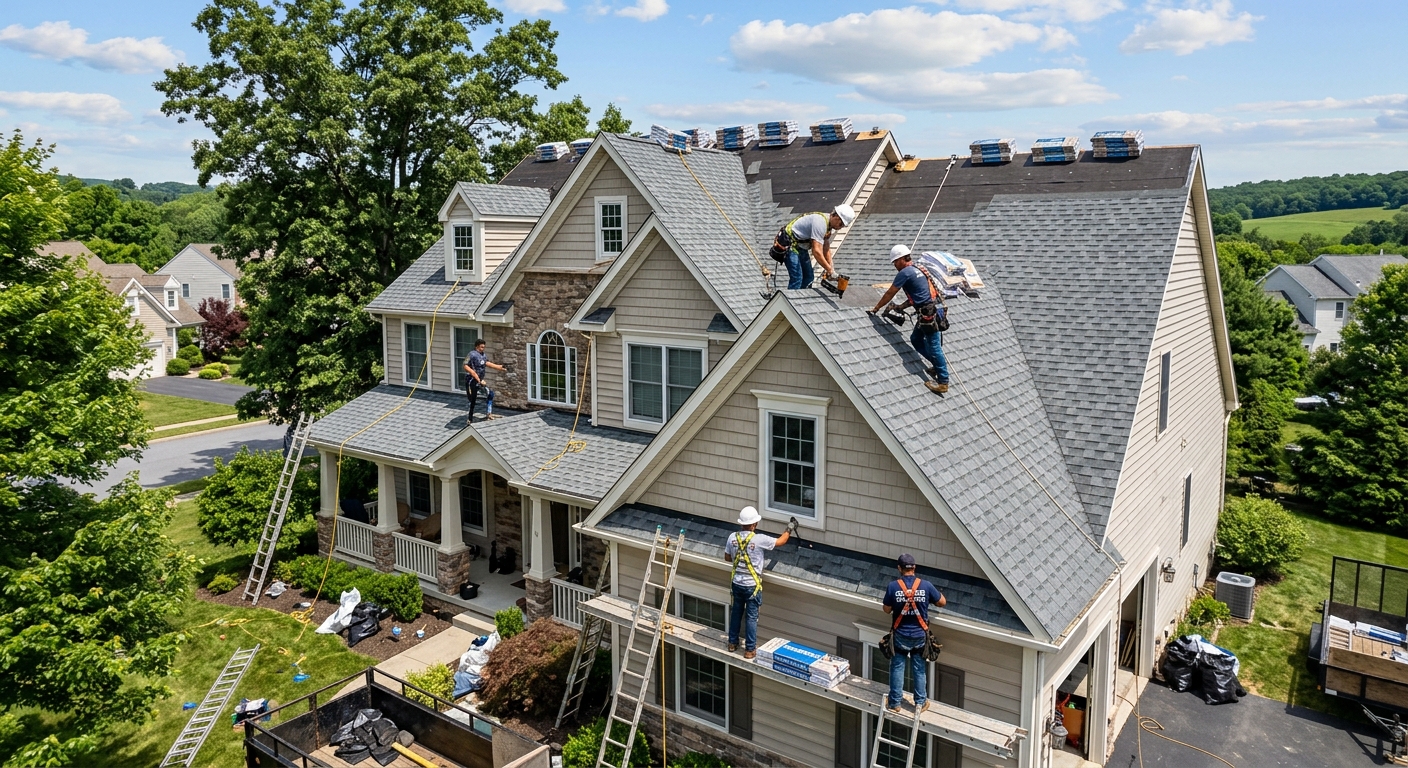
Westtown roofing prices by material and scope — 2026
In Westtown, roof pricing tightly reflects the area’s suburban character and home ownership patterns. With a homeownership rate over 80% and more than 70% of homes being single-family (U.S. Census Bureau, ACS 2024), homeowners here are more likely to pay for long-lasting materials and reputable installation. The prevalence of large subdivisions built from the 1970s to the 1990s in nearby West Goshen and Uwchlan means Westtown’s roofs are hitting their first or second replacement window—these aren’t historic slate tear-offs or brand-new builder specials, but average 25–35 year-old architectural shingles nearing the end of their service life. This results in regular demand for full replacements, not just patches.
Because architectural asphalt shingles have dominated local HOA standards since the 1980s, these materials rule the replacement market, both in price and in appearance. Many homes here have enough roof complexity—gables, porches, and additions—that square footage and roofing system choices swing the cost within a wide, but predictable, range. Quality replacement in Westtown will almost always include new underlayment and ice guard, reflecting today’s code—not always present on original builds. Flat membranes factor in for additions and porches, and storm repairs are common after wind events, which Westtown streets do not often escape.
| Material / Scope |
Lifespan |
Best for |
Price range (installed) |
| Asphalt shingles — architectural (30-yr) |
25–30 yrs |
Suburban homes, standard HOA projects |
$11,000–$23,500 |
| Asphalt shingles — impact-resistant (Class 4) |
30+ yrs |
Homes vulnerable to hail and ridge-line winds |
$18,000–$23,500 |
| Metal standing seam |
40–70 yrs |
High-end homes, long-term durability |
$27,000–$48,000 |
| Flat roof — TPO or EPDM |
15–25 yrs |
Porches, low-slope additions, select rowhomes |
$14,000–$28,000 |
| Roof repair — leak or isolated section |
n/a |
Emergency and targeted repairs |
$600–$2,200 |
Prices are estimates for a typical Westtown home and vary with roof size, pitch, decking condition and material selection.
Reading the warranty on a Westtown roof
In Westtown, roof warranties come in two parts—manufacturer and workmanship—and they are each only as good as their limitations. Manufacturer warranties, provided by the shingle or membrane brand, cover defects in the roofing material itself. These are usually prorated after the first decade and require strict compliance with installation guidelines—improper ventilation, skipping ice barrier, or installing a second layer over old shingles often voids coverage. Most manufacturers also require registration within a limited window (often 60 days), and some transfer to a new homeowner only once, if at all. If you plan to sell your Westtown home, check those transfer terms; otherwise, the next owner may be left unprotected.
The workmanship warranty is what the installer backs. In Chester County’s contractor-heavy market, the length of the labor guarantee is less important than the track record of the company standing behind it. A claim of 25 years from a two-year-old firm carries little real value compared to ten years from an established, well-reviewed local business. Most legitimate contractors in Westtown offer at least a 5–10 year workmanship warranty on full replacements. Always confirm this is written out as a separate line, not just implied as “whatever the shingle covers.” If it’s not specified, you likely have no labor coverage at all.
Roof age and construction era in Westtown
Westtown’s housing stock is shaped heavily by the development boom in surrounding West Goshen and Uwchlan from the 1970s through the 1990s. Nearly half the homes here, however, were still built before 1980 (U.S. Census Bureau, ACS 2024), which influences roofing needs. Most homes from the 1970s onward were built with moderate roof pitches, plywood or early OSB decking, and typically a single layer of architectural shingles installed by production builders keeping to the minimum code of the day. Ice guard beneath shingles wasn’t always required, so it’s not uncommon to find eaves without proper ice barrier—leading to leaks after harsh winters, especially when replacement cycles are overdue.
Suburban communities like Westtown, with many homes approaching the 30–50 year mark, are now entering their second cycle of full roof replacement. For homes built in the early 1980s, if the shingles have never been replaced, you’re often dealing with curled, brittle product well past its prime, or you’re seeing “second layer” jobs from the early 2000s where new shingles were laid on top of old. Rip-and-replace is now best practice, as codes and products have shifted. Homeowners should expect to budget for removal and possible deck repairs; hidden damage is more likely in houses where the first re-roof skipped a proper tear-off. It’s rarely just a cosmetic upgrade at this age—it’s a moisture and sheathing checkup, too.
Reading a roofing estimate line by line
A clear, detailed estimate is the only way to know what you’re buying in Westtown’s contractor-saturated market. Look for the total roof area (“squares”), stated with pitch and measurable dimensions. Tear-off and disposal fees should list the number of shingle layers and dumpster cost separately—some homes from the 70s-90s have two layers, affecting labor and dump fees. Underlayment and ice shield should be listed by specific product and coverage, not just as “felt”; your eaves may need more than the minimum code, especially after years of freeze-thaw cycles. Any deck replacement should be a per-sheet contingency—most commonly half-inch CDX plywood—so you know if damage is found, what you’ll pay per sheet, not a lump “extra.”
Warranties must be split: the installer’s workmanship years are not the same as the material brand warranty. Payment terms matter: a 10–15% deposit is standard, with the balance on completion. If the estimate is a single lump-sum with no area breakdown, square count, or materials listed, you can’t compare it to another bid—and the lowest bid may then be hiding corners cut.
| Line item |
What to look for |
Red flag if… |
| Roof area |
stated in squares, with pitch |
no measurement given |
| Tear-off and disposal |
number of layers, dumpster included |
bundled into one figure |
| Underlayment |
product type and coverage |
listed only as 'felt' |
| Ice and water shield |
coverage height at eaves |
omitted entirely |
| Decking |
per-sheet contingency price |
no allowance at all |
| Warranty |
workmanship years stated separately |
only the shingle warranty |
| Payment |
deposit under 15%, balance on completion |
large upfront cash |
Timing a roof replacement in Westtown
Westtown’s climate and Chester County’s bustling contractor market create a distinct seasonality for roof work. Asphalt shingles require daytime temperatures reliably above 45°F to properly seal, which makes March through November the prime window for replacement—late spring through early fall is busiest. Crews book up quickly during the September–October rush, since families here try to finish big projects before holidays and school schedules tighten. If you call for a full roof after Labor Day, expect four to six weeks out for reputable installers—sometimes longer, as Chester County’s proximity to the Philadelphia metro means higher demand and less idle labor.
Emergencies—like storm damage from one of the area’s frequent ridge-line wind events—will always command a premium if they fall outside regular scheduling. Roof leak repair or full replacement during the dead of February often costs more than a September job, not only because specialty crews are needed, but because cold, damp conditions slow down both tear-off and shingle adhesion. Planning ahead for replacement in late spring or early fall, before the rains and deep freeze, usually lands better pricing and a more manageable project timeline.
Pennsylvania code and Chester County permit rules for roofing
Roofing in Westtown falls under the Pennsylvania Uniform Construction Code (UCC), which is based on the International Residential Code (IRC). For most homes here, the key permit trigger is the scope: in West Chester Borough, a building permit is required if your roof replacement involves any structural deck repair. Simple like-for-like shingle repairs, as long as they total less than one roofing square, are commonly performed without a permit. Surrounding townships each run their own offices, so if you’re outside the Borough, check with your local municipal codes department for their threshold.
No trade-specific roofers’ license exists in Pennsylvania; required is a Home Improvement Contractor (HIC) registration for work over $500. You can verify a contractor’s HIC number at hic.attorneygeneral.gov. Workers’ compensation insurance is mandatory for all employers; the WCAIS system (wcais.pa.gov) allows you to check insurance status of any business. Get proof of both registration and insurance up front—if a contractor can’t provide it, walk away. Federal EPA Lead RRP rules also apply for homes built before 1978, especially if a roof tear-off disturbs painted wood trim; you can check certified renovators at certifiedrenovatorsearch.epa.gov.
Low-slope and flat roofs in Westtown
Many Westtown homes feature a flat or low-slope section—porches, modern additions, or even low-pitch rear roofs. These areas cannot use standard asphalt shingles, as the minimum safe slope is 3/12; anything less risks water wicking under the tabs and leaks from ponding after summer storms or thaw cycles. Flat roofs in our market are best replaced with TPO or EPDM membrane, designed to remain watertight despite standing water and our region’s freeze-thaw swings. Expect a professional-grade flat roof replacement to run $14,000–$28,000 for typical areas; membrane installs involve more prep, specialized flashings, and require a different skillset than standard shingle jobs.
Membrane roofs last 15–25 years if maintained—shorter than metal or shingle systems, but with far fewer leak events when properly installed. If you receive a quote suggesting shingles on a 2/12 pitch (or lower), that contractor is signaling a disregard for known best practice and local code. A proper flat roof build costs more upfront, but saves years of patching and interior repair.
Frequently asked questions — roofing in Westtown
Can a contractor cover my insurance deductible in Pennsylvania?
No, in Pennsylvania, waiving or “covering” a homeowner’s insurance deductible is prohibited under the Home Improvement Consumer Protection Act (HICPA). This applies in Westtown and across Chester County. Ethical contractors are not allowed to rebate, absorb, or refund your deductible amount after storm damage or insurance repair. If someone offers to handle your deductible, it’s a red flag—they’re skirting state law and could jeopardize your claim. Honest roof leak repairs here range from $600–$2,200; if a contractor says your out-of-pocket cost will be “zero,” they’re likely inflating the scope or billing your insurer fraudulently. That approach can trigger insurer refusal or even result in fines for all involved. Always obtain and read a written contract, and don’t sign up with anyone offering “free roofs.”
What happens if it rains mid-replacement?
If rain hits during a Westtown roof replacement, a responsible crew immediately secures any exposed sections with tarps. Many Chester County homeowners worry about this, given how quickly pop-up storms can develop here. Crews work in stages—removing only as much roof as they can replace and dry-in that day, which is a best practice. If forecasted weather is questionable, the project may be delayed. If rain is sudden, areas stripped to decking are tarped with at least 6-mil plastic and fastened down. This temporary cover protects your attic and interiors but can slow the job down a day or two, and in some cases, a brief emergency tarping may cost extra, within that $600–$2,200 roof repair range. Don’t let a contractor remove more roof than they can secure the same day, even if pressed “to finish sooner.”
How much does it cost to repair a roof leak in Westtown?
Typical roof leak repairs in Westtown come in at $600–$2,200. This covers common problems—flashing failures, pipe boot leaks, or small shingle blow-offs after a windstorm. Larger leaks under satellite dishes, old chimney flashings, or skylight surrounds may hit the top of the range. If a repair estimate is higher than that, ask for a breakdown; many local homes only need a targeted fix, not a full tear-off. Be wary of anyone who says you must replace the entire roof due to a minor leak unless there’s evidence of widespread shingle failure or sheathing rot. Pay for just the necessary repair if the rest of your roof is still serviceable.
Does attic ventilation matter in Westtown's climate?
Yes, attic ventilation is important in Westtown. Our climate is defined by humid summers and moderate freeze-thaw cycles, which means poor ventilation can breed attic mold and shorten shingle life. Under the Pennsylvania Uniform Construction Code (UCC), proper venting supports your manufacturer warranty—insufficient ventilation can void coverage. Roofers here regularly find overheated, brittle shingles and musty attic insulation in homes built to earlier, lower standards. A vented ridge and undisturbed soffit vents help your attic stay dry year-round, even when the exterior temperature swings from 14°F in winter to muggy highs in July. While fixing ventilation isn’t as expensive as a new roof, catching it early saves you a potential full replacement at $11,000–$23,500 sooner than necessary.
Can I inspect my own roof safely?
While you can inspect sections of your Westtown roof from the ground with binoculars (looking for missing shingles or debris in gutters), climbing onto a roof is not recommended unless you’re trained and equipped with fall protection. Our local homes often have moderate roof pitch—enough to be hazardous for most homeowners. Walking on brittle, aging shingles from the 1980s or 1990s can also cause more damage than you find. If you spot issues—granule loss, lifted edges, sagging valleys—hire a local, insured roofer to do a safe inspection. Many will perform this for a nominal diagnostic fee, generally under $600–$2,200 if a leak is found and fixed during the visit.
Are impact-resistant shingles worth it in Westtown?
Impact-resistant (Class 4) shingles can make sense in Westtown, especially on homes exposed to the area’s frequent ridge-line wind events. These shingles cost more—replacements usually run $18,000–$23,500—but withstand hail and flying debris much better than standard products. HOAs in some newer Chester County subdivisions might also approve only specific shingle types. While we’re not in a hail epicenter, our wind history does support the upgrade, especially if your plan is to stay in your home for decades or you want less risk of emergency repairs after storms. If insurance premiums won’t drop, weigh the peace of mind against the premium price.
How do I verify a roofing contractor is registered in Pennsylvania?
All contractors working on roof jobs over $500 in Pennsylvania—including those serving Westtown—must have Home Improvement Contractor (HIC) registration through the Pennsylvania Office of Attorney General. Homeowners should verify registration at hic.attorneygeneral.gov before signing a contract. For jobs involving employees (not just the owner), workers’ compensation must be current—check the WCAIS database (wcais.pa.gov) for insurance status. Never take a registration number or insurance certificate at face value; quick searches on these official systems confirm legitimacy and protect against handyman scams. Properly registered Westtown contractors are required to write out the full contract terms for any replacement or substantial repair, which may cost you $11,000–$23,500 for typical architectural shingles.
Is a metal roof worth the extra cost in Westtown?
Metal standing seam roofs are a premium choice and can easily cost $27,000–$48,000 for a typical Westtown home, roughly double or more the price of asphalt shingles. They’re best suited for high-end properties, long-term owners, or where architectural review boards allow them. Metal lasts far longer—up to 70 years—and is great for homes exposed to heavy winds or where fire risk is a concern, such as close to woods or older structures. If you plan to move within ten years or your HOA limits roof styles, you’ll rarely recoup the upfront cost. For families staying put, metal makes sense over two asphalt roof cycles, but weigh local resale value before signing up—many buyers still expect shingles in Chester County subdivisions.
Should I use a local roofer or a national company?
In Westtown, where the contractor market is crowded with firms based in or near West Chester, using a local roofer has distinct advantages. Local contractors depend on word-of-mouth and have direct experience with Chester County code enforcement, wind damage patterns, and neighborhood HOA preferences. National firms, while often well-resourced, can cycle crews through without the same stake in ongoing reputation. For warranty claims or future repairs, dealing with a crew you can call directly—especially for work in the $11,000–$23,500 range—is typically more responsive. Local firms will be more familiar with which subdivisions require special treatments or products, and you’ll have better luck getting references from neighbors who’ve used them recently.