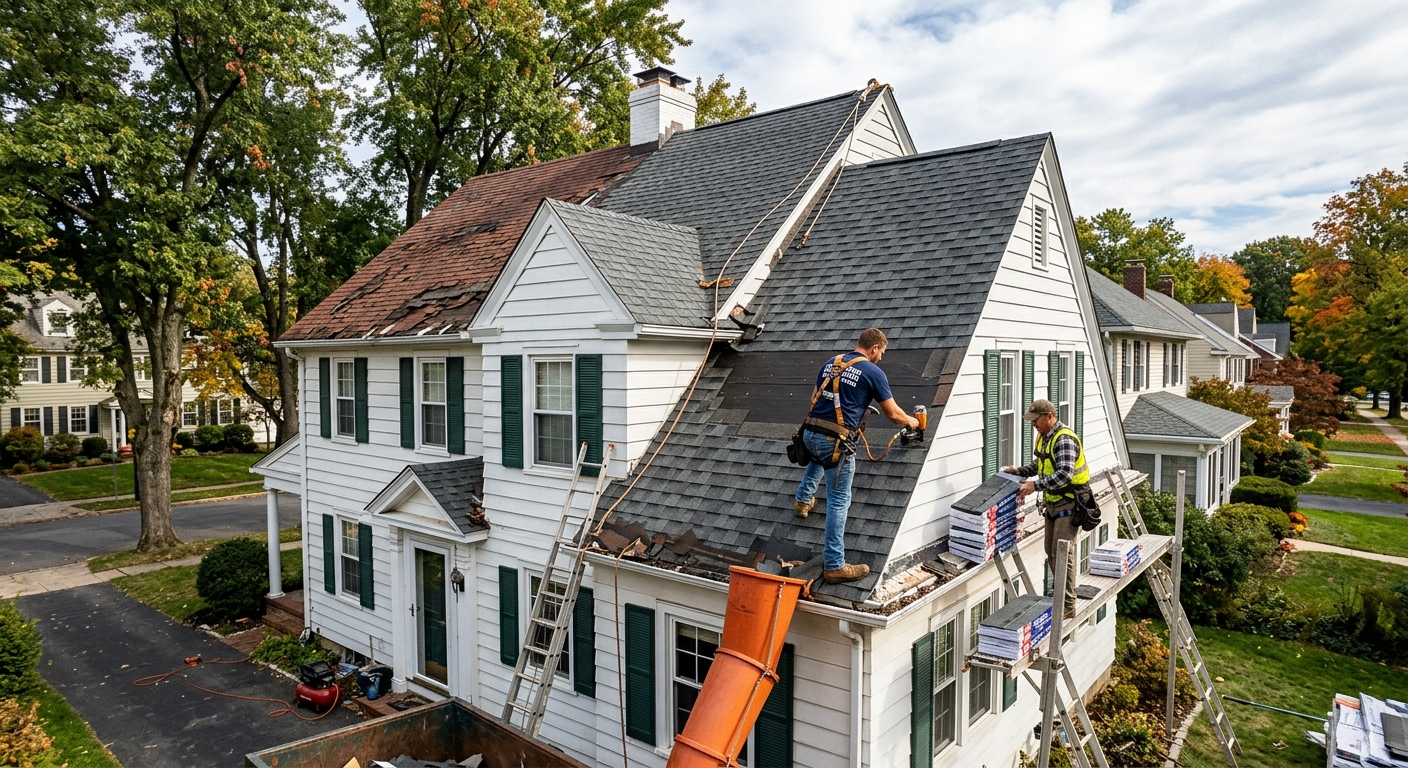
Scott roofing prices by material and scope — 2026
In Scott, roofing costs are shaped by the area's high homeownership rate and a large share of single-family homes—facts that directly influence demand for full roof replacements and repair jobs (U.S. Census Bureau, ACS 2024). The typical Scott roof covers a freestanding house rather than a duplex or rowhome, so quoted prices here reflect the 74.4% prevalence of single-family structures, many built decades ago. With over half the housing in Columbia County dating to before 1980, tear-off and replacement is the rule, not the exception, especially in Bloomsburg and Berwick where roof decks and framing have already seen one or two cycles of re-roof.
What this means for Scott homeowners: most roofs needing replacement will involve a full tear-off, frequently uncovering sections of aged plank or thin plywood decking that may need repair. Quoting is rarely just about new shingles—it’s about dealing with what’s lurking underneath, addressing issues from older construction, and coping with winter snow loads that punish aging roofs every season.
Below is a rundown of realistic 2026 installed prices for common roofing types and scopes found here:
| Material / Scope |
Lifespan |
Best for |
Price range (installed) |
| Asphalt shingles — architectural (30-yr) |
25–30 yrs |
Most Scott homes with pitched roofs |
$9,200–$19,500 |
| Asphalt shingles — impact-resistant (Class 4) |
30+ yrs |
Homes facing ridge-line wind or hail |
$15,000–$19,500 |
| Metal standing seam |
40–70 yrs |
Long-term owners, shallow-pitch roofs |
$22,500–$40,000 |
| Flat roof — TPO or EPDM |
15–25 yrs |
Low-slope porch or commercial |
$11,500–$23,500 |
| Roof repair — leak or isolated section |
n/a |
Targeted fixes on sound roofs |
$475–$1,850 |
Prices are estimates for a typical Scott home and vary with roof size, pitch, decking condition and material selection.
Why gutters get replaced with the roof
Gutters, downspouts, drip edge, and yard grading all work together to keep Scott homes dry—especially important given Columbia County’s heavy snow loads and older housing stock where wet basements are common. Replacing just the roof but leaving undersized or clogged gutters risks trapping water at the eaves, creating dams and sending runoff right to the foundation. In Scott, when downspouts discharge too close to the house, that water can seep straight into basements or crawl spaces, especially on homes built before proper damp-proofing was standard.
Modern roofing warranties often require proof of adequate drainage. A new gutter run—properly installed with the right size and pitched for flow—can mean the difference between a bone-dry basement and a persistent moisture problem. Gutter guards also pay off in this region, where autumn leaf fall can choke drainage overnight during a storm. A full gutter system replacement alongside a new roof typically costs $1,500–$3,800 for most homes in Scott, depending on lineal feet and upgrade options like guards or oversized downspouts.
Addressing both at once means your new roof lasts longer and you don’t end up with ponding or unexpected leaks traced to old, leaky gutters. In Scott, piecemeal drainage work is a quick way to turn a new roof job into only a partial fix.
Reading a roofing estimate line by line
Scott homeowners should expect—and require—specific details in any roofing estimate. Start with roof area, always shown in “squares” (a square is 100 sq ft of roof surface) with the roof pitch clearly stated. Tear-off and disposal should be itemized, indicating how many layers exist and if dumpster rental is included. Underlayment and ice barrier sections should reference actual products (not generic “felt”) and coverage details. Most older Scott roofs are decked with historic planking or thin plywood, so your quote must state a per-sheet contingency price for rotten or undersized decking found during tear-off.
At the flashing and vent boots line, you should see locations listed: sidewall, chimney, valleys, etc. Roofing warranties split between workmanship (the installer covers leaks or errors) and material (the manufacturer covers shingle failure); these must be separated out. Payment terms should follow Pennsylvania rules—with a modest deposit and the balance due on completion, no large up-front ask.
If the quote lumps everything together without square counts or line items, you cannot compare apples to apples. Vague estimates hide shortcuts—most commonly by skipping tear-off, underlayment, or skimping on decking repair and flashing. Here’s what every line means for Scott roofs:
| Line item |
What to look for |
Red flag if… |
| Roof area |
stated in squares, with pitch |
no measurement given |
| Tear-off and disposal |
number of layers, dumpster included |
bundled into one figure |
| Underlayment |
product type and coverage |
listed only as 'felt' |
| Ice and water shield |
coverage height at eaves |
omitted entirely |
| Decking |
per-sheet contingency price |
no allowance at all |
| Warranty |
workmanship years stated separately |
only the shingle warranty |
| Payment |
deposit under 15%, balance on completion |
large upfront cash |
The cost drivers behind a Scott roof replacement
Roofing quotes in Scott may differ by thousands of dollars, even for neighboring homes. The biggest drivers are roof size (in squares), pitch, material chosen, and unseen issues that only turn up once tear-off starts. For Scott’s single-family homes, which typically have plenty of roof area and old framing, these variables amplify differences between competing quotes. The code-mandated snow load of 40 psf in Columbia County requires roofers to spec materials and underlayment that will stand up to snow and ice, especially in exposed areas south of Bloomsburg where ridgeline wind is a seasonal issue and impact-resistant shingles are sometimes justified.
Older homes complicate the math—most have at least one prior roofing layer that must be removed (sometimes two or three on pre-war construction), triggering full-tear requirements. That adds $500–$1,500 per extra layer for removal and disposal. When uncovering sheathing, Scott crews routinely find rot or undersized boards, so per-sheet decking repairs (typically $75–$150 each) must be built into every estimate. On top of this, code and local practice often require an ice barrier at the eaves, costing another $300–$800 depending on length and detail needed.
| Factor |
Why it matters here |
Cost impact |
| Roof size in squares |
each square is 100 sq ft of roof surface |
primary multiplier |
| Pitch and access |
steep pitches need harnesses and slow the crew |
+20–30% labour |
| Existing layers to tear off |
two or more layers means full tear-off and disposal |
$500–$1,500 per layer |
| Decking condition |
rot is found during tear-off, not before |
$75–$150 per sheet |
| Ice barrier at eaves |
required where ice damming has a history |
$300–$800 |
| Material grade |
3-tab vs architectural vs Class 4 impact-resistant |
$500–$2,500 |
Filing a roof claim after a Pennsylvania storm
When storm damage hits a Scott roof—especially after wind-driven rain or hail—the first step is to carefully document everything with photos and written notes before any cleanup begins. Only then should you report the loss to your insurance carrier. The adjuster should provide you with a written “scope of loss” detailing covered repairs or replacement, dividing out actual cash value (what your roof was worth today, factoring in age) and replacement cost (the full amount to restore it).
In Pennsylvania, roofing contracts over $500 must be in writing under the Home Improvement Consumer Protection Act. You are entitled to a 3 business-day right of cancellation on any contract over that amount—no pressure or hard sell is legal. Waiving or “covering” your deductible is strictly prohibited here; any contractor offering to do so puts both you and themselves at legal risk, and is reason enough to walk away from the bid.
The insurer will typically issue the first check for the actual cash value, and release the rest once a signed contract and invoice are provided for the full replacement work. Never authorize permanent repairs until the adjuster inspects the damage, and always keep originals of every document. This process is routine in rural Columbia County, where roof exposure along Appalachian ridges reliably produces a steady trickle of storm-related claims each year.
Roofing permits in Scott: what you need before work starts
In Scott, roofing permitting falls under the Pennsylvania Uniform Construction Code (UCC), which is based on the IRC and enforced by the PA Department of Labor & Industry or by municipal code offices. Scott itself, as a township in Columbia County, uses its own code office, while nearby Bloomsburg has a dedicated enforcement office handling building permits. Any significant roof replacement—especially if it involves removing or replacing structural decking—requires a permit. Basic repairs (like swapping a few shingles or minor patching) generally do not, but once you’re removing more than 25% of the total roof area or altering the structure, permits come into play.
Before hiring, verify that your roofer holds a valid Home Improvement Contractor (HIC) registration for contracts over $500. You can confirm this at hic.attorneygeneral.gov. For your protection as a homeowner, Pennsylvania requires every employer to have workers’ compensation insurance. You can check coverage at the WCAIS system (wcais.pa.gov). If your home is pre-1978, the federal EPA Lead Renovation, Repair and Painting Rule (RRP) applies, and you can search certified renovators at certifiedrenovatorsearch.epa.gov.
Always ask your contractor for their HIC number and proof of current workers’ compensation before work begins—it’s the fastest way to weed out unqualified or uninsured roofers working in Scott.
Scott homes and their roof lines
The majority of homes in Scott and Columbia County were built before 1980, with many older than 1950, especially in nearby Bloomsburg and Berwick. This era of construction impacts virtually every roof replacement: most houses have medium to steep pitches and use 1x plank decking, not plywood or OSB. Because code-required ice-and-water barricades were not in effect when these roofs were installed, few originals have any ice barrier at all under the shingles—meaning Scott homeowners are especially prone to winter ice dam leaks until a modern membrane is added at tear-off.
With decades of layered shingle history, it’s common for Scott roofs to hold two or even three layers of prior roofing, making full tear-off a must on most jobs. Wood decking in these homes is often found to be gapped, soft, or spongy when older roofs come off. The result is predictable: almost every full replacement ends up with a handful of decking sheets needing replacement, which should always be priced as a line item on your estimate. Valley and dormer flashing is typically basic or missing, since many roofs were last done when code and building science were more casual. When planning a roof replacement in Scott, factor in not just surface replacement but underlying repairs—few homes here will be “simple” shingle swaps.
Frequently asked questions — roofing in Scott
Do I need a permit to replace a roof in Scott?
Yes, most full roof replacements in Scott Township require a permit, especially if you’re removing all roofing down to the decking or making any changes to the structure. This falls under the Pennsylvania Uniform Construction Code, which is enforced by the local municipality here. Minor repairs—say, a few missing shingles or small patches under $1,850—typically don’t need a permit, but as soon as you’re replacing a large section or the entire system, municipal code requires one. Always check with the Scott code office before starting, and expect your roofing contractor to handle the permit application. Permits are not just paperwork—they keep your roof job legal and insurable, and are proof that the job passed minimum safety and installation standards.
Are impact-resistant shingles worth it in Scott?
Impact-resistant (Class 4) shingles cost more up front—typically $15,000–$19,500 for a Scott home—but can be a smart investment here. Why? Columbia County sits along Appalachian ridges that see high winds and occasional hail. Standard architectural shingles do well, but if your home is especially exposed or you’ve had past storm claims, impact-resistant shingles may prevent future damage and help with insurance. Some policies offer a discount for Class 4. That said, for most Scott homes with moderate tree cover and no history of major hail, the upgrade is optional. If your roof barely sees any more abuse than rain and light snow, Class 4 is peace of mind—not a requirement. Don’t let anyone oversell you if you don’t truly need it.
How can I tell if my roof decking is rotted?
In Scott’s older homes, rotten decking is common but not always visible from inside. Signs include spongy or uneven spots when walking the roof, sagging ridges, or visible staining in attic spaces. During a roofing tear-off, your contractor should expose the wood deck fully—if you see dark, crumbling, or delaminated boards, that’s rot. Decking replacement is usually charged per sheet (about $75–$150 here). The reality is, you can’t spot all problems from the ground—full assessment comes when old shingles are removed. If your contractor skips this step or refuses to address visible rot, get a second opinion. On Scott roofs built before 1980, it’s wise to plan for some decking replacement in the budget.
Does attic ventilation matter in Scott's climate?
Attic ventilation is absolutely important in Scott’s climate, given our long heating season (over 6,000 degree days) and harsh winter cold. Poor ventilation traps moisture against your roof deck, hastening rot and shingle failure, especially in older Columbia County homes with original plank sheathing. When you’re replacing a roof for $9,200–$19,500, proper ridge and soffit venting is a small extra investment that pays dividends in roof life and reduced icing issues. Without it, attics stay damp and baking hot in summer, and trapped heat leads to ice damming at the eaves. All new replacements should include a review (and likely improvement) of your attic ventilation.
Will the crew damage my landscaping or driveway?
On most Scott jobs, the driveway and landscaping are at risk if precautions aren’t taken—especially with tight lot lines and mature trees common in pre-1980 homes. Professional crews should use ground tarps and plywood to shield beds and hard surfaces when tossing old shingles and debris. If you’re quoted for a full replacement (say, $15,000), cleanup and property protection are standard. Make sure the contract spells this out. Driveways are also at risk from dumpsters and delivery trucks, so proper pad placement matters. If a contractor won’t guarantee “no damage” or include landscaping protection in their estimate, ask for references from recent Scott projects before signing.
How much does a flat roof replacement cost in Scott?
Flat roof replacement—TPO or EPDM—is less common here but necessary on low-slope porches or commercial properties in and around Scott. Expect a typical price range of $11,500–$23,500 depending on size and detail. Flat roofs are more sensitive to ponding and require scrupulously managed drainage because of our freeze-thaw cycles and heavy snow loads. If your flat roof is showing seams, bubbles, or frequent leaks, a full membrane replacement is the right call. Many older flat roofs in Scott have outdated tar or rolled asphalt that’s well past its service life; investing in a new membrane now can head off interior water damage later.
What warranty should a Scott roofer offer?
For roof replacements in Scott, a reputable company should offer you two separate warranties: the manufacturer’s warranty (covering the shingles themselves, usually 25–30 years for architectural products) and a workmanship warranty (the installer stands behind their labor). On a typical job of $15,000, expect a written workmanship warranty of at least 5 years—some give 10. Material warranties only cover manufacturer defects, not improper installation or leak issues from missed flashing. Ask for both in writing, and read the fine print on exclusions. Pennsylvania law requires your contract to spell out warranty terms. Don’t accept “lifetime” as an answer—get a year count and what each covers for your records.
Is a metal roof worth the extra cost in Scott?
Metal standing seam roofs cost more up front—typically $22,500–$40,000 for a Scott home—but come with unique advantages for long-term owners. Metal stands up to Columbia County’s heavy snow and ridge-line wind, sheds ice more quickly, and can last 40–70 years with little maintenance. For rural properties with minimal tree cover, corrosion isn’t an issue. If you’re planning to stay in your home for decades, or want a near “set it and forget it” solution, the investment makes sense. However, if you’ll likely sell within 10–15 years, the payback is hard to capture at resale. For most single-family homes in Scott, architectural shingles remain the default, but metal is gaining traction for permanence and peace of mind in harsh weather.
Does homeowner's insurance cover roof replacement in Scott?
Homeowner’s insurance in Scott will generally cover roof replacement if the loss is caused by a covered peril (hail, windstorm, falling trees). The payout depends on your policy: some pay actual cash value (depreciated) while others cover full replacement cost. You must pay your deductible—by law, Pennsylvania contractors are forbidden to waive or absorb it. Roofs replaced only because of age or wear and tear are not covered. For a storm-damaged roof, insurance often pays close to the full replacement cost (like $15,000 for architectural shingles), minus your deductible. Always document damage before cleanup, have a written scope prepared, and never start work before the adjuster’s inspection.