Camp Hill roofing prices by material and scope — 2026
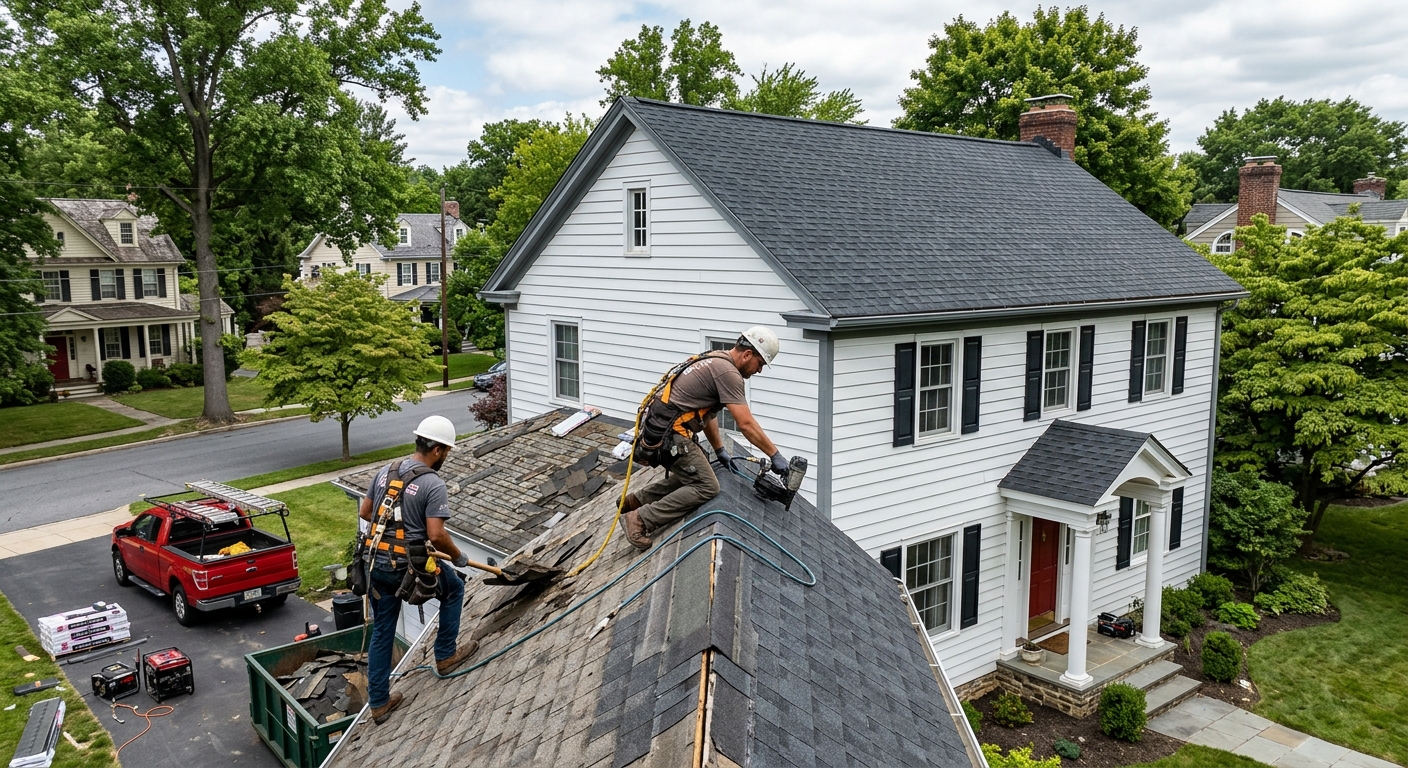
In Camp Hill, roof replacement choices and costs reflect local housing age and the dominance of post-war subdivisions. With 93.1% of homes built before 1980 and 74.9% built as single-family houses (U.S. Census Bureau, ACS 2024), most roofs approaching the end of their useful life are still on their second or possibly third generation of shingles. That means a high ongoing demand for replacements—especially in the neighborhoods that went up around Hampden and Silver Spring Townships after 1950, where entire blocks share the same roof slope and product era. As these large tracts cycle through their typical 25–30 year asphalt shingle lives, you’ll see crews rolling from one property to the next for several months straight and suppliers keeping architectural shingles in ready supply.
Metal and flat roof options exist but are less common; flat roof sections tend to show up on additions or porches, not as whole-house systems. Asphalt remains the market norm, and pricing reflects these realities closely. Below is what you should expect for fully installed jobs in 2026—no “starting from,” just real Camp Hill numbers.
| Material / Scope |
Lifespan |
Best for |
Price range (installed) |
| Asphalt shingles — architectural (30-yr) |
25–30 yrs |
Standard re-roofing of Camp Hill single-family homes |
$10,500–$21,500 |
| Asphalt shingles — impact-resistant (Class 4) |
30+ yrs |
Exposed ridge-line or wind-prone homes |
$17,000–$21,500 |
| Metal standing seam |
40–70 yrs |
Long-term solution for farmsteads or premium upgrades |
$25,000–$44,500 |
| Flat roof — TPO or EPDM |
15–25 yrs |
Low-slope additions, porches, or rear sections |
$13,000–$26,000 |
| Roof repair — leak or isolated section |
n/a |
Isolated leaks, small repairs |
$550–$2,100 |
Prices are estimates for a typical Camp Hill home and vary with roof size, pitch, decking condition and material selection.
When a Camp Hill roof is worth repairing — and when it isn't
In Camp Hill, the age of your roof shows up in your options—especially with so many homes built before 1980, and waves of similar homes reroofed at 25–30 year intervals. For a roof under 15 years old with a single small leak, a repair is justified. If you’re within the 15–25 year window and you’re starting to see more than one active leak, replacement stands out as the more cost-effective choice. A quick math check: three leak repairs at $1,300 each could run you $3,900, which is well on your way to a new architectural-shingle roof starting at $10,500—and you’re still left with old, failure-prone material that could let go anywhere else next winter.
If your roof is past 25 years or if the leaks line up with past storm events (wind lifts in the valley are common), don’t bother repairing—you’re likely to chase problems, especially with the cycle of freeze-thaw that breaks tar lines and opens old nail holes. Flat roof membranes with ponding or blisters also need full replacement, not patchwork. Quick fixes are only justified on active leaks right before winter, just to buy time until conditions allow a full replacement.
| Situation |
Recommendation |
Typical cost |
Reasoning |
| Under 15 years, one isolated leak |
Repair |
$550–$2,100 |
Shingles and underlayment still have service life; cost-effective for a single spot. |
| 15–25 years, several leak points |
Replace |
$10,500–$21,500 |
Multiple leaks signal end-of-life; replacement stops the repair cycle. |
| 25+ years, any active leak |
Replace now |
$10,500–$21,500 |
Aging shingles and underlay are at failure age for Camp Hill tracts. |
| Storm damage, wind or hail |
Document, claim, replace |
$10,500–$21,500 |
Insurance may cover the roof and old repairs rarely last after major events. |
| Flat roof ponding or blistering |
Replace membrane |
$13,000–$26,000 |
Ponding means the membrane is compromised; patches won’t last. |
| Active leak entering winter |
Emergency repair, schedule replacement |
$550–$2,100 |
Prevent interior damage, then plan full replacement when conditions allow. |
When to book roofing work in Camp Hill
Central Pennsylvania’s roofing calendar is tightly ruled by freeze-thaw cycles and the peak call volume created by saturated markets like the Harrisburg–Carlisle metro. In Camp Hill, most architectural shingle replacements and metal installs are reliably scheduled from late March through early November. Shingles need daytime temperatures above 40 °F to seal properly; trying to roof a whole house in January risks poor adhesion and callback issues—something local crews avoid unless it’s emergency tarping or a small repair.
Plan ahead. With multiple regional roofing suppliers in Cumberland County and ongoing reroof cycles in the suburbs, prime months like September and October are booked out fast, often filled by contracts signed in June or July. Wait too long and you’ll either pay a premium for squeezing in last-minute work, or be forced to settle for a spring start. If your leak or storm damage occurs in February, expect higher labor costs as materials are less pliable, on-call crews shrink, and more complex safety setups are needed on icy surfaces. Emergency work in winter nearly always costs more per square than a planned job in shoulder season, where the same replacement might come in at $17,000 instead of the top of the band.
Best advice: Budget for a spring or fall job, and secure estimates as soon as you suspect an issue—especially on the older homes that still dominate Camp Hill streets.
Permits and code requirements in Camp Hill
Residential roofing work in Camp Hill falls under the Pennsylvania Uniform Construction Code (UCC), which is based on the International Residential Code (IRC). Permits are generally required for full roof replacements—especially those involving decking repairs or major membrane work—but not typically for like-for-like shingle overlays, provided no structural work or decking replacement is planned. Emergency tarping, small repairs, or simple shingle swaps generally do not need permits unless the municipality says otherwise.
In Cumberland County, code authority rests with municipal code offices. That means your permit is issued either by the specific Borough of Carlisle Codes Department (if you live in Carlisle) or by Camp Hill’s municipal office, not a central county department. In municipalities that have opted out, the PA Department of Labor & Industry enforces the code requirements directly.
For consumer protection, your contractor must hold Pennsylvania Home Improvement Contractor (HIC) registration for any job over $500; verify this at hic.attorneygeneral.gov. All Pennsylvania roofing contractors hiring workers must carry workers’ compensation insurance—double-check active coverage with WCAIS (wcais.pa.gov) before signing.
Every contract over $500 also requires a written agreement and a three business-day right to cancel under state law. Never accept a contractor’s promise to handle your insurance deductible—waiving a deductible is illegal in Pennsylvania.
Reading the warranty on a Camp Hill roof
In Camp Hill, homeowners should keep warranties straight: manufacturer and contractor coverage are two different promises. Manufacturer warranties cover material defects—like shingle granule loss or premature cracking. They’re almost always prorated after year 10, and require registration within a set window (usually 60–90 days after install). Failing to register can void the entire coverage, so don’t let the paperwork slide.
Workmanship warranties hinge on the roofer’s staying power. A 25-year workmanship warranty from a two-year-old company isn’t much protection if the business folds; a 10-year warranty from a roofer with deep roots in the Harrisburg–Carlisle market is more credible and often all you’ll need. Coverage is often voided by negligence—like failing to ventilate the attic, or layering new shingles over old ones (common on flip jobs but risky and code-questionable).
Most manufacturer warranties may be transferred at resale for a fee, but only once. Always ask your installer whether both material and labor warranties will survive a house sale, and what the fine print requires. Don’t assume “lifetime” means your lifetime—read every clause, or you may find you’re on your own for repairs after just 10–15 years.
Flat roof sections: the part most quotes get wrong
Many Camp Hill homes have a porch, addition, or garage roof that sits nearly flat—sometimes a 2/12 pitch or less. Shingles are not made for these slopes. They leak along the nail line during Cumberland Valley wind-driven rains and trap ice at the transition, no matter how carefully they’re installed. The right system for a flat roof here is a continuous membrane—TPO or EPDM. These materials can withstand our freeze-thaw cycles, prevent ponding water from creeping into seams, and last 15–25 years when laid well. Pricing is higher than for a shingled section of equal size—count on $13,000–$26,000 for a typical membrane replacement on an addition or low-slope rear section.
If a roofer proposes shingles for your 2/12 or flatter roof, take it as a red flag about their standards and knowledge of local conditions. Ponding, blistering, and membrane shrinkage are all signals the roof needs a full membrane replacement—not a patch or a shingle overlay. Pay close attention to flat areas; the right system means no ceiling stains and far fewer emergency calls when the next winter rolls in.
Snow load, ice dams and wind in Camp Hill
The Cumberland Valley’s ridge-line winds and pronounced freeze-thaw cycling give Camp Hill a set of roofing problems not found just one county west. With a ground snow load of 30 psf and a winter design temperature of 12 °F, ice dams at the eave are a recurring issue: snow melts above a heated attic, trickles down and freezes right above the gutter line, then backs water under the lower shingle courses. When that happens, it doesn’t matter how high-quality your shingles are—without a proper ice and water shield installed well uphill from the eave, water ends up inside the exterior wall. The fix isn’t cheap: rot under the eave may push repairs into the $550–$2,100 range or trigger full replacement near $10,500–$21,500 if the decking suffers widely.
Wind is an even bigger culprit here. Ridge-line developments and exposed farmsteads in Cumberland County face gusts funneled through the valley, which can lift or break shingles along the roof edges. A shingle bruised by hail or torque won’t always show a clean hole—it often looks fine until the seal lifts in the next storm, then the next freeze lets water in.
If your house is sited on the edge of Camp Hill or faces into these wind corridors, it is always worth opting for upgraded, impact-resistant shingles even though costs run higher: $17,000–$21,500 is real insurance against the hidden consequences of “bruised but not broken.” Storm repair cycles here aren’t a sales pitch—they’re a byproduct of local climate quirks and code-driven material selection.
Frequently asked questions — roofing in Camp Hill
How long does a roof replacement take in Camp Hill?
A typical full roof replacement on a Camp Hill single-family home usually takes 1–2 days for architectural shingles, though weather and crew size matter in Pennsylvania’s climate. If a major storm has just passed and several neighboring houses need work (not unusual along the ridge or in the older 1950s tracts), plan on delays from supplier bottlenecks and higher call volumes. Metal roofs or larger structures may run 2–4 days, especially if decking repairs are needed or flat roof sections get new membrane. Complex projects with both shingles and flat roofing can stretch to a week. Your best window is spring through fall when freeze-thaw cycling isn’t a hazard. For a standard asphalt job, expect $10,500–$21,500 and 2–4 days from tear-off to clean-up, barring rain or frost delays.
Is metal roofing noisy in rain?
Modern metal standing seam roofing in Camp Hill, when installed over solid decking with proper underlayment (as required by the Pennsylvania Uniform Construction Code), is not notably noisier than asphalt. The old notion of “loud tin roof thunder” usually came from installing metal directly over rafters, which almost never happens here. Most local homes have plywood or OSB sheathing, which deadens sound quite well. Some noise might slip through, especially in uninsulated garages or three-season porches—if that bothers you, options like additional underlayment can help. Metal is a smart choice against valley winds and hail, even if it comes at a higher cost: $25,000–$44,500. Unless you love silence and have a music studio in your attic, noise isn’t a reason to skip metal.
Why do roofs fail faster in south-central Pennsylvania?
Roofs in Camp Hill and the broader Cumberland Valley often face shorter lifespans not because of installer shortcuts, but the combination of repeated freeze-thaw cycles and wind stress unique to our region. Melting snow refreezes above uninsulated eaves, causing ice dams and water backup every winter. Suburban tracts here are especially vulnerable to wind-lift along ridges—shingles loosen slightly each time, then the next big gust or storm can rip them off clean. Hail occasionally bruises the shingle mat without obvious holes, setting up a leak months or years later. For many homes, these cumulative effects mean a 25–30 year roof, installed perfectly, still ends up replaced closer to 22–25 years. It’s why your neighbor’s roof that was new in the early 2000s is hitting the $10,500–$21,500 mark today, right on schedule.
Should I use a local roofer or a national company?
For Camp Hill homeowners, a local roofer is usually the better bet. Local contractors know the quirks of our 1950s tracts, valley wind patterns, and which houses tend to show the first leaks after a rough freeze. If you need warranty service or quick storm repairs, a crew based in the Harrisburg–Carlisle area will prioritize familiar clients over out-of-town jobs. National companies may offer “big brand” backing, but their traveling crews may not specialize in the underlayment strategies this region’s freeze-thaw demands. On price, both may quote similar numbers—expect asphalt shingles in the $10,500–$21,500 band either way—but hands-on local experience matters when the job is more than a simple overlay.
What if my insurer denies my roof claim?
If your Camp Hill insurer denies a roof claim—common if they suspect “wear and tear” or argue that the roof was beyond its expected life—don’t panic. First, get detailed pictures and a second opinion from a reputable roofer, not just an insurance adjuster. Sometimes, policy language is the issue, especially on older homes with too many layers or spot repairs. Even a denied claim doesn’t mean you have to start at the top of the price range. Repairs for limited sections start at $550–$2,100, and if a full replacement is needed, a straightforward architectural shingle job can still land in the median of $17,000. Keep records and push for a re-inspection with your contractor present.
How do I verify a roofing contractor is registered in Pennsylvania?
For any Camp Hill roofing job over $500, Pennsylvania law requires the contractor to have a Home Improvement Contractor (HIC) registration. This isn’t a specialized “roofer’s license,” but you can quickly check registration status on the state registry at hic.attorneygeneral.gov. Enter the company’s name or registration number—if it doesn’t show up, they can’t lawfully contract your job. For worker safety, you should also check their workers’ compensation coverage via WCAIS (wcais.pa.gov)—especially relevant in south-central PA, where crews often juggle multiple projects around storm events and slips happen. Don’t accept excuses. Registration is non-negotiable and protects your rights under the Home Improvement Consumer Protection Act.
What does roof replacement cost per square in Camp Hill?
Pricing per “square” (100 square feet of roofing) is still used by many local Camp Hill contractors when quoting jobs. For architectural asphalt shingles on a standard, walkable roof, you’ll see rates in the $450–$650 per square range (which lines up with total job bands of $10,500–$21,500 for typical houses). Metal, by contrast, can jump to $900–$1,600 per square given complex flashings and slower installs. Be sure you know if tear-off and disposal, underlayment, and flashing repairs are included—the best companies quote all-in and keep change orders rare.
How can I tell if my roof decking is rotted?
On Camp Hill’s older homes, plywood or board roof decking can go soft under long-term leaks—especially near eaves, valleys, or around old chimneys. Signs to watch for: any “give” or springiness underfoot in your attic, persistent musty smell above a leak, nail “pops” pushing up shingles, or visible sagging from below. During a roof replacement, reputable contractors will lift sections of old shingles to check the wood for rot or delamination. Don’t let a roofer sell you a full job just for minor staining, though—smaller repairs may still be possible if the damage hasn’t spread. Replacement of one or two sheets adds around $550–$2,100 depending on access and scope, while hidden widespread rot may tip the value toward a total tear-off.
Does roof pitch affect the price in Camp Hill?
Absolutely—and in Camp Hill, steep pitches (over 7/12) are not unusual, particularly on gable-fronted homes from the 1950s suburbs. Steep roofs require more safety setup, longer labor hours, and often extra underlayment to deal with wind uplift. This adds cost. Expect to pay toward the upper end of the local price range—approaching $21,500 for architectural shingles on a high-pitch job. Conversely, very low-slope or flat sections demand membrane materials, which are also pricier per square: $13,000–$26,000 in total for a typical flat roof job. Always get pitch and material specified in your estimate to avoid surprises.