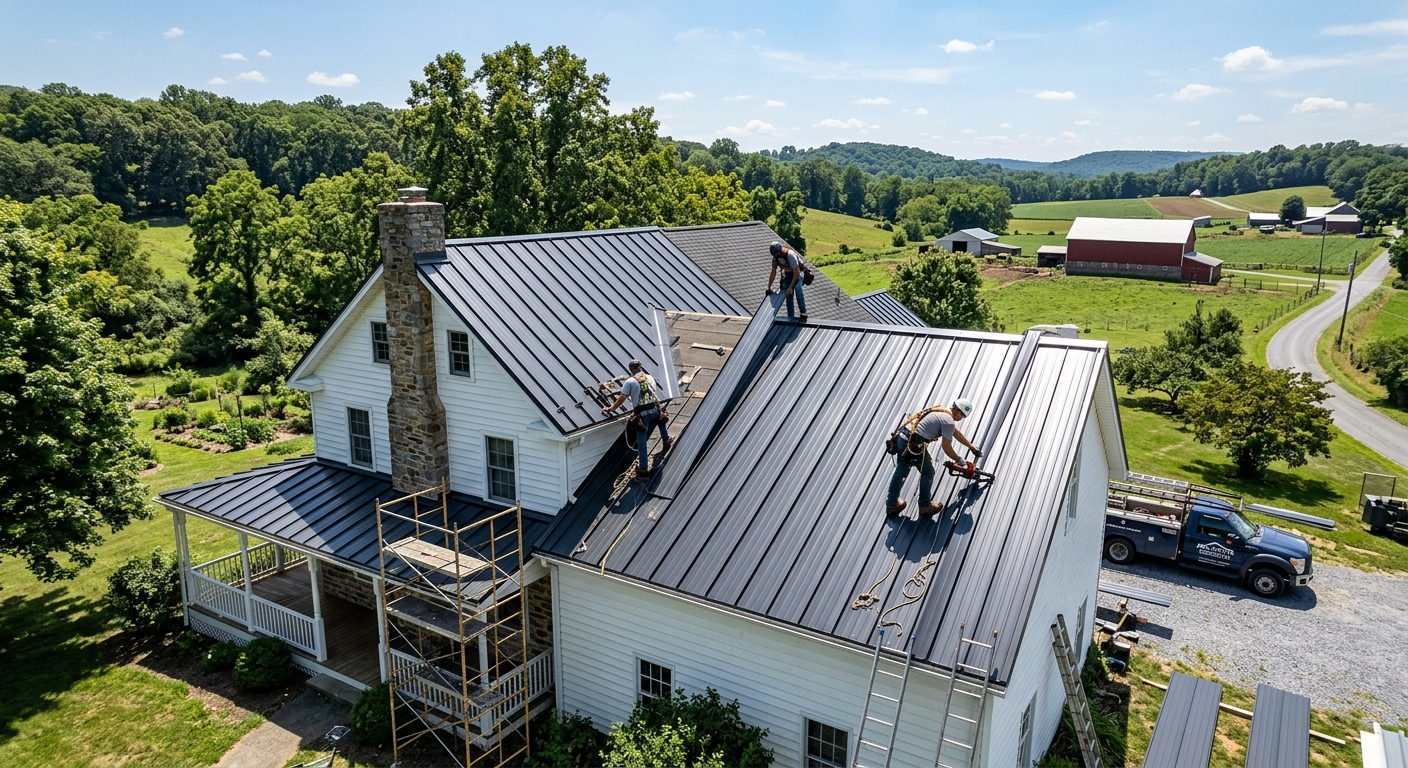
Turtle Creek roofing prices by material and scope — 2026
Turtle Creek homeowners face a specific set of roofing realities. Most homes here were built before 1980, and almost half are single-family houses (U.S. Census Bureau, ACS 2024). That means original roofs have long since reached the end of their intended lifespan, and every replacement tends to uncover older problems—not just with shingles, but with the wood deck below. Turtle Creek sits in Allegheny County, where much of the housing stock dates from 1900–1950, so it’s common for replacements to require extensive tear-off and structural repair as part of the job. This adds not just labor but material cost, especially when rotted sheathing comes to light. Homes here are typically capped with architectural asphalt shingles, the norm for this part of the county thanks to their balance of price and performance in freeze-thaw weather and against storm tracks common to the area. For flat roofs—often found on additions, porches, and some rowhouses around Turtle Creek—membrane systems like TPO or EPDM are necessary due to local drainage and slope challenges, and these jobs fall in a higher cost band due to specialized installation. Metal is less common but worth considering if you want longevity through the cycles of Western Pennsylvania weather, though it involves a larger upfront investment. For homeowners seeing isolated leaks or damage from windblown debris, minor repairs can often extend the life of your roof before a complete replacement is needed, but patchwork can only go so far once the underlying substrate starts to fail.
| Material / Scope |
Lifespan |
Best for |
Price range (installed) |
| Asphalt shingles — architectural (30-yr) |
25–30 yrs |
Most Turtle Creek homes |
$8,900–$19,000 |
| Asphalt shingles — impact-resistant (Class 4) |
30+ yrs |
Hail/wind exposure, heavy tree cover |
$14,500–$19,000 |
| Metal standing seam |
40–70 yrs |
Long-term owners, low maintenance |
$21,500–$38,500 |
| Flat roof — TPO or EPDM |
15–25 yrs |
Flat porches, low-slope additions |
$11,500–$22,500 |
| Roof repair — leak or isolated section |
n/a |
Patching storm or age damage |
$475–$1,800 |
Prices are estimates for a typical Turtle Creek home and vary with roof size, pitch, decking condition and material selection.
Pennsylvania code and Allegheny County permit rules for roofing
Pennsylvania regulates roofing work under the Pennsylvania Uniform Construction Code (UCC), which is based on the IRC. This code governs how roofing replacements and repairs are performed statewide, but enforcement is handled locally. In Allegheny County—and specifically in Pittsburgh, which is the county seat—the Department of Permits, Licenses, and Inspections enforces building and roofing code provisions across the county. For Turtle Creek homeowners, a permit is typically required when replacing over 50% of your roof’s area in Pittsburgh. This means that if you’re undertaking a full roof replacement, you’ll likely need a permit, but like-for-like shingle repairs under a small area threshold usually don’t require one.
For contractor credentials, Pennsylvania requires Home Improvement Contractor (HIC) registration for any contract over $500. Homeowners can and should verify this registration through the state’s online system at hic.attorneygeneral.gov. Any professional roofer should provide their registration number for your inspection—don’t take their word for it. Insurance is just as critical: workers’ compensation coverage is mandatory for every roofing contractor employing workers in Pennsylvania, and you can verify the coverage status at WCAIS (wcais.pa.gov). Pennsylvania does not require trade-specific roofing licenses, but the HIC registration and proper insurance are non-negotiable, especially since your consumer protections under the Home Improvement Consumer Protection Act kick in above the $500 threshold, including required written contracts and your three-day cancellation right.
TPO and EPDM on Turtle Creek homes
Many Turtle Creek homes have a flat or low-slope section—a porch roof, a sunroom, or the back of a rowhouse. These areas cannot be roofed effectively with standard asphalt shingles. Shingles are designed for steep slopes; when installed on anything less than about 3:12 pitch, water doesn’t shed fast enough and can back up under the seams, leading to quick leaks and rotten decking. Flat or low-slope roofs here face added risk from ponding water, especially with our freeze-thaw cycles and clay-heavy soils preventing perfect drainage. That’s why single-ply membranes like TPO and EPDM are the standard: they’re fully adhered or mechanically fastened, form a continuous waterproof barrier, and perform far better in standing water than any shingle could.
Membrane lifespan does trail behind the steeper parts of your roof, with a typical TPO or EPDM installation in this area lasting 15–25 years—not bad given the abuse from southwestern Pennsylvania storms. You can expect a full flat roof membrane replacement to run between $11,500–$22,500 depending on the size and accessibility. If a roofer suggests shingles on anything flatter than 2/12 pitch, be cautious: they’re signaling unfamiliarity with code and standard practice in our county. Always insist on the right system for the right part of your house.
Reading the warranty on a Turtle Creek roof
Most Turtle Creek homeowners muddle contractor and manufacturer warranties—sometimes intentionally, sometimes not. Here’s the difference: manufacturer warranties strictly cover material defects, such as premature granule loss or shingle splitting, and are almost always prorated. That means your coverage value drops each year, and transfer at resale is only valid if you register promptly and follow all manufacturer protocols (sometimes as tight as 60 days after installation). Manufacturer warranties can be voided if your new roof is layered over an old one (never smart on Turtle Creek’s older wood decks) or if the attic is poorly ventilated, which is a bigger concern here due to freeze-thaw cycles driving condensation issues.
Workmanship warranties are a promise from your contractor to fix installation errors. These are only as reliable as the company’s ability to survive—the flashiest 25-year warranty from a two-year-old company is ultimately less valuable than a well-established local outfit’s 10-year coverage. In Allegheny County, continuity matters. Most reputable roofers provide clear written terms: look for separate documents for materials and for labor. If a contractor will transfer a workmanship warranty to a new owner, clarify if it requires a transfer fee or notification. Don’t rely on handshake promises or over-the-phone guarantees, and remember that many loopholes exist—non-registration, additional rooftop work, or improper attic conditions can all void your coverage.
How to vet a Turtle Creek roofing contractor
Start vetting any Turtle Creek roofer by confirming their Home Improvement Contractor (HIC) registration through hic.attorneygeneral.gov. This is legally required for any roofing job over $500. Next, insist on proof of workers’ compensation coverage—don’t accept a copy of a certificate alone; use the WCAIS system yourself at wcais.pa.gov for real-time verification. Always ask for a detailed written contract, which is mandatory above $500 under the Home Improvement Consumer Protection Act, and don’t sign anything if the contract is incomplete or missing critical details.
- Confirm current HIC registration at hic.attorneygeneral.gov
- Verify workers’ compensation at wcais.pa.gov
- Request proof of liability coverage (original documents, not photocopies)
- Review the written contract for pricing, scope, and timeline
- Ask for references from recent Allegheny County jobs
- Check years in business and physical address in the county
- Compare warranty documents—manufacturer vs. workmanship
- Visit an active or completed job if possible
- Talk through the payment schedule—deposit, milestones, completion
- See itemized quotes, not lump sums
- Check for membership in a recognized industry group or supplier
Red flags in Turtle Creek’s saturated contractor market: door-knocking after storms; pressure to sign on the spot; refusal to provide HIC or insurance proof; quotes far below the $8,900–$19,000 band; or using a local-sounding name but no local address. These are common here and worth walking away from.
Filing a roof claim after a Pennsylvania storm
If a storm has damaged your Turtle Creek roof, start by taking clear, dated photos from the ground and inside your attic—before any temporary repairs. This creates the best record for your insurer. Next, contact your insurance company and ask for their process regarding the scope of loss. Be sure you receive a detailed written scope from the adjuster—the insurance company’s representative—before any major cleanup or repair work begins.
Understand your policy: ‘actual cash value’ pays only for the depreciated roof, while ‘replacement cost’ policies cover full roof costs minus your deductible. It’s routine for an adjuster to visit and inspect damage before approving claims. Don’t be tempted by a contractor offering to “waive” or “cover” your deductible—a practice prohibited by Pennsylvania law. If anyone promises this, find another roofer; the Home Improvement Consumer Protection Act is explicit about not allowing consumers to avoid their deductibles.
Keep your written contract above the $500 threshold for legal protection, and use your three-day right of cancellation if you feel pressured. Don’t authorize permanent repairs until you’re satisfied with the insurer’s scope and price band—your portion on a full replacement is almost always just your deductible, and repairs can range from $475–$1,800 for emergencies up to full replacements at $8,900–$19,000. Documentation, patience, and reputable help give you the best chance at a smooth claim process in Allegheny County.
How to compare roofing quotes in Turtle Creek
Comparing roofing estimates in Turtle Creek isn’t just about the total—it’s about the details each quote provides. A solid estimate lists roof area as squares (one square is 100 sq ft), states the pitch (steepness), and spells out the type of shingles or membrane being installed. Tear-off and disposal should be itemized: Allegheny County’s older homes often mean two or more layers must be removed, so you need to see the number of layers and whether dumpster service is included. Underlayment should be specified by product and coverage, and ice and water shield (needed by code along eaves) should have height indicated, not just a blanket mention.
If the quote is vague—“30 squares, all labor and material”—it’s hiding crucial information about what’s actually being done and what you’re really getting for your money. Decking replacement (needed often on homes built before 1950 in Turtle Creek) must be included as a price per sheet contingency. Warranty coverage needs separating: workmanship in years and any manufacturer’s coverage, ideally in different sections of the quote. Payment should be staged, never front-loaded. You gain real leverage by asking for this level of breakout before signing.
| Line item |
What to look for |
Red flag if… |
| Roof area |
stated in squares, with pitch |
no measurement given |
| Tear-off and disposal |
number of layers, dumpster included |
bundled into one figure |
| Underlayment |
product type and coverage |
listed only as 'felt' |
| Ice and water shield |
coverage height at eaves |
omitted entirely |
| Decking |
per-sheet contingency price |
no allowance at all |
| Warranty |
workmanship years stated separately |
only the shingle warranty |
| Payment |
deposit under 15%, balance on completion |
large upfront cash |
Frequently asked questions — roofing in Turtle Creek
How much does it cost to repair a roof leak in Turtle Creek?
For Turtle Creek homes, repair costs depend on whether you’re looking at one active leak or a bigger underlying issue. Most isolated roof repairs—for example, patching around a chimney flash or fixing a torn shingle section—land between $475–$1,800. Older homes in Turtle Creek, often built before 1950, frequently have additional decking problems or water intrusion that might push you into the higher end of that band. Many contractors here charge within this range for jobs that can be diagnosed and fixed in one day with standard materials. If your quote is much higher, ask exactly what’s driving it—sometimes a repair crosses into partial replacement territory with wider damage. Always get a written scope of work and check for hidden costs, especially if your home has a history of leaks or vent issues.
Do I need my own inspection before the adjuster visits?
If you’ve filed an insurance claim after a storm in Turtle Creek, consider having a reputable local roofer do a quick pre-inspection before the adjuster arrives. While not required, this can help you understand what the adjuster should look for—and whether your damage is merely cosmetic or could reach the full replacement threshold of $8,900–$19,000. Many older Turtle Creek homes (nearly all built before 1980) have subtle damage that adjusters unfamiliar with Allegheny County roofs might miss, such as compromised felt, flashing rot, or layered shingles. A roofer’s inspection gives you a second opinion, arms you with questions, and may uncover code issues relevant to your policy. You’re never required to hire for this, so don’t pay unless complex access or reports are needed.
Does attic ventilation matter in Turtle Creek's climate?
Yes, attic ventilation is crucial for Turtle Creek roofs. In southwestern Pennsylvania, freeze-thaw cycles are tough on houses built before 1980, and nearly all Turtle Creek roofs fall in this category. Poor ventilation leads to trapped moisture, which can rot decking and shorten shingle life. It's also a common cause of warranty denial—manufacturer warranties on new installations in the $8,900–$19,000 range often require proof of adequate venting before they'll cover defects. Look for a quote that adds soffit and ridge venting or box vents if your attic space is stuffy or shows moisture signs. While you won’t see an instant payoff on utility bills, good airflow can easily prevent the kind of damage that becomes expensive down the line.
Why is my Turtle Creek roofing quote higher than the online average?
Online “average roof cost” numbers rarely match reality in Turtle Creek. For one, almost all homes here predate 1980 and have been reroofed—sometimes layered, sometimes on top of worn deck boards. Tear-off and decking repairs drive up roof costs locally, as does the need for full code-compliant ice/water barrier coverage. Expect a total architectural shingle job, including tear-off and new underlayment, to run between $8,900–$19,000. That’s higher than the national average, but local conditions and Pittsburgh-area labor mean you’re paying for a thorough, code-compliant job on an older structure. Low-ball quotes may skip key steps—like replacing rotten wood—which always proves more expensive down the line.
How do I find a reputable roofer in Turtle Creek?
Start by verifying the roofer’s Home Improvement Contractor (HIC) registration at hic.attorneygeneral.gov—this is required for any job over $500. Then check insurance (liability and workers’ compensation via wcais.pa.gov). Ask for references from jobs right here in Allegheny County, and vet them by visiting a current project or reviewing photos. Avoid storm-chasers and anyone who knocks unsolicited on your door after wind or hail; the saturated Pittsburgh-area market means trustworthy contractors stand out for their clear documentation and specific, written proposals. For full replacements, your quote should fall in the $8,900–$19,000 (shingles) or $11,500–$22,500 (flat roof) span for proper work. Never pay more than a small deposit up front, and always insist on a written contract with itemized line items.
Are impact-resistant shingles worth it in Turtle Creek?
Impact-resistant Class 4 shingles are a smart upgrade for parts of Turtle Creek exposed to tree limbs, windblown debris, or occasional hail brought by Ohio Valley storms. They cost more—expect full replacements with these shingles to run $14,500–$19,000—but they can minimize repairs, prolong roof life, and may even shave a bit off your insurance premiums (check your carrier to confirm). Keep in mind, though, that impact resistance focuses on obvious blows; it won’t help with underlying decking issues common in older Turtle Creek homes. If your house is heavily shaded or surrounded by large trees, or has a history of storm damage, it's well worth considering as part of your reroof plan.
How do I know if my Turtle Creek roof needs replacing?
Telltale signs your Turtle Creek roof is at the end of its life: frequent leaks even after repairs, granules clogging gutters, sagging or dips, and visible daylight in the attic. On homes built 1900–1950, deck rot and shingle cupping are extra common. If a pro quotes repeat repairs above $1,800 in a single season, you’re probably better off investing in a full replacement—especially since isolated fixes won’t address underlying wood damage. Have a contractor pull back a few shingles to spot soft or water-stained decking. Also, if your roof was last replaced before 2000 and you see curling on the south side, it’s time to budget for a new system within the $8,900–$19,000 range for architectural shingles.
Are there historic district rules affecting roofing in Turtle Creek?
There are no specific historic district rules listed for Turtle Creek in the current Allegheny County code facts, so standard Pennsylvania Uniform Construction Code (UCC) applies for most replacement jobs. That’s fortunate: you won’t face extra approval steps or limitations on architectural shingle color or profile, which are common in classified historic districts. Still, since a huge share of Turtle Creek homes were built before 1950, some houses may have details that neighbors or block associations like to keep visually consistent. Always check with your local borough office before choosing non-traditional materials or colors, but for most homes, you can proceed within the $8,900–$19,000 range for a full asphalt shingle roof without any historic restriction headaches.
How long does a roof replacement take in Turtle Creek?
Most Turtle Creek roof replacements are completed in one to three days for single-family homes using architectural shingles. Timeline depends on roof size, pitch, and the amount of deck repair needed—a common issue in homes built before 1980. If tear-off reveals extensive rotten wood, plan for an extra day and a higher final cost (still within the $8,900–$19,000 band for standard shingle jobs). Flat roofs or complicated builds may stretch to four or five days, especially if weather interrupts. Reliable crews in Allegheny County rarely leave a jobsite open overnight without full waterproofing, so you shouldn’t see weeks-long projects unless serious structural surprises turn up. Ask your contractor for a written start/finish window in your agreement to keep everyone accountable.