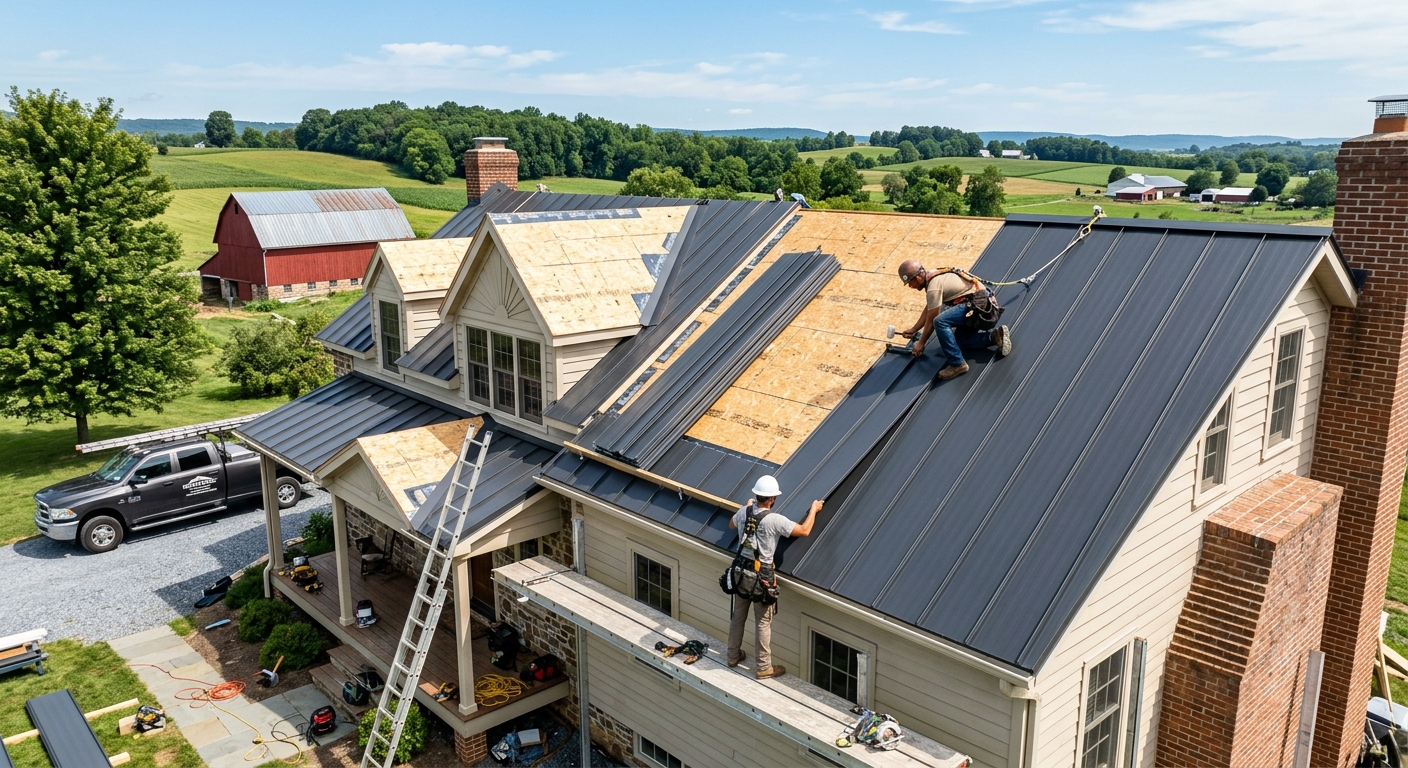
Roofing Replacement & Repair costs in East Brandywine — 2026
Roofing work in East Brandywine comes with its own cost realities driven by the area’s housing age and homeowner priorities. With a high percentage of owner-occupied, single-family homes and a median household income of $163,750 (U.S. Census Bureau, ACS 2024), there’s strong demand for quality roofing and an expectation of durable materials and workmanship. Extensive neighborhoods developed between the 1970s and 1990s in nearby West Goshen and Uwchlan now have shingles and underlayment reaching the end of their service lives. For East Brandywine homeowners, this means most replacement projects involve not just swapping shingles but addressing worn-out flashing, underlayments, and sometimes repairing the roof deck itself—all in one scope.
Recent cost inflation and saturated contractor demand across Chester County—spurred by aging developments and repeated storm events, especially along ridges—mean prices are neither bottom-dollar nor inflated beyond what the market demands for professional labor. Below is what you can expect to pay for key roofing services and materials on a typical home here—where most roofs are pitched and sized in the 2,000–3,500 square foot range and have some degree of accessibility for equipment.
| Material / Scope |
Lifespan |
Best for |
Price range (installed) |
| Asphalt shingles — architectural (30-yr) |
25–30 yrs |
Suburban homes, HOA-compliant roofs |
$12,000–$25,000 |
| Asphalt shingles — impact-resistant (Class 4) |
30+ yrs |
Storm-exposed ridges, hail-prone zones |
$19,500–$25,000 |
| Metal standing seam |
40–70 yrs |
Longevity, low maintenance, select custom homes |
$29,000–$51,500 |
| Flat roof — TPO or EPDM |
15–25 yrs |
Porches, additions, low-slope sections |
$15,000–$30,000 |
| Roof repair — leak or isolated section |
n/a |
Quick fix, isolated damage on sound roof |
$650–$2,400 |
Prices are estimates for a typical East Brandywine home and vary with roof size, pitch, decking condition and material selection.
Roofing permits in East Brandywine: what you need before work starts
In East Brandywine, the rules about roofing permits draw directly from the Pennsylvania Uniform Construction Code (UCC), which is based on the IRC. The actual code authority is the PA Department of Labor & Industry, but municipalities enforce the code unless they've opted out. In practice, this means that for a full roof replacement involving structural deck repair, you’ll often need a building permit—especially if your home is within the jurisdiction of West Chester Borough. Routine like-for-like shingle repairs under one square, on the other hand, are generally performed without a permit in the borough and typically follow suit in the surrounding townships.
To protect yourself and your investment, always verify that your roofing contractor holds a valid Pennsylvania Home Improvement Contractor (HIC) registration. This is mandatory for contracts over $500. The registration status can be checked at hic.attorneygeneral.gov. In addition, every contractor employing workers must maintain workers' compensation coverage—this is Pennsylvania law—and you can verify their coverage by searching the WCAIS system at wcais.pa.gov.
Getting these documents up front does more than just tick a box: unregistered or uninsured crews open you up to liability and can jeopardize claims or warranties. When in doubt, ask for the paperwork—and check it against official registries rather than taking a business card at face value.
Water management on a East Brandywine roof
On East Brandywine homes, the roof, gutters, downspouts, and yard grading must all work together to keep water away from the foundation. When replacing a roof, skipping the gutters is a false economy—cracked, undersized, or mis-pitched gutters can overwhelm even a brand-new shingle system and quickly lead to water pooling near foundation walls. This is especially true in our local subdivisions, where downspout discharge too close to the house is a major culprit for damp basements and even minor flooding.
Many roofing warranties in our area require continuous, properly sized gutters and tight-fitting drip edge to function as intended. If the installer sees gutter systems that are rusted through or poorly sloped, expect them to recommend replacement: typically adding $1,900–$3,500 for standard aluminum systems, including new downspouts and basic guards. Higher-end gutter guards can add another $950–$1,500 depending on roof size and debris load in your tree canopy.
Without managing where roof runoff lands, you’re solving only half the problem; the rest could appear as water marks in the basement—often long before you notice a shingle out of place.
Roofing season and lead times in Chester County
Chester County's roofing season runs from late March into early November. In East Brandywine, architectural shingles need warmer days (ideally above 40°F) to bond properly, so most replacements are scheduled between April and October. Cold snaps in early spring or late fall can delay full tear-offs, and even emergency repairs may rely on tarping when temperatures fall below the safe range for adhesives.
The saturated Philadelphia metro roofing market means that even with plenty of contractors based in or near West Chester, lead times for full roof replacements can reach three to six weeks in peak season (May through September). Emergencies—like a major ridge-line wind event—will push prices up and can bump regular jobs down the waiting list. An emergency repair in February, when crews may be mobilized for snow and ice issues, often costs more than a scheduled replacement, both in direct labor and in the difficulty of working cold, short days. Plan ahead: September is when crews are at their busiest, with homeowners rushing to get roofs on before winter, but late spring and early summer often let you book the best teams with minimal delay.
Repair or replace? A decision guide for East Brandywine roofs
East Brandywine’s housing stock is dominated by homes built from the late 1970s through the 1990s. In practical terms, most asphalt shingle roofs here are now 25–45 years old—pushing the upper range where repairs are a sound investment. If your roof is under 15 years and has a single, isolated leak (such as from a missing shingle around a vent), a targeted repair is reasonable and typically runs $650–$2,400. But if you’re patching multiple trouble spots on a roof installed before 2000, you’re likely pouring money into a system that will keep failing. Three repairs at $1,500 each quickly add up to $4,500, which is a significant fraction of a full roof replacement in the $12,000–$25,000 range common in East Brandywine.
Severe storm damage (from wind, hail, or a major coastal storm remnant) often warrants a replacement due to the risk of hidden failures and insurance criteria for payout. Flat roofs showing ponding or blistering on additions or low-slope sections should not be repeatedly patched; full membrane replacement in the $15,000–$30,000 range gives peace of mind and fixes latent issues. And if you’re heading into winter with an active leak, invest in an emergency repair but don’t put off planning for a full replacement—continuous water intrusion is a recipe for interior damage and mold.
| Situation |
Recommendation |
Typical cost |
Reasoning |
| Under 15 years, one isolated leak |
Repair |
$650–$2,400 |
Roof system still in serviceable shape, isolated issue |
| 15–25 years, several leak points |
Replace |
$12,000–$25,000 |
Patching becomes recurring; underlying wear widespread |
| 25+ years, any active leak |
Replace now |
$12,000–$25,000 |
Material at end of life; repairs rarely last |
| Storm damage, wind or hail |
Document, claim, replace |
$12,000–$25,000 |
Replacement often meets insurer, code, and warranty requirements |
| Flat roof ponding or blistering |
Replace membrane |
$15,000–$30,000 |
Patching unlikely to resolve source of issue; start fresh |
| Active leak entering winter |
Emergency repair, schedule replacement |
$650–$2,400 |
Prevent interior and attic damage; plan for spring install |
How southeastern Pennsylvania's weather shapes roofing here
Chester County’s central corridor, including East Brandywine, sits along the South Valley Hills and Chester Valley—both known for wind events and spillover storms from the coast. These ridge-lines funnel wind that can lift shingles, break tabs, and drive rain horizontally under laps in the roof system. Even shingles that don’t blow off may suffer from wind-driven “ratcheting,” which bends and weakens the material with every gust, translating to repairs or full replacements in the $12,000–$25,000 range when enough of the field is affected.
The region sees a ground snow load of 30 pounds per square foot, which is enough to test older, low-profile roofs but not enough to demand heavy ice-and-water shielding across every square inch (as is required further north). Still, the 14°F winter design temperature plus moderate freeze-thaw cycles can form ice dams at the eave if the attic isn’t ventilated—a ridge of ice builds, water pools above it, and eventually pushes under shingles into the house. Repairing ceilings and insulation after a melt costs much more than proactive underlayment and adequate ventilation during roof replacement.
When coastal storms throw hail across the county, many architectural shingles survive without a puncture but still suffer from bruising—localized compression of the mat, which can go unnoticed until leaks appear months later. Impact-resistant Class 4 shingles can help, but swapping damaged slopes after a storm often means full replacement is the only reliable fix with local crews charging $12,000–$25,000. Every one of these mechanisms shows up as a predictable line item in East Brandywine’s roofing invoices—and each has a distinct, local cause.
Decking, ventilation and flashing — the hidden roof costs
In East Brandywine, most roofing quotes target material and basic labor—but the surprises come once the old roof is stripped. With nearly four in ten homes built before 1980, rot or delamination in the roof decking is not rare. Every sheet replaced typically adds $400–$800 per 4x8-foot panel, sometimes more if the rot extends beyond a simple patch.
Attic ventilation is often inadequate, especially on houses built before continuous ridge and soffit venting became standard in the 1990s. In southeastern Pennsylvania, poor ventilation drives up attic temperature in the summer (cooking shingles from beneath) and encourages ice damming in winter. If your roofing contract skips over ventilation, ask: a proper vent ridge averages $800–$1,600 installed, but saves you from warranty headaches and early shingle failure.
Flashing—the thin metal at all roof-wall intersections, chimneys, and valleys—is another price wild card. On older homes, it’s almost always worth spending $650–$1,900 to replace rather than reuse rusty or improperly lapped flashing. Vent boots and drip edge are smaller line items ($300–$700 per system), but skipping them is a false economy; water will find every shortcut nature allows. Ask any Chester County roofer: attic leaks after a new roof are most often a ventilation, flashing, or boot issue, not poor shingle installation.
Frequently asked questions — roofing in East Brandywine
How do I verify a roofing contractor is registered in Pennsylvania?
Homeowners in East Brandywine should always verify a roofer’s Pennsylvania Home Improvement Contractor (HIC) registration. This registration is required for any job over $500 and is the state’s mechanism to track insurance, bonding, and consumer protection compliance. You can check a contractor’s active registration at the official public database—hic.attorneygeneral.gov—by searching the business name or HIC number. This site confirms status and complaint history. For further assurance, you can also look up their workers’ compensation insurance coverage under the WCAIS system at wcais.pa.gov. Never take a registration certificate at face value alone: unscrupulous companies sometimes show expired or someone else’s papers. It should take you just minutes, and failing to check could expose you to liability or void eligibility for warranty and recourse. A legitimate roofing crew in East Brandywine won’t mind you double-checking—most will even provide you the necessary links.
How long do architectural shingles last compared to 3-tab?
Architectural shingles, installed throughout East Brandywine’s subdivisions since the 1980s, outlast the bare-bones 3-tab shingles thanks to heavier construction and deeper shadow lines. On average, you’ll get 25–30 years of service from modern architectural shingles (the type priced at $12,000–$25,000 for a replacement), while 3-tab shingles often fail closer to 15–20 years, especially in our area’s wind-prone, moderately humid summers. Most HOA-managed neighborhoods built in the 1970s–1990s mandated architectural products for curb appeal, and it’s rare to find new 3-tab roofs going on today. If your East Brandywine home still has 3-tabs, you’re overdue for a full tear-off—the extra decade of protection and superior performance in storm events more than justifies the upgrade.
How much does a flat roof replacement cost in East Brandywine?
If you have a low-slope or entirely flat roof area—common on porches, sunrooms, or attached garages in East Brandywine—full membrane replacement with TPO or EPDM materials runs between $15,000–$30,000 for most homes. That number covers tear-off, material, flashing, labor, and new terminations at skylights or vertical walls. Labor costs in Chester County remain elevated due to the concentration of skilled contractors who operate from the West Chester area and the consistent demand created by older additions and high-quality housing stock. Patching flat roof leaks seldom provides more than a one- or two-year fix, making full replacement the smart option if the existing membrane is more than 15 years old or showing widespread signs of ponding or blistering.
Do I need my own inspection before the adjuster visits?
While it isn’t required, many East Brandywine homeowners find it beneficial to have a reputable roofer perform a roof assessment before their insurance adjuster arrives. This pre-inspection (typically in the $650–$2,400 repair/assessment fee range if it involves temporary tarping or detailed leak diagnosis) provides documentation—including photos and measurements—establishing the scope and seriousness of damage prior to the insurance review. Local contractors know the telltale signs of storm and wind events along the Chester Valley, and can point out issues that might otherwise be overlooked or dismissed by the adjuster. Ultimately, it puts you in a stronger position for a fair claim, especially if the event that caused the damage was geographically specific or severe.
What does it mean if my shingles are curling or losing granules?
Curling or missing granules on East Brandywine roofs—especially those installed before 2000—typically signal the end of the shingle’s designed life. Granule loss, often visible in gutters or at the drip edge, leaves the underlying asphalt mat exposed to UV damage, accelerating drying, cracking, and water infiltration. Curling shows moisture movement and failed sealant strips, both of which are aggravated by summer humidity and winter freeze-thaw cycles in our climate. At this point, repeated repairs are rarely cost-effective and you’re likely looking at a full reroof in the $12,000–$25,000 range. In the short term, minor repairs can be made, but patching aged or worn-out shingles doesn’t buy much additional life—or resale confidence.
What is the best time of year to replace a roof in East Brandywine?
The best window for roofing work in East Brandywine runs from April through October. During these months, temperatures reliably allow for proper shingle sealing, and local crews are fully mobilized. Planning your project for spring or early summer often means shorter lead times and less risk of weather delays. By September, most local companies—who serve not just East Brandywine but all of the Chester County–West Chester corridor—are booked up, with homeowners rushing to finish before winter hits. There’s nothing wrong with installing in autumn, but avoid late fall if temperatures dip below adhesion standards. Emergency mid-winter jobs cost more and offer fewer scheduling options, with repairs in February commonly running $1,500–$2,400 before a full spring replacement is possible.
What warranty should a East Brandywine roofer offer?
Any reputable roofer serving East Brandywine should offer both a manufacturer’s warranty (typically 25–30 years for architectural shingles in the $12,000–$25,000 price band) and a workmanship warranty, which in this region often runs from five to ten years, depending on the contractor’s track record and written policy. Manufacturer warranties protect against material failures, but are voided by improper ventilation, skipped underlayment, or inadequate flashing—all of which are issues seen locally, especially in homes built before modern code adoption. Always get your warranty terms in writing and ask what specific conditions (attic insulation, continuous ridge/soffit venting) must be met to keep protection valid. Take time to read the exclusions—warranties are only as good as the installer and the paperwork.
Why is my East Brandywine roofing quote higher than the online average?
Out-of-area price calculators often miss local realities. In East Brandywine, quotes for a full architectural shingle replacement regularly fall between $12,000–$25,000, which is higher than "US average" figures you’ll find online. This is driven by both housing size (many 2,500+ sq.ft. homes), deck repair likelihood thanks to 38.5% pre-1980 builds, and higher local labor costs due to Chester County's proximity to Philadelphia’s trades market. Local crew standards, warranty expectations, and required compliance with Pennsylvania Uniform Construction Code all add to honest cost. If your job includes full gutter replacement, new ventilation, and ridge cap systems—as many local homes need—it simply cannot be compared to a basic shingle-over-shingle quote from a generic estimator.
What causes ice dams on East Brandywine roofs?
Ice dams form when warm air leaks into the attic, heating the roof deck and melting snow in the middle of the roof, even while the eaves remain cold. Meltwater then refreezes at the overhang, forming a ridge of ice that traps subsequent runoff, pushing it under shingles and into the attic. Southeastern Pennsylvania’s moderate freeze-thaw pattern and the 14°F winter design temp makes this a recurring worry in East Brandywine, especially on homes lacking modern soffit-to-ridge ventilation. Proper underlayment and air sealing—typically included in replacements in the $12,000–$25,000 range—are the best defense. If you see icicles or ceiling stains, address attic insulation during your next roofing job to prevent expensive interior repair bills in the future.