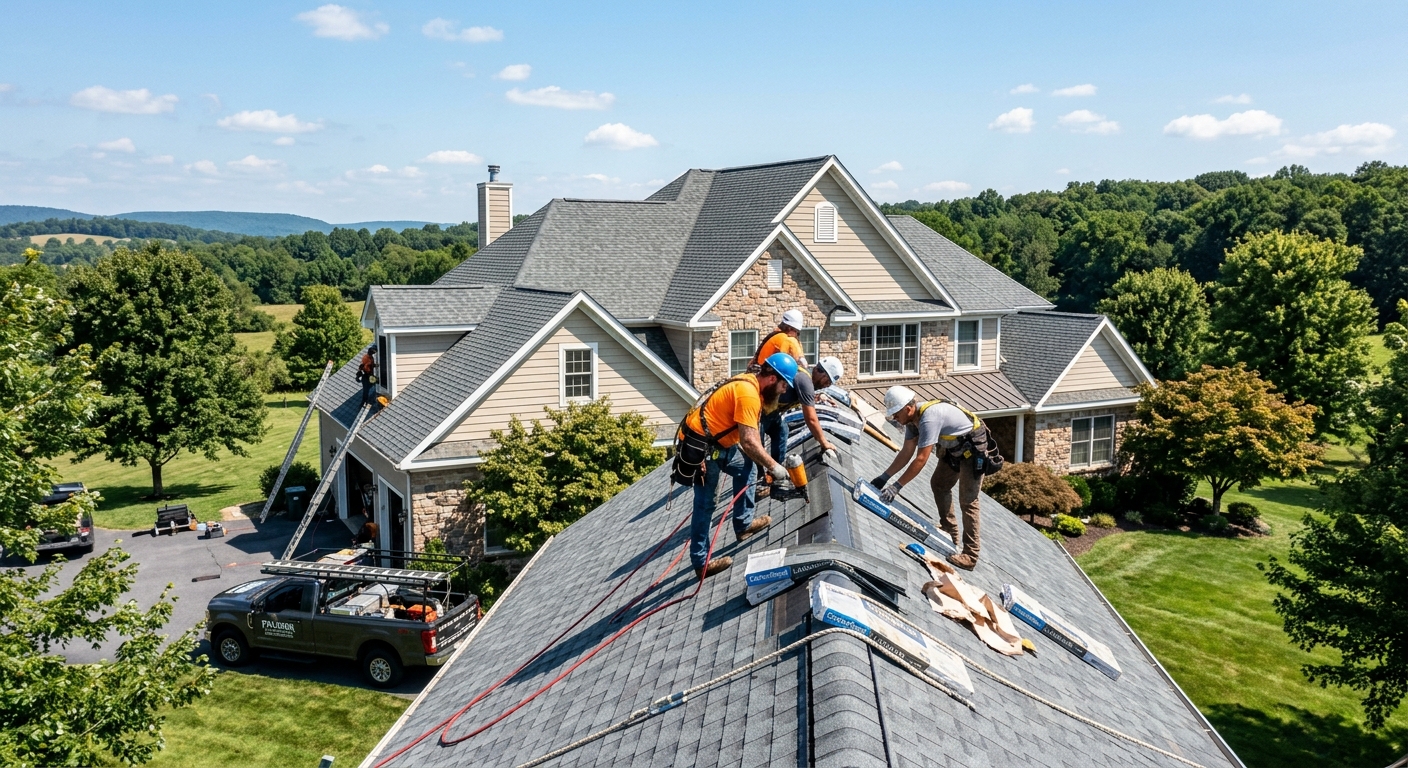
West Vincent roofing prices by material and scope — 2026
In West Vincent, roof pricing reflects a market shaped by high homeownership rates and a preponderance of single-family houses. With 84.1% of the housing stock being single-family homes and a median household income substantially above average (U.S. Census Bureau, ACS 2024), most roofs here are large suburban installations rather than compact urban jobs. Many properties were built in the flush of 1970s–1990s subdivision development, meaning extensive aging asphalt shingle roofs are now reaching end-of-life at once. In practical terms, this creates sizable roof scopes—typically steeply-pitched, multi-plane 2,500–3,500 square-foot jobs, especially in the older pockets of West Vincent and nearby West Goshen. There’s less “patchwork” homeowner work and more full-tear replacements with ice shielding and flashing upgrades.
Asphalt architectural shingles dominate due to decades of HOA standards, but homeowners with higher budgets or a desire to stand out increasingly consider standing seam metal for its 40–70 year lifespan, especially on gabled homes. Flat roofing shows up on home additions and some split-level or contemporary-era builds. Below is a realistic snapshot of current market pricing for installed roof systems:
| Material / Scope |
Lifespan |
Best for |
Price range (installed) |
| Asphalt shingles — architectural (30-yr) |
25–30 yrs |
Suburban tract homes, HOA-compliant replacements |
$12,000–$25,500 |
| Asphalt shingles — impact-resistant (Class 4) |
30+ yrs |
Wind-prone ridges, insurance-driven upgrades |
$20,000–$25,500 |
| Metal standing seam |
40–70 yrs |
High-end upgrades, snow-shedding roofs |
$29,500–$53,000 |
| Flat roof — TPO or EPDM |
15–25 yrs |
Home additions, mid-century splits, contemporary builds |
$15,500–$31,000 |
| Roof repair — leak or isolated section |
n/a |
Spot leaks, post-storm patches |
$650–$2,400 |
Prices are estimates for a typical West Vincent home and vary with roof size, pitch, decking condition and material selection.
Pennsylvania code and Chester County permit rules for roofing
Roofing work in West Vincent falls under the Pennsylvania Uniform Construction Code (UCC), based on the International Residential Code. The Pennsylvania Department of Labor & Industry oversees the code, but enforcement is handled by local municipalities unless a township has opted out. For jobs involving structural deck replacement—typical in older West Vincent homes or in situations of rot—expect your township to require a building permit. However, if you’re just repairing a handful of shingles (under one roofing square), especially with no decking work, this often does not trigger a permit requirement in most Chester County municipalities.
To protect yourself, verify your contractor’s Home Improvement Contractor (HIC) registration via the Pennsylvania Office of Attorney General at hic.attorneygeneral.gov. HIC registration is mandatory for home improvement contracts over $500, which includes all full roof replacements. For workers’ compensation insurance, which is required in Pennsylvania for all employers, you can check their coverage through the state’s WCAIS database at wcais.pa.gov. Never rely on a contractor’s printed certificate—look it up directly, especially if any subcontractors are involved in your roof job.
Contracts over $500 must be in writing and are covered by the Home Improvement Consumer Protection Act, which gives you a three business-day right of cancellation. Be wary of any contractor offering to “waive your deductible”—this is prohibited by state law.
How to compare roofing quotes in West Vincent
To make a smart decision on your West Vincent roofing project, insist on itemized and transparent quotes. Demand that every estimate lists the roof area in “squares” (100-square-foot units) and clearly states the roof pitch—Chester County subdivisions often have 8/12 or steeper slopes, making shortcuts on pitch a red flag. Tear-off and disposal should list the number of old shingle layers and whether a dumpster is provided; this can affect both cost and clean-up in a township with strict disposal rules. Your quote should specify the type of underlayment and ice/water shield, not just generic “felt,” and state exactly how many rows of ice barrier will be used at the eaves (especially given the local freeze-thaw cycle).
Decking is where scope can explode: make sure per-sheet plywood replacement is priced as a contingency, not left vague. Flashings, vent boots, and ridge vent work should be clearly written out. Always separate workmanship and manufacturer warranties—many roofs in West Vincent outlast their labor warranty but are still within the shingle warranty period. Payment structure matters: deposits should stay under 15%, with final payment due at completion, not before. If you only get a lump sum with no square footage or breakdown, you can’t compare quotes—or trust that contractor.
| Line item |
What to look for |
Red flag if… |
| Roof area |
stated in squares, with pitch |
no measurement given |
| Tear-off and disposal |
number of layers, dumpster included |
bundled into one figure |
| Underlayment |
product type and coverage |
listed only as 'felt' |
| Ice and water shield |
coverage height at eaves |
omitted entirely |
| Decking |
per-sheet contingency price |
no allowance at all |
| Warranty |
workmanship years stated separately |
only the shingle warranty |
| Payment |
deposit under 15%, balance on completion |
large upfront cash |
When a West Vincent roof is worth repairing — and when it isn't
In West Vincent, where many roofs went on in the 1980s–1990s building boom, age drives most repair-versus-replace calls. If your roof is under 15 years old and you’ve got a single leak—often from flashing at the chimney or a slipped shingle—a localized repair at $650–$2,400 makes sense. But after 15–20 years, especially if you’re seeing multiple leaks, it’s usually time to replace. Two or three repairs over separate seasons can easily run $4,800–$7,200, which is a third to half the cost of a new architectural shingle roof ($12,000–$25,500), with none of the warranty or resale value. For roofs over 25 years, even a “minor” leak points to system-wide failure—don’t waste money chasing spots.
Storm damage along Chester Valley’s windy ridge lines is almost always handled as a replacement claim, not a long-term repair. Flat roofs with ponding or blistering, common on mid-century additions, should have the membrane replaced rather than patched. And any leak going into winter, especially in a home with attic insulation gaps, should get a temporary emergency fix ($650–$2,400) plus a full replacement on the first dry spell.
| Situation |
Recommendation |
Typical cost |
Reasoning |
| Under 15 years, one isolated leak |
Repair |
$650–$2,400 |
Preserves roof life; localized problem |
| 15–25 years, several leak points |
Replace |
$12,000–$25,500 |
System failure; repairs no longer cost-effective |
| 25+ years, any active leak |
Replace now |
$12,000–$25,500 |
Roof past design life—repairs waste money |
| Storm damage, wind or hail |
Document, claim, replace |
$12,000–$25,500 |
Insurance covers full system; patching is short-term |
| Flat roof ponding or blistering |
Replace membrane |
$15,500–$31,000 |
Ponding signals end-of-life for the membrane |
| Active leak entering winter |
Emergency repair, schedule replacement |
$650–$2,400 |
Temporary measure to prevent interior damage |
How southeastern Pennsylvania's weather shapes roofing here
Central Chester County, including West Vincent, faces a mix of moderate ground snow (30 psf load) and periodic wind events, especially along the South Valley and Chester Valley ridgelines. Ice dams are a recurring risk each winter when snow lingers on the roof, temperatures dip below the 14 °F design temp, and attic heat escapes unevenly, melting snow at the ridge and refreezing at the eave. This freeze-thaw cycle pushes water up under shingles, leading to leaks that don’t appear until the next sunny patch—often after the damage is done. Without a self-adhering ice barrier underlayment at the eaves, a single dam can cause $1,550 or more in ceiling and wall repairs, and repeat events can drive a homeowner straight into a full system replacement at $12,000–$25,500.
The West Vincent area’s frequent coastal storm remnants and ridgeline winds cause wind-driven rain that exploits any weak point in flashing or shingle laps. Here, hail does more than just bruise shingles: impact marks may not leave a visible puncture but still shatter the asphalt mat, leading to early granule loss and hidden leaks over time. Insurance adjusters in Chester County are savvy to these patterns and may approve a replacement within the first inspection if damage is widespread. These distinctive local pressures—snow, melt-back, wind and hail—push most West Vincent homeowners to prioritize upgraded underlayments and heavier-weight architectural shingles, rather than betting on a builder-basic roof to survive the next weather cycle.
When to book roofing work in West Vincent
Roofing season in southeastern Pennsylvania runs from early April to late November. The stretch from May through September offers the best conditions—warmer days allow new asphalt shingles to self-seal, and crews can move efficiently on steep West Vincent pitches. After mid-October, falling temperatures slow down installations and the risk of missed adhesive bonds rises, making it less ideal for fresh installs except in emergencies.
In a saturated contractor market like Chester County, most reputable roofers are fully booked for several weeks during the summer rush—expect a 4–6 week lead time from signed contract to job start in peak season. Emergency repairs (especially from late-winter wind or ice events) often cost more than planned work, sometimes doubling the price of a simple summer repair. That $650–$2,400 patch can climb if you need a tarp or a crew out in freezing rain on short notice. If you want the best selection of installers and straightforward pricing, have your roof inspected and scheduled before school lets out or after Labor Day—before the autumn call volume spikes with those first hard frosts and the HOA notices start rolling in.
What gets discovered after tear-off in West Vincent
One of the most common shocks for West Vincent homeowners after roof tear-off is hidden deck damage—rot around eaves, under skylights, or behind brick chimneys, especially on 1970s–1990s homes that are now seeing their first full replacement. Decking sheets (usually 1/2" plywood) run $150–$250 per sheet installed, and most roofs need at least a couple replaced once old shingles come up. Inadequate attic ventilation is another sleeper issue here: venting blocked by insulation or undersized ridge vents lets heat and moisture build along the roof deck, worsening ice damming and voiding warranties. Upgrading to a continuous ridge vent and adding eave vents can mean another $1,200–$2,500, but it's the only way to break the cycle of mid-winter leaks and early shingle failure in this climate.
Other dollar risks include corroded flashing at brick chimneys and sidewalls ($450–$1,200 to replace), cracked vent boots around PVC stacks ($150–$350 each), and missing drip edge at the eaves—now a must under the Pennsylvania code, but not always installed on earlier jobs. None of these are “upsells,” just facts of working on a 30-year-old roof in Chester County. A thorough pre-job inspection can catch most of these, but budget a 10–15% buffer on your quote for the real West Vincent tear-off surprises. Ridge vent upgrades, flashings, deck repair, and unseen issues under old valley metal separate the bottom-dollar bids from the ones that leave you dry next winter.
Frequently asked questions — roofing in West Vincent
What does roof replacement cost per square in West Vincent?
On typical West Vincent homes, expect a replacement with architectural asphalt shingles to run $600–$850 per square, installed. This pricing accounts for Chester County's prevalent 8/12 and steeper pitches, the need for ice barrier at the eaves due to freeze-thaw cycles, and disposal costs in a well-regulated township. Most local roofs are between 25–40 squares, leading to total replacement costs of $12,000–$25,500. Costs are higher for steep or cut-up roofs with dormers, valleys, or complex lines, as well as for those needing significant plywood replacement after tear-off. Metal and flat roofs have different square pricing and are usually calculated as a system. Don’t rely on “national averages”—this market’s labor and insurance requirements are above the Pennsylvania median.
What causes ice dams on West Vincent roofs?
Ice dams form on West Vincent roofs when snow melts on the upper roof (warmed by sun or attic heat) and refreezes at the colder eave, where the roof sticks out past the wall. This creates a dam of ice that can trap water, which then backs up under shingles and leaks inside. In Chester County, common triggers include poor attic ventilation and insulation gaps—many 1970s–1990s homes here were built with minimal eave venting. The resulting leaks can destroy ceilings and require roof repairs between $650–$2,400, or force you into a full replacement if damage is widespread. Prevention in southeastern PA depends on proper eave ice barrier and an attic that stays cold, not “roof rakes” or salt pucks.
What does it mean if my shingles are curling or losing granules?
Curled or bald shingles on a West Vincent home are early signs of roof failure, especially for architectural shingles past the 20-year mark. Granule loss means the asphalt underneath is exposed to sun and water, leading rapidly to brittleness and leaks. Curling often shows up first on south-facing slopes or along eaves, where sun and freeze-thaw are hardest. In this climate, it typically signals you’ve got 1–3 years or less before leaks begin. At that stage, pouring more money into repairs makes little sense—full replacement with architectural shingles ($12,000–$25,500) or metal is more cost-effective in the long run for West Vincent’s aging subdivisions.
Is ice barrier underlayment required in West Vincent?
Yes, under the Pennsylvania Uniform Construction Code, self-adhering ice barrier underlayment must be installed at the eaves for full roof replacements on sloped roofs. In West Vincent—where rooflines see frequent melt-refreeze cycles and the ground snow load is 30 psf—ice shield is not just best practice but a code requirement. Older homes (pre-1990s) may lack this feature, which is why leaks at the eaves are a leading cause of calls after hard winters. Expect all reputable Chester County contractors to itemize at least 3 feet of ice barrier along eaves in your quote. Skipping this protection can void warranties and will not save much money ($350–$700 of a full job).
How long does a roof replacement take in West Vincent?
Most full asphalt shingle replacements on West Vincent homes take 2–3 working days, including tear-off, repairs, and new installation. Weather is a factor—summer jobs may be interrupted by pop-up thunderstorms, while late fall and winter can add a day due to shorter daylight and slower adhesive set. Flat roof replacements sometimes go faster; complex gables, valleys, or chimney work can add half a day. Scheduling is also a challenge: in Chester County’s saturated market, it may take 4–6 weeks to get on a reputable installer’s calendar during peak season. Emergency replacements (for active leaks) tend to cost more, especially during winter, as premium labor rates or tarping may add to your invoice ($650–$2,400).
What should a roofing quote include in West Vincent?
A proper quote for your West Vincent home details the roof area in measured squares with the actual pitch listed, names the product and manufacturer for shingles, underlayment, and ice barrier, and states how many rows of ice shield will be used along eaves. It should list per-sheet pricing for any decking replacements (typically $150–$250 per sheet), spell out flashing and vent boot work, and separate the manufacturer’s warranty from workmanship coverage. Dumpsters and site cleanup should be included. The payment schedule must show any deposit (usually under 15%) and the balance on completion—be cautious of heavy upfront cash demands. If the quote is just a lump sum with no breakdown, you’re flying blind and can’t compare apples to apples in this market.
Does roof pitch affect the price in West Vincent?
Absolutely. In West Vincent’s subdivisions, steep 8/12, 10/12, and steeper slopes are common and require not just more labor, but extra safety precautions—scaffold, harnesses, and ladder jacks all add cost and slow production. Steeper roofs also create more waste, particularly with cut-up gable and hip lines found on larger Chester County homes. It’s not unusual for a steep roof’s install price per square to land at the top of the regional band ($800–$850), and the risk of hidden scope (like valley flashing and extra underlayment) goes up too. If your quote doesn’t specify pitch, it’s not telling you the real story—or the real cost—for a project here.
Do metal roofs shed snow better in West Vincent?
Yes—standing seam metal roofs are favored by some West Vincent homeowners exactly for this reason. The smooth, painted panels and lack of shingle seams let snow slide off easily, minimizing buildup at the eave and reducing ice dam risk. This is useful on ridge-line homes in Chester Valley, where local wind patterns shove snow into drifts and increase the chance of melt-refreeze. Metal roofs also stand up better to hail, with fewer granule losses or hidden punctures to worry about. The installation cost is higher ($29,500–$53,000), but homeowners value the lower maintenance and peace of mind during Chester County winters.
Can a contractor cover my insurance deductible in Pennsylvania?
No, and it’s a legal issue here. The Pennsylvania Home Improvement Consumer Protection Act forbids contractors from advertising or agreeing to pay, rebate, or absorb your homeowner’s insurance deductible. Any contractor in West Vincent or elsewhere in Chester County offering to “waive your deductible” is violating state law—and almost certainly planning to cut corners elsewhere in your job to cover the difference. Legitimate contractors will give you a detailed invoice and expect you to pay your deductible as part of the insurance settlement. Trying to sidestep this not only risks denied claims, but can also expose you to fraud penalties and undermine warranty coverage. Stick with professional, above-board estimates that reflect the true scope and cost in this market (e.g., $12,000–$25,500 for most full replacements).