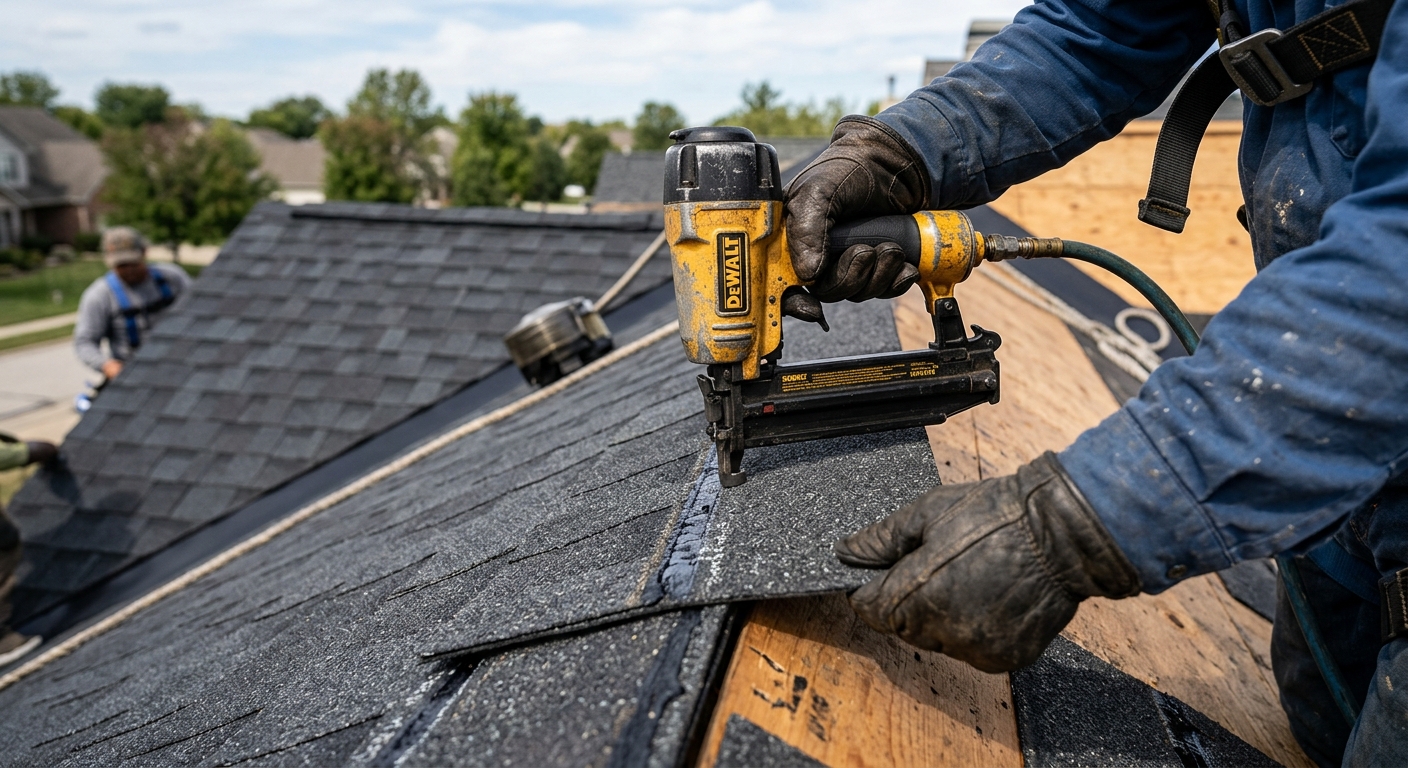
Roofing Replacement & Repair costs in North Huntingdon — 2026
In North Huntingdon, nearly 70% of homes were built before 1980, and almost 90% are owner-occupied (U.S. Census Bureau, ACS 2024), so the roofing market here is dominated by replacements and repairs on old suburban houses. Large tracts from the 1960s to 1980s have now cycled past their original roof and are facing recurring issues tied directly to age, outmoded materials, and insulation gaps. That means many North Huntingdon households are balancing between major re-roofing investments and shorter-term repairs as their asphalt shingles break down.
That suburban development wave in Hempfield and North Huntingdon shaped today’s roof market: most of these homes were roofed first with older 3-tab asphalt, often laid over basic plywood decking and with minimal ice-dam protection. If you live in one of these neighborhoods, you’re likely within your roof’s end-of-life window, especially if the material is still the original or first replacement. As a result, the majority of local projects are full replacements—sometimes after patchwork repairs have stopped being cost-effective. These cycles are typical here, not everywhere.
| Material / Scope |
Lifespan |
Best for |
Price range (installed) |
| Asphalt shingles — architectural (30-yr) |
25–30 yrs |
Pitched, single-family homes |
$9,900–$21,000 |
| Asphalt shingles — impact-resistant (Class 4) |
30+ yrs |
Exposed ridge-line and hail-prone roofs |
$16,000–$21,000 |
| Metal standing seam |
40–70 yrs |
Permanent upgrade, hilltop homes |
$24,000–$43,000 |
| Flat roof — TPO or EPDM |
15–25 yrs |
Porches, additions, low-slope details |
$12,500–$25,000 |
| Roof repair — leak or isolated section |
n/a |
Flashing, pop-outs, storm repairs |
$500–$2,000 |
Prices are estimates for a typical North Huntingdon home and vary with roof size, pitch, decking condition and material selection.
North Huntingdon homes and their roof lines
Most North Huntingdon homes were built in the surge of 1960s–1980s subdivisions, with 70.1% of local housing built before 1980 (U.S. Census Bureau, ACS 2024). That means you’re likely looking at a medium-pitch roof, usually 4/12 to 7/12, typically using plywood decking rather than the plank found in true century homes or the OSB common in newer houses. Asphalt shingles were almost universal, and ice barrier underlayment was not a code requirement in these eras—making eaves more vulnerable to ice dams and water backup.
Many homes from this era still carry their original, or at most a second, layer of roofing. Two layers were often permitted until relatively recently, so a tear-off may reveal both the most recent architectural shingle and, underneath, a tightening, brittle 3-tab. That also means flashing details—wall intersections, roof valleys, and step-flashings—are often original and near the end of their useful life. Decking rot around chimneys or eaves is common where ice or storm leaks went unnoticed for years.
Replacement on a house like this usually brings the first real improvement in underlayment, ventilation, and moisture control since initial construction. Expect that uncovering the decking will reveal some water damage or poorly nailed sections, which is typical rather than the exception in North Huntingdon.
Filing a roof claim after a Pennsylvania storm
If your North Huntingdon home takes wind or hail damage, start by documenting absolutely everything. Don’t clear the debris or haul away shingles until you’ve got photos and videos showing both the overall roof and each problem spot. These records matter when you file with your insurer, who will almost always send a field adjuster to confirm damage. Insist that the insurance company provides you with a written “scope of loss”—it should clearly list every damaged area, what repairs or replacements are needed, and which materials are covered.
Understand what you’re owed: many North Huntingdon homes are insured for “replacement cost value,” but the insurer may issue you a first check for only the “actual cash value” (meaning, the depreciated value of your old roof), with the remainder paid out only after you’ve completed replacement. Make sure your contractor gives you a written estimate that matches the insurance scope, not just a handshake or a napkin number.
A few things to know by Pennsylvania law: for any roof contract over $500, you must have a written agreement, and you get a three-business-day right of cancellation under the Home Improvement Consumer Protection Act. Importantly, it is illegal in Pennsylvania for a roofing contractor to offer to pay or waive your homeowners insurance deductible. Any company proposing this risks your entire claim, and it’s the clearest sign to walk away. Verify these details—no exceptions.
When a North Huntingdon roof is worth repairing — and when it isn't
In North Huntingdon’s subdivisions, deciding whether you should repair or replace comes down to the age of your shingles, the number and location of leaks, and how your roof was built. For homes with an asphalt roof under 15 years old—especially architectural shingles—a single flashing leak or pipe boot failure is a good candidate for a straightforward repair. The typical repair runs between $500–$2,000. But if your roof is pushing 20 years (which many are), and you’re patching more than one leak, you’re creeping up toward the cost of a new roof and still chasing old material.
For example: two repairs at $1,250 each will set you back $2,500, before you’ve touched decking or flashing. A full architectural shingle replacement averages $16,000—but buys you 25–30 years of peace and upgraded moisture protection. If your roof is over 25 years old, especially if it’s already got two layers, replacement is the clear choice. Storm or hail damage is another situation where insurance may cover replacement, not repairs. For flat roofs—especially with visible blistering or ponding—membrane replacement at $12,500–$25,000 is more economical long-term than piecemeal patches.
| Situation |
Recommendation |
Typical cost |
Reasoning |
| Under 15 years, one isolated leak |
Repair |
$500–$2,000 |
Material still viable; targeted repair lasts |
| 15–25 years, several leak points |
Replace |
$9,900–$21,000 |
Multiple weak spots signal end of lifespan |
| 25+ years, any active leak |
Replace now |
$9,900–$21,000 |
Patching is wasted money at this age |
| Storm damage, wind or hail |
Document, claim, replace |
$9,900–$21,000 |
Insurer usually covers full roof |
| Flat roof ponding or blistering |
Replace membrane |
$12,500–$25,000 |
Patches rarely last; membrane failure is progressive |
| Active leak entering winter |
Emergency repair, schedule replacement |
$500–$2,000 |
Stop leak, prevent ice damage, then re-roof |
Low-slope and flat roofs in North Huntingdon
With so many homes in North Huntingdon sporting rear additions, porch roofs, or garage aprons, flat and low-slope roofing is a common sight here. The key difference: if the pitch is below about 3/12, asphalt shingles simply don’t shed water fast enough—leading to seepage, ice damming, and chronic leaks. On a low slope, standing water can back up under the shingles. That’s why porch and addition roofs here last much longer with a membrane like TPO or EPDM, which handles ponding and pushes water toward the gutter instead of letting it sit.
Shingles installed on flat or near-flat surfaces in this area are a red flag: it means the roofer has ignored manufacturer guidelines and best practices for southwestern Pennsylvania’s freeze-thaw cycles. A properly installed membrane will deliver 15–25 years of service, while patchwork shingle jobs often need attention by year five. The price for a full membrane replacement in North Huntingdon runs $12,500–$25,000 for a standard residential setup. Spend the money once, not every spring.
Pennsylvania code and Westmoreland County permit rules for roofing
In Westmoreland County and North Huntingdon Township, roofing jobs fall under the Pennsylvania Uniform Construction Code (UCC), which is based on the International Residential Code. Permits are required for roof replacements, especially if you’re changing the roof deck or structure, or switching materials. Local municipalities—like North Huntingdon Township—issue permits and enforce the UCC; if a township opts out, enforcement falls to the PA Department of Labor & Industry.
To protect yourself, verify your contractor’s Home Improvement Contractor (HIC) registration with the Pennsylvania Office of Attorney General at hic.attorneygeneral.gov—this is required for any contract over $500, including nearly all roofing projects. Always ask to see up-to-date workers’ compensation insurance and double-check its validity using the WCAIS platform (wcais.pa.gov). Insurance and registration are both mandatory in Pennsylvania, and you should avoid anyone who can’t produce documentation.
What North Huntingdon's climate does to a roof
North Huntingdon sits squarely in the Ohio Valley wind and hail corridor, meaning our roofs see more physical abuse than those just east or south of here. With a ground snow load of 30 pounds per square foot and winter lows designed for 8°F, roofs in this county are built to handle snowpack that arrives quickly and can stick around for weeks. That load compresses older 3-tab shingles, especially on ridge lines and exposed neighborhoods. When warmth from an attic melts bottom-layer snow, the runoff refreezes at the cold eave—a classic “ice dam.” Without a proper ice-and-water barrier (missing from most 1960s–1980s installations), meltwater works under the shingles, soaking the plywood.
Hail—common here during spring and summer—can blunt and bruise architectural shingles. Even when there are no outright holes, bruises crush the mat of the shingle, cutting years off its life. We see many North Huntingdon replacements paid by insurance not because of gaping holes, but because enough bruised shingles appear after a storm to void the manufacturer’s wind or algae warranty. The cost: premature replacement at $9,900–$21,000, well ahead of expectancy, or an endless patch cycle.
Hilly terrain compounds runoff, so guttering and downspout strategy is more critical here than in flatter suburbs—if water consistently overshoots, even the best shingles won’t keep your roof deck dry for long.
Frequently asked questions — roofing in North Huntingdon
What if my insurer denies my roof claim?
The reality for North Huntingdon homeowners is that not every insurance claim gets approved, especially if your roof is considered old or if damage is labeled as “wear and tear” instead of a sudden event. If you believe your claim was unfairly denied, request the full written justification and the photos or inspection reports used in the decision. A reputable local roofer can review the adjuster’s findings and identify whether damage from hail or wind is visible and documentable, which is common in Westmoreland County’s wind corridor. If your roof’s age is within the policy’s limits, but the insurer is resisting, you may need to bring in a public adjuster or file a claim appeal. The out-of-pocket cost to replace an asphalt shingle roof here averages $9,900–$21,000, so vet every decision carefully before giving up your claim rights.
How much does it cost to repair a roof leak in North Huntingdon?
For most single-leak repairs—like swapping out a damaged pipe boot or replacing a bit of flashing—you’re looking at $500–$2,000 in North Huntingdon. The wide range depends on access, steepness, and whether decking underneath is rotted. Costs here are driven up in part because so much of the housing stock is now well past its first roof and original flashings, so “a simple repair” can open a bigger can of worms. If you’re quoted well above this price range for a straightforward asphalt patch in this market, ask for a line-item breakdown or a second opinion.
Is a sagging roof line an emergency?
A mild roof dip or “swayback” is not uncommon in older North Huntingdon homes, especially if the structure dates to the massive 1960s–1980s build-out and decking has never been replaced. If the ridge is just a little wavy and shingles are intact, it isn’t an immediate emergency, but visible sag backed by leaks means moisture and possible hidden rot—a problem as our climate sees repeated freeze-thaw stress. If water is infiltrating through a sagging area, you could be facing both rafter and decking repairs plus a new roof, often in the $9,900–$21,000 band. Don’t wait through another winter if water is entering; delay can turn repairable structural trouble into a rebuild.
Is ice barrier underlayment required in North Huntingdon?
For modern replacements, yes: the Pennsylvania Uniform Construction Code now requires an ice barrier (ice-and-water shield) at the eaves. However, most North Huntingdon homes built before the 1990s were roofed without it, which left them vulnerable to ice dams—especially as described under our climate. Any reputable roofer in this region will include ice barrier installation in a reroof. If you’re quoted without it, that’s a warning flag. Installing it with your new asphalt shingle roof (in the $9,900–$21,000 price zone) adds crucial long-term protection against leaks.
Is metal roofing noisy in rain?
When installed directly over open rafters or without an insulated attic in North Huntingdon homes, metal roofs can be noticeably louder than asphalt during heavy rain. However, most local homes have finished attics with insulation and plywood or OSB decking, which greatly diminishes sound. A standing seam metal roof, fully installed over solid substrate, is not much noisier than a thick architectural shingle roof. Expect to pay in the $24,000–$43,000 range for residential metal here. If sound is a concern, ask your contractor how they install—attic structure matters more than metal type.
What happens if rotted decking is found after tear-off?
On a pre-1980 North Huntingdon house, it’s common for contractors to uncover water-damaged or rotted plywood after taking off the old shingles, especially near eaves or valleys. This hidden damage adds time and material cost, but it should be included as a line-item in your contract before work starts. Standard replacement means removing only the bad sections, not the entire deck. For a typical project, count on anywhere from a few hundred up to several thousand dollars extra—within the $9,900–$21,000 total for a full roof replacement. If the contractor finds more than 10% of the deck is bad, ask to see photos before approving additional costs.
What warranty should a North Huntingdon roofer offer?
For North Huntingdon homes, a reputable local roofer should offer at least a 10-year workmanship warranty plus the manufacturer’s material warranty on architectural shingles (often 30 years pro-rated). Metal roofing should carry similar or better terms. Watch out for “manufacturer warranty only” offers—if the leak is caused by poor flashing or deck prep, that’s not covered by the shingle manufacturer. For a complete roof in the $9,900–$21,000 (asphalt) or $24,000–$43,000 (metal) range, long-term peace of mind is part of what you’re paying for. Get the warranty in writing, with clear details on exclusions.
How much snow load can a North Huntingdon roof handle?
Roofs in North Huntingdon and the broader Westmoreland County area are built to the code-mandated ground snow load of 30 pounds per square foot, per the Pennsylvania Uniform Construction Code. That covers normal winter snowfalls plus most heavy storms we see here. If your home was built before the current structural code cycle, it may handle less—but most 1960s–1980s subdivisions used trusses or rafters sized with this region’s snow and freeze-thaw in mind. If you’re concerned about heavy snow or planning a roof replacement in the $9,900–$21,000 price band, ask your contractor to check the rafter sizing and confirm all structural members are performing as intended after decades in a freeze-thaw climate.
What's the cheapest way to replace a roof in North Huntingdon?
The lowest outlay for a proper re-roof in North Huntingdon is to stick with architectural asphalt shingles, installed directly over sound decking with basic flashing and code-required ice barrier. That puts you in the $9,900–$21,000 range, depending on your roof’s size and complexity. Resist shortcuts like overlaying new shingles over old ones, as your local code and insurance both frown on this and ventilation problems will shorten a new roof’s life. Choose a local, established roofer who pulls permits and gets everything in writing. Saving a couple thousand today can cost much more in repairs, leaks, or denied claims down the line.