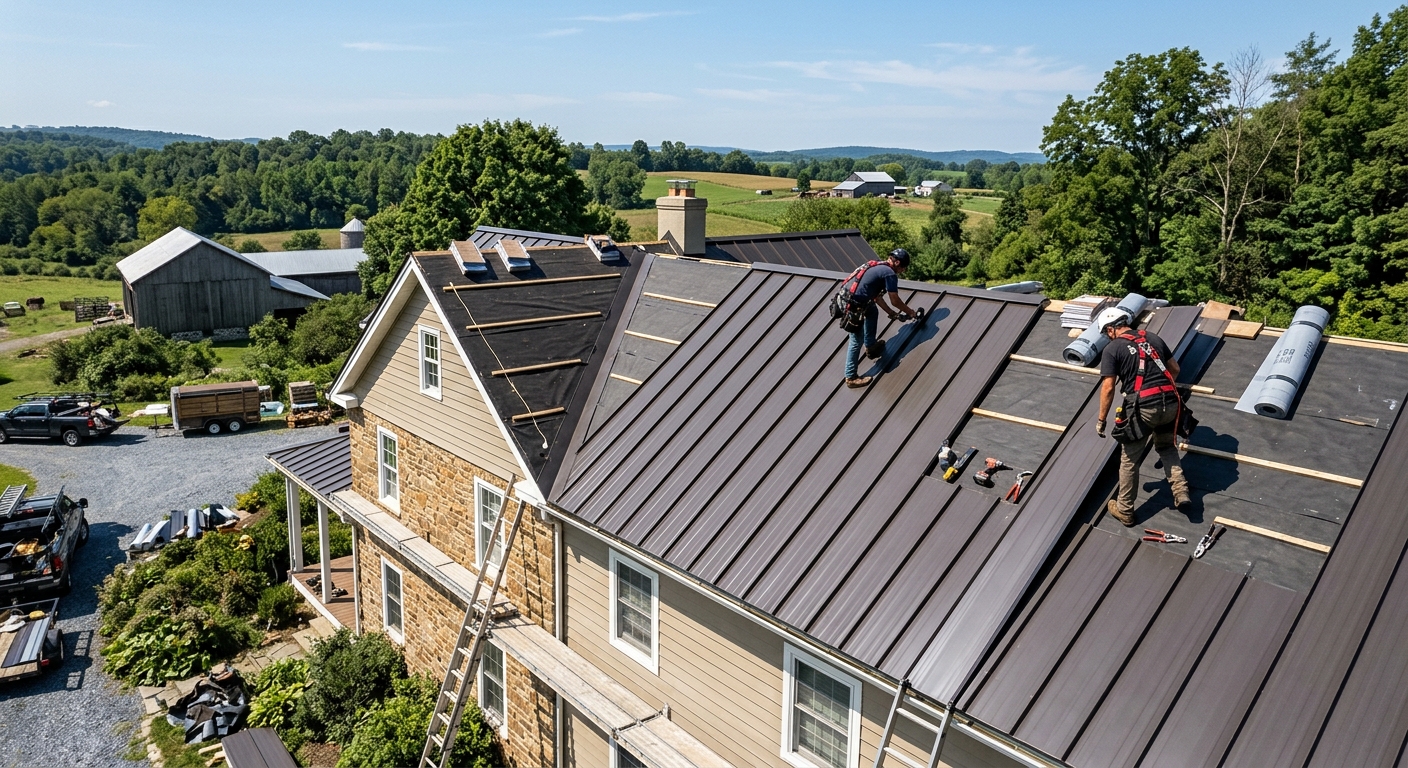
Roofing Replacement & Repair costs in Easton — 2026
Easton’s roof replacement and repair costs in 2026 are shaped directly by its housing mix and market density. With just 26.9% of homes in Easton being single-family houses and more than 87% built before 1980 (U.S. Census Bureau, ACS 2024), there’s a steady demand for both flat membrane systems on rowhomes and porch roofs, and architectural asphalt shingles on pitched, postwar suburban homes. Most houses around Easton and Palmer Township emerged from the large post‑World War II subdivision boom, which means many homes are now on their second or third roof, often having two or more layers to remove before new installation. This era tends to have pitched roofs well-suited to asphalt shingles, but years of patching combine old deck planking with newer plywood sections.
What this means for Easton homeowners: roof jobs are rarely “straight rip and re-shingle.” Expect repairs to roof deck sections and integration of modern ice barrier, especially after decades of roof overlays. Dense housing and aging stock often call for both re-roofing and gutter/system upgrades to protect against ice damming along the Lehigh Valley escarpments.
| Material / Scope |
Lifespan |
Best for |
Price range (installed) |
| Asphalt shingles — architectural (30-yr) |
25–30 yrs |
Suburban pitched roofs, typical Easton replacements |
$9,100–$19,000 |
| Asphalt shingles — impact-resistant (Class 4) |
30+ yrs |
Ridge-line and escarpment sites prone to wind damage |
$15,000–$19,000 |
| Metal standing seam |
40–70 yrs |
High snow load, minimal maintenance, signature farmhouses |
$22,000–$39,500 |
| Flat roof — TPO or EPDM |
15–25 yrs |
Rowhome back additions, porches, low-slope sections |
$11,500–$23,000 |
| Roof repair — leak or isolated section |
n/a |
Specific leaks, small wind or ice damage |
$475–$1,800 |
Prices are estimates for a typical Easton home and vary with roof size, pitch, decking condition and material selection.
TPO and EPDM on Easton homes
Many Easton houses feature at least one flat or near-flat section—think rear additions, porches, or rowhome extensions along dense city blocks. These areas require a membrane system like TPO or EPDM instead of shingles, because asphalt shingles fail when the roof pitch is too low to reliably shed water. On a slope below 2/12, water doesn’t run off fast enough—meaning ponding, seepage, and premature shingle failure. The pooled water then exploits any gap, damaging your framing and interiors.
Flat roofing membranes like TPO or EPDM form a continuous barrier. Properly installed, these systems manage ponding and resist freeze-thaw damage. While a membrane roof won’t match the 25–30 year lifespan of architectural shingles, a well-installed TPO or EPDM system should last 15–25 years in Easton’s climate. Full replacement on a typical rowhome or back addition lands between $11,500–$23,000 here in 2026.
If a roofer recommends standard shingles for a flat (or near-flat) roof in Easton—anything 2/12 pitch or lower—they’re signaling a lack of care or code knowledge. Even the best shingle will leak on a flat roof here. Pick a contractor who explains this up front and quotes accordingly.
Easton homes and their roof lines
Easton has an older housing stock: over 87% of homes in the city were built before 1980 (U.S. Census Bureau, ACS 2024). That reality is visible from the street—rows of early- and mid-20th century houses with moderately pitched roofs, built when roof decks were made from solid plank boards, not modern plywood or OSB. These homes predate widespread code requirements for ice and water shield, so unless someone has reroofed in the past 20 years and upgraded, most roofs have felt paper and lack the modern barriers that help prevent leaks from ice dams. Multiple roof layers aren’t rare: years of patch-on-patch repairs mean many Easton roofs need complete tear-offs, extra dump fees and deck replacement at the next full job.
Large post‑World War II subdivision growth in Palmer Township brought the classic pitched mid-century roofs you see in most neighborhoods. These homes tend to have simple gables or low hips, making them cost-efficient for re-roofing but often masking the need for unseen decking repairs. If you live in a house that hasn’t been fully reroofed in the past 25 years, expect at least some deck damage. On homes this old, roofers must check for rot and update flashing and underlayment to current code—especially for winter protection in high ice dam areas bridging Bethlehem and Easton.
Choosing a roofer in Northampton County
In Northampton County, a legitimate roofer must have Pennsylvania Home Improvement Contractor (HIC) registration for jobs over $500—this is state-issued and can be verified at hic.attorneygeneral.gov. Every roofer with employees must carry workers’ compensation insurance; check via the WCAIS system (wcais.pa.gov). For homes built before 1978, Federal EPA Lead RRP Rule certification applies, and you can verify certification at certifiedrenovatorsearch.epa.gov. Always insist on a written contract as required by the Home Improvement Consumer Protection Act for anything over $500—don’t settle for a handshake, even for smaller patch jobs. In this county, due diligence starts before anyone climbs your roof.
- Verify HIC registration at hic.attorneygeneral.gov
- Get a written contract before work starts (required by law over $500)
- Check workers' compensation insurance on wcais.pa.gov
- Confirm EPA Lead RRP certification if your home is pre-1978
- Request local references (recent and nearby)
- Ensure a clear, line-item estimate (not just a lump sum)
- See proof of up-to-date liability insurance coverage
- Ask about roof deck replacement protocol
- Find out who pulls permits (especially in Bethlehem and Palmer)
- Require a specific start and finish window in the contract
- Don’t pay more than 1/3 upfront (state law sets the max deposit)
- Check for a local office or yard—avoid contractors with no physical presence in Northampton County
Red flags here: contractors who cold-call or show up unasked after storms, out-of-county plates, refusal to share registration info, requesting full payment before starting, and “too good to be true” pricing in this saturated Lehigh Valley market.
Why gutters get replaced with the roof
A complete roofing job in Easton almost always means looking at gutters, too. The roof, drip edge, gutters, leaders, and downspout runout are a single water-management system. If your gutters are rotted, undersized, or dumping water next to your home’s foundation, a new roof alone is a partial fix at best—especially in neighborhoods where basement dampness is already a problem. Seamless aluminum gutters should be replaced when the roof comes off if they’re pulling away, leaking at seams, or showing severe corrosion from decades of freeze-thaw. Poor drainage and ice damming are twin threats here, and some roof warranties require that gutters and downspouts discharge water at least four feet from the foundation. Replacing both in one go means no future labor overlap and helps you avoid out-of-pocket call-backs.
Installing new seamless aluminum gutters on a typical Easton single-family home during a roof replacement will run $2,400–$4,800, depending on house size and downspout count. Adding gutter guards is extra but may save headaches with autumn leaves from big urban trees.
Roofing permits in Easton: what you need before work starts
Easton and Northampton County towns follow the Pennsylvania Uniform Construction Code (UCC), based on the IRC, with enforcement by either the local municipality or the PA Department of Labor & Industry where a town opts out. In Easton, minor roof repairs like isolated shingle patches usually don’t require a permit; full roof replacements—including any job with new sheathing—often trigger the need for a permit, especially in Bethlehem. Your roofer should tell you up front what’s needed for your specific address, but you can always check with your local code office or the state Department of Labor & Industry for clarity. Bethlehem’s City Department of Community & Economic Development handles building permits for that city.
To confirm your contractor’s legal ability to work, verify their Home Improvement Contractor (HIC) registration at hic.attorneygeneral.gov. Employers must have active workers’ compensation coverage for all roofers on your job—verify this via the WCAIS system at wcais.pa.gov. For jobs touching any painted surface on homes built before 1978, lead-safe certification under Federal EPA Lead RRP is a must. Roofing contractors are not separately licensed by the state—there’s no trade license, just HIC registration—so don’t be swayed by big claims about “licensing” if it’s not on the public registry.
Asphalt, metal or membrane — what suits a Easton roof
In northeastern Pennsylvania, a roof’s performance is controlled by how well it handles snow load (40 psf) and punishing winter lows (design temp 4°F). Architectural asphalt shingles dominate in Easton and Bethlehem for good reason: they’re compatible with the mid-century pitched roofs in post-war subdivisions, handle snow loads, and are far more affordable than metal for the average replacement. Metal standing seam roofs are the low-maintenance, high-shed option—ideal for homes on exposed ridgelines in Lower Saucon or Forks Township, where wind and snow are fierce—but that resilience comes at a higher initial price. Flat/low-slope rowhome additions cannot use shingles; only a TPO or EPDM membrane will last there and prevent leaks from ponding and snowmelt refreeze. Membranes work, but require more frequent replacement and attentive flashing—especially in Easton’s freeze-thaw zone.
You should only consider a metal roof if you plan to stay put long-term or own property at risk for high wind and ice backup; the majority of Easton homes are best-served by architectural shingles. Upgrading to impact-resistant Class 4 shingles—justifiable along escarpments—isn’t needed on every lot, and the extra upfront cost rarely pays for itself unless your insurer gives a premium discount. Membrane systems are a must where the roof is flat, not where it just “seems like a good idea.”
| Material |
Installed cost |
Lifespan |
Cold-climate performance |
Maintenance |
| Asphalt architectural |
$9,100–$19,000 |
25–30 yrs |
Handles local snow load, code-compliant underlayment crucial |
Inspect after snow events, replace failed ice barrier |
| Asphalt Class 4 impact-resistant |
$15,000–$19,000 |
30+ yrs |
Best for wind-exposed ridges, otherwise similar to standard |
Same as above; higher hail resistance |
| Metal standing seam |
$22,000–$39,500 |
40–70 yrs |
Sheds snow efficiently, resists ice damming |
Minimal, occasional fastener checks |
| TPO / EPDM membrane |
$11,500–$23,000 |
15–25 yrs |
Proper slope critical; seams and penetrations are weak points |
Annual inspection for punctures, re-seal as needed |
Frequently asked questions — roofing in Easton
Does roof pitch affect the price in Easton?
Roof pitch plays a big role in roofing costs for Easton homeowners. Steeper pitches—common in some Palmer Township postwar suburbs—usually call for extra safety equipment and require more labor to install. If your roof is particularly steep, expect your quote to land at the higher end of the local range ($9,100–$19,000 for a typical architectural shingle job). Conversely, low-pitch or nearly flat roofs need membrane systems like TPO or EPDM, which have different installation methods and costs ($11,500–$23,000). Roofers familiar with Easton will factor local architecture and pitch directly into their estimate, so always ask for a breakdown that shows whether increased pitch or safety precautions are impacting your final price.
How do I find a reputable roofer in Easton?
In Easton, the most reliable way to find a reputable roofer is by verifying their Pennsylvania Home Improvement Contractor (HIC) registration—check the number yourself at hic.attorneygeneral.gov. You should also ask for local references specifically from your neighborhood, as a saturated Lehigh Valley market sees door-knockers and storm chasers appear after every wind event. A reputable roofer will also carry workers’ compensation (which you can verify on wcais.pa.gov), provide a written contract as required by state law, and offer a clear, line-item estimate. For a basic roof repair, you’ll find legitimate contractors quoting in the $475–$1,800 range. Don’t trust anyone who wants full payment before starting or refuses to show written proof of registration or insurance.
What is the best time of year to replace a roof in Easton?
Most Easton roofing jobs happen between April and early November—this avoids issues with shingles or adhesives failing to seal during deep cold snaps (the winter design temp here drops to just 4°F). Summer isn’t always the best, since heavy thunderstorms and humidity can delay completion or complicate flat roof work. Booking an install in shoulder seasons (late spring or early fall) is ideal for both weather and availability. If your roof is actively leaking and causing interior damage, don’t wait—emergency repairs can run $475–$1,800 but will save much bigger costs in the long run. For a planned full replacement, scheduling outside peak demand (just after school starts or before the holidays) may save money and ensure your materials are ready.
How long do architectural shingles last compared to 3-tab?
In Easton, most new roofs use architectural shingles, which are thicker and more durable than older 3-tab styles. Architectural shingles are rated for 25–30 years here, assuming proper installation and attic ventilation. By comparison, 3-tab asphalt shingles—common on city row homes built before 1980—may only get 15–20 years before their wind seals fail or granules wear off. If you opt for a full architectural shingle replacement, expect a current cost between $9,100–$19,000. Upgrading from 3-tab to architectural not only extends lifespan, it gives better wind and impact resistance—the real benefit in Northampton County’s storm-prone pockets along the ridges.
What is the difference between replacement cost and actual cash value?
In Easton, insurance policies may offer either replacement cost, which pays you enough to replace your roof with new materials, or actual cash value, which deducts for age and wear. If your 25-year-old roof is damaged in a windstorm, actual cash value may only cover a small fraction of a new roof’s price—sometimes $4,000 when the job will actually run $15,000 or more for an architectural shingle replacement. Replacement cost coverage means you’re reimbursed the full, current market rate after deductibles. Since most Easton homes were built before 1980, make sure to ask your insurance agent exactly what your policy pays, as many roofs being replaced here are already well past halfway through their original life.
How do I verify a roofing contractor is registered in Pennsylvania?
To verify a contractor’s Home Improvement Contractor (HIC) registration in Pennsylvania—including anyone working on roofs in Easton—go to hic.attorneygeneral.gov and enter their company name or number. Never take a business card as proof: check the registry yourself to ensure their number is active and hasn’t been revoked. This registry is the official source for legal status. Workers’ compensation insurance should be verified at wcais.pa.gov. With full HIC registration and insurance confirmed, you can proceed confidently with everything from minor leak repairs ($475–$1,800) to full replacements. Avoid anyone refusing to provide their HIC number up front.
How long should a roof last in Easton?
A properly installed architectural asphalt shingle roof in Easton should last 25–30 years, assuming current code underlayment and good attic ventilation. Metal standing seam can often last 40–70 years, and high-quality membrane roofs (TPO/EPDM) provide 15–25 years of service on flat sections if maintenance isn’t neglected. Repairs may be needed sooner if the house has seen repeated ice damming along the Lehigh Valley escarpment. Most homes in Easton built before 1980 are already on at least their second roof. A full shingle replacement here runs $9,100–$19,000 in 2026. Membrane systems, especially on flat porch roofs, usually come due a bit sooner—plan for about two decades as a realistic local average.
Does attic ventilation matter in Easton's climate?
Absolutely. Easton’s climate—with over 6,100 heating degree days per year and serious winter lows—means that moisture in the attic quickly turns to ice dams on the roof if not vented properly. Most roofs in Easton's postwar subdivisions lacked modern venting; during a replacement, it’s smart to add ridge and soffit vents. Good attic airflow prevents mold and helps shingles or membrane systems last their rated lifespan. Poor ventilation can void some shingle warranties and shorten life by years—which matters at replacement costs of $9,100–$19,000 for a single job. Ask your roofer how they’ll improve or maintain proper ventilation before you sign anything.
How much does it cost to repair a roof leak in Easton?
For a small leak or isolated section repair in Easton, expect to pay anywhere from $475–$1,800 in 2026. Pricing is influenced by location—a leak on a steep two-story rowhome may run higher than a simple patch on a one-story sunroom. Labor shortages and market saturation in the Lehigh Valley can swing prices either direction after storm events, but reputable contractors will provide a clear, written estimate and identify whether you need a simple fix or a larger replacement. Always check the HIC registry and require proof of insurance before letting anyone onto your roof, even for a small job.