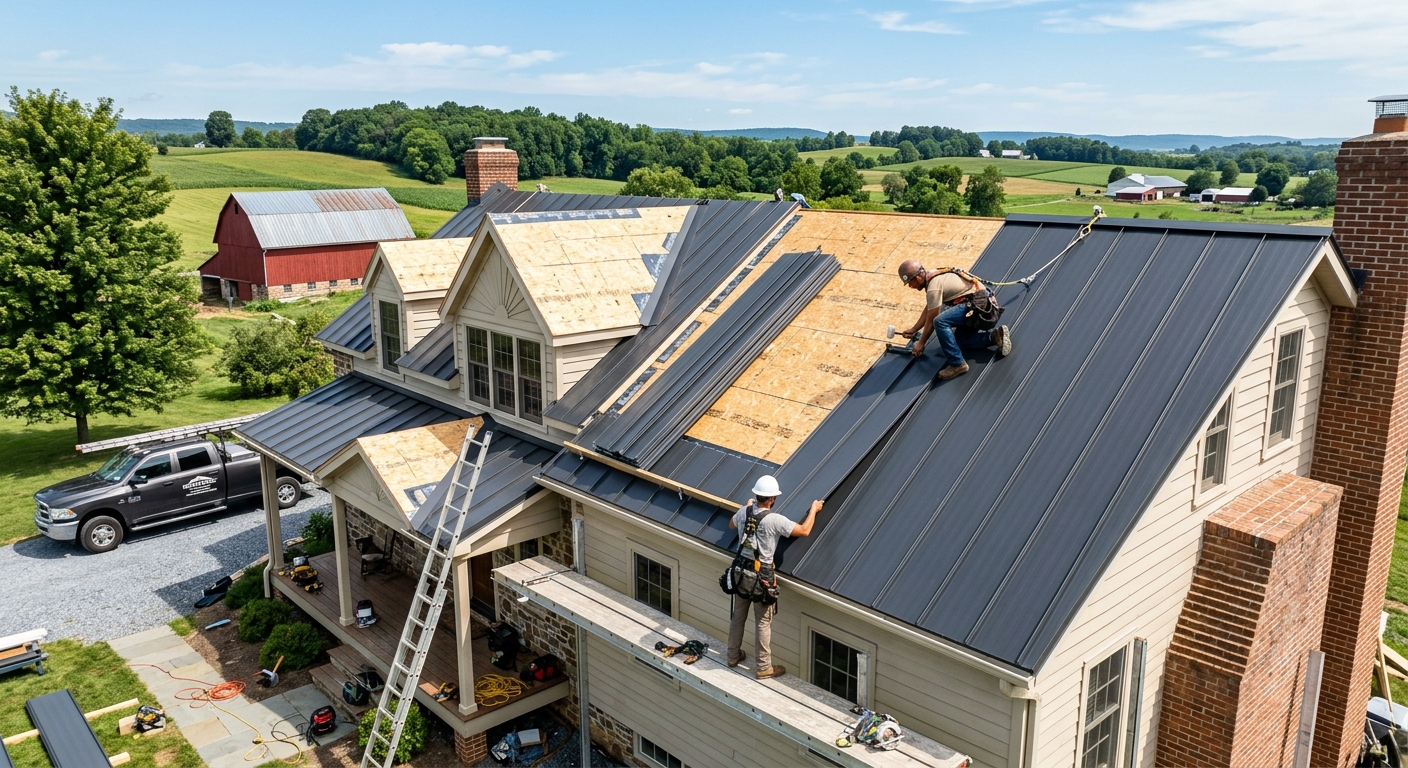
What roof replacement costs in Salisbury in 2026
Salisbury sits amidst Lancaster County’s agricultural belt, with over 75 percent of households owning their homes (U.S. Census Bureau, ACS 2024). This high homeownership and a sizable base of single-family homes means roof work is frequent and visible here. Most residential roofs in Salisbury are pitched, frame-built and often date back to before 1950, a legacy of the county’s older housing stock. On these older homes, multiple layers of shingles are common due to decades of reroofing—each layer adds weight and complicates replacements. When replacing a roof in Salisbury, it’s typical for crews to find “stair-cased” layers underneath, which may require complete tear-off and sometimes new sheathing. This pushes costs above neighboring markets that have newer inventory and fewer historic upgrades.
Adding to this, regional price pressure from Amish and Mennonite shingle crews keep asphalt roofing competitive, but higher-pitch and multi-layer jobs inevitably mean more labor. Countywide, flat roof work is less dominant, but when it’s needed—on porches and additions—it commands a premium, especially where membrane installation is required.
| Material / Scope |
Lifespan |
Best for |
Price range (installed) |
| Asphalt shingles — architectural (30-yr) |
25–30 yrs |
Older detached houses, moderate budgets |
$9,700–$20,500 |
| Asphalt shingles — impact-resistant (Class 4) |
30+ yrs |
Protection against hail and wind |
$16,000–$20,500 |
| Metal standing seam |
40–70 yrs |
Historic homes, maximum longevity |
$23,500–$42,000 |
| Flat roof — TPO or EPDM |
15–25 yrs |
Low-slope additions, porches |
$12,500–$24,500 |
| Roof repair — leak or isolated section |
n/a |
Spot leaks, shingle replacement |
$500–$1,950 |
Prices are estimates for a typical Salisbury home and vary with roof size, pitch, decking condition and material selection.
Pennsylvania code and Lancaster County permit rules for roofing
Roofing jobs in Salisbury are governed by the Pennsylvania Uniform Construction Code (UCC), based on the International Residential Code, and enforced by local municipalities. In Salisbury and surrounding Lancaster County townships, you'll need a building permit if your roof replacement involves installing new sheathing or performing any structural work. However, if you're just having a few shingles replaced to fix a minor leak, permits are typically not required—most townships treat small repairs as routine maintenance.
Permits themselves are issued by the individual township code enforcement offices—there is no single countywide office, so always check directly with your township. If you’re hiring a contractor for any roofing contract over $500, Pennsylvania law requires them to have Home Improvement Contractor (HIC) registration, issued by the Office of Attorney General. You can verify a roofer’s HIC registration status at hic.attorneygeneral.gov.
For your safety, all employers in Pennsylvania must carry workers’ compensation insurance—even Amish and Mennonite crews fall under this state rule. Verify coverage through the WCAIS system at wcais.pa.gov. Don’t accept a bid from anyone who can’t supply these credentials. As a homeowner, you want a signed contract with the HIC number listed, not only for your protection but because it’s required for any contract above the $500 threshold.
Snow load, ice dams and wind in Salisbury
If you live in Salisbury, your roof contends with a ground snow load of 30 psf and winter design temperatures down to 12 °F. But what matters most here isn’t heavy lake-effect snow—Lancaster County roofs are more exposed to sudden wind bursts rolling off the Susquehanna River valley, especially during spring and summer thunderstorms. A quick wind gust can get under a lifted shingle edge and peel up whole sections, particularly on roofs where multiple layers create uneven surfaces.
On older, steeper roofs (common to Salisbury’s pre-1950 homes), ice dams are an annual threat. Warm air rising through the attic melts snow from underneath, sending water to the eaves—at the cold overhang, it refreezes, forming a dam. As meltwater backs up, it can seep under shingles and soak deck boards, especially if there’s no modern ice and water barrier installed. A leak like this can trigger repairs in the band of $500–$1,950, or replacement of decking at additional cost, especially if rotted wood is discovered during tear-off. Wind-driven rain finds its way into gaps at flashing or boot collars; repairs here remain among the most frequent service calls in Salisbury.
Hail is less frequent, but impacts do matter: even without visible holes, hailstones can bruise shingle mats, speeding up granule loss and shortening lifespan, especially on older three-tab shingles still common under newer layers. For homeowners, choosing impact-resistant shingles (Class 4 rated) is a real investment in mitigation, with costs running $16,000–$20,500 for a typical project.
How to compare roofing quotes in Salisbury
When you receive a roofing quote in Salisbury, it should be more than a lump-sum figure. Readable estimates for Lancaster County homes—especially the older ones with complex layers—ought to specify the roof area in “squares" (one square = 100 sq ft) and include the pitch, since steep roofs are a mainstay here. Quality quotes itemize tear-off and disposal, listing the number of existing shingle layers (often more than one in this area) and including dumpster costs.
Look for underlayment and ice-and-water shield listed by product type (not just “felt”), and confirm how high up the eave barrier is specified. Decking replacement should always be shown as a per-sheet contingency, since decades-old deck boards sometimes need swapping out. All flashings—valleys, walls, plumbing vents—should be listed, and warranties split out: labor vs. manufacturer. With payment, it’s reasonable to expect a deposit under 15%, balance due at completion—not before.
Beware one-page jobs with only a “roof replacement” sum; you can’t compare bids that hide square footage, skip layer count, or ignore contingency pricing for rotten boards. If workmanship warranty terms are omitted or only the shingle warranty is listed, ask for more detail before signing.
| Line item |
What to look for |
Red flag if… |
| Roof area |
stated in squares, with pitch |
no measurement given |
| Tear-off and disposal |
number of layers, dumpster included |
bundled into one figure |
| Underlayment |
product type and coverage |
listed only as 'felt' |
| Ice and water shield |
coverage height at eaves |
omitted entirely |
| Decking |
per-sheet contingency price |
no allowance at all |
| Warranty |
workmanship years stated separately |
only the shingle warranty |
| Payment |
deposit under 15%, balance on completion |
large upfront cash |
Low-slope and flat roofs in Salisbury
In Salisbury, many homes have a flat or low-slope section—especially on rear additions, porch roofs, or the back side of older rowhouses. These areas require a different roofing system than the main pitched roof. Standard asphalt shingles aren’t designed for slopes below 2/12 pitch; water drains too slowly, and capillary action draws moisture under shingle laps, which leads to rot and leaks. Instead, Salisbury roofers use TPO or EPDM membrane for flat work, which are single pieces, heat- or chemically-bonded at seams for a watertight surface.
Ponding is a frequent problem on older flat sections—deck sag or clogged drainage elevate risk. Flat membrane roofs on a typical Salisbury home run $12,500–$24,500, usually in the same range or higher than a steeper shingle replacement due to more labor-intensive prep and greater material expense. Membrane systems last 15–25 years if properly installed and maintained, but trapped water from a poorly pitched deck can cut that short.
If a roofer suggests new shingles on a 2/12 or lower pitch, that’s a sign their standards aren’t up to code for Lancaster County’s conditions. Insist on membrane for flat or near-flat areas; it’s what will pass inspection and protect your home over the long term.
Filing a roof claim after a Pennsylvania storm
When your roof sustains damage from one of the Susquehanna River valley’s wind bursts or thunderstorms, the first step is to document everything before any cleanup. Take clear, dated photos of the damage from several angles—including the roof, the ground, the attic, and any affected interiors. Once documented, contact your insurer to file a claim; Pennsylvania policies require you to mitigate further damage, but not to start major repairs before an adjuster visits.
You’ll receive a written scope of loss from your insurance adjuster, detailing what’s covered. Understand the terms: “actual cash value” means depreciation is deducted, so if your roof is near its lifespan, your check may be much lower than the bill. “Replacement cost value” is better, but be sure your policy actually provides for it. Expect the insurer’s adjuster to verify not only the damage but also confirm it's from a covered event (not decades of wear).
Pennsylvania’s Home Improvement Consumer Protection Act (HICPA) requires a written contract for any roofing work above $500, and you have a three business-day right to cancel signed contracts. Know that it’s illegal in Pennsylvania for a roofing contractor to offer to “waive” or “cover” your insurance deductible—if someone proposes this, they’re asking you to commit insurance fraud and you should walk away immediately. All contracts must be clean, aboveboard, and entirely in writing to protect both parties during the claim and rebuilding process.
Water management on a Salisbury roof
In Salisbury, properly installed gutters and downspouts are vital to protect your home—not just your new roof. Gutters channel water away from your eaves, while downspout extensions must discharge well away from your foundation; neglect this and you could be dealing not just with soggy landscaping, but also with a wet basement or crawlspace. When replacing a roof, failing to address sagging or undersized gutters is leaving the job half-done—most credible installers in Lancaster County will recommend upgrading or at least rehanging gutters as part of the contract.
All edge metal (drip edge) needs to be integrated under the starter row of shingles and continuous into the gutter trough, or rainwater will rot your fascia and leak behind siding. Some roofing warranties actually specify that drainage systems must be functional to remain valid—because water running down walls doesn’t just void shingles, it voids warranty coverage too.
Budget for new seamless aluminum gutters, downspouts, and guards alongside the roof: for a typical single-family home in Salisbury, expect $2,200–$3,950 when paired with a replacement roof. Don’t ignore this line item if a contractor conveniently omits it from their scope.
Frequently asked questions — roofing in Salisbury
What does it mean if my shingles are curling or losing granules?
In Salisbury, curling shingles or visible granule loss often point to a roof reaching the end of its service life—especially if your home is one of the many built before 1950. Frequent freeze-thaw cycles in Lancaster County accelerate this kind of aging; as roofs expand and contract, shingle edges lift and lose adhesion. Granule loss leaves the underlying asphalt exposed to the sun, causing it to dry out, crack, and fail even faster. Sometimes you might see this near roof valleys or along the south-facing slopes that get the most weather. Typically, if more than 10 percent of your roof shows these symptoms, it's wise to get a professional inspection. Spot repairs can run within the $500–$1,950 range, but widespread curling usually signals it's time to budget for full replacement.
Why do roofs fail faster in south-central Pennsylvania?
Roofing in Salisbury doesn’t contend with lake-effect snow, but our biggest enemy is rapid freeze-thaw cycling and sudden wind events driven by valley weather. Shingles are repeatedly stressed during quick swings between thawing sun and freezing nights; that tension works the nails loose and causes edges to lift. Susquehanna River valley gusts are tough on old, layered roofs in particular—one exposed, uneven shingle makes a weak spot that invites the next storm in. This is why, even with careful maintenance, most traditional shingle roofs in Lancaster County last nearer the low end of the typical $9,700–$20,500 replacement cycle.
What warranty should a Salisbury roofer offer?
For roof replacements in Salisbury, a solid quote will always distinguish between the manufacturer’s material warranty (often limited lifetime or 30–50 years for architectural shingles) and the installer’s workmanship warranty, which is usually 5–10 years. Don’t confuse the two: if a leak develops because of a bad nail line or skipped flashing, only the workmanship warranty applies. Lancaster County’s older homes—with their steep decks and multiple re-roofs—mean proper installation is just as important as shingle brand. Make sure the written contract spells out labor vs. material coverage, and don’t settle for less than a 5-year workmanship term on a complete architectural shingle replacement (which will run $9,700–$20,500 locally). Ask for references, too—especially on houses similar to yours.
How much does a new roof cost in Salisbury?
For a typical single-family home in Salisbury, architectural shingle replacement in 2026 is estimated between $9,700–$20,500. Most older, steeper-roofed houses settle right around $16,000 for a full tear-off and replacement, especially if there are multiple layers or decking repairs involved. Metal standing seam runs higher, in the $23,500–$42,000 range. If you only need a leak repair or minor shingle section replaced, costs are much less—usually $500–$1,950. Steep slopes, complex valleys, or significant decking repairs tend to add to the total, and having gutters replaced at the same time (as is often necessary on older Salisbury homes) will add a few thousand dollars to your project.
Can I install new shingles over old ones in Pennsylvania?
Pennsylvania code allows a single additional roofing layer over the old, but in a place like Salisbury—where homes often have two or more shingles layers from decades of repairs—local roofing contractors almost always recommend complete tear-off. Older houses in Lancaster County nearly always have a mixture of three-tabs, architectural, and maybe a rolled roof layered underneath, which adds weight and can hide rot. During inspection, if the existing roof already has two layers, a permit office here won’t accept a third. While overlaying may seem cheaper up front (avoiding the full $9,700–$20,500 replacement), you risk missing rotten decking and voiding manufacturer warranties. Tear-off and fresh installation is standard for code compliance and best value long-term.
Why is my Salisbury roofing quote higher than the online average?
Online roofing averages overlook the realities of Salisbury’s housing stock—especially the prevalence of pre-1950 homes with multiple shingle layers, steep slopes, and sometimes uneven original decking. Local labor is affordable thanks to the Amish and Mennonite crews, but removing two or more shingle layers on a tall house with a complex roofline takes time and multiple dump fees. These realities push the price to the upper end of the $9,700–$20,500 band. In addition, city permit requirements and the cost of proper ice dam protection (especially for eaves and valleys) add budget items that an online estimator misses. If your bid itemizes these, it’s more trustworthy than a “cheap” lump sum.
What is the best roofing material for Salisbury's climate?
For most Salisbury homes, premium architectural asphalt shingles are the best fit, blending affordability with decent resistance to the county’s rapid freeze-thaw cycles and wind bursts. They last 25–30 years when properly installed using modern underlayments and ice-and-water barriers. On homes with large tree canopies or exposed western slopes, impact-rated (Class 4) shingles might be worth the added $16,000–$20,500 up-charge for longer hail and wind protection. Metal roofs are an option for historic or farmhouse properties; they shed snow and resist wind better, though at a higher up-front price. Flat sections (additions or porches) should only use membrane—TPO or EPDM—never shingles, for reliable drainage and leak-free performance.
What happens if it rains mid-replacement?
Good Salisbury roofing crews always stage projects to avoid leaving your home exposed. Since sudden thunderstorms aren’t rare in the Susquehanna River valley, responsible contractors “dry-in” with synthetic underlayment or tarp every day’s work, never tearing off more roof than can be watertight by evening. If an unexpected shower hits, they halt work and cover the exposed area tightly—any water intrusion should be documented and handled as part of the contract. A full replacement in Salisbury may span several days on larger or steeper homes. If rain does cause damage, repairs may range from minor ceiling touch-up to more involved fixes, often below the $1,950 threshold, but only if caught and corrected right away. Ask how your crew handles weather delays before the job begins, and never let anyone leave a roof open overnight without full coverage.
What if my insurer denies my roof claim?
If your Salisbury roof claim is denied, it’s often because the insurer judged the damage to be from wear and tear, not a recent storm—a tricky distinction in Lancaster County where multiple roof layers hide old leaks. First, request a written explanation for the denial. If you think the adjuster missed clear storm damage (such as shingle tabs creased by wind bursts common to our area), you can request a second inspection or bring in an independent, HIC-registered contractor for their documented findings. If your policy only covers actual cash value, you may receive a lower payout than expected and may need to cover the remainder yourself—making repair decisions in the band of $500–$1,950 instead of a full replacement. Either way, always demand documentation; insurers in Pennsylvania are required to put claim decisions in writing, giving you grounds to appeal if necessary.