Forks roofing prices by material and scope — 2026
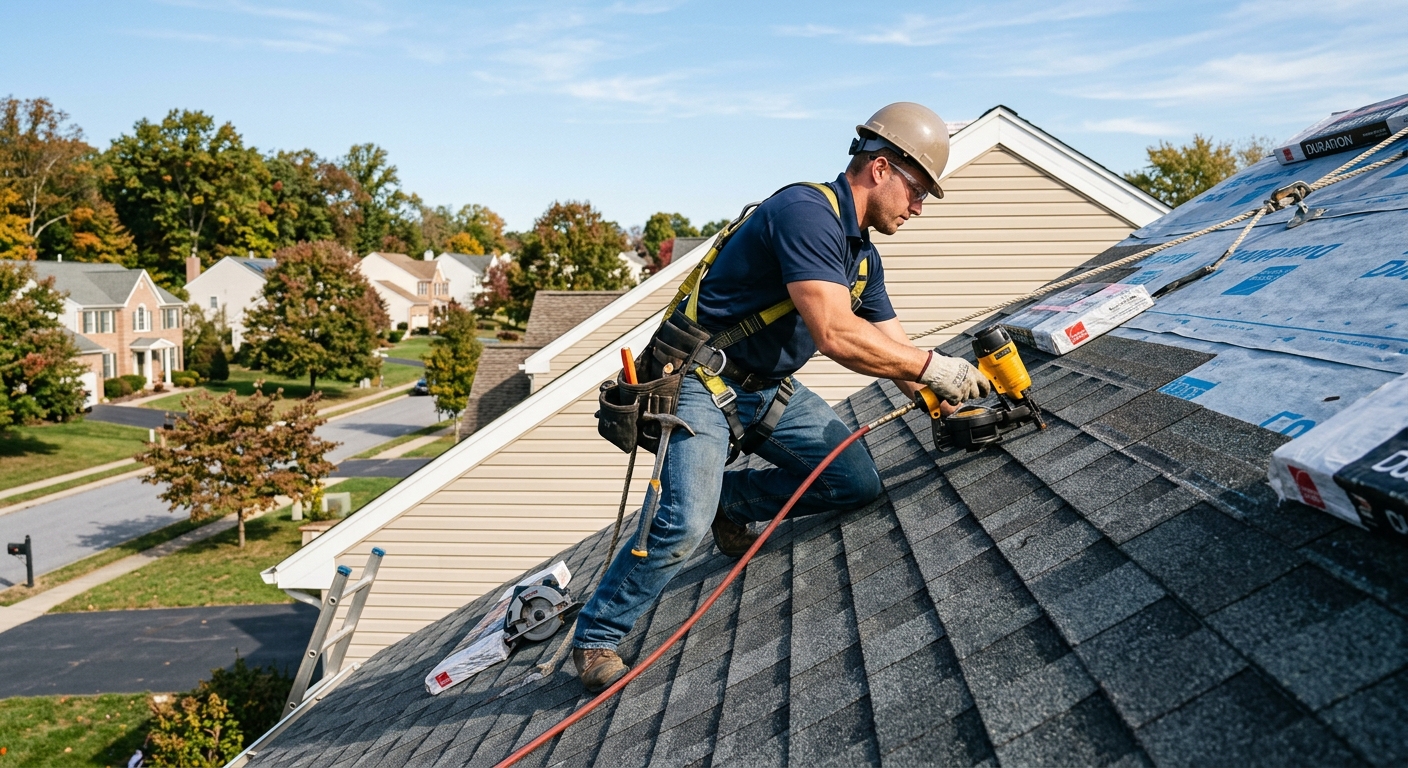
Forks, as part of the Lehigh Valley, is largely made up of single-family homes with a high homeownership rate. When nearly every home is owner-occupied and 68.4% are single-family (U.S. Census Bureau, ACS 2024), it drives real spending on roofing—and most residents are invested in long-term value over short-term patchwork. Large post‑World War II subdivisions in Palmer Township spilled into Forks, creating neighborhoods with roofs that are now hitting their first or second full replacement cycle. This means most residents face full-tear-off jobs, not simple shingle overlays. Forks roofs tend to be pitched and are almost always covered with architectural asphalt shingles, with jobs tending toward the mid-to-upper end of the price bands shown below, especially where ventilation or decking issues drive up labor hours.
| Material / Scope |
Lifespan |
Best for |
Price range (installed) |
| Asphalt shingles — architectural (30-yr) |
25–30 yrs |
Typical Forks pitched-roof home needing value and curb appeal |
$10,500–$22,000 |
| Asphalt shingles — impact-resistant (Class 4) |
30+ yrs |
Homes on ridge-lines and escarpments facing high wind and hail |
$17,000–$22,000 |
| Metal standing seam |
40–70 yrs |
Homes where snow shedding, longevity, and minimal maintenance matter most |
$25,500–$45,500 |
| Flat roof — TPO or EPDM |
15–25 yrs |
Split-level or mid-century homes with low-slope areas or additions |
$13,500–$26,500 |
| Roof repair — leak or isolated section |
n/a |
Patching a smaller storm-damaged area or flashing update |
$550–$2,100 |
Prices are estimates for a typical Forks home and vary with roof size, pitch, decking condition and material selection.
Timing a roof replacement in Forks
In Forks, most asphalt shingle roofs are installed from April through early November to take advantage of the moderate temperatures needed for proper shingle sealing. At 4 °F winter design temperature and a 40 psf ground snow load, installation after mid-November means risking poor adhesion, especially on the shaded roof faces that are common in this part of Northampton County. Crews tend to book solid from May through September—high demand from owner-occupied homes all across the Lehigh Valley, combined with the saturated suburban roofing market around Bethlehem and Easton, means it’s often a 4–8 week lead time for a replacement during peak season.
If you get caught with a leak or major storm damage in February or March, expect both longer wait times and higher out-of-pocket costs, especially if emergency tarping or snow/ice removal is required before repairs. An emergency patch in winter can run on the upper end of the repair price band, while planned replacements done in September (shoulder season but before the cold sets in) can often be scheduled more quickly and with better crew availability. Homeowners looking to save don’t benefit from waiting until winter; timing a replacement for late summer or early fall is usually the best balance between cost and scheduling flexibility in Forks.
Material comparison for Forks homeowners
In Forks, materials stand up to repeated snow loads, winter lows of 4 °F, and the occasional wind-driven rain that comes down the Lehigh Valley escarpments. Architectural asphalt shingles remain the default because they deliver 25–30 years of performance at a first-cost Forks families can justify—roofs here are traditionally steeper, and with 40 psf ground snow load, these shingles do well, especially when paired with modern ice barriers at the eaves. Metal standing seam is a big up-front jump but is unmatched here for ice-dam prevention, since snow slides off rather than building up and seeking roof deck gaps. If you’re worried about snow and would rather never shovel a roof again, metal is appealing, though on post‑WWII Forks homes, the investment is rarely justified unless you plan to stay 30+ years.
Flat roofs—often additions or split-level back ells—call for TPO or EPDM. They can handle standing water from snowmelt but only if drainage is designed right. Membrane jobs cost less than metal but run higher than shingles, and in this climate 15–25 years is a typical run before seams may fail. In this region, impact-resistant (Class 4) asphalt is worth considering for ridgeline homes that catch wind or hail, but for most of Forks, the added expense is only justified if you’ve had prior storm claims.
| Material |
Installed cost |
Lifespan |
Cold-climate performance |
Maintenance |
| Asphalt architectural |
$10,500–$22,000 |
25–30 yrs |
Performs well, especially with modern ice barrier at eaves |
Routine inspection; valleys/eaves are ice dam risk |
| Asphalt Class 4 impact-resistant |
$17,000–$22,000 |
30+ yrs |
Best for homes exposed to wind/hail on escarpments |
Low; periodic check after major storms |
| Metal standing seam |
$25,500–$45,500 |
40–70 yrs |
Excellent—snow shedding reduces ice dams, long lifespan |
Minimal; periodic fastener and seam check |
| TPO / EPDM membrane |
$13,500–$26,500 |
15–25 yrs |
Good for low-slope; careful attention needed to seams, drains |
Inspect regularly for seam splits, ponding after snowmelt |
Pennsylvania code and Northampton County permit rules for roofing
Forks roofing work is regulated under the Pennsylvania Uniform Construction Code (UCC), which is based on the IRC and enforced locally in Northampton County by individual township code offices. Full roof replacements that include new sheathing require a permit in Bethlehem—most jobs in Forks will also trigger a permit if deck work is needed, so always confirm requirements with your township code office before work starts. Simple repairs, like isolated shingle patching in Easton, typically do not need a permit.
Any roofing contract over $500 must be covered by a written agreement under the Home Improvement Consumer Protection Act (HICPA), with a 3 business-day right of cancellation. Roofing contractors in Forks must hold a Home Improvement Contractor (HIC) registration for jobs over $500, which you can verify at hic.attorneygeneral.gov. Workers' compensation is required for all employers in Pennsylvania—including all roofers—and coverage can be checked through the WCAIS system (wcais.pa.gov). These steps protect you as the homeowner from out-of-pocket liability if a worker is injured on your property or if there is a contract dispute. Always insist on written proof before signing anything.
Roof age and construction era in Forks
In Forks, much of the housing stock reflects the post‑World War II building boom of Palmer Township and surrounding areas. Many homes here were built in the 1950s through the late 1970s, and today 22.8% of properties were built before 1980 (U.S. Census Bureau, ACS 2024). These homes usually have a 5/12 to 7/12 roof pitch, with decking that’s often either 1x lumber planking on the oldest homes or plywood/early OSB on homes from the 1970s onward. Ice and water barrier at the eaves was not code back then, so unless there’s been an upgrade since, the risk of ice dam leaks is high on north-facing and shaded eaves.
First-generation 3-tab shingles installed around the late 1980s or early 1990s are now at end of life. Many Forks homeowners are facing their first or, for homes built pre-1970, possibly their second major roof replacement. Nail pops, brittle shingles, and subtle roof deck deflection are all signs of an aging system here. Most roofs installed before 1980 may hold two layers of shingles—tear-off is almost always required now because code does not permit additional layers over soft or damaged deck. If your Forks home is from the mid-century era, a full-tear-off and inspection of the underlying deck is essential before choosing a new roofing system.
Snow load, ice dams and wind in Forks
Forks sits right at the intersection of the Lehigh Valley escarpments, which channel wind events that can lift shingles and drive water under poorly nailed courses. The ground snow load here is 40 psf, meaning even a “normal” winter can put thousands of pounds up there for weeks—especially on northern exposures that see less sun. When daytime melting meets sub-freezing roof eaves (4 °F winter design temp), ice dams form: melted snow runs to the eave, refreezes, and creates a berm that backs up water under shingles. On older Forks roofs lacking modern ice barrier, this is a common cause for insurance claims and out-of-pocket repairs running up to $2,100 for interior and exterior patching.
Wind is a special challenge along ridge lines in Forks and Lower Saucon, with frequent gusts that exploit any loose shingle edge—especially old roofs nearing end of life. That’s why Class 4 impact-rated shingles are a smart buy for homes facing sustained wind exposures or where hail is a threat. Hail doesn’t always puncture asphalt but can bruise shingles, weakening the mat and leading to leaks months or years later—another way a minor storm becomes a $550–$2,100 repair or even pushes a borderline roof into full replacement.
To manage these risks, a proper re-roof in Forks should always include ice and water shield at the eaves and valleys, and careful attention to shingle nailing and edge detail. If you have substantial tree cover or northern exposures, these code-level details will pay for themselves the first time a heavy, wet snow settles in for a week.
Workmanship vs manufacturer warranty
Every Forks roof comes with two kinds of warranty, though most homeowners only remember the headline number. The manufacturer warranty (from GAF, CertainTeed, etc.) covers the shingles or membranes against factory defect and is almost always prorated over time. It usually requires registration within 30–60 days after installation, and may not be transferable at resale unless specifically stated. This warranty can be voided if you install over old shingles, skip required ventilation, or use non-matching accessories.
The workmanship warranty is offered by your installer and covers installation errors—nailing, flashing, or leak points—for a defined term, often 5–15 years in Forks. A 25-year “workmanship” warranty from a two-year-old company with no local track record won’t help you if the business folds; ten years from an established local company is the safer bet. Pay attention to what’s actually in writing. Most warranties don’t cover ice dam leaks unless code ice barrier is proved, and layering new shingles on top of old usually cancels both material and labor coverage. Make sure your contract calls out the type and length of both warranties, and always request copies of all registration documents once the job is complete.
Frequently asked questions — roofing in Forks
How much snow load can a Forks roof handle?
The typical Forks roof is built to a 40 psf ground snow load standard, per northeastern Pennsylvania code requirements. This means that even under a two-foot accumulation of wet, heavy snow, the roof structure should withstand the weight without distress. Homes built before 1980 may or may not have been originally engineered to this standard, depending on how strictly the township enforced code in those years—if your roof deck sags or you have visible movement at rafters, it may be time for a thorough replacement, especially since a full replacement here can run $10,500–$22,000. For most homes in Forks with steep roof pitches, the snow tends to shed before it becomes an overload risk, but always clear prolonged deep drifts from shaded lower roofs. If you’re at all uncertain, ask your contractor to check rafter sizing and deck integrity as part of any major replacement estimate.
What does roof replacement cost per square in Forks?
In Forks, architectural asphalt shingle replacement typically falls between $10,500–$22,000 for a complete job. On a 2,000-square-foot roof (about 20 "squares"), that's roughly $525 to $1,100 per square, installed. That number reflects local labor rates, common roof pitches in postwar subdivisions, and the extra detail work required for ice barrier at eaves or re-sheeting rotted deck on older homes. If your house is at the higher end of the price range, it may be due to a steeper roof, difficult access, or multiple layers to tear off. Always ask for a detailed scope, and be wary of any Forks bid that comes in far under these figures—there’s almost always a catch.
Do I need my own inspection before the adjuster visits?
In Forks, it’s a good idea to have a reputable roofer inspect your roof before the insurance adjuster arrives, especially after a ridge-line wind or hail event. Local contractors can point out subtle hail bruises, wind creases, or flashing failures that an adjuster—especially one from outside the Lehigh Valley—might overlook. This can make a real difference in how much your claim covers. For instance, if visible or hidden storm damage is found, insurance might cover a repair costing $550–$2,100 rather than leaving you to pay out of pocket later when leaks develop. An honest local inspection, with photos, also ensures only necessary work is claimed. Don’t let anyone force a claim for replacement if all you need is a patch—insurance companies in Pennsylvania frown on inflated or unfounded storm claims.
Are storm-chasing roofers a problem in Forks?
After wind or hail storms, especially along the Lehigh Valley ridge lines, Forks often sees out-of-town roofing crews canvassing neighborhoods offering quick repairs or replacements. While not all are bad actors, many “storm chasers” cut corners, skip local permit rules, or vanish before warranty issues are resolved. Given that a full Forks roof replacement typically costs $10,500–$22,000, it’s important not to be rushed by high-pressure sales tactics. Always verify a contractor’s Home Improvement Contractor (HIC) registration at hic.attorneygeneral.gov and demand written contracts. A reputable local roofer will be familiar with Northampton County code and the ice barrier or underlayment practices needed for this climate—they’ll stick around to stand by their work.
What is the best time of year to replace a roof in Forks?
The optimal window for roof replacement in Forks is late summer through early fall, from August to early October. Temperatures are reliably warm enough for new shingles to seal properly, but you avoid the late spring/early summer rush when every contractor in the Lehigh Valley is booked for weeks. Scheduling in September often leads to better crew availability and more attention to details like ice and water shield at the eaves—both crucial here where the winter design temperature drops to 4 °F. If you wait into November or December, labor costs can climb and material performance may suffer, driving up the risk—and sometimes even pushing your job up to or above the higher end of the $10,500–$22,000 band for asphalt shingle replacement.
How much does a flat roof replacement cost in Forks?
In Forks, flat roof sections—whether they’re on mid-century split-levels or rear additions—are usually re-roofed with TPO or EPDM membrane. A typical membrane replacement runs between $13,500–$26,500, depending on area, accessibility, and whether any insulation or deck repair is required. Flat roofs here experience snow load and winter freeze-thaw cycles that test seams and drains more than slope; a skilled installation with properly heat-welded seams and flashings is essential to avoid ponding water and leaks. Always ask for photos of deck and drain prep, and insist that any ponding or deck softness is addressed as part of the job. Some crews push cheap roll roofing, but you won’t get the 15–25-year life you should expect for a Forks membrane priced in the above range.
What are the signs of hail damage on a roof?
Hail damage in Forks often means more than just visible punctures. On asphalt shingle roofs, look for soft, bruised spots where the surface granules are missing or displaced—these bruises can break down the underlying mat over months, eventually leading to leaks. Hail hitting metal roofs might leave shallow dents but usually won’t compromise waterproofing. If you suspect recent hail (which happens more often along the Lehigh Valley ridges), compare protected and exposed surfaces: gutter guards, siding, or car hoods can show similar ping marks. If you need documentation for a claim, a professional assessment might only result in a $550–$2,100 repair now, but will catch problems before they become full replacement jobs. Forks adjusters know the signs, but a local roofer can help document with photos and moisture readings.
Are there historic district rules affecting roofing in Forks?
Forks itself isn't governed by historic district roofing rules—the strictest guidelines in Northampton County are specific to older parts of Bethlehem and Easton, not Forks Township or the typical postwar subdivisions common here. If your home borders a historic property or you’re within a specialized overlay near Easton, it’s worth checking with your township code office just to be safe, but for the vast majority of Forks residents you can select modern architectural shingles, metal, or membranes based only on code and personal preference. The only pricing impact is your material choice—expect $10,500–$22,000 for architectural shingle work, with no historic premium in Forks.
Is metal roofing noisy in rain?
Modern metal roofing in Forks, when installed over proper plywood decking and optional insulation, is only slightly louder than architectural shingles during a rainstorm. In most post‑WWII homes here, the attic insulation and solid deck absorb much of the impact noise. The sound difference is most noticeable in exposed-rafter areas—like uninsulated sunrooms or barns—not in typical Forks bedrooms. If noise is a major concern, your contractor can add a synthetic underlayment to further deaden sound. The benefit is that metal sheds snow before it becomes a heavy load, which may prevent an expensive ice-dam repair (up to $2,100) in this climate. For most Forks homeowners, the improved longevity outweighs any minor increase in rain noise.