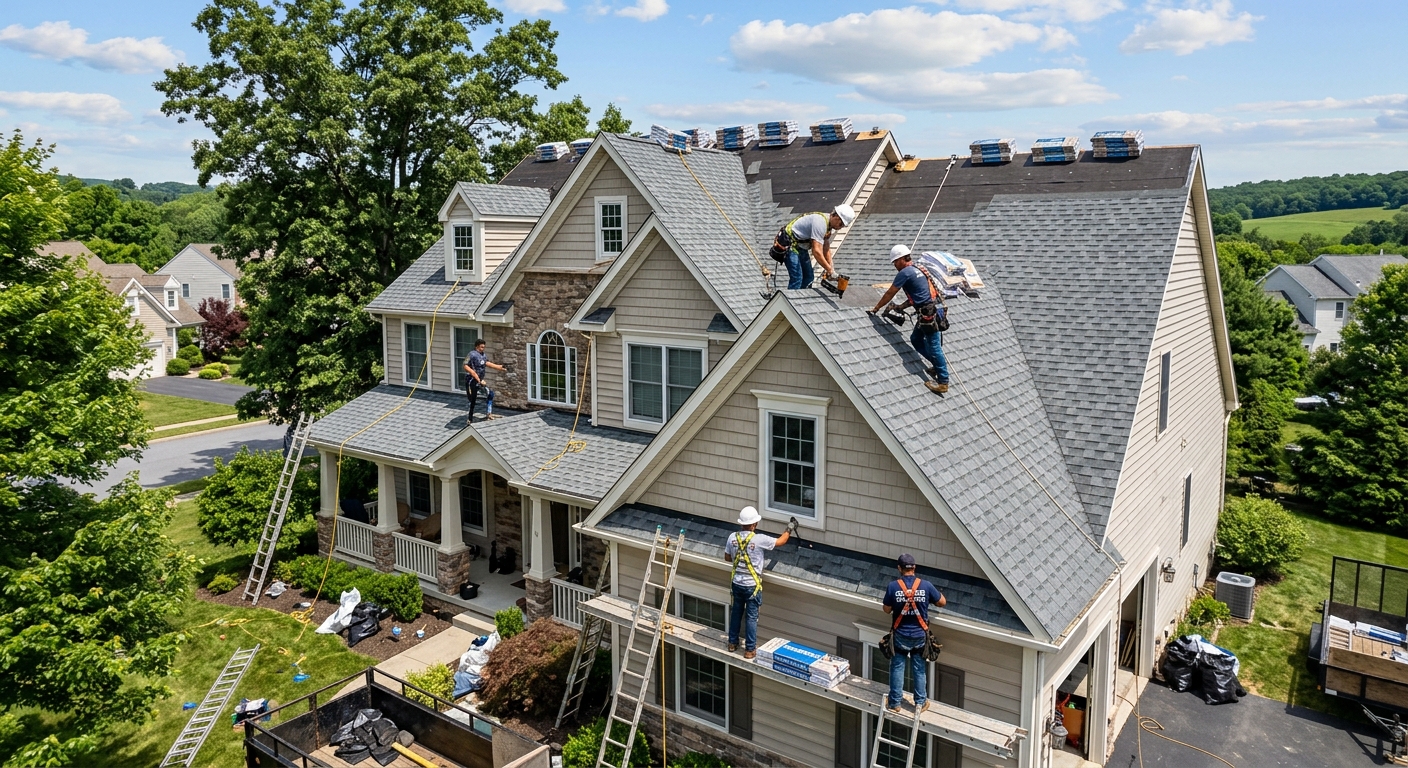
Roofing Replacement & Repair costs in Bethlehem — 2026
Bethlehem’s aging housing stock and high rate of homeownership shape a roofing market with steady demand and unique challenges. With 79.3% of homes built before 1980 and a homeownership rate just under 50% (U.S. Census Bureau, ACS 2024), many roofs in Bethlehem are well past their original service life. Older neighborhoods see frequent patching, while owners in the city’s post-World War II subdivisions often face full tear-offs as their asphalt shingles reach end-of-life.
The post-war building boom in Palmer Township set the pattern: thousands of homes roofed in architectural asphalt after the mid-century now need thorough re-roofing, not just spot repairs. In Bethlehem itself, most single-family homes sit under a similar 25–30-year roofing cycle—meaning replacement often includes addressing old decking, ice dam defense, ventilation, and decades of repairs layered atop one another.
Local labor saturation means prices here don’t fluctuate wildly from street to street, but projects requiring full decking replacement or reworking older details can run at the upper end of the typical cost range. Below is a breakdown of common roofing project costs in Bethlehem for 2026:
| Material / Scope |
Lifespan |
Best for |
Price range (installed) |
| Asphalt shingles — architectural (30-yr) |
25–30 yrs |
Pitched roofs in most Bethlehem neighborhoods |
$9,100–$19,000 |
| Asphalt shingles — impact-resistant (Class 4) |
30+ yrs |
Ridge-line homes along Lehigh Valley escarpments |
$15,000–$19,000 |
| Metal standing seam |
40–70 yrs |
Ice-prone valleys, owners staying long-term |
$22,000–$39,500 |
| Flat roof — TPO or EPDM |
15–25 yrs |
Row homes and low-slope additions |
$11,500–$23,000 |
| Roof repair — leak or isolated section |
n/a |
Routine storm and age-related fixes |
$475–$1,800 |
Prices are estimates for a typical Bethlehem home and vary with roof size, pitch, decking condition and material selection.
Storm damage and insurance claims in Bethlehem
Storms that pass through Bethlehem can damage shingles, break flashing, and rip gutters away, especially along the exposed ridges of the Lehigh Valley escarpments. If your roof takes a hit, start by photographing the damage from multiple angles before anyone moves debris. Insurers require documentation of the loss before cleanup to process a claim fairly. Do not have repairs done until your insurer’s adjuster inspects the site, unless temporary emergency tarping is needed for safety.
Next, expect your insurance company to send an adjuster to write a “scope of loss.” This describes everything damaged and what the policy will cover. Understand the difference between “actual cash value” (what your old roof was worth just before the loss, minus age and wear) and “replacement cost” (what it costs to put on a new roof today). Most older Bethlehem homes are insured on a replacement-cost basis, but only if you actually do the work; if you take an actual cash value payout and skip repairs, you’ll get less.
A reputable contractor should never offer to “waive your deductible” or “eat your deductible”—that practice is prohibited in Pennsylvania, and any company making such an offer is asking you to commit insurance fraud. Pennsylvania’s Home Improvement Consumer Protection Act (HICPA) requires every roofing contract over $500 to be in writing, and you have a three business-day right to cancel. Read your contract and scope, and do not rush signing with the first storm chaser at your door.
Workmanship vs manufacturer warranty
Most Bethlehem homeowners hear “roof warranty” and don’t realize there are two guarantees at play: the manufacturer’s warranty and the workmanship warranty. Manufacturer warranties, typically spanning 25 to 50 years, cover defects in the roofing material itself—like shingle granule loss or premature cracking. They are almost always prorated, meaning the coverage drops in dollar value as the roof ages. These warranties are usually transferable to a new homeowner once, but you often have to register the transfer within 30–60 days of a home sale—miss that deadline, and the next owner is out of luck.
The workmanship warranty comes from your contractor and covers labor and installation quality. This is only as reliable as the company backing it. In Bethlehem’s busy roofing market, a 25-year labor warranty from a newcomer is less valuable than ten years from a firm who’s been on the same corner for a decade. If a contractor folds, the workmanship warranty dies with them.
Coverage can be voided by improper attic ventilation, layering new shingles over old (which some mid-century homes here still have), or poor roof deck prep. Always ask what could void your warranty, and get all warranty details—and registration requirements—in writing when your contract is signed.
Asphalt, metal or membrane — what suits a Bethlehem roof
Bethlehem’s winters test any roof: ground snow load hits 40 psf, and design temperatures drop as low as 4 °F. Architectural asphalt shingles remain the material of choice here because they’re cost-effective for the steep, mid-century roofs that dominate our blocks, and perform acceptably under snow when well installed. Asphalt’s lower up-front cost—often $9,100–$19,000—fits the budget of the typical owner in Bethlehem.
Metal standing seam excels in handling snow and ice, shedding quickly before dams form and lasting 40 to 70 years, but at $22,000–$39,500 installed. It’s the right call on exposed hillsides or if you plan to stay in your house for decades. Membrane roofing (TPO/EPDM), starting near $11,500, is designed for flat or near-flat pitches found in row homes and some rear additions—nowhere else will they be competitive.
Why are architectural asphalt shingles everywhere in Bethlehem and Easton? Local homes mostly date from the 1940s–1970s, with medium to steep pitches and deck spans that respond best to flexible, layered asphalt. Metal’s extra cost is harder to justify unless your roof gets extraordinary snow or wind, or you want to “roof it once for good.” Paying double for standing seam on a basic 1950 ranch is rarely smart given the neighborhood’s typical home value.
| Material |
Installed cost |
Lifespan |
Cold-climate performance |
Maintenance |
| Asphalt architectural |
$9,100–$19,000 |
25–30 yrs |
Good under snow if well ventilated; risk of ice dams on valleys |
Low–moderate (annual inspection) |
| Asphalt Class 4 impact-resistant |
$15,000–$19,000 |
30+ yrs |
Handles local hail and wind; still needs solid venting |
Low–moderate |
| Metal standing seam |
$22,000–$39,500 |
40–70 yrs |
Excellent snow and ice shed, tight against wind |
Low (occasional cleaning, fastener checks) |
| TPO / EPDM membrane |
$11,500–$23,000 |
15–25 yrs |
No ice dam risk, but seams can fail if ponding water is ignored |
Moderate (seam checks, debris removal) |
Bethlehem homes and their roof lines
With over 79% of Bethlehem’s homes built before 1980 (U.S. Census Bureau, ACS 2024), most area roofs are set over steep to modest pitches and have gone through at least one replacement cycle, often with two or more shingle layers present. The post-WWII construction wave left Palmer Township and many in-town blocks with mid-century homes using plank sheathing, later switched to plywood in the late 1960s–1970s. If your home predates 1975, odds are the original deck is true 1×6 or 1×8 boards—with more flex and seams to address than newer OSB or plywood decks.
Code-required ice barriers? They didn’t exist when much of Bethlehem was built. Unless a roof has been redone carefully in the last decade, ice and water shield is often absent from eaves and valleys, leaving homes more prone to winter leaks. If your roofer uncovers “double layering”—one set of shingles over another—it means dumping everything and inspecting every deck seam is non-negotiable, especially given how frequently snow and melt cycle here each winter.
Owners of “first replacement” 1980s–1990s homes should expect to replace not just the outer surface but check flashing, ventilation, and insulation are up to spec. For row homes and older twins, low slopes require scrutinizing for hidden leaks and failed flat-roof membrane seams.
Pennsylvania code and Northampton County permit rules for roofing
All residential roofing work in Bethlehem follows the Pennsylvania Uniform Construction Code (UCC), based on the International Residential Code, and is enforced locally by the City of Bethlehem Department of Community & Economic Development. If you’re in Bethlehem, a building permit is mandatory for any full roof replacement—especially if new sheathing is installed. In contrast, minor shingle repairs or patching sometimes proceed without a permit in neighboring Easton.
Pennsylvania requires roofing contractors to have Home Improvement Contractor (HIC) registration from the Office of Attorney General for any project over $500. You can verify a contractor’s registration at hic.attorneygeneral.gov. Every employer in this state must carry workers' compensation insurance—a homeowner may and should check a roofer's policy status at the state-run WCAIS database (wcais.pa.gov).
No special trade licensing or local roofers’ board exists in Pennsylvania; registration and insurance checks are your best defenses. For pre-1978 homes, the federal EPA Lead RRP Rule also applies. Bottom line: don’t let any contractor start a replacement roof in Bethlehem without showing you a valid HIC registration, evidence of current insurance, and a city permit. You should receive a signed written contract—required by state law—with full project scope and cancellation period spelled out.
Gutters, drainage and roof longevity in Bethlehem
Bethlehem’s steep rooflines and frequent snow melt mean every component of your drainage system counts. Gutters, downspouts, drip edge, and the slope of soil away from the house all work together to keep water out of your basement (a common worry here after wet winters). If you replace a roof and leave decades-old gutters or let downspouts discharge close to the foundation, you’re setting up for water intrusion, mold, and even shifting basement walls.
Modern roofing warranties—including the ones offered on new asphalt shingle and metal roofs—may be voided if drainage is inadequate, since water pooling and backed-up gutters will send moisture under the new roof deck. In Bethlehem, replacing gutters during a roof install usually costs an extra $1,800–$3,400, depending on whether you opt for seamless aluminum, gutter guards, or larger downspout capacity for ice-prone eaves. Given our aging housing and local freeze/thaw cycles, skipping a full drainage system upgrade when re-roofing is rarely money saved in the long run.
Frequently asked questions — roofing in Bethlehem
Why do roofs fail faster in northeastern Pennsylvania?
Roofs in Bethlehem take a beating from heavy snowfall, repeated freeze-thaw cycles and wind-driven rain funneled along the Lehigh Valley’s ridges. These severe winter events wear out flashing and shingles faster than in milder parts of the state. The region’s 40 psf snow load is well above the national average, and older roofs may have missing or inadequate ice barriers. When you combine that with aging roofing decks on homes mostly built before 1980, failures happen sooner—especially if subpar repairs or layered shingles have left hidden trouble spots. A full architectural shingle replacement in Bethlehem typically lands between $9,100–$19,000 due to these local pressures.
What if my insurer denies my roof claim?
Insurance claim denials in Bethlehem usually happen if your roof’s age means wear and tear—not sudden damage—caused the leak, or if you can’t prove storm damage happened. If this happens, ask for a detailed written explanation of the denial, and have an experienced local roofer examine and document your roof. Sometimes insurers miss hail marks, wind damage or leave out underlying issues uncovered during the repair process. Fixing a storm-related leak out of pocket generally costs $475–$1,800, but if there is evidence of covered damage, persisting with an independent adjuster or re-submitting supporting photos can reverse an initial denial.
What should a roofing quote include in Bethlehem?
Bethlehem homeowners should expect a written quote that spells out exactly what’s covered: tear-off and disposal of all existing layers, new underlayment (including ice barrier, if applicable), flashing details, ventilation improvements, gutter or fascia work (if included), warranty terms, and the total installed price. The contract, as required in Pennsylvania by law, must also lay out payment terms and your three business-day right of cancellation. Reroofing a typical Bethlehem home with architectural shingles generally totals $9,100–$19,000. Be suspicious of quotes missing detailed line-items or that offer to “waive your deductible”—that’s not legal in Pennsylvania.
How much does a new roof cost in Bethlehem?
In 2026, a new architectural asphalt shingle roof on a typical Bethlehem home will fall in the range of $9,100–$19,000 installed, with most projects landing around $15,000. If you choose impact-resistant shingles or if you need to replace rotted decking, expect to pay at the higher end. Upgrading to metal standing seam increases costs to $22,000–$39,500. Flat roofs using TPO or EPDM membrane—common on many older row homes—cost $11,500–$23,000. Ballpark figures can be confirmed with a site inspection and written proposal from an established local contractor.
Is a sagging roof line an emergency?
In Bethlehem’s older housing, a sagging roof line often means structural decking or even framing problems that have developed over decades. If your roof appears to dip or has a visible “wave,” especially after heavy winter snow, call a contractor to inspect as soon as possible. Water intrusion, rot, and ice dam damage are common culprits. Repair costs can vary widely—from a minor re-sheathing job at $1,800 up to a full replacement at $9,100–$19,000. Letting a sag go risks much costlier damage if framing or walls are compromised, so act quickly.
Are impact-resistant shingles worth it in Bethlehem?
For ridge-top homes and those exposed to frequent wind events along the Lehigh Valley escarpments, Class 4 impact-resistant shingles offer peace of mind and sometimes an insurance discount. While regular architectural shingles are more common, the higher price—typically $15,000–$19,000 for a full roof in Bethlehem—reflects material costs and additional fastening details. Owners here who’ve suffered multiple storm repairs or frequent wind-blown tabs often find the longer expected lifespan worth it, especially as insurance policies get stricter about roof conditions. For lower-exposure homes, the extra cost isn’t always necessary.
What does roof replacement cost per square in Bethlehem?
Roofing is typically priced “by the square,” with one square equal to 100 square feet. In Bethlehem, the installed cost for architectural asphalt shingles ranges from $365–$575 per square for an average roof, depending on decking repairs and accessibility. Steep pitches or complicated valleys—common in mid-century Bethlehem neighborhoods—can add to labor costs. Metal and flat membranes jump to $800–$1,200 per square installed. Always insist on a written proposal that details square footage, tear-off, and all flashings to avoid budget surprises.
Do I need to leave my house during a roof replacement?
Most Bethlehem homeowners can stay home throughout a roof replacement unless significant structural repairs are required or the attic is finished living space. Expect some early-morning noise and vibration, and protect items in the attic from dust. Replacement of a typical peaked-roof home is usually completed in one to three days. Roofs on larger or lower-sloped homes may take an extra day, but you should not face major disruption. Replacement projects in Bethlehem start around $9,100, but the process is managed to minimize your downtime and site disruption.
Is ice barrier underlayment required in Bethlehem?
For older Bethlehem homes, ice & water shield wasn’t standard or required by code until recent decades. Under the Pennsylvania Uniform Construction Code, however, new re-roofing work now must include ice barrier underlayment at eaves and in any valley areas—critical requirements here with 40 psf snow load and frequent freeze-thaw. If you’re replacing a roof, make sure your written contract specifies this upgrade. For an architectural shingle roof, total replacement with proper ice barrier runs $9,100–$19,000. Skipping this line item almost guarantees problems with winter leaks and warranty coverage down the road.