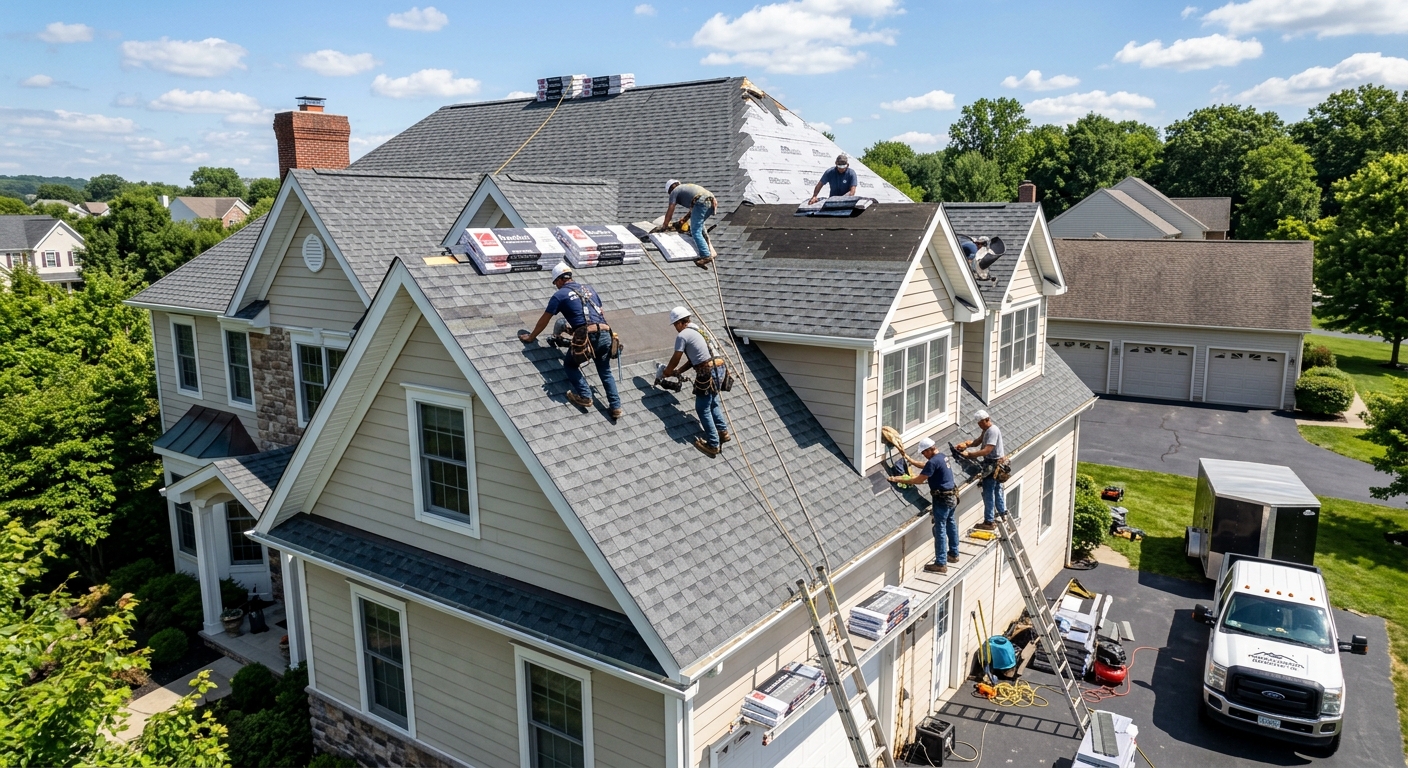
What roof replacement costs in Limerick in 2026
Limerick’s roofing market reflects the realities of Montgomery County’s high homeownership rate and abundance of single-family homes (U.S. Census Bureau, ACS 2024). With most houses owner-occupied, there’s consistent demand for timely roof replacement due to the clear incentive to maintain major assets. On any street in Limerick, you’ll see the legacy of post-WWII construction in its roof architecture and material choices—those homes closely mirror the tract housing in Abington and Cheltenham. When roofing fails in Limerick, it’s not just a patch job; with so many homes built after the war boom, full asphalt roof replacements are the norm rather than the exception. These jobs range from tearing off first-generation 3-tab shingles to updating to modern architectural products, especially as code and HOA pressures have nudged homeowners toward higher-end options.
Most current full-replacement jobs in Limerick focus on architectural asphalt shingles, which suit the moderate freeze-thaw cycles of southeastern Pennsylvania and meet HOA requirements found throughout Montgomery County townships. Metal roofing is seen, but more often on custom builds or rural edges of the zip code. For low-slope sections and additions, TPO or EPDM membranes come up when decks wear out, often on decades-old porches or dormers. Actual repair costs for leaks, as opposed to full replacements, often come into play when a known trouble spot (like a skylight or chimney) is the only concern. Limerick’s current prices cluster tightly—here’s what to expect:
| Material / Scope |
Lifespan |
Best for |
Price range (installed) |
| Asphalt shingles — architectural (30-yr) |
25–30 yrs |
Traditional single-family homes |
$10,500–$22,000 |
| Asphalt shingles — impact-resistant (Class 4) |
30+ yrs |
Storm-prone areas, HOA properties |
$17,000–$22,000 |
| Metal standing seam |
40–70 yrs |
Custom homes, snow-shedding roofs |
$25,500–$45,500 |
| Flat roof — TPO or EPDM |
15–25 yrs |
Low-slope sections, porches, dormers |
$13,500–$26,500 |
| Roof repair — leak or isolated section |
n/a |
Chimney, flashing, or small area fixes |
$550–$2,100 |
Prices are estimates for a typical Limerick home and vary with roof size, pitch, decking condition and material selection.
What moves the price of a roof in Limerick
In Limerick, two nearly identical houses can get quotes differing by thousands, not because of arbitrary pricing but due to real, local cost drivers. The most direct variable is the size of your roof—every “square” (that’s 100 square feet) your house has, multiplied up, sets the material and disposal tally. Homes built during Limerick’s main housing wave, repeating the Abington and Cheltenham model, tend to have mid- to large-sized gable roofs that land toward the higher end when re-shingling with architectural options. This means, for most owner-occupied single-family homes, asphalt shingle replacement usually lands in the $10,500–$22,000 range, with bigger homes topping the chart.
Pitch and access are a bigger factor here than in many places. Steep rooflines—common on the postwar stock—require full harness setups and extra time, pushing labor up by 20–30%. If the house has more than a single layer of old shingles, code (the Pennsylvania Uniform Construction Code, per the PA Department of Labor & Industry) requires a full tear-off, with each extra layer adding $500–$1,500 in disposal and labor costs. Given southeastern Pennsylvania’s 30 psf ground snow load, roofers often include ice barriers at the eaves, especially if the home has had ice damming in the past, for another $300–$800.
Decking is another wild card: Most homes in the area use plywood, but anywhere damage from a past leak is uncovered, you might see a sheet or two swapped out at $75–$150 each. Upgrading to impact-resistant Class 4 shingles for better wind and storm resilience—no overkill, considering the Schuylkill River valley’s thunderstorm exposure—can lift the material charge by $500–$2,500 depending on the house.
| Factor |
Why it matters here |
Cost impact |
| Roof size in squares |
Each square is 100 sq ft of roof surface — most Limerick homes are mid- to large-size due to postwar construction |
Primary multiplier |
| Pitch and access |
Steep pitches need harnesses and slow the crew — common on local tract homes |
+20–30% labour |
| Existing layers to tear off |
Two or more layers means full tear-off and disposal (per UCC code) |
$500–$1,500 per layer |
| Decking condition |
Rot is found during tear-off, not before; plywood common on homes here |
$75–$150 per sheet |
| Ice barrier at eaves |
Required where ice damming has a history; 30 psf snow load is a real local factor |
$300–$800 |
| Material grade |
3-tab vs architectural vs Class 4 impact-resistant — architectural is HOA favorite locally |
$500–$2,500 |
Limerick homes and their roof lines
Limerick’s housing stock lines up with the trends seen across Montgomery County: the dominant share of single-family homes, and a construction wave that really gained steam after World War II. Fewer than one in five homes here were built before 1980 (U.S. Census Bureau, ACS 2024). That means most roofs in Limerick aren’t the 80-year-old structures you’ll find in the county seat, but rather suburban builds from the 1970s onward, built with plywood or OSB roof decking under their original shingles—not plank boards.
These homes usually feature moderate to steep gable rooflines, which translate to straightforward—but sometimes steep—working conditions for a roofer. That roof pitch, plus the square footage typical of postwar development, is why most Limerick owners face higher average price tags for replacement. These are “first-replacement” roofs, rather than the second or third recovery seen in older communities. So if your home was last roofed in the late 1990s or early 2000s, it’s probably now due for its first full tear-off and re-roof.
It’s unlikely—though not impossible—to find multiple shingle layers on these post-1980 builds, since Montgomery County enforcement and modern codes discourage roofovers. And while the original builds rarely flashed or decked to today’s standards, you’ll see proper underlayments now, especially ice barriers, as the local snow load and updated codes have tightened requirements. Expect plywood decking in decent shape if nothing’s leaked, and a roofline built for a 25–30 year cycle of replacement, not early failure due to chronic neglect.
Roofing warranties in Limerick: what's actually covered
Nearly every Limerick homeowner who asks about roofing warranties wants “lifetime peace of mind,” but the reality is more nuanced—and worth understanding before you sign. In Montgomery County, as elsewhere, you’ll get two distinct layers of warranty: the manufacturer’s warranty (on the product) and the installer’s (on labor and workmanship).
Manufacturer warranties, common with all the big asphalt brands, cover material defects—shingles failing prematurely, or manufacturing flaws. These are usually heavily prorated after the first decade, and always subject to proper installation (including correct ventilation; improper venting can void any claim). Registration deadlines apply—typically within 30 to 90 days of install if you want full protection. Most can be transferred one time when you sell, but paperwork has to be done promptly and new owners should confirm transfer during closing.
The contractor’s workmanship warranty, on the other hand, is only as strong as the company’s reputation and survival in the local market. Many outfits offer 10-year (or even 25-year) labor coverage, but a 25-year promise from a business that’s two years old isn’t the same as 10 years from a crew that’s roofed Limerick homes for decades. Missed registration, layering new shingles over old ones, or poor attic ventilation can all void even the best written warranty. Get every coverage detail in writing, and ask pointed questions about what is—and isn’t—covered if you ever have a problem.
Roofing permits in Limerick: what you need before work starts
Roofing work in Limerick falls under the Pennsylvania Uniform Construction Code (UCC), which is enforced by the PA Department of Labor & Industry or by local township code offices if the municipality hasn’t opted out. In places like Norristown, replacing more than 25% of an existing roof surface typically means a building permit is mandatory. For smaller repairs—especially those under one roofing square—some nearby townships, like Lower Merion, allow minor work without a permit. So, if you’re planning a full tear-off and replacement in Limerick, you will almost always need a permit; patch jobs under one square may not trigger this requirement, depending on the township.
Every roofing contractor working on jobs over $500 is required to be registered as a Home Improvement Contractor (HIC) with the Pennsylvania Office of Attorney General. You should verify your contractor’s registration at hic.attorneygeneral.gov before signing. Workers’ compensation for all employees is mandatory in Pennsylvania, and homeowners should confirm their contractor’s coverage status using WCAIS (wcais.pa.gov).
Under the Home Improvement Consumer Protection Act (HICPA), any roofing contract over $500 must be in writing, and you are entitled to a 3-business-day right of cancellation. No roofer can legally waive your homeowner’s insurance deductible, and you should avoid anyone who offers this.
Material comparison for Limerick homeowners
When it comes to material choices in Limerick, climate and code realities matter more than magazine buzzwords. Architectural asphalt shingles dominate Montgomery County not by accident, but because they strike a balance between upfront cost, long-term performance, and the kind of look that HOAs in Upper Dublin or Cheltenham consistently approve. With a 30 psf ground snow load and winter design temperatures down to 14°F, asphalt’s flexibility and easy patchability give it an edge for most local homes. That’s why a typical full-job lands in the $10,500–$22,000 range and lasts up to 30 years if installed right.
Metal standing seam roofs are physically tougher, shed snow instantly (useful during the freeze-thaw cycles that hit Limerick), and last 40–70 years. But unless you’re planning to stay in your home for decades and can handle the upfront hit ($25,500–$45,500), the payoff just isn’t there for most. Flat roof membranes (TPO/EPDM) have their place, specifically on additions or low-slope sections where shingles would fail quickly.
If your roof takes a pounding from wind or hail—more of a real risk near the Schuylkill River valley—Class 4 impact-resistant shingles ($17,000–$22,000) might make sense. But for the vast majority of Limerick jobs, especially first replacements on postwar housing, architectural asphalt is a practical, code-compliant choice. Expensive materials are rarely justified unless your roof sees exceptional abuse or you’re eliminating insurance claims or chronic storm repairs.
| Material |
Installed cost |
Lifespan |
Cold-climate performance |
Maintenance |
| Asphalt architectural |
$10,500–$22,000 |
25–30 yrs |
Reliable with proper ventilation and ice barrier |
Occasional shingle or flashing repairs |
| Asphalt Class 4 impact-resistant |
$17,000–$22,000 |
30+ yrs |
Stronger in wind/hail events, otherwise similar |
Low, can outlast standard shingles in heavy storms |
| Metal standing seam |
$25,500–$45,500 |
40–70 yrs |
Excellent, immediate snow-shedding |
Minimal, but fastener and coating checkups advised |
| TPO / EPDM membrane |
$13,500–$26,500 |
15–25 yrs |
Stable, but seams must be flawless; vulnerable if ponding occurs |
Annual inspection, seam touchups as needed |
When to book roofing work in Limerick
Limerick sits squarely within southeastern Pennsylvania’s freeze-thaw belt, so roofing is a seasonal sport. Peak replacement season runs from late April through early November, when daytime highs let shingles seal and adhesives cure properly. If you want your new roof to last its full design life, book installs when temperatures are consistently above 45°F—you don’t want to roll shingles in December cold or August humidity unless you’re up against a leak emergency.
The market here is dense—Montgomery County forms part of the Philadelphia metro’s crowded contractor pool, especially around townships like Lower Merion. That means spring and fall fill up fast, and it’s not uncommon for reputable local roofers to be booked out six weeks or more during September and October. If you plan a late-season job, expect to pay more or face scheduling delays.
Emergencies are another story. A storm-damage tarping or patch job in February, when crews are working with short daylight and bitter wind, almost always lands near the top of the repair price band ($2,100). Plan ahead—if your roof is failing, it’s more cost-effective and convenient to schedule for early fall than to wait for a leak right before the holidays.
Frequently asked questions — roofing in Limerick
Does attic ventilation matter in Limerick's climate?
Attic ventilation is critical in Limerick given our mix of cold winters and humid summers. Without adequate airflow, heat and moisture can build up under your roof deck, which leads to premature shingle aging, warped decking, and even potential mold. Pennsylvania’s codes—including the Uniform Construction Code enforced here—don’t just suggest ventilation: they expect it, in part because our 30 psf ground snow load and 14°F winter design temperature mean ice damming and condensation are local risks. A roof replacement done without fixing underlying vent issues won’t last its stated 25–30 years, and can even void your manufacturer’s warranty if a future claim arises. When budgeting for a project in the $10,500–$22,000 range, include soffit-to-ridge ventilation upgrades—they’re a low percentage of total cost, but make all the difference in life expectancy here.
What does roof replacement cost per square in Limerick?
In Limerick, you can expect to pay anywhere from $650–$1,100 per roofing square (that’s 100 square feet) installed for a typical architectural asphalt system. This puts most full replacement jobs on local homes well within the $10,500–$22,000 band, depending on size, pitch, and tear-off work. Homes built after 1980 tend to have larger footprints and moderate roof slopes, increasing total squares compared to older city rowhomes. Additional layers, steep pitches, or the need for upgraded materials like Class 4 impact-resistant shingles can push per-square rates toward the high end of the band. For repairs of just a section, costs per square naturally skew much higher, sometimes exceeding $2,100 for a small, isolated fix.
Do I need to leave my house during a roof replacement?
For Limerick’s single-family homes, you won’t need to leave during a typical full roof replacement. The vast majority of jobs here—especially those in the $10,500–$22,000 bracket—are completed from outside, with only brief access to attics if ventilation is being improved. The main discomforts you’ll experience are noise, vibrations, and driveway or yard access being limited. If you work from home or have young children, plan for a couple of long, noisy days. For more extensive work (like when decking or significant rot repairs are found), there may be more interior disruption, but it’s rarely cause to relocate. Your roofer should tarp properly to protect landscaping and clean up thoroughly. For safety, keep pets and children inside or at a friend’s house while crews are overhead.
How do I confirm a roofer carries workers' compensation?
In Pennsylvania, including Limerick, every roofing contractor with employees must provide workers’ compensation, no exceptions. You have two ways to verify their coverage: first, ask your contractor for a certificate of insurance showing current workers’ comp. Second, and more reliably, check the state’s Workers’ Compensation Automation and Integration System (WCAIS) at wcais.pa.gov. Enter the company’s name and confirm policy status is active. This is a non-negotiable, especially for jobs over $500—liability for injuries shouldn’t fall on the homeowner if a worker is hurt while roofing in your yard. Contractors who dodge this question or won’t provide proof should be crossed off your list immediately.
What is the difference between TPO and EPDM?
TPO (thermoplastic polyolefin) and EPDM (ethylene propylene diene monomer) are both flat roof membranes used throughout Limerick, especially on porches and low-slope home additions. TPO is a white, heat-welded membrane that reflects sunlight and is a little stiffer, while EPDM is a black rubber membrane, typically adhered or mechanically attached, that handles ponded water better but absorbs more heat. With our moderate freeze-thaw cycles and some risk of ponding from snowmelt, either can be the right choice, but TPO often wins on energy efficiency for sun-exposed roofs, and EPDM is proven for longevity on shaded additions. Costs in Limerick for a new membrane roof fall in the $13,500–$26,500 band, and the better option is decided by exposure, not just price alone.
What are the signs of hail damage on a roof?
Hail isn’t an annual event in Limerick, but when storms hit the Schuylkill River valley, they can leave marks. Hail-damaged shingles often show circular bruises, surface granule loss, or soft spots you can feel underfoot or see from a ladder. It’s easiest to spot after a storm when loose granules collect in your gutters or at downspout ends. Metal roofs may dent but rarely lose waterproofing. With asphalt shingles, a roof that has a cluster of bruised tabs or surface cracks from hail may need more than a basic repair—even if the damage looks cosmetic, water can work its way in. Typical repair costs for smaller affected areas land in the $550–$2,100 band, but heavy, widespread hail can require a full replacement in the standard price ranges.
Should I use a local roofer or a national company?
In the saturated Montgomery County market, including Limerick, you’ll see both local operators and larger, branded roofing companies. Local roofers know the quirks of our postwar tract roofs—decking types, HOA restrictions, township inspectors better than a crew from farther afield. National chains, on the other hand, sometimes offer more robust corporate warranties, but you’re often paying administrative overhead. For roof replacement projects in the $10,500–$22,000 range, a deeply local company is in a better position to spot ice dam risks, venting mistakes, or handling township paperwork. Ultimately, whoever you choose should be HIC registered and verifiable via the state’s registry, and you should feel comfortable you’d get service if there’s a warranty call back five years down the line.
Do I need my own inspection before the adjuster visits?
If you suspect storm damage in Limerick and are filing a homeowner’s insurance claim, it’s wise—but not mandatory—to have a roof professional inspect before your adjuster arrives. An experienced local roofer, familiar with Limerick rooflines and storm patterns, can mark problem areas and spot legitimate claim items that might be missed by someone who only sees your home for 15 minutes. This can make your interaction with the adjuster smoother and less adversarial. For repairs under $2,100, a small leak or shingle damage may not be worth a claim if your deductible is close to that number, but for widespread hail or wind damage, having clear documentation from a trusted roofer can only help. Remember, self-inspections are fine for visible damage, but don’t walk on the roof yourself.
What's the cheapest way to replace a roof in Limerick?
The most cost-effective roof replacement in Limerick is almost always a straightforward tear-off and re-roof with architectural asphalt shingles—favoring simple gables and minimal add-ons. If you keep your material grade to standard architectural (rather than Class 4 impact), and your roof has only a single old layer to remove, most Limerick jobs will come in at the low end of the $10,500–$22,000 range. Avoid unnecessary upgrades—no fancy metal unless you want a 70-year roof, and no added features unless storm exposure makes them critical. Always get a few quotes, check HIC registration, and avoid any roofer who tries to push work you didn’t ask for, especially in our highly competitive local market. Patching only bad spots doesn’t pay long-term if your shingles are curling or leaking in more than one area.