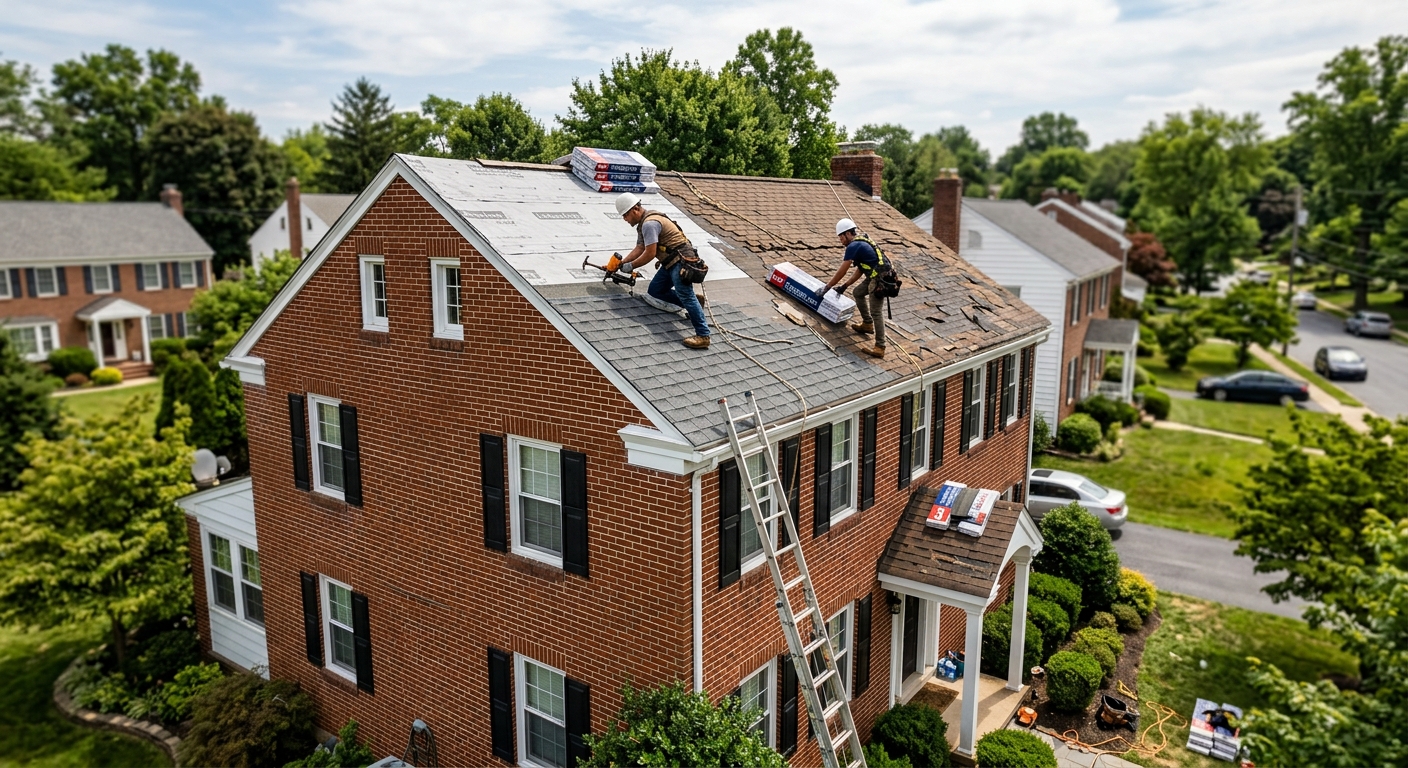
What roof replacement costs in Swatara in 2026
In Swatara, roof replacement decisions are shaped by the mix of older homes and high homeownership. With 87.5% of households owning their homes and most single-family (83.8%) construction concentrated before 1980, owners face the reality of aging roofs needing more than patchwork. That means most roofs you'll see in Swatara have either approached their end-of-life, or will soon, especially if they still have original systems or minimal updates.
Lebanon’s postwar housing surge (1945–1975) set the tone for Swatara’s neighborhoods: these homes were typically built with steeper pitches and, outside the city, often with plank or early plywood roof decks. There was little attic ventilation or ice barrier required by code at the time, so most homes are due for upgrades during re-roofing. Those conditions directly affect scope — from the likely need to bring roof ventilation up to today’s Pennsylvania Uniform Construction Code, to the common removal of multiple shingle layers on each tear-off.
If you’re budgeting for a roof, here’s what real Swatara projects look like:
| Material / Scope |
Lifespan |
Best for |
Price range (installed) |
| Asphalt shingles — architectural (30-yr) |
25–30 yrs |
Lebanon County single-family homes |
$9,100–$19,000 |
| Asphalt shingles — impact-resistant (Class 4) |
30+ yrs |
South Mountain wind exposure |
$15,000–$19,000 |
| Metal standing seam |
40–70 yrs |
Farmhouses, custom homes |
$22,000–$39,000 |
| Flat roof — TPO or EPDM |
15–25 yrs |
Low-slope and rear porch roofs |
$11,500–$23,000 |
| Roof repair — leak or isolated section |
n/a |
Small area fixes (flashing, pipe boots) |
$475–$1,800 |
Prices are estimates for a typical Swatara home and vary with roof size, pitch, decking condition and material selection.
What Swatara's housing stock means for your roof
Swatara’s roofscape is a direct reflection of Lebanon County’s postwar building boom. Over 55.2% of homes here went up before 1980, which matters for your roof in several ways. First, most houses from this era have simple gabled or hip roofs with moderate pitches, designed when labor and materials were both affordable and standards lower. Roof decks are usually plank or early plywood, not OSB, which is good for lasting power but often means there are old shingle nails and surface unevenness under current roofs.
If your house was last roofed before the mid-2000s, there’s a real chance it lacks ice barrier along eaves — it simply wasn’t in the code yet. Attic ventilation is another weak spot: early venting methods (soffit grilles, minimal ridge vent) are the rule, not the exception. When roofers in Swatara go to replace a system from this housing wave, they often find two or even three layers of old shingles that must be stripped before installing the new roof. This depth adds to labor costs and makes re-roofing a heavier job than most newer construction areas.
For homes from the late-90s or 2000s pocket developments, you’re likely facing your first replacement, which is more straightforward (no buried layers and better sheathing) — but even these can surprise you if attic moisture or inadequate venting shows up in the tear-off.
Permits and code requirements in Swatara
Roofing work in Swatara is governed by the Pennsylvania Uniform Construction Code (UCC), which follows the International Residential Code (IRC) as its backbone. Who enforces it depends on your exact address: in Lebanon city, roof replacements that include replacement of structural decking or any truss repair require a building permit, handled through the City of Lebanon Code Enforcement Office. If you’re in North Lebanon Township or the other townships around Swatara, minor shingle repairs covering less than one roofing square typically proceed without a permit. Full replacements and any project involving deck or truss work may still trigger a permit, so always check with your local township or the authority handling UCC enforcement for your property.
Pennsylvania does not require a specific state roofing license, but any contractor performing work over $500 must have a Home Improvement Contractor (HIC) registration issued by the Pennsylvania Office of Attorney General. Always verify a contractor’s registration at hic.attorneygeneral.gov before signing a contract. Because all employers in Pennsylvania are required to carry workers’ compensation insurance, you can check coverage through WCAIS at wcais.pa.gov. Both checks help protect you from unregistered or uninsured operators, which are a real risk even in a moderate local market like Lebanon County.
Remember, for any job over $500, a written contract is required, and you have a 3 business-day right of cancellation under state law.
Filing a roof claim after a Pennsylvania storm
If a storm damages your Swatara roof, start by taking clear photos of every affected area before cleanup or temporary repairs. Insurers expect proof of condition at the time of loss, and documenting everything — missing shingles, water stains, dented gutters — will make your claim go much smoother. Next, get a written scope of loss either from your insurance adjuster or a qualified roofer who works regularly in Lebanon County. This outlines what’s needed for a complete, code-compliant repair or replacement, not just a quick patch job.
Pennsylvania insurers pay claims either at actual cash value (ACV) — factoring in depreciation — or replacement cost value (RCV). If your policy is ACV only, you’ll have to cover the gap between the depreciated value and the true replacement price, which is a significant consideration when a new roof might cost $9,100–$19,000 for shingles or much more for metal.
Don’t be pressured by anyone offering to “eat” or cover your deductible. Pennsylvania specifically prohibits waiving a homeowner's insurance deductible. Any contractor making that offer is violating the Home Improvement Consumer Protection Act and you should walk away immediately — insurers and state authorities both see this as insurance fraud.
Expect the insurer to send an adjuster to inspect your property. Be present and have your own roofer there if possible to make sure nothing is missed. Only sign a contract once you have the final scope, description of repairs, and full understanding of what your insurer will and will not pay for.
Patching vs full replacement in Swatara
For Swatara homeowners, the roof repair vs. replacement decision is clearer than you might think. If your asphalt roof is under 15 years old and the leak is isolated — often at a pipe boot, flashing, or ridge vent — a repair is cost-effective and usually extends the life of the system for several years. But with much of the housing built before 1980, most roofs run 20 to 30 years between full replacements, and repairs become less sensible after the 20-year mark. In this era, leaks often signal systemic failure, not just bad luck.
If you’re patching every year or two, those bills add up quickly: two leak repairs averaging $1,150 each will cost over $2,300 in just two years. That's a significant dent in the cost of a full replacement — usually $9,100–$19,000 for architectural asphalt in Swatara. Once you’re facing cracked, curling, or missing shingles in multiple spots — especially if your attic deck is plank from the original build era — a new system makes more financial sense. Emergency tarping or winter repairs are just stopgaps; they’re only worth it if replacement can’t happen right away.
| Situation |
Recommendation |
Typical cost |
Reasoning |
| Under 15 years, one isolated leak |
Repair |
$475–$1,800 |
Roof system still has life; fix and monitor |
| 15–25 years, several leak points |
Replace |
$9,100–$19,000 |
Leaks suggest widespread wear; repair isn’t cost-effective |
| 25+ years, any active leak |
Replace now |
$9,100–$19,000 |
Roof at end-of-life, risk of sheathing damage |
| Storm damage, wind or hail |
Document, claim, replace |
$9,100–$19,000 |
Document before cleanup; insurance may fund replacement |
| Flat roof ponding or blistering |
Replace membrane |
$11,500–$23,000 |
Damage signals full system fatigue on low-slope roofs |
| Active leak entering winter |
Emergency repair, schedule replacement |
$475–$1,800 |
Prevent interior damage until full job can be scheduled |
Water management on a Swatara roof
A roof in Swatara is only as reliable as its water shedding system. That means your gutters, downspouts, drip edge, and the ground grade all work together — and if one piece is wrong, you can have leaks, foundation trouble, or basement moisture. Replacing just the shingles without addressing old or undersized gutters is a half-measure; new roofs need gutters in shape to manage Lebanon County’s moderate snowmelt and heavy storm runoff.
Downspouts discharging too close to your foundation put basement walls at risk — a special concern for the region’s older block basements and slab-on-grade additions. Modern drip edge is now required by code, but it only works if water is then caught and carried away by functioning gutters and extended downspouts. Some roofing warranties are voided if drainage is poor, since water splash-back or overflow damages the new fascia and lower roof.
For most Swatara homes, full seamless aluminum gutter replacement during a roof job adds about $2,200–$4,400 (depending on length and number of stories) to the main roof bill — a smart investment in protecting both your roof and your foundation.
When to book roofing work in Swatara
Swatara follows Lebanon County’s south-central Pennsylvania climate: pronounced freeze-thaw, moderate snowfall, and winter lows near 12°F. The best work window for asphalt and metal roofing installation runs April through early November, with May, June, September, and October especially reliable for temperature and crew availability. Crews in this moderate suburban market aren’t oversold like in denser metro corridors, but local pros are still booked out 2–6 weeks for full replacements in summer and early fall.
Shingle systems need warm enough temps for proper sealing — at least 40°F and climbing — so March and late November installs often require hand-sealing each tab. Emergency jobs in January or February (when we see the harshest freeze-thaw cycles) cost more, both for materials and for labor pulled from other tasks. Flat roofers may refuse membrane installs if conditions are too cold for adhesives to cure. If you want the best deal and the fewest headaches, plan roof work for after the last frost but before leaf drop in November.
If your roof is leaking now, don’t wait for the ideal weather — a small emergency repair may run $475–$1,800, but waiting until spring could double your interior repair costs.
Frequently asked questions — roofing in Swatara
How much deposit should I pay a roofer upfront?
Pennsylvania regulates deposits on home improvement contracts. In Swatara, you should not pay more than one-third of the contract price as a deposit. The Home Improvement Consumer Protection Act (HICPA) requires a written contract for any job over $500, and explicitly limits deposits to this percentage — so if your replacement roof comes to $15,000, your deposit should never be more than $5,000 before work begins. Final payment is customarily due only when the job is done and passes municipal inspection, if one is required. Reputable Lebanon County contractors know this rule and will never ask for full payment upfront. If a roofer is pressuring you for half (or more), that’s a red flag to look elsewhere.
Do I need a permit to replace a roof in Swatara?
Permit requirements in Swatara depend on the municipality. In Lebanon city, any roof replacement that involves replacing structural decking or repairing trusses will require a building permit from the City of Lebanon Code Enforcement Office. In the county’s townships, like North Lebanon, you typically do not need a permit for minor repair work covering less than one roofing square — a single leak patch, for example, which runs $475–$1,800. For full replacement, especially if it involves updating attic ventilation or any deck repairs, check with your township office or whoever handles enforcement of the Pennsylvania Uniform Construction Code (UCC) in your area. Your roofer should handle the paperwork, but don’t proceed without confirmation.
How do I know if my Swatara roof needs replacing?
The typical Swatara home was built before 1980, meaning most roofs are on their second or third layer by now. If you’re seeing consistent shingle loss after storms, granular buildup in your gutters, soft spots when walking the roof, or ceiling stains appearing after a thaw, it’s likely time to replace. A patch might get you another season, but when multiple leaks or widespread curling appear, spending on repair adds up quickly. Two repairs at $1,150 apiece are almost a third of a new roof, which in this area averages $9,100–$19,000 for architectural asphalt shingles. Attic inspection may reveal old or rotten decking, another sign it's past repair time for roofs built in this construction era.
What is the difference between TPO and EPDM?
TPO (Thermoplastic Polyolefin) and EPDM (Ethylene Propylene Diene Monomer) are both membrane materials used on flat roofs, common on Lebanon County rear porches or low-slope additions. EPDM is a rubber-like black sheet, known for flexibility and proven track record; TPO is a bright white membrane that helps reflect heat, reducing attic temperatures in summer. In Swatara, TPO is a better pick if your flat roof gets a lot of sun and you want some cooling benefit. EPDM makes sense for shaded or lower-traffic roof areas. Either material, correctly installed, falls in the $11,500–$23,000 range for a typical job here, and both offer around 20-year lifespans with low maintenance.
What is the best time of year to replace a roof in Swatara?
The best months for roof replacement in Swatara are April through early November. In south-central Pennsylvania, you want consistent weather above 40°F so that shingles seal properly and adhesives cure on low-slope membranes. Most reputable crews are booked ahead, especially for full replacements between late May and mid-October when rain and extreme heat are rare. The sweet spot for price and quality is often September, before the fall rush for emergency jobs after summer storms. Emergency roof work in winter — say, in February — can cost more, since roofers may need to hand-seal shingles and handle snow or ice. Even a small patch then can run $475–$1,800.
Do I need my own inspection before the adjuster visits?
It’s wise to have your own experienced roofer check your Swatara roof before your insurer’s adjuster shows up, especially after a storm. Local pros spot hidden hail bruising, wind-lifted shingles, or damaged flashing that outsiders may miss. A contractor’s report, complete with photos, can help you dispute an adjuster’s lowball scope or overlooked damage. If the roofer also gives you a written estimate — say, showing your storm repair or replacement is in the $9,100–$19,000 band — you’ll have leverage for full, code-compliant work rather than spot fixes. That’s important, because local storms often expose decades-old flaws that insurance should address.
Does attic ventilation matter in Swatara's climate?
Absolutely. With most Swatara homes built before modern codes, poor ventilation routinely shortens roof life. Insufficient intake and exhaust vents allow poor air flow, trapping moisture and heat — a big deal here, where freeze-thaw cycles are strong and there are over 5,200 heating degree days a year. The result is curling shingles and, sometimes, attic mold. Upgrading your vents when re-roofing (especially if spending $9,100–$19,000 on a new system) is money well spent, and often now required by code. Proper venting keeps roof decks dry and helps shingles last closer to their full rated lifespan.
What's the cheapest way to replace a roof in Swatara?
The most cost-effective roof replacement in Swatara is a single-layer tear-off with a basic architectural asphalt shingle — nothing fancy, just durable. Avoiding luxury materials and steep-slope work keeps costs at the lower band, about $9,100 for an average-size home if the deck is solid and disposal is simple. Resist anyone pushing a second layer of shingles or skipping code-required ice barrier — that’s risky in Lebanon County’s freeze-thaw climate, and can void warranties. If you need to save further, consider having gutters and low-slope sections done later, not by using cut-rate materials or unregistered crews.
How much does a flat roof replacement cost in Swatara?
Flat roof replacement on a Swatara home — think TPO or EPDM membrane on a low-slope addition or garage — averages between $11,500–$23,000 in 2026. That spread covers everything from basic residential walk-off porch roofs at the low end to larger garages or light commercial-grade flats at the high end. Labor, deck repairs, parapet work, and the need to tie into existing guttering all nudge the price upward. Membrane jobs are more sensitive to weather; your roofer will schedule for spring through fall for best adhesive cure. Prices stay high if there’s rotten decking found, or if you want to add insulation or improve drainage at the same time.