Roofing Contractor
Pennsylvania
For Lower Merion homeowners needing shingle replacement, our contractor partners provides licensed PA roofers. Flat roof systems — replacement from $8221. No-obligation quote available.
Several roofing estimates requested this week in Lower Merion
Lower Merion Housing Data — ACS 2024
Older housing stock
82%
of homes pre-1980
Homeowners
17,987
owner-occupied units
Ownership rate
75%
of households own their home
Single-family homes
56%
of housing units
Median household income
$160,572
annual (ACS estimate)
With 82% of Lower Merion's housing stock built before 1980, aging infrastructure is one of the leading drivers of roofing contractor calls in Montgomery. Older systems deteriorate faster, increasing risk and repair costs for homeowners.
COST RANGE
Estimates based on roof size, pitch, material and tear-off requirements
Insurance tip: Most homeowner policies cover sudden damage. Ask your contractor about documentation to maximize your claim.
* Estimates for Lower Merion, Pennsylvania. Final pricing after on-site assessment.
Proper attic ventilation and insulation protect your Lower Merion roof from premature failure. Our contractors assess and correct ridge vents, soffits and attic insulation levels.
From missing shingles to flashing leaks and soffit damage, our Lower Merion roofers diagnose and fix problems fast. Emergency tarping available same-day for active leaks.
TPO, EPDM and modified bitumen flat roof systems installed by certified Lower Merion contractors. Seamless membranes, proper drainage slope and manufacturer warranties.
Hail and wind storm damage assessment by licensed Lower Merion roofers. Detailed documentation for insurance claims, emergency tarping and priority scheduling for storm-damaged homes.
Seamless aluminum and copper gutters installed and repaired by our Lower Merion contractors. Proper sizing, downspout placement and gutter guards to protect your roofing investment.
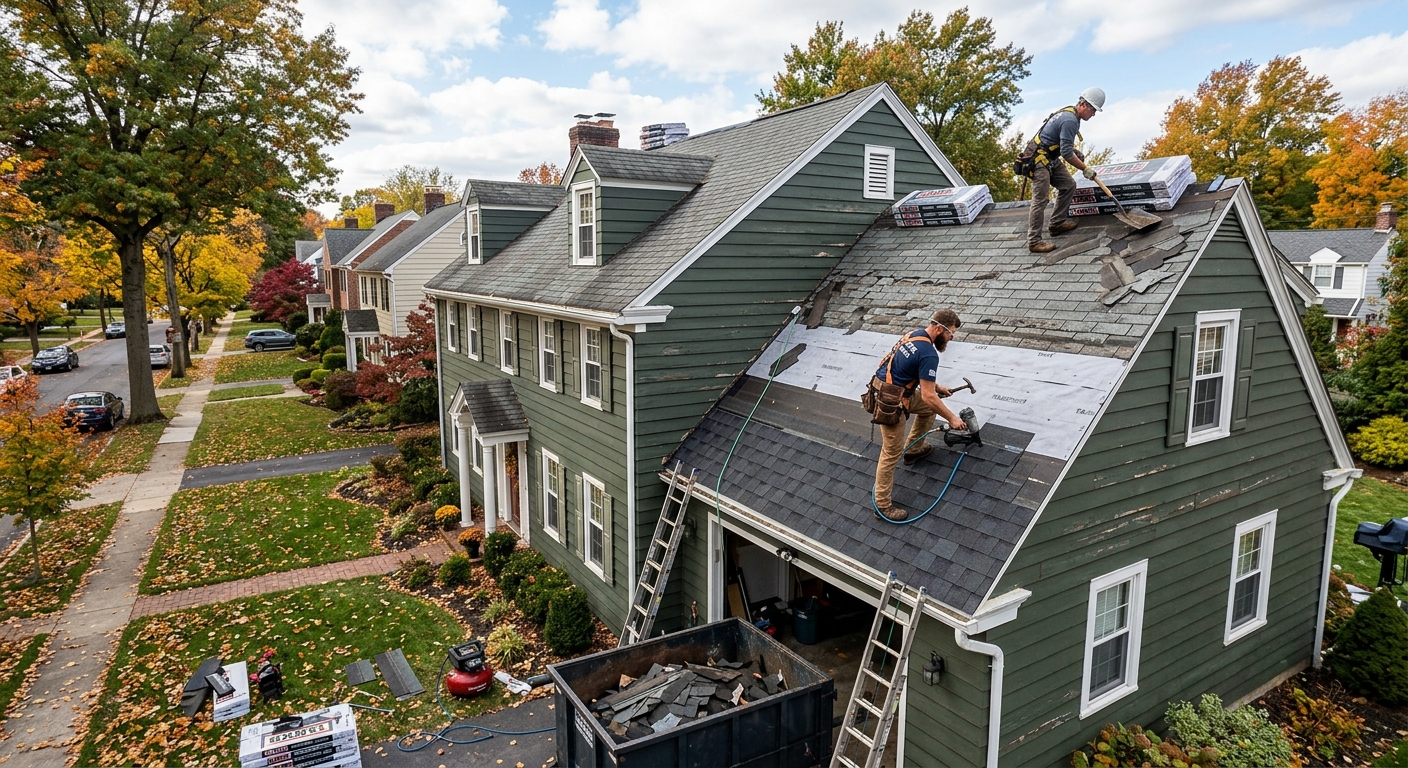
Complete tear-off and replacement of your Lower Merion home's roofing system. Our licensed contractors install manufacturer-certified shingles with full underlayment, flashing and ridge cap. Most jobs completed in 1-2 days.
Professional roof inspection by licensed Lower Merion contractors — pre-purchase inspections, annual maintenance checks, warranty inspections. Written report with photos included.
Standing seam and corrugated metal roofing systems installed by certified contractors in Lower Merion, PA. Lifespan 40-70 years, energy-efficient, low maintenance.
Lower Merion sits in Montgomery County’s most competitive roofing market, shaped by decades of high homeownership (74.6%) and a population of over 63,000 (U.S. Census Bureau, ACS 2024). These residents have invested heavily in their homes, and the township’s roofing expectations—and pricing—reflect that. Because 81.7% of homes were built before 1980, many roofs in Lower Merion are at or beyond their original lifespan, driving real demand for replacements, not just cosmetic repairs.
Post–World War II tract housing in Abington and Cheltenham created a wave of neighborhoods with similar roof profiles: moderate-pitch, mid-century wood decking, and a design built around architectural asphalt shingle replacements. Most Lower Merion homes share that DNA, so when you bid a roof in this township, the scope often means plywood overlay, proper attic ventilation, and—unless previously updated—removal of multiple shingle layers.
The table below reflects what homeowners can realistically expect to pay for the most common Lower Merion roofing work in 2026. These figures assume a typical single-family home, steep enough for shingles but with possible flat sections over additions or porches.
| Material / Scope | Lifespan | Best for | Price range (installed) |
|---|---|---|---|
| Asphalt shingles — architectural (30-yr) | 25–30 yrs | Suburban family homes, HOA compliance, first replacement after original roof | $11,500–$24,500 |
| Asphalt shingles — impact-resistant (Class 4) | 30+ yrs | Wind-prone sites, homes protected against insurance surcharges | $19,000–$24,500 |
| Metal standing seam | 40–70 yrs | High-end homes, homes with complex roof shapes, long-term investment | $28,000–$50,000 |
| Flat roof — TPO or EPDM | 15–25 yrs | Porches, additions, low-slope sections, rowhouse rears | $14,500–$29,000 |
| Roof repair — leak or isolated section | n/a | Spot leaks, minor storm damage, single-area fixes | $600–$2,300 |
Prices are estimates for a typical Lower Merion home and vary with roof size, pitch, decking condition and material selection.
Flat or low-slope roofs are common in Lower Merion—think porch roofs, kitchen additions, and rear sections on older homes. These areas demand a totally different roofing system than pitched main roofs. Asphalt shingles, which rely on water quickly running off, simply don’t last on slopes below 3/12: the water sneaks under tabs, and freeze/thaw cycles pull them right up. The result is leaks, rot, and repair call after repair call.
That’s why professional roofers here specify single-ply membranes like TPO or EPDM for any section at or under a 2/12 pitch. These materials are reinforced, flexible, and fully adhered or mechanically fastened for a watertight surface—built to resist ponding common on old porch and addition roofs in Lower Merion. A properly installed membrane lasts 15–25 years, which is only a bit shorter than a shingle roof, but the reliability and leak prevention are night and day. Expect a full flat roof membrane replacement in this area to cost $14,500–$29,000 depending on the square footage and whether additional insulation is included.
If a contractor quotes shingles on a 2/12 section, it tells you they’re either cutting corners or don’t know our local standards. That’s not a bid to trust with your house.
Montgomery County, including Lower Merion, is a crowded roofing market—there’s no shortage of available contractors, but that makes vetting each one even more important. In Pennsylvania, any job over $500 requires the contractor to carry a valid Home Improvement Contractor (HIC) registration from the Pennsylvania Office of Attorney General (check it at hic.attorneygeneral.gov) and provide a written contract. Employers must have workers’ compensation coverage; check this at WCAIS (wcais.pa.gov).
Red flags specific to our saturated market: door-knockers showing up unannounced after a storm, companies without a real Montgomery County address, non-local area codes, and anyone pressing you to sign a contract on the spot “because they’re in the neighborhood.” If it feels rushed, keep looking.
Over 81% of Lower Merion homes were built before 1980 (U.S. Census Bureau, ACS 2024), tying the township’s housing stock directly to mid-century subdivision and post-war tract development patterns common in surrounding Abington and Cheltenham. Roofs from that era are pitched (not flat), mostly 4/12 to 7/12, originally decked with 1x plank boards—plywood became standard only by the late 1970s. Few, if any, were built with a modern ice barrier: most only received basic asphalt felt underlayment, which means today’s replacements often expose hidden rot at the eaves where freeze-thaw is harshest.
Multiple roof layers are typical. Prior to the Pennsylvania Uniform Construction Code (UCC), it was common practice to add new shingles over the old to save money. Many Lower Merion roofs now have two, sometimes even three layers stacked up, which can stress decking and shorten lifespan. Tearing off all old material is almost always necessary for a long-lasting replacement—and for code compliance.
With the first replacement typically needed 18–25 years in, most mid-century homes in Lower Merion are on their second or even third roof by now. Expect that the job will involve correcting past shortcuts: thick stacks of old shingles, fragile plank sheathing, and possible unvented attics that need updating to modern code during replacement.
In Lower Merion Township, roofing work that involves only minor repairs—specifically, fixing under one roofing square (100 square feet) of shingles—can usually be done without a permit. For anything more substantial, including replacing over one square or performing a full roof replacement, you’ll need to pull a building permit. Permits in Lower Merion are enforced at the municipal level, under the Pennsylvania Uniform Construction Code (UCC), with oversight by the PA Department of Labor & Industry where townships have not opted in. In practice, Lower Merion Township operates its own code enforcement office.
To protect yourself, always verify that your roofing contractor is registered with the Pennsylvania Office of Attorney General for Home Improvement Contractor (HIC) work (hic.attorneygeneral.gov). Workers’ compensation insurance is mandatory—every employer must carry it—and you can check compliance status at WCAIS (wcais.pa.gov). Ask to see certificates for liability insurance as well.
For homes built before 1978, the federal EPA Lead RRP Rule applies to any project disturbing painted surfaces; verify the renovator’s certification at certifiedrenovatorsearch.epa.gov. No statewide roofing or trade license is required in Pennsylvania, but HIC registration and written contracts for jobs over $500 are mandatory under the Home Improvement Consumer Protection Act (HICPA). Remember—waiving your homeowner insurance deductible on a claim is illegal.
A repair seems tempting when your leak is minor and you’d like to avoid a complete replacement, but in Lower Merion’s aging housing stock, there’s a sharp line between a cost-effective fix and throwing money away. If your roof is under 15 years old and has one clear, isolated leak spot—for example, around a vent pipe or flashing—a professional repair costing $600–$2,300 can add years of service. But beyond 20 years, especially with multiple leaks, repairs become serial band-aids.
Take this scenario: if a 25-year-old roof develops several leak points, and you spend $1,450 each year patching it, three repairs put you over $4,350—money better invested in a replacement (typically $11,500–$24,500). Most Lower Merion roofs hit the 18–25 year threshold when even the best fixes are temporary. If your roof deck is original plank, and you see extensive shingle curling, patching rarely buys more than a season or two.
Flat roofing is even less forgiving: visible ponding, blistering, or seam failures on a 15-year-old membrane isn’t a repair job—it’s time for full replacement, generally $14,500–$29,000. Always ask for honest advice: if the reality is you’re due for a new roof, don’t pay a contractor to keep promising temporary miracles.
| Situation | Recommendation | Typical cost | Reasoning |
|---|---|---|---|
| Under 15 years, one isolated leak | Repair | $600–$2,300 | Modern roof, otherwise good condition; localized fix adds real lifespan |
| 15–25 years, several leak points | Replace | $11,500–$24,500 | Approaching end of life; patching just delays the inevitable |
| 25+ years, any active leak | Replace now | $11,500–$24,500 | Roof past functional life; further repairs waste money |
| Storm damage, wind or hail | Document, claim, replace | $11,500–$24,500 | Insurance claim covers full replacement; repairs not cost-effective |
| Flat roof ponding or blistering | Replace membrane | $14,500–$29,000 | Membrane failure; patching won’t stop new leaks forming soon |
| Active leak entering winter | Emergency repair, schedule replacement | $600–$2,300 | Quick fix to prevent interior damage until proper work can be done |
In Lower Merion, timing your roof replacement pays—literally. The best months for new shingle installation are late April through mid-November, when temperatures average high enough for shingle seal-down and crews can work efficiently. Summer brings humid heat but is still good for roofing; the real price jump happens when you need a roof in winter. Replacing a roof during January or February, when temperatures drop into the teens overnight and snow is not uncommon (ground snow load: 30 psf), means special cold-weather techniques and higher labor costs.
Because Lower Merion is part of a saturated metro roofing market, top contractors can book out 6–10 weeks in peak months—sometimes longer if a major thunderstorm or tropical rain event moves through Montgomery County. By contrast, emergency tarping or midwinter jobs cost more and often can’t be scheduled except at premium pricing, since crews juggle fewer daylight hours and tough weather conditions.
If you want first pick of schedule and project team, start getting estimates six weeks ahead of your preferred install—especially for September and October, when everyone in Lower Merion hopes to replace roofs before winter hits.