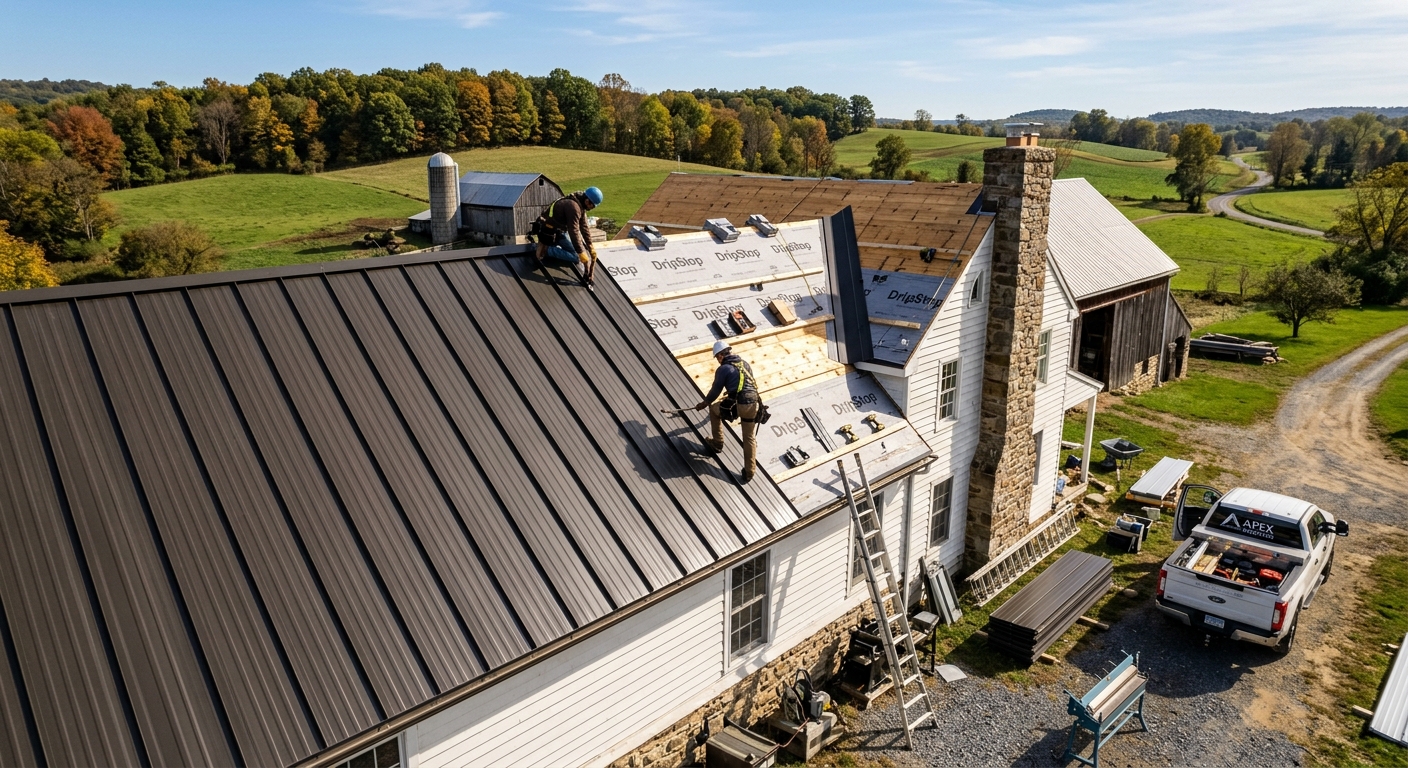
Lower Moreland roofing prices by material and scope — 2026
Lower Moreland’s roofing market is shaped by its high rate of homeownership—85.8%—and a housing stock where three out of four homes were built before 1980 (U.S. Census Bureau, ACS 2024). These older, mostly single-family homes lined along wide suburban streets drive consistent demand for roof replacements, especially with architectural shingles that match original appearances and Township standards.
The tract housing built after World War II in neighboring Abington and Cheltenham has set the template for much of Lower Moreland: simple rooflines, asphalt shingle dominance, and roofs nearing the end of their 25–30 year lifecycle. This means most replacement projects here aren’t one-off patches—they’re full tear-offs aimed at decades-old structures, making scope, style, and price predictably broad across the area.
Compared to more urban or rural areas, Lower Moreland homeowners face a saturated competitive market typical of inner Montgomery County, providing a wide bid range for the same roof—especially for upgrades like Class 4 shingles or full metal conversions. Below, you’ll find real numbers for what replacement or repairs cost in Lower Moreland’s current market.
| Material / Scope |
Lifespan |
Best for |
Price range (installed) |
| Asphalt shingles — architectural (30-yr) |
25–30 yrs |
Most Lower Moreland homes; HOA-friendly |
$11,000–$23,500 |
| Asphalt shingles — impact-resistant (Class 4) |
30+ yrs |
Storm-prone areas, insurance discounts |
$18,500–$23,500 |
| Metal standing seam |
40–70 yrs |
Premium upgrades, complex or low-slope roofs |
$27,000–$48,500 |
| Flat roof — TPO or EPDM |
15–25 yrs |
Flat additions, garages, some post-war ranches |
$14,000–$28,500 |
| Roof repair — leak or isolated section |
n/a |
Minor storm or age-related leaks, isolated failure |
$600–$2,200 |
Prices are estimates for a typical Lower Moreland home and vary with roof size, pitch, decking condition and material selection.
Decking, ventilation and flashing — the hidden roof costs
Most Lower Moreland roof quotes exclude hidden contingencies that don’t show up until tear-off, but the odds of hitting at least one of them are higher with homes built before 1980. Water-stained or rotted decking (the plywood under your shingles) can add $75–$150 per sheet to your bill—easy to miss unless your attic is accessible and you check before work starts.
Our southeastern Pennsylvania climate gets moderate freeze-thaw cycles, so attic ventilation is critical; without it, trapped moisture causes both mold and ice damming, not just higher utility bills. Poor ventilation isn’t just uncomfortable—it’ll void most shingle warranties (and insurance may refuse claims if the manufacturer rejects them for this reason). Upgrading or adding intake or ridge vents runs $350–$1,100 on most replacement jobs here.
Flashing—metal installed around chimneys and wall intersections—is another “invisible” item. If you skip it, that’s almost always where leaks start. Replacing flashing and vent boots usually tacks on $300–$1,000 depending on the number of penetrations. Drip edge at the eaves prevents water from wicking under your new shingles and is a small but easy upcharge—generally $250–$600 for a whole roof but well worth it for long-term reliability.
No reputable Lower Moreland roofer will promise a final price without allowances for these issues on vintage housing stock. A quote with contingencies called out means fewer surprises after tear-off.
Roofing permits in Lower Moreland: what you need before work starts
Lower Moreland Township follows the Pennsylvania Uniform Construction Code (UCC), based on the IRC, with code enforcement handled by the local municipality—not by the county or state authorities except where noted. A building permit is typically required when replacing more than one roofing square of shingles, but minor repairs under that limit usually move forward without a permit in Lower Merion Township. For a full replacement, always check with your township office before starting work; do not expect your contractor to handle it by default.
Pennsylvania requires any contractor working on home improvements over $500 to be registered as a Home Improvement Contractor (HIC) through the Office of Attorney General. Homeowners should verify this registration at hic.attorneygeneral.gov before signing—don’t take a business card or website at face value. For employer-run crews, workers’ compensation is mandatory and can be checked directly through the WCAIS system at wcais.pa.gov. A reputable roofer will supply both their HIC registration and proof of insurance up front if asked.
Finally, the written contract is required by law for jobs over $500, with a three day “cooling-off” cancellation right built in by the Home Improvement Consumer Protection Act. If you’re offered a discount to skip your deductible, walk away—a homeowner’s insurance deductible cannot be waived under Pennsylvania law.
Timing a roof replacement in Lower Moreland
Lower Moreland sits squarely in the Philadelphia metro, which means roofing contractors are busy from late spring through fall. The best months for asphalt shingle roof replacement are April through early November, when daytime highs average 60–85°F—a range that lets shingles seal properly for weather resistance. Most crews here won’t roof in mid-winter unless it’s an emergency, because cold weather prevents the adhesive on new shingles from setting before the next freeze-thaw.
September and October are particularly busy, with many homeowners trying to beat the first frost or address leaks before winter. Bookings fill up well in advance due to the market saturation across inner Montgomery County—it isn’t unusual for reputable contractors to be booked 6–8 weeks out in late summer.
Emergencies in February or March, when snow load and ice damming peak and frosts linger, can easily run $600–$2,200 for even minor repairs—sometimes more if you need emergency tarping or storm aftercare. Planning ahead for replacement—especially on homes built before 1980—will save you money and spare you a scramble in peak leak season.
What a proper Lower Moreland roofing quote contains
A clear, itemized estimate isn’t just paperwork—it’s how you avoid surprises and compare apples to apples. For Lower Moreland homes, a proper quote must state the roof area in squares (100 square feet per square), the roof’s pitch, and whether the job involves one or two layers of tear-off. Underlayment and ice barrier should be specified by product (not just “felt”), with a line for how many feet of ice and water shield get installed at the eaves.
Decking should always appear as a per-sheet “if needed” price since most older homes hide at least a few bad spots. All flashing and vent boot work should be called out by location (chimney, stack, etc). Workmanship warranties—usually 5 to 10 years—are separate from the shingle manufacturer's warranty, which can run 25–50 years but is easier to void. Finally, the payment schedule: a legitimate company will never ask for more than a 15% deposit before work begins, with the balance due on completion and a written contract always provided.
If a quote only gives a lump sum, doesn’t measure, or skips mentioning icing and ventilation, find someone else. Those are the quotes that end in upcharges or shoddy work.
| Line item |
What to look for |
Red flag if… |
| Roof area |
stated in squares, with pitch |
no measurement given |
| Tear-off and disposal |
number of layers, dumpster included |
bundled into one figure |
| Underlayment |
product type and coverage |
listed only as 'felt' |
| Ice and water shield |
coverage height at eaves |
omitted entirely |
| Decking |
per-sheet contingency price |
no allowance at all |
| Warranty |
workmanship years stated separately |
only the shingle warranty |
| Payment |
deposit under 15%, balance on completion |
large upfront cash |
Water management on a Lower Moreland roof
In Lower Moreland, a complete roofing job rarely ends at the shingles. Gutters, downspouts, drip edge, and the grade around your home work as a single system channeling water safely away from the foundation. Replacing a roof but leaving failing gutters bypasses the protection you’re paying for—overflow and improper downspout placement send water straight toward basement walls, which is a common cause of moisture problems in older homes here.
Drip edge isn’t cosmetic; it directs water into the gutter, preventing rot at the roof edge and foundation splash-back. Many manufacturer warranties also require proper guttering and drainage—if you skip this, you risk voiding both your roof warranty and your homeowner’s insurance for water intrusion claims.
A full aluminum gutter replacement with proper downspout extensions, tied in during roof work, will run $2,000–$4,200 on a standard Lower Moreland home. Add gutter guards for another $1,200–$2,200 if you have mature trees. If the new roof is the perfect opportunity to upgrade drainage, don’t cheap out—you only want to do this once every few decades.
What moves the price of a roof in Lower Moreland
Even with tight competition in Lower Moreland, roof quotes range widely for the exact same house. Some of that is labor rates, but the biggest drivers are house-specific: roof size, pitch, and complexity. A 24-square Cape Cod costs much less to replace than a sprawling split-level—roof size is the primary multiplier, because every additional square (100 square feet) compounds material and labor. Here, labor will also jump if your roof pitch is above 7:12 or access is tough, because crew safety rigging and workflow slow down; you can expect to pay 20–30% more for a steeper roof or if multiple layers of shingles have to come off.
The age of Lower Moreland housing stock (over 74% built pre-1980) makes decking replacement a recurring cost—rot and hidden damage aren’t rare after 40–50 years of water cycles and freeze-thaw. Even careful contractors won’t know the decking’s true shape until they strip the shingles, so expect a contingency of $75–$150 per sheet if they have to replace rotted sections.
Climate factors do their part. Southeastern Montgomery County’s 30 psf ground snow load and moderate freeze-thaw cycles mean a code-compliant ice barrier at the eaves is critical. Homes that have a history of ice damming or are shaded by tall trees should budget another $300–$800 for added ice and water shield to prevent winter leaks. Finally, material upgrades—such as moving to impact-resistant (Class 4) shingles for storm resilience—add up quickly, with a bump of $500–$2,500 over basic architectural.
| Factor |
Why it matters here |
Cost impact |
| Roof size in squares |
each square is 100 sq ft of roof surface |
primary multiplier |
| Pitch and access |
steep pitches need harnesses and slow the crew |
+20–30% labour |
| Existing layers to tear off |
two or more layers means full tear-off and disposal |
$500–$1,500 per layer |
| Decking condition |
rot is found during tear-off, not before |
$75–$150 per sheet |
| Ice barrier at eaves |
required where ice damming has a history |
$300–$800 |
| Material grade |
3-tab vs architectural vs Class 4 impact-resistant |
$500–$2,500 |
Frequently asked questions — roofing in Lower Moreland
How long does a roof replacement take in Lower Moreland?
For most Lower Moreland homes—a typical post-war single-family with straightforward rooflines—a full asphalt shingle roof replacement is a two- to three-day project, weather permitting. Crews in Montgomery County are accustomed to working quickly due to saturated local demand, but rain delays or unexpected decking repairs can add an extra day. If your roof has complex features (valleys, dormers, or skylights), allow up to five days. Planning during peak fall season can mean a lead time of four to six weeks before work can even begin, as reputable crews book up early here. Minor repairs, by comparison, such as an isolated leak fix, may be completed in just a few hours, with a typical leak repair running $1,400 in this market. Always confirm with your contractor whether decking or gutter contingencies could extend the timeline.
How long should a roof last in Lower Moreland?
Architectural asphalt shingles—by far the dominant roof type in Lower Moreland—should last 25 to 30 years under this climate’s moderate freeze-thaw and steamy summer cycles. The flatter rooflines and heavy mature trees of the area push some roofs toward the lower end of that range if moss or debris is left uncontrolled. Metal standing seam roofs installed in Lower Moreland are a premium upgrade, but when done properly can push 40 to 70 years before needing full replacement, justifying their $27,000–$48,500 install range. Watch out for premature failure: lack of attic ventilation or missing ice barrier can cut lifespan in half, especially in unrenovated pre-1980 homes. A solid replacement—done with up-to-code underlayment and ventilation—should deliver decades of protection on Lower Moreland’s housing stock.
Are impact-resistant shingles worth it in Lower Moreland?
Impact-resistant (Class 4) shingles cost more up front (from $18,500–$23,500 for a full replacement here), but offer better storm resilience, especially given Montgomery County’s regular exposure to coastal windstorms and debris. Some Lower Moreland homeowners may see small insurance discounts, but the real value is in fewer repairs after hail or wind. If your house sits under old maples or near areas historically hit by storm remnants, upgrading can mean going a decade or more between repairs—something a standard architectural shingle won’t always deliver. On homes without tree cover and not in a wind-prone pocket, standard architectural shingles remain more than adequate. Many buyers simply like the added peace of mind.
Is ice barrier underlayment required in Lower Moreland?
Ice barrier (ice and water shield) is strongly recommended—and functionally required by code—in areas like Lower Moreland with winter lows around 14°F and a 30 psf ground snow load. While some older homes only had felt at the eaves, proper replacement today includes at least three feet of ice barrier above the warm wall line to guard against ice damming. With most of the housing stock built before 1980, many hidden soffit or insulation issues make houses more prone to winter leaks. Expect reputable roofers to include at least $300–$800 for proper ice barrier in any Lower Moreland estimate, and to call out the coverage stretch on your contract. Skipping this is asking for trouble—in some cases, insurance will not cover winter water damage if code-required underlayment was missing.
How do I find a reputable roofer in Lower Moreland?
Start by insisting on Pennsylvania Home Improvement Contractor (HIC) registration—a legal requirement for any job over $500. Look up your contractor’s registration yourself at hic.attorneygeneral.gov, and confirm proof of workers' compensation through WCAIS (wcais.pa.gov) if they have a crew. In Lower Moreland’s crowded roofing market, referrals from neighbors who have similar homes built in the same era are especially valuable. Always demand a written contract and a detailed estimate—skip lump sums. Consider how long the company has worked in Montgomery County, ideally with references for post-1980 and older homes. Good roofers expect you to ask; if the answers are vague, find someone else.
What's the cheapest way to replace a roof in Lower Moreland?
If you want the absolute lowest upfront cost, basic architectural asphalt shingles remain the price leader in Lower Moreland, starting at around $11,000 for an uncomplicated single-story house. To keep your bill down, schedule during spring or late summer when crews aren't yet booked solid, and make sure permits and code minimums are met—cutting corners here only leads to insurance and warranty headaches. Avoid unnecessary add-ons unless you know your decking or ventilation needs a real upgrade. You can sometimes save a few hundred dollars by handling your own gutter or attic work, but weigh the hassle and warranty risk. Always check the estimate for hidden flashings and contingencies—these drive up “cheap” bids at final invoice if skipped.
How much snow load can a Lower Moreland roof handle?
Roofs in Lower Moreland, per the local code requirements from the Pennsylvania UCC, are rated for a ground snow load of 30 pounds per square foot. That means even older homes were built, or must be upgraded, to withstand a typical southeastern Pennsylvania winter. With the area’s moderate freeze-thaw cycles, problems are more likely from improper attic ventilation and resultant ice damming than from direct snow load collapse. If you’re replacing your roof—especially on a structure built before 1980—ensure the contractor checks for hidden structural weaknesses. An inspection, often included in a standard roof replacement (which costs $11,000–$23,500 for architectural shingles), should address both snow load and attic airflow.
How much does a new roof cost in Lower Moreland?
The going rate for a full roof replacement with architectural asphalt shingles on a typical Lower Moreland home falls between $11,000–$23,500 in 2026. Most homeowners land near $18,500 unless the house is unusually large or steep. Upgrading to metal jumps the figure—expect $27,000–$48,500 for standing seam metal, while flat roof membrane systems fall between $14,000–$28,500. These numbers include tear-off, installation, underlayment, flashing, and basic gutter tie-in. Additional costs apply for rot repairs, ventilation upgrades, or Class 4 impact-resistant shingles. Always insist on a written, line-item estimate and ask questions about code, warranty, and hidden conditions before signing anything.
What is the difference between replacement cost and actual cash value?
“Replacement cost” means your insurance will pay the full amount needed to install a brand new roof of similar quality, minus your deductible. “Actual cash value” pays only what your old roof was worth after years of use and wear—which, for a typical architectural shingle roof in Lower Moreland (worth $11,000–$23,500 new) might be just a fraction after 25–30 years. Most policies on homes in this area favor replacement cost, especially since so much of the housing is older and has experienced at least one roof cycle. If your policy is actual cash value, you’ll shoulder much more of the final bill during a storm or age-related claim. Always confirm the coverage type before filing, and ask roofers to code their quotes accordingly on insurance-driven jobs.