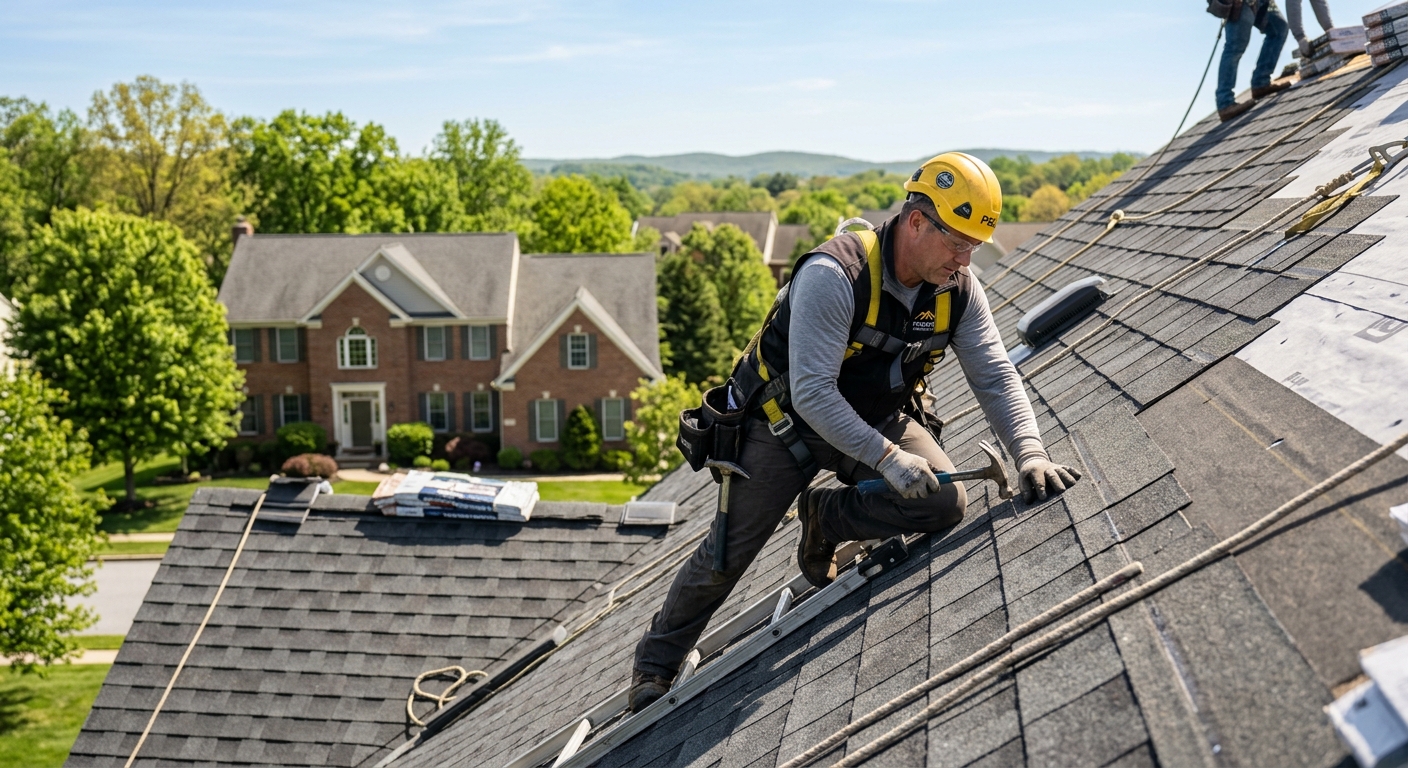
Martic roofing prices by material and scope — 2026
In Martic, where over 91% of households own their homes and the median income is $87,744 (U.S. Census Bureau, ACS 2024), most residents treat their roofs as long-term investments. Roofing costs here are shaped by the age and pitch of typical houses: Lancaster County is full of pre-1950 homes, which means you’re often dealing with steep slopes and, in many cases, two or even three layers of old shingles under the top layer. This history drives up tear-off time and can expose extra work on the deck—especially likely if no full replacement has been done for decades.
Because most Martic roofs are older and pitched steeply, any replacement often includes not just new shingles or metal but also work on hidden layers, adding weeks to some jobs compared to newer homes on flatter ground. Multiple existing layers can also lock you into full tear-off and disposal costs, whether you choose shingle or metal. Based on these realities, here’s what you can expect to pay in 2026:
| Material / Scope |
Lifespan |
Best for |
Price range (installed) |
| Asphalt shingles — architectural (30-yr) |
25–30 yrs |
Standard Martic roof replacements |
$9,700–$20,500 |
| Asphalt shingles — impact-resistant (Class 4) |
30+ yrs |
Areas with wind or hail exposure |
$16,000–$20,500 |
| Metal standing seam |
40–70 yrs |
Long-term value, steep older homes |
$23,500–$42,000 |
| Flat roof — TPO or EPDM |
15–25 yrs |
Low-slope additions or porches |
$12,500–$24,500 |
| Roof repair — leak or isolated section |
n/a |
Single leaks or shingle patches |
$500–$1,950 |
Prices are estimates for a typical Martic home and vary with roof size, pitch, decking condition and material selection.
Decking, ventilation and flashing — the hidden roof costs
With so much of Martic’s housing dating back before 1950, roofing jobs rarely go exactly as planned. Once the old roofing is peeled back, it’s common to find rotted plywood or original lumber decking hidden beneath layers of asphalt. Expect to add $900–$2,700 if more than a few new plywood sheets are needed. This isn’t padding—old frame houses here often hide water intrusion and previous patch jobs, especially along eaves or around chimneys.
Ventilation is the next hidden factor. Our south-central Pennsylvania climate puts roofs through heavy freeze-thaw cycles, especially in January and February. If the attic isn’t vented properly, warm air rises, melts the underside of roof snow, and then re-freezes at the eaves—creating damaging ice dams. Upgrading ventilation (ridge vent, soffit vents) during replacement can run $950–$2,000, and is money well spent on older Martic homes that never had proper airflow.
Chimney and wall flashings are another culprit for hidden costs. Steep-pitched Martic roofs and multiple valleys mean there’s often a lot of flashing to inspect, and replacing all of it can cost $750–$2,200 on a typical home. Neglecting flashing is why many shingle installations here never make it to their rated lifespan. Drip edge and vent boot replacements are usually a minor add-on—$200–$500—but skipping them is simply asking for a leak. Smart contractors flag these contingencies in advance; the less "surprise" during your Martic roof job, the better.
Patching vs full replacement in Martic
In Martic, your choice between patching and replacement comes down to roof age, leak location, and how many layers are present. On a roof less than 15 years old, with a single leak at a vent, a repair makes sense—there’s no reason to tear off an otherwise solid roof. But in Martic’s older housing stock, once you see several leaks (especially across different slopes), underlying decking and multi-layer shingle buildup tip the balance toward replacement. Jumping from patch to patch on a roof over 25 years old is rarely money well spent.
Let’s look at the math: two or three repairs per winter at $1,250 each quickly add up. After just four repairs, you’ve spent roughly $5,000—half or more of the cost of a brand new roof that will last 25–30 years. Especially if your home is among the 35% built before 1980 (U.S. Census Bureau, ACS 2024), you’ll likely have original decking or hidden water damage as well, making replacement the clear value move. For a flat roof with ponding or deep blisters, repairs are usually a waste—membrane failure means start fresh.
| Situation |
Recommendation |
Typical cost |
Reasoning |
| Under 15 years, one isolated leak |
Repair |
$500–$1,950 |
Roof likely has remaining life; targeted fixes cost-effective |
| 15–25 years, several leak points |
Replace |
$9,700–$20,500 |
Leaks suggest system-wide wear, especially in multi-layer roofs |
| 25+ years, any active leak |
Replace now |
$9,700–$20,500 |
Out of warranty, high risk of rot and repeated leaks |
| Storm damage, wind or hail |
Document, claim, replace |
$9,700–$20,500 |
Insurance likely covers; hidden damage requires full job |
| Flat roof ponding or blistering |
Replace membrane |
$12,500–$24,500 |
Ponding and blisters mean underlying system failure |
| Active leak entering winter |
Emergency repair, schedule replacement |
$500–$1,950 |
Prevent interior damage, but plan for spring/summer full replacement |
How to vet a Martic roofing contractor
Getting the right contractor is especially important in Martic, where price pressure from the larger Lancaster–York–Harrisburg market draws all kinds of roofers into the area. For any roofing contract over $500, Pennsylvania law requires the contractor to have a valid Home Improvement Contractor (HIC) registration, which you can verify at hic.attorneygeneral.gov. Always confirm active workers’ compensation insurance through WCAIS (wcais.pa.gov) for any crew setting foot on your roof. Written contracts aren’t optional—they’re a legal requirement (Home Improvement Consumer Protection Act), and must include your 3-business-day right to cancel.
- Verify HIC registration at hic.attorneygeneral.gov
- Check workers’ compensation at wcais.pa.gov
- Request a copy of current liability insurance
- Insist on a written contract for any job over $500
- Read the 3-day right of cancellation language before you sign
- Ask for 3 recent Martic or Lancaster County references
- See photos of recent jobs on steep, older homes like yours
- Confirm who will be on-site (no "subbing out" without disclosure)
- Inspect the contract for payment schedule—avoid heavy upfront deposits
- Ask about contingency costs (decking, flashing) in writing
- For pre-1978 homes, ask about EPA Lead RRP certification
- Ensure proper cleanup and debris disposal plan is included
Red flags in the Martic market include: contractors who show up door-to-door right after a thunderstorm, anyone who refuses written verification of HIC registration, companies with out-of-state plates and no local references, pressure to sign a contract on the spot, or any offer to “cover” your insurance deductible (which is illegal in Pennsylvania).
Pennsylvania code and Lancaster County permit rules for roofing
Martic homeowners fall under the Pennsylvania Uniform Construction Code (UCC), which is based on the IRC and is enforced by each municipality or by the PA Department of Labor & Industry (L&I) if that municipality opts out. In Lancaster County’s townships—including Martic—minor roof leak repairs that involve just a few shingle replacements usually don’t require a permit. But any full roof replacement involving new sheathing or structural work would require a building permit in Lancaster city and may require one in other municipalities as well. Always check with your township code office before starting, since enforcement is local.
For any roofing contract over $500, your contractor must hold valid HIC registration, and you can confirm this at hic.attorneygeneral.gov. Ask for their certificate of liability insurance and verify their workers’ compensation coverage at the state’s WCAIS system (wcais.pa.gov) before allowing work to begin. Pennsylvania does not have a special trade license for roofing—registration and insurance are what matter for consumer protection here. Always insist on a written contract as required by the Home Improvement Consumer Protection Act; this cannot be waived for major work.
Filing a roof claim after a Pennsylvania storm
If a wind burst off the Susquehanna leaves tree limbs or shingles in your yard, your first step in Martic should be to document the entire scene. Take photos of damage—not just on the roof, but anything impacted around your home—before you start cleanup or temporary repairs. Then secure the home with emergency tarping if more rain is due; quick patch repairs typically run $500–$1,950 and are often reimbursable under most insurance policies.
Request a written scope of loss from your insurer before authorizing full replacement. Claims are commonly settled under “Actual Cash Value” (ACV)—the depreciated value before the event—or “Replacement Cost Value” (RCV), which covers full repair or replacement. Insist on written details so you know which you’re getting, and keep every receipt, including for debris disposal or extra decking found during the job.
Pennsylvania’s Home Improvement Consumer Protection Act applies here: any roof contract over $500 must be written, and you retain a three-day right to cancel. Importantly, waiving your insurance deductible is illegal—any contractor offering to “eat the deductible” is asking you to participate in insurance fraud and should be avoided. Expect an insurance adjuster visit before larger claims are approved, and consider having your contractor present at that meeting to make sure all storm-caused damage is included in the adjuster’s scope.
Timing a roof replacement in Martic
Roofing in Martic is best planned between late April and early November. Shingle manufacturers want temperatures above 45°F for proper sealing, so April, May, September and October are prime months—shingles settle well, and you avoid both winter ice and summer rush pricing. July and August can see job backlogs because of saturated market demand from Lancaster, York, and Harrisburg—if you want work done then, book early. The competitive nature of the market means crews can be booked solid 4–8 weeks out in summer, while a storm in February may lead to premium charges for emergency service (tarping or stop-gap repairs at $500–$1,950).
Plan ahead, and you’ll likely get the crew and timing you want. Waiting until late fall or after the first hard frost forces crews to rush, and shingle sealing may not be reliable. March is sloppy, as repeated freeze-thaw cycles slow down projects. Emergency leaks in the winter nearly always cost more and are harder to finish correctly. Scheduling in September offers the best mix of price competitiveness and weather certainty for Martic homes.
Frequently asked questions — roofing in Martic
What happens if rotted decking is found after tear-off?
On many older Martic homes, once your roofing contractor removes the top layer of shingles, it’s not uncommon to find spots of rotted or soft roof decking underneath. When this happens, your crew should show you the damage in person or at least provide photo documentation before moving forward. Expect to see an added line item for new plywood or plank replacement—usually charged by the sheet. For most homes in Martic, the cost is around $900–$2,700 for moderate replacement. If your contract doesn’t spell out a “per sheet” rate for decking, ask before the job starts; reputable roofers in Lancaster County always list this as a possible cost. Skipping rotten decking just guarantees more leaks later, so it’s not something to ignore or patch over.
What warranty should a Martic roofer offer?
For Martic homeowners, a reputable roofer should provide two warranties. First, you want the material warranty—architectural shingles carry a manufacturer’s warranty of 25 to 30 years, even up to “lifetime” for impact-resistant products in the $16,000–$20,500 range. Second, you should insist on a written workmanship warranty from the installer, typically covering leaks and flashing breakdowns for at least 5 years (some offer 10). Older homes often need attention to details like decking and flashing, so ask what’s included and excluded. Avoid anyone who tries to pass off a “verbal guarantee”—that’s not worth much if something goes wrong in year three. Get all warranty promises in writing as part of your signed contract.
Why is my Martic roofing quote higher than the online average?
Many online averages are based on newer, flatter homes outside the northeast, but in Martic, housing is older and roof pitches are often much steeper. Tear-off is slower, safety is more complex, and almost every full replacement uncovers layers of older shingles underneath. These extra labor and disposal costs push even straightforward asphalt shingle jobs into the $9,700–$20,500 range. If decking is rotten, flashing is rusted out, or chimneys need reworking, prices climb fast. Online estimates rarely factor in these common Lancaster County realities, so Martic prices can seem higher—but that reflects the true cost of well-done work on older regional homes.
How long do architectural shingles last compared to 3-tab?
Architectural shingles have become the standard in Martic for good reason: the best lines will last 25–30 years, as opposed to older 3-tab styles, which often topped out at 15–18 years in Pennsylvania’s freeze-thaw winters. The slightly higher upfront cost (typically $9,700–$20,500 for a full replacement here) buys you a thicker shingle, longer manufacturer warranty, and much better wind resistance for those Susquehanna River-driven storms. Most Martic homes built before 1980 originally had 3-tab shingles, but every replacement today should use architectural for better lifespan and curb appeal.
Do I need my own inspection before the adjuster visits?
Having a reputable Martic roofer inspect your storm-damaged roof before the insurance adjuster arrives is a smart move. Local contractors are familiar with what adjusters look for and can help you document damage—including items insurance might otherwise miss, such as deteriorated flashing or hidden decking rot. Most roofers will provide a free written estimate, and if you need emergency tarping beforehand, expect to spend between $500–$1,950. A pre-adjuster inspection helps ensure your full claim is documented, which is especially important for older homes with layers of issues that adjusters new to Lancaster County may overlook.
How do I verify a roofing contractor is registered in Pennsylvania?
Every roofing contractor doing jobs over $500 in Martic must be registered with the Pennsylvania Office of Attorney General under the Home Improvement Contractor (HIC) program. Simply visit hic.attorneygeneral.gov and search for your contractor’s business name or registration number. This search allows you to confirm not just current registration, but any enforcement actions or complaints as well. It’s a quick step, and in a saturated market where low-priced crews sometimes roam in from out of town, it’s your main protection. For your peace of mind on a replacement that costs $9,700–$20,500 or more, verifying HIC registration is non-negotiable.
What causes ice dams on Martic roofs?
Ice dams on Martic roofs are nearly always caused by attic ventilation and insulation problems—something especially common in older Lancaster County homes. When your attic stays too warm in winter, snow melts high up on the roof and re-freezes as ice at the colder eaves, backing up under shingles and causing leaks. Our pronounced freeze-thaw cycles mean this happens repeatedly from December through March. Upgrading ventilation, like adding a ridge vent or proper soffit venting, generally costs $950–$2,000 as part of a roof job. If you’re seeing icicles or leaks after snow, have your roofer inspect for airflow issues as part of any replacement or repair in Martic.
What does it mean if my shingles are curling or losing granules?
Curling shingles and heavy granule loss are signs your Martic roof is nearing the end of its useful life. Curled edges let water creep underneath, while granule loss exposes shingle mats to the sun, causing brittle, leaky roofs right as our wet winter hits. On houses built before 1980—common here—this usually means original or overly weathered layers underneath. At this stage, repairs are only a band-aid. Most homeowners end up replacing the roof entirely, at costs ranging from $9,700–$20,500 for architectural shingles. Ignoring these warning signs usually leads to rot in the deck and far more expensive problems down the line.
What's the cheapest way to replace a roof in Martic?
The least expensive route is almost always a single-layer tear-off and re-roof with architectural shingles. For smaller or modest-pitch homes, you may land near the low end of $9,700–$20,500, especially if no significant decking or flashing work is needed. Avoid burying old roofs under new layers; multiple layers only mask problems and shorten lifespan, particularly in pre-1950s Martic housing. Skip unnecessary upgrades, ask for builder-grade shingles from a reputable manufacturer, and plan your project for the late spring or early fall, when labor demand is down (and rates often dip). The real savings come from catching problems early before minor leaks drive up hidden costs.