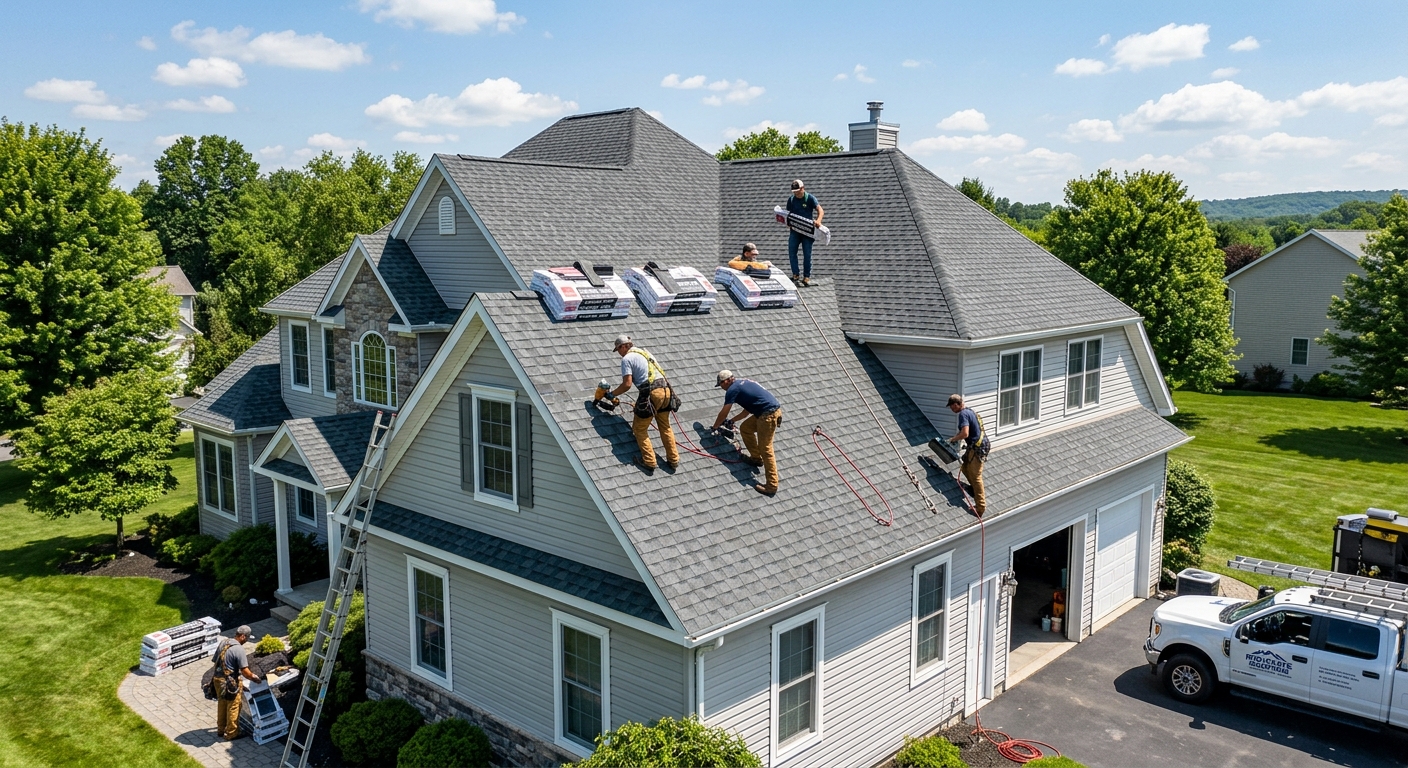
Middle Paxton roofing prices by material and scope — 2026
Middle Paxton’s roof replacement costs reflect both its suburban growth and its housing stock. With over 62% of homes built before 1980 and nearly all of them being single-family houses (U.S. Census Bureau, ACS 2024), the roofing market here is shaped by the same mid-century building boom that filled Lower Paxton and Swatara with tract developments. In practical terms, this means a higher share of full roof replacements rather than patchwork repairs, as the area’s aging asphalt shingle systems reach end of life in clusters.
If your house is in Middle Paxton, odds are your roof is close in age to your neighbors’—and has seen similar weather. Whole street blocks often hit the 25–30 year mark around the same time, making scheduling and pricing for full tear-offs more predictable here than in neighborhoods with homes built decades apart. It also means that bids are typically higher during peak replacement cycles, especially after storm seasons.
The table below covers realistic 2026 installed price ranges for the materials and scopes you’re most likely to encounter here:
| Material / Scope |
Lifespan |
Best for |
Price range (installed) |
| Asphalt shingles — architectural (30-yr) |
25–30 yrs |
Typical Middle Paxton single-family roof |
$9,600–$20,000 |
| Asphalt shingles — impact-resistant (Class 4) |
30+ yrs |
Susquehanna ridge-line wind areas |
$15,500–$20,000 |
| Metal standing seam |
40–70 yrs |
Long-term value, low maintenance |
$23,000–$41,500 |
| Flat roof — TPO or EPDM |
15–25 yrs |
Flat/low-slope porches, additions |
$12,000–$24,000 |
| Roof repair — leak or isolated section |
n/a |
Small leaks, blown-off shingles |
$500–$1,900 |
Prices are estimates for a typical Middle Paxton home and vary with roof size, pitch, decking condition and material selection.
Patching vs full replacement in Middle Paxton
When deciding between repair and replacement in Middle Paxton, look honestly at your roof’s age, leak history, and what the neighborhood is facing. With so many homes built in the post-World War II suburban expansion, a large share of roofs hit the 20–30 year mark about the same time. If your house hasn’t had a full roof replacement since the 1990s or earlier, and you’ve started patching a leak every couple years, you’re likely nearing the point where repairs become a sunk cost. For example, two or three repairs at $1,200 each can quickly total $3,600–$5,000 — money that’s better spent as part of a full replacement in the $9,600–$20,000 range, especially when you consider the risk of hidden wood rot and interior damage with every new leak.
Repairs make sense if you’re dealing with one minor leak and a relatively young roof, or if a storm takes out only a specific section. But for roofs over 25 years, or showing widespread granule loss, water stains in multiple ceiling spots, or curling shingles, replacement isn’t just a smarter investment — it’s often needed quickly to protect your home from further loss.
| Situation |
Recommendation |
Typical cost |
Reasoning |
| Under 15 years, one isolated leak |
Repair |
$500–$1,900 |
Roof has plenty of life left; target fix is cost-effective. |
| 15–25 years, several leak points |
Replace |
$9,600–$20,000 |
Multiple failures signal end-of-life systemic issues. |
| 25+ years, any active leak |
Replace now |
$9,600–$20,000 |
Roof is past useful life per common build era; repairs just mask larger risk. |
| Storm damage, wind or hail |
Document, claim, replace |
$9,600–$20,000 |
Insurance may pay—complete replacement restores full protection. |
| Flat roof ponding or blistering |
Replace membrane |
$12,000–$24,000 |
Failure of membrane will spread; patchwork won’t last. |
| Active leak entering winter |
Emergency repair, schedule replacement |
$500–$1,900 |
Short-term fix to prevent freeze-thaw damage until replacement. |
Roofing warranties in Middle Paxton: what's actually covered
In Middle Paxton, every roof comes with two distinct warranties, but the fine print matters. The first is the manufacturer material warranty. For asphalt shingles, these are usually described as 30-year or “lifetime,” but manufacturers only cover defects in the shingle itself—not leaks, improper installation, or storm damage. Most are prorated after the first decade, and you have to register the warranty within a set window or it may be drastically reduced. Layering new shingles over old or poor attic ventilation—both common in older Dauphin County homes—will void coverage fast.
The second is the workmanship warranty from your installer. This covers labor errors and installation flaws, typically for anywhere from 2 to 25 years. It’s only as good as the company backing it: a so-called “25-year” labor warranty from a startup is worth little compared to a decade of coverage from a contractor established in Dauphin County since the last building boom. If you resell your home, confirm if either warranty is transferable; many only allow a one-time transfer during the first few years. Always keep documentation on file—a missing contract will prevent any claim here, and coverage disputes rarely break in the homeowner’s favor. Double-check warranty registration with both the contractor and manufacturer promptly after the job.
What Middle Paxton's climate does to a roof
Middle Paxton sits in the Susquehanna River valley above Harrisburg, exposed to pronounced ridge-line winds and the kind of freeze-thaw cycling that urban counties to the south rarely see. Our ground snow load is set at 30 pounds per square foot and the winter design temperature bottoms at 12 °F, so roofs here don’t just shed water—they deal with ice. Snow accumulates at eaves, then freezes and thaws, driving meltwater under shingles and causing ice damming. Poor attic ventilation sends warm air against the roof deck, accelerating this process: the result is water infiltration, rotted edge decking, and repair bills in the $500–$1,900 bracket—or, if ignored, a full replacement in the $9,600–$20,000 band.
On the windward side of the valley, especially around Harrisburg and Dauphin Borough, strong gusts lift shingles at edges and peaks. You’ll often see localized uplift and missing tabs along roof perimeters, leading to “zipper” leaks down interior walls—one reason the more expensive impact- and wind-rated shingles ($15,500–$20,000) find actual value here, not just in marketing. Hail is less frequent than storms, but even minor hail bruises can crush shingle granules. These spots compromise water-shedding even without visible holes, often going undetected until they multiply into leaks months or years later.
Mid-winter storms also test metal and flat roofs. Membrane systems with ponding water see seams split when water freezes and expands, forcing even young flat roofs into the $12,000–$24,000 replacement range prematurely if not addressed.
The scope items Middle Paxton homeowners don't budget for
Most Middle Paxton homeowners focus on the per-square price for shingles, but the true cost swings on details discovered at tear-off. The most common surprise is rotted or spongy roof decking, hidden under shingles until the old system comes off. Replacing plywood can add $500–$2,000 depending on the extent. Damaged or missing flashing around chimneys, sidewalls, and valleys—common in the patchwork repairs typical of older suburban development—adds another $300–$800.
Attic ventilation, neglected by original homebuilders and many contractors alike, is more than an efficiency concern here. In south-central Pennsylvania’s climate, poor ventilation drives warm air into the roof deck, fueling ice damming even in moderate snowfall. This can void manufacturer warranties and often requires adding or enlarging soffit, gable, or ridge vents, costing anywhere from $400–$1,500.
Don’t overlook small ticket items—new vent boots ($40–$90 each), replacing drip edge ($250–$600), or installing ridge vent on older construction ($350–$800 for a typical roof). While your contract should outline these lines, many homeowners don’t budget for them, and defaults at contract signing can cause disputes. Ask your roofer whether your contract covers hidden decking or is “wood at additional charge,” and how ventilation and flashing are priced if needed mid-project.
Choosing a roofer in Dauphin County
A quality roof starts with careful contractor vetting—skipping this step is the fastest way to lose thousands. Every contractor offering roof work in Middle Paxton over $500 is required to hold a Home Improvement Contractor (HIC) registration, issued by the Pennsylvania Office of Attorney General. You can (and should) verify this at hic.attorneygeneral.gov before you sign. Require proof of workers’ compensation, which you can verify at wcais.pa.gov. Get a written, detailed contract—not a bid, but a signed contract covering scope, materials, payment schedule, and warranty.
- Confirm the contractor’s active HIC registration on hic.attorneygeneral.gov
- Request a certificate of workers’ compensation and verify via wcais.pa.gov
- Review the detailed written contract for all scope and exclusions
- Demand physical addresses—no PO boxes or out-of-state offices
- Ask about warranty details: length and what voids it
- Clarify lead paint procedures if your home is pre-1978 (see certifiedrenovatorsearch.epa.gov)
- Request recent, local references—at least three finished in the past 12 months in Dauphin County
- Check the payment schedule—never pay more than a small deposit upfront
- Insist on a copy of any municipal permit before work begins
- Check the company’s years in business locally—avoid new entities if possible
- Confirm if the company will do the work or if they subcontract crews
- Read all contract fine print, including the cancellation and change order clauses
Red flags in Dauphin County include: door-knockers after storms promising “free roofs,” requests for large prepayments, contractors who refuse local references, companies refusing to show registration or insurance, or those pushing you to skip the permit. The saturated Harrisburg-area market attracts out-of-area outfits after every storm, so prioritize local track records and documentation.
Permits and code requirements in Middle Paxton
Roofing work in Middle Paxton is governed by the Pennsylvania Uniform Construction Code (UCC), enforced by your local municipality in Dauphin County. A full roof replacement almost always requires a building permit, whether architectural shingles, metal, or flat membrane. Simple repairs—such as replacing a few shingles or patching a leak—generally do not, but it’s best to confirm with the township code office, as some have adopted stricter policies.
The code authority here is the Pennsylvania Department of Labor & Industry, but permits are typically issued and overseen by your local municipal code office. For any roof project over $500, your contractor must have an active Home Improvement Contractor (HIC) registration from the Pennsylvania Office of Attorney General—verify at hic.attorneygeneral.gov. Workers’ compensation insurance is mandatory for every roofing employer, and you can check coverage using the WCAIS system at wcais.pa.gov. Always ask to see both proof of registration and workers’ comp before signing a contract.
The Home Improvement Consumer Protection Act gives you a three business-day right of cancellation on jobs over $500, and requires a written contract. Never allow a contractor to “take care of the permit” without seeing the document: as the homeowner, you’re on the hook for unpermitted work and potential fines under the UCC.
Frequently asked questions — roofing in Middle Paxton
Why is my Middle Paxton roofing quote higher than the online average?
Most national roofing averages don’t capture the mix of older roofs and code requirements you’ll encounter in Middle Paxton. With so many homes here built before 1980, a typical roof replacement involves more layers, unexpected wood rot, and older ventilation setups needing upgrades—items rarely quoted upfront elsewhere. Local labor and hauling costs also run higher in the Harrisburg–Carlisle metro than reported U.S. averages. If you see a price above $15,500 for a roof that’s steep, complex, or has bad decking, it usually reflects real scope, not gouging. Median roof prices here track tightly to the $9,600–$20,000 range, with most full replacements falling in the upper half when hidden repairs are required.
How long does a roof replacement take in Middle Paxton?
For a typical single-family home in Middle Paxton, a full asphalt shingle replacement—assuming one layer and minor deck repair—usually wraps in two to three working days, weather permitting. If you’re in a pocket with back-to-back roof jobs after a storm or within a subdivision where several houses are reroofed at once, scheduling can run longer. Flat roof or metal projects may take up to a week, especially if decking replacement or custom flashing is required. Remember, any delays due to municipal inspections or bad weather are common in Dauphin County’s late winter and spring. Your actual timeline can shift, but you should never be billed for surprises not outlined in your contract—any additional fixes should be documented and costed at the agreed rates, typically $500–$2,000 for hidden wood rot or flashing upgrades.
Are storm-chasing roofers a problem in Middle Paxton?
Middle Paxton, along with the greater Harrisburg area, sees a wave of out-of-town roofing companies every time a major storm rolls through the Susquehanna River valley. These crews often knock doors offering “free” roof inspections or promising to “waive your deductible”—which is actually prohibited by state law. While some do adequate work, many vanish before warranty claims arise or cut corners on code compliance. Always check for local HIC registration at hic.attorneygeneral.gov and never sign a contract on your porch the same day as a storm. If a roofer’s bid seems too good to be true, especially one that races through a scope of work for under $9,600, ask for Dauphin County references and proof of insurance before proceeding.
Is metal roofing noisy in rain?
A properly installed standing seam metal roof in Middle Paxton is only marginally noisier than shingles—provided it’s fitted over solid decking and underlayment. The echo-chamber effect you sometimes hear about generally happens with “barn-style” panel installs over open framing, not residential jobs in our area. With most older homes here getting metal roofs as retrofits, the old deck and insulation usually remain, further dampening noise. That said, heavy rain can have a slightly sharper tap, but it’s rarely intrusive. Metal roofs, while costing $23,000–$41,500, last much longer than shingle systems and are less likely to suffer from wind uplift during Dauphin County’s ridge-line gusts—often making the slight sound difference a worthwhile trade-off.
What does roof replacement cost per square in Middle Paxton?
In Middle Paxton, a “square” (100 square feet) of architectural asphalt shingle roof—including tear-off, install, basic underlayment, and standard warranty—will fall in the $480–$700 range for most single-layer, walkable roofs. Steeper pitches, multiple layers, or complex roof shapes (valleys, dormers) push this up to $800 or more per square. Remember that per-square pricing only tells part of the story: hidden deck repair or code upgrades (like ridge vent or ice barrier) can add several thousand dollars to the total. Most full replacements end up in the $9,600–$20,000 band, with the final per-square price reflecting real, job-specific scope in our market.
Can I install new shingles over old ones in Pennsylvania?
In Pennsylvania, including Middle Paxton, you’re allowed to install a second layer of asphalt shingles over the old one if the local code office permits and the roof deck is sound. However, it’s rarely wise. Layering new shingles on top voids nearly every manufacturer’s warranty and makes underlying defects harder—and more expensive—to find and fix down the line. It can also create uneven surfaces, leading to future leaks. Most reputable roofers here will recommend a full tear-off to building code, and many Middle Paxton homes have already maxed out their allowable layers. Cutting corners usually risks another replacement sooner and rotted decking that can drive your next bill well above $9,600.
Why do roofs fail faster in south-central Pennsylvania?
Roofs in Middle Paxton and the greater Harrisburg area take a specific beating from our climate. The freeze-thaw cycles and ridge winds along the Susquehanna River valley are tougher on roofing materials than in less exposed parts of the state. Ice damming is a constant threat after heavy snow, especially on homes with older ventilation designs. Summer heat alone isn’t harsh here, but the seasonal swings break down asphalt and underlayment well before “lifetime” ratings advertise. Impact from windborne debris during spring and fall storms further shortens service life. That’s why so many area roofs land at full replacement in the $9,600–$20,000 bracket after 22–28 years, instead of the 30–35 some brochures promise.
What are the signs of hail damage on a roof?
Hail damage on Middle Paxton roofs can be subtle, often missing to the untrained eye. Look for bruised shingle spots—literally soft areas that give under gentle finger pressure—crushed granules exposing black asphalt, or small, circular marks on metal flashings and gutters. Unlike blown-off tabs or missing shingles, hail rarely causes immediate leaks, but it weakens the water resistance and can void some manufacturer warranties if not claimed promptly. After a summer storm, consider a professional roof inspection—especially if you’re seeing granules in your gutters. Repairs for isolated hail damage commonly run $500–$1,900, but widespread impact can justify a claim for full replacement in the $9,600–$20,000 range under most policies.
Will filing a roof claim raise my premium?
In Middle Paxton, as in most of Pennsylvania, there’s no universal answer—every insurer’s rating system is different. A single claim for genuine storm damage, especially when many neighbors are also filing (like after a documented wind or hail event in Dauphin County), often has little effect on your renewal. Multiple claims within a short time, or a pattern of small bills (like a series of $1,200 repairs) instead of a one-time full replacement in the $9,600–$20,000 range, might draw attention. Some carriers offer forgiveness for your first event, especially if your home’s roof age matches the neighborhood’s average life cycle. Always review your policy and talk to your agent before filing; letting a roof leak continue will almost certainly cost you more in the long run than a possible minor increase in premiums.