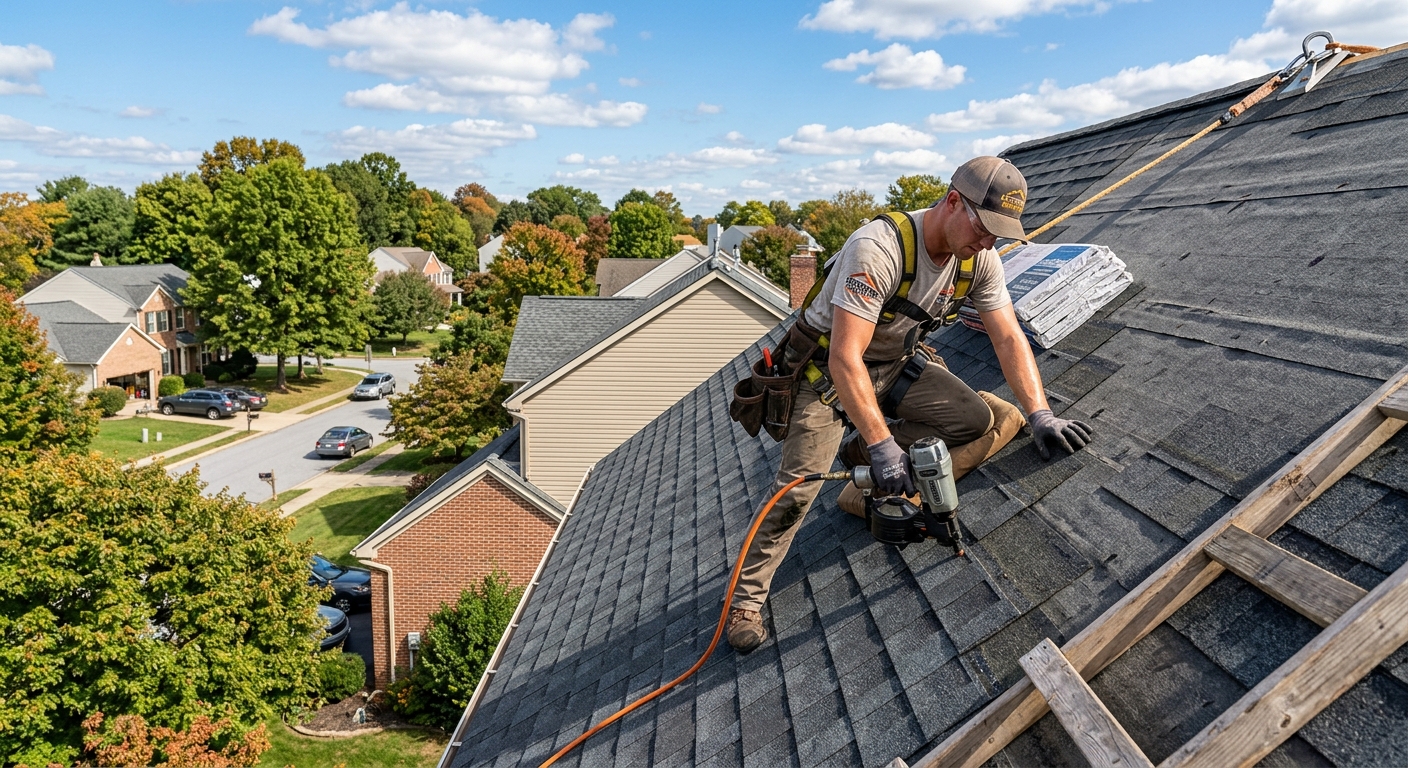
Milford roofing prices by material and scope — 2026
Milford sits in Bucks County’s packed Philadelphia metro market—a pocket with a high number of owner-occupied homes and a median income over $120,000 (U.S. Census Bureau, ACS 2024). Most Milford roofs are on single-family homes built before 1980. In fact, a notable portion of the existing stock was built during the massive 1950s Levittown boom in nearby townships, which sent waves of affordable, pitched-roof housing through Lower Bucks County. As those original Levittown-era roofs in Falls and Bristol age out, Milford homeowners see more full-deck replacements, attic ventilation upgrades, and insurance-driven storm repairs than in newer markets.
Most homes here use architectural asphalt shingles—because they fit postwar roof slopes and last long enough for typical move cycles. But with recent big storms, metal and membrane options are showing up more, especially where wind-driven rain or low slopes are a challenge. If your Milford roof is original or over 25 years old, count on full tear-off and possible decking replacement. Here is what you can expect to pay for a typical roof project:
| Material / Scope |
Lifespan |
Best for |
Price range (installed) |
| Asphalt shingles — architectural (30-yr) |
25–30 yrs |
Sloped Milford homes, balanced price/longevity |
$11,000–$23,000 |
| Asphalt shingles — impact-resistant (Class 4) |
30+ yrs |
Higher storm exposure or frequent hail |
$18,000–$23,000 |
| Metal standing seam |
40–70 yrs |
Long-term value, snow shedding, luxury look |
$26,500–$47,000 |
| Flat roof — TPO or EPDM |
15–25 yrs |
Low-sloped porch, addition, or ranch home |
$14,000–$27,500 |
| Roof repair — leak or isolated section |
n/a |
Flashing failure, minor shingle blow-off |
$550–$2,200 |
Prices are estimates for a typical Milford home and vary with roof size, pitch, decking condition and material selection.
Checking out a roofer in Milford: what to verify
When hiring for a roof replacement or repair in Milford, the risk isn’t just shoddy work—southeastern Bucks County’s competitive market brings a steady stream of out-of-area claim-chasers looking to sign jobs quickly after storms. Always check for Pennsylvania Home Improvement Contractor (HIC) registration at hic.attorneygeneral.gov, and ask for proof of workers’ comp insurance. Milford has no local trade license for roofers, so HIC registration and insurance are how contracts and consumer rights are enforced.
Here’s your vetting checklist:
- HIC registration number (verify at hic.attorneygeneral.gov)
- Written contract for any project over $500 (as required by HICPA)
- Workers’ compensation insurance certificate (verify at wcais.pa.gov)
- Clear, local address—not just a cell phone or online form
- Company name matches truck signage and contract
- References from completed jobs in Bucks County
- Cost estimate using price bands for this region
- Information on materials being installed (match your contract to actual product)
- EPA Lead RRP certification for pre-1978 homes (check at certifiedrenovatorsearch.epa.gov)
- Proof of manufacturer certification if warranties are offered
- Details on debris disposal plan—who handles haul-away and clean-up
- Schedule and daily work hours—no vague “window”
Red flags in Bucks County: pressure to sign after hail or wind, out-of-area phone numbers, no office or company truck in the area, evasiveness about HIC registration, and promises to “absorb” or “waive” your deductible (illegal). A saturated market means you have choices—there’s no need to rush.
Asphalt, metal or membrane — what suits a Milford roof
Bucks County roofs, including those in Milford, must stand up to a 30 lb/sqft ground snow load and a winter design temperature of 14 °F. Asphalt architectural shingles dominate here because they were factory-designed to handle moderate snow accumulation on the pitched roofs typical of Levittown-era homes, and their price puts a full tear-off within reach for most residents. Metal standing seam excels at shedding heavy snow and shrinking ice dam risks, but the upcharge is rarely justified unless you plan to be in the house for decades or have persistent storm losses. Flat roof membranes—TPO and EPDM—show up mainly on porches or postwar ranches with low slopes, since asphalt shingles will simply fail on those rooftops.
Metal roofing will outlive asphalt in theory, but not always in practice; hail dents and expansion-contraction cycles are a reality along the Delaware River valley. Membrane roofs are cheaper than metal and keep leaks at bay if seams are well detailed. For most Milford homeowners, architectural asphalt remains the solid winner on value, appearance, and maintenance simplicity. Only step up to metal if you want a curb appeal upgrade or you’re already facing constant ice damming under big snow drifts. For a bungalow or ranch with a 1/12 or 2/12 pitch, membrane is your logical choice, but don’t pay metal prices for a roof that won’t be seen.
| Material |
Installed cost |
Lifespan |
Cold-climate performance |
Maintenance |
| Asphalt architectural |
$11,000–$23,000 |
25–30 yrs |
Good: sheds 30 psf snow load with proper ventilation |
Annual inspection, replace after 25–30 winters |
| Asphalt Class 4 impact-resistant |
$18,000–$23,000 |
30+ yrs |
Better: resists hail bruising, less shingle blow-off |
Low; periodic check after big storms |
| Metal standing seam |
$26,500–$47,000 |
40–70 yrs |
Excellent: sheds snow, stops ice dams, resists wind |
Minimal, repaint trim at intervals |
| TPO / EPDM membrane |
$14,000–$27,500 |
15–25 yrs |
Good for low slope, handles ponding if properly installed |
Inspect seams, patch as needed |
Permits and code requirements in Milford
Roofing work in Milford falls under the Pennsylvania Uniform Construction Code (UCC), which is enforced by municipalities or, if the local township opts out, by the PA Department of Labor & Industry. Roof replacement—meaning a full tear-off and new shingles or membrane—typically requires a building permit, while minor patching (such as one or two shingle repair jobs) usually does not. Always check with your local township office before starting work.
You should only hire a contractor with a valid Pennsylvania Home Improvement Contractor (HIC) registration, which you can check yourself at hic.attorneygeneral.gov. For any job with employees (not solo operators), workers’ compensation insurance is required by Pennsylvania law; you can verify coverage status at wcais.pa.gov. Contractors are required by the Home Improvement Consumer Protection Act (HICPA) to provide a written contract for projects over $500, including a three-business day right to cancel. For homes built before 1978, confirm that your roofer’s EPA Lead RRP certification is current, especially if work disturbs painted siding or trim.
Milford does not require a roofing trade license—just HIC registration, valid insurance, and adherence to state and municipal codes. This is your main shield against fly-by-night operators.
What Milford's climate does to a roof
Milford roofs face Delaware River valley thunderstorms that drive rain under loose shingles and saturate old flashings, leading to expensive hidden sheathing damage. The region’s ground snow load of 30 psf means a heavy, wet spring snow can flood eaves overnight, causing ice dams when overnight lows hit 14 °F—a common winter design temperature here. Those ice dams form as attic warmth melts snow, which then refreezes at the cold roof edge, trapping water that seeps beneath shingle tabs and into wood decking. A repair that costs $550–$2,200 for flashing or section replacement often turns into full-deck tear-off at $11,000–$23,000 when left unchecked.
The same frequent wind-driven rain corridors that bring hail to Bucks County can bruise asphalt shingles without punching any holes. The result: shingle granule loss, surface dents, and insurance disputes over what counts as “damage.” For older Levittown-era roofs, exposed nails or degraded felt underlayment add to the water infiltration risk. Even flat roofs—on ranches and porches—require vigilant membrane checks: ponding from humid summer storms degrades seams, opening up leaks that travel laterally and evade detection until insulation is saturated.
Proper underlayment at eaves, and swift gutter cleaning after storms, are two of the only ways to keep damage from stacking up. In Milford, it’s not the flashiest storm that blows your roof—it's the handful of overlooked, incremental leaks that add up to a replacement cost faster than in counties with less storm exposure.
Patching vs full replacement in Milford
Bucks County’s housing stock puts many Milford homeowners at a crossroads: repair the roof you have, or move on to a full replacement? Here, anything under 15 years old with a single leak is usually a small flashing or membrane issue—worth repairing for $550–$2,200. But if your home is among the 1950s through 1970s builds, and you have two or more active leaks, spending that repair money year after year doesn’t add up; one season of big repairs often covers nearly 10–15% of full replacement cost, and it only takes a few years to outspend what a new roof would have cost. Once a typical architectural asphalt roof in Milford passes 25 years, any leak means replacement is the only defensible choice.
Storm events accelerate this divide. After wind or hail, patching is a stopgap—document for insurance and replace as soon as possible. Flat roofs with ponding or blistering are usually beyond repair because patching a failing membrane is good money after bad. Heading into winter with an active leak? Quick emergency repair can prevent bigger interior costs, but plan to replace.
| Situation |
Recommendation |
Typical cost |
Reasoning |
| Under 15 years, one isolated leak |
Repair |
$550–$2,200 |
Likely flashing or vent issue, cost-effective fix |
| 15–25 years, several leak points |
Replace |
$11,000–$23,000 |
Deck and underlayment likely failing from age |
| 25+ years, any active leak |
Replace now |
$11,000–$23,000 |
Shingles past their reliable life, repair won’t last |
| Storm damage, wind or hail |
Document, claim, replace |
$11,000–$23,000 |
Insurable event, patching wastes deductible |
| Flat roof ponding or blistering |
Replace membrane |
$14,000–$27,500 |
Patching won’t solve underlying water/trap problems |
| Active leak entering winter |
Emergency repair, schedule replacement |
$550–$2,200 |
Stop interior damage now, but plan for full roof |
Timing a roof replacement in Milford
In Milford, the best window for roof replacement runs from late March through early November. Summer’s humidity and permanent roofing crews make sealing and scheduling easy, but Bucks County’s dense contractor market means reputable roofers are often booked out six weeks or more by late spring. September and October are ideal—crews are at their sharpest after summer, and shingle self-sealing works best in 50–80 °F weather.
Wait too long, and you’ll fight for labor with storm, hail, and insurance claims following each thunderstorm corridor rolling through the Delaware Valley. An emergency job in February—when days barely reach 14 °F and adhesive strips won’t bond—can push you into the upper end of price bands, with many jobs landing at $23,000 or more for a full shingle replacement. In contrast, a planned autumn replacement means competitive bids and proper ventilation upgrades if needed. Metal installations can run longer into the off-season since they’re less temperature-sensitive, but heavy snow or ice makes tear-off and install hazardous for crews and property alike.
With so many contractors canvassing Bucks County, you usually have plenty of scheduling choice—unless a major local storm hits. Book early and avoid rush pricing whenever possible.
Frequently asked questions — roofing in Milford
Can I install new shingles over old ones in Pennsylvania?
In Pennsylvania under the Uniform Construction Code (UCC), it’s technically possible to install a new layer of shingles over old ones—often called “reroofing” or an overlay—but it’s not always a good idea for Milford homes. Most local code offices (and good contractors) caution against it for anything but an undamaged, flat, single-layer roof with no soft sheathing or ventilation issues, and overlays are outright prohibited if there are already two or more layers present. Roofers don’t like to warranty overlays because they hide wood rot and make leaks tougher to trace later. While an overlay may look cheaper up front, it can complicate future tear-offs and cause you to pay the high end of the replacement range—well over $23,000—when the full removal is eventually needed. For most Milford homes, full tear-off is the correct move.
Why do roofs fail faster in southeastern Pennsylvania?
Roofs in Milford and across Bucks County have to handle heavy, wet spring snows, intense summer humidity, and frequent wind-driven rain from Delaware Valley thunderstorms—a pattern very specific to our corner of the state. All of these stress the sealants and underlayment in ways that drier or less storm-prone parts of Pennsylvania don’t see. Older homes, especially from the Levittown wave, may still have outdated ventilation or original wood sheathing, making even a relatively young shingle roof more prone to leaks or hidden damage. When you add in repeated ice damming from design temperatures near 14 °F, you quickly move from minor repairs at $550–$2,200 to a full shingle replacement at $18,000 sooner than the national average.
How much does a new roof cost in Milford?
The typical Milford homeowner replacing a pitched roof with architectural asphalt shingles should expect a total cost of $11,000–$23,000 for a complete tear-off, disposal, and installation. Metal roofs typically run between $26,500–$47,000 if you’re looking for maximum lifespan and don’t mind the up-front price. Flat roof membrane jobs—mainly for low-slope porches or additions—usually run in the $14,000–$27,500 range. Most local jobs fall about midway between the band, but steep slopes, multiple layers, or sheathing repair will push your number to the high end.
What is the best time of year to replace a roof in Milford?
For Milford, schedule your roof replacement from April through October if you want adhesive strips to self-seal properly and installers to have enough daylight for a clean tear-off and dry-in. The sweet spot is September and October—cool enough for comfortable work, but still warm for shingle sealing. Wait too long, and you’ll run into a seasonal backlog after thunderstorms or a local hail event, driving costs to the top of the range—often $23,000 or more for shingle jobs. Emergency full replacements performed during a February freeze also cost more by necessity, both for labor premiums and risk of damage from rushed work.
How do I find a reputable roofer in Milford?
Start by verifying the roofer’s Pennsylvania Home Improvement Contractor (HIC) registration at hic.attorneygeneral.gov, and ask for proof of workers’ comp insurance (check at wcais.pa.gov). A reputable contractor won’t dodge these questions. Get references for recent jobs finished in Bucks County—local township names matter. Make sure you have a detailed, written contract for any job over $500, as required by the Home Improvement Consumer Protection Act. Finally, compare your estimate to price bands for the region: for architectural shingles, that’s $11,000–$23,000. Local presence and clarity on who owns the business are big trust signals.
How long do architectural shingles last compared to 3-tab?
Most Milford roofs use architectural shingles, which are rated for 25–30 years in this region, versus about 15–20 years for the older 3-tab style. The extra thickness and staggered construction of architectural shingles makes them much less likely to lift during Delaware Valley thunderstorms, and far less prone to losing tab corners from wind-driven rain. While initial roof replacement cost sits in the $11,000–$23,000 range for both types, the longer service life and reduced call-backs for architectural upgrades make them a better value—especially for homes built in the 1950s and ’60s now hitting their third roof cycle.
Will filing a roof claim raise my premium?
In Pennsylvania, a single weather-related roof claim—especially for wind or hail—will generally not cause your carrier to drop you, but it can affect your rate at renewal, depending on your total claim history and the number of claims in your ZIP code. Milford’s storm exposure means insurance companies track clusters of claims tightly, so expect some upward pressure on your premium if many neighbors are filing for the same storm event. Still, a full replacement after hail (at $11,000–$23,000 for architectural shingles) is almost never worth paying out of pocket if damage is widespread. Always document everything thoroughly and get an inspection before calling your insurance agent.
What does it mean if my shingles are curling or losing granules?
Curling tabs and heavy granule loss on a Milford roof usually signal end-of-life for an asphalt shingle. This often happens after repeat freeze-thaw cycles and high humidity driven by our local climate—once the fiberglass or mat is exposed, water wicks through, and you risk deck rot or attic leaks. For roofs installed more than 20 years ago (especially any left from that 1950s–1970s boom), you’re likely in replacement territory, with full jobs running $11,000–$23,000. Minor early loss after a new install can sometimes be weathering in, but ongoing issues always warrant a full inspection. Don’t wait too long—decking damage pushes costs even higher.
How much does it cost to repair a roof leak in Milford?
For an isolated shingle, flashing, or pipe boot leak in Milford, expect repair costs between $550–$2,200, depending on accessibility and the age of your roof. That lower end is for quick patches; more complex repairs—where water has soaked the deck or underlayment—can easily hit the upper end of this range. If your roof is more than 20 years old or you notice more than one active leak, it’s wise to get a replacement estimate too; repeated spot repairs can quickly overtake the cost of a new install, which lands at $11,000–$23,000 for a typical home in Bucks County.